JAYO 2.0 PLA Plus 3D Filament 1.75MM 6-Roll Pack
Official Store Deal
Expert Analysis Overview
JAYO 2.0 PLA Plus Filament is a high-performance 3D printing material engineered for creators demanding superior mechanical properties and print reliability. This upgraded Polylactic Acid variant addresses common limitations of standard PLA, offering enhanced durability and speed for a broad spectrum of FDM printing applications. It positions itself as a robust solution for both hobbyists and professionals seeking consistent, high-quality results.
The product explicitly highlights its PLA+ 2.0 formulation, contrasting it with "Ordinary PLA+". Visuals indicate an impact strength of 8 KJ/M for PLA+ 2.0, a significant increase over the 3.9 KJ/M of its predecessor. Elongation at break is also listed at 19.725% for the upgraded version, compared to 18.5%. These figures are critical.
This substantial boost in impact strength translates directly into more robust and resilient 3D printed parts. Components subjected to minor drops or moderate mechanical stress, which would typically fracture with standard PLA, exhibit a far greater chance of remaining intact. The improved elongation at break implies a material that can deform more before failing, offering a degree of flexibility crucial for snap-fit designs or parts experiencing dynamic loads. This is a material designed for longevity.
Standard PLA, while easy to print, is often criticized for its inherent brittleness. Many early 3D printing enthusiasts encountered frustration when functional prototypes or even decorative items would break from accidental impacts. The development of PLA+ aimed to mitigate this, but PLA+ 2.0 pushes these boundaries further, positioning itself as a material that bridges the gap between the printability of PLA and the mechanical robustness often associated with more challenging engineering filaments like ABS or PETG, without requiring their specialized printing environments. It's a clear upgrade.
Impact strength, measured in Joules per meter (J/m) or Kilojoules per meter (KJ/M), quantifies a material's ability to absorb energy before fracturing. A higher value indicates greater toughness. Elongation at break, expressed as a percentage, measures how much a material can stretch or deform plastically before it breaks. These metrics are critical for assessing a filament's suitability for functional parts, directly influencing the durability and reliability of printed objects. Understanding these values helps in material selection.
If you are designing enclosures for electronics, printing tools, or creating prototypes that will undergo handling and light use, the enhanced mechanical properties of JAYO 2.0 PLA Plus significantly reduce the likelihood of premature failure. This translates to fewer re-prints and more reliable end-use parts. The material performs well.
The product images clearly depict spools with neatly wound filament, explicitly stating "The filament is mechanically wound with strict manual inspection to ensure neat winding." The diameter is specified as 1.75mm. This precision is non-negotiable.
A precisely wound spool is paramount for uninterrupted 3D printing. Tangled filament on a spool is a leading cause of print failures, often resulting in air prints, nozzle clogs, or even damage to the printer's extruder. The promise of neat winding minimizes these frustrating occurrences, allowing for longer, more complex prints to complete without supervision. Consistent 1.75mm diameter ensures uniform material flow through the hotend, which is fundamental for achieving dimensionally accurate parts and smooth surface finishes. Consistency is key.
Many budget filaments often cut corners on winding quality, leading to frustrating mid-print tangles. This can be particularly problematic for overnight prints or large-scale projects where constant monitoring is impractical. The emphasis on both mechanical winding and manual inspection suggests a commitment to preventing these common pitfalls, setting it apart from generic, less reliable options. It prevents print failures.
Filament diameter consistency is crucial because 3D printers rely on precise volumetric extrusion. Any variation in diameter directly impacts the amount of material pushed through the nozzle, leading to under-extrusion (gaps, weak layers) or over-extrusion (blobs, dimensional inaccuracies). A deviation of even 0.05mm can noticeably degrade print quality, affecting both the aesthetic and structural integrity of the final object. This directly impacts axis stability during printing.
In a scenario where you are printing a large, intricate model that might take 20+ hours, the assurance of neatly wound filament is invaluable. It removes a significant variable from the equation of print success, allowing the user to focus on design and slicing parameters rather than babysitting the spool. This improves overall print reliability.
The filament supports a print speed of 50-300MM/S and has a recommended print temperature range of 205-215°C. It is also stated to be "widely compatible with all FDM 3D printers on the market." These are impressive specifications.
The ability to print at speeds up to 300MM/S represents a substantial leap in productivity for 3D printing enthusiasts and professionals. This allows for rapid prototyping and quicker iteration cycles, significantly reducing the time from concept to physical object. The specified temperature range of 205-215°C is standard for PLA variants, indicating good thermal stability within the hotend, which contributes to consistent extrusion and layer adhesion. This filament is designed for modern, faster 3D printers. Speed is a major advantage.
Older or entry-level PLA filaments often struggle to maintain quality at speeds exceeding 60-80MM/S, leading to ghosting, ringing, or poor layer adhesion. The JAYO 2.0 PLA Plus, by supporting speeds up to 300MM/S, caters directly to the increasing prevalence of high-speed FDM printers. This capability allows users to fully utilize the performance of their advanced machines, unlike many standard filaments that become a bottleneck. It eliminates bottlenecks.
Print speed is a critical factor in 3D printing efficiency. However, increasing speed without adequate material flow and thermal management can lead to print defects. Filaments optimized for high speed typically have a lower melt viscosity at printing temperatures, allowing them to flow more readily through the nozzle even when extruded rapidly. This optimization ensures that layer consistency is maintained even at accelerated rates. It's a balance of factors.
For a small business relying on 3D printing for custom orders or rapid product development, the capacity to print three to four times faster than with conventional PLA can dramatically improve throughput and profitability. This filament enables a faster return on investment for high-speed printer owners. It boosts productivity significantly.
The product explicitly labels itself as "Eco-Friendly PLA+" and highlights its "Excellent Load Bearing" and "Bent Without Breaking" characteristics. This dual focus is important.
PLA, derived from renewable resources like corn starch, is inherently more environmentally friendly than petroleum-based plastics. The "Eco-Friendly PLA+" designation reinforces this commitment to sustainability, appealing to users conscious of their environmental footprint. Furthermore, the "Excellent Load Bearing" and "Bent Without Breaking" attributes, visually demonstrated by a flexible printed part, underscore the material's suitability for functional applications where parts need to withstand stress without immediate fracture. This is not just a decorative material. It's a responsible choice.
While many plastics offer high strength, their environmental impact is a growing concern. JAYO 2.0 PLA Plus offers a compelling balance, providing enhanced mechanical properties while retaining the biodegradable and renewable aspects of PLA. This contrasts with engineering plastics like ABS, which are petroleum-derived and produce more noxious fumes during printing. It's a better alternative.
Polylactic Acid (PLA) is a thermoplastic aliphatic polyester derived from renewable biomass, typically fermented plant starch. It is biodegradable under industrial composting conditions, making it a more sustainable choice compared to traditional plastics. Its low toxicity and ease of printing have made it the most popular filament for hobbyist 3D printing. The material's properties are well-understood.
An educator introducing students to 3D printing might appreciate the eco-friendly aspect, teaching responsible material choices alongside design principles. Similarly, a designer creating prototypes for consumer products can confidently use this filament, knowing the material offers both performance and a reduced environmental impact. It supports diverse users.
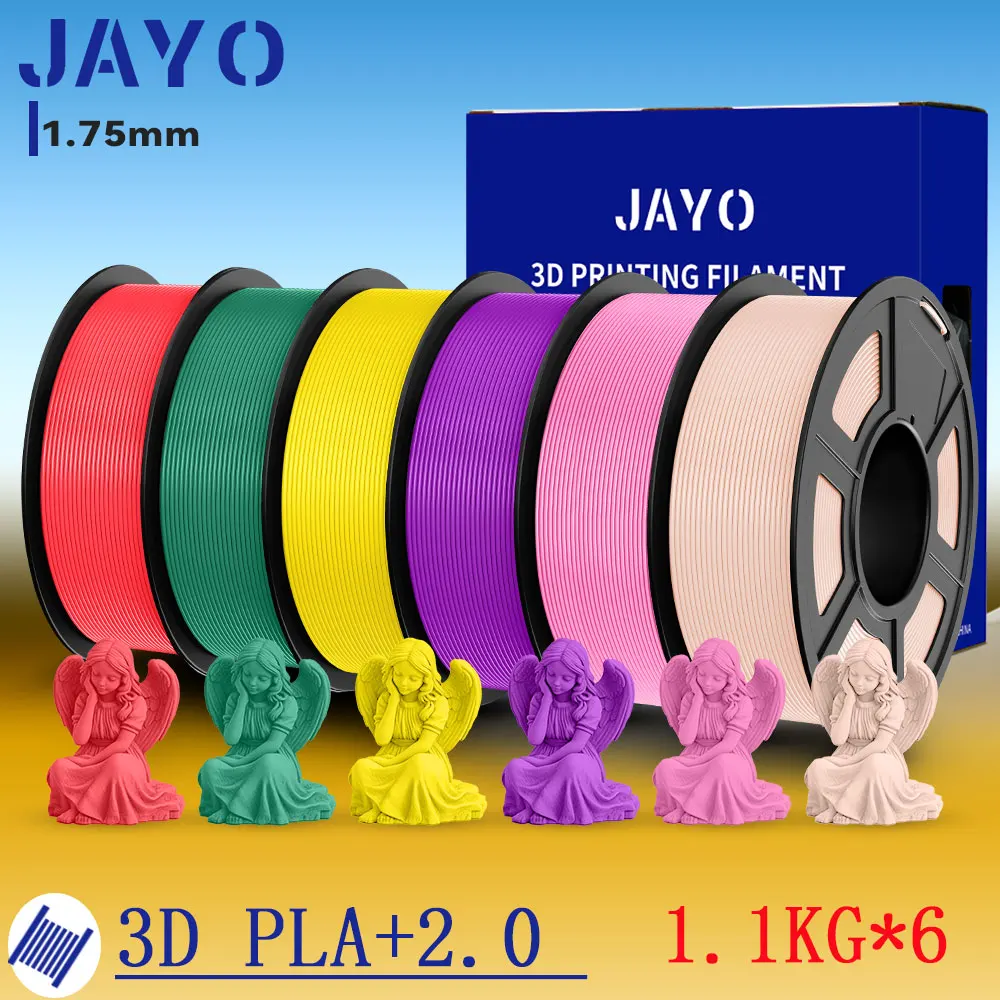
The product is offered in a 6-roll pack with a variety of colors, including red, green, yellow, purple, pink, and beige, and images show numerous printed objects in diverse hues. This variety is a clear benefit.
The availability of multiple vibrant colors in a single pack provides immediate versatility for creative projects. This eliminates the need to purchase individual spools for different color requirements, streamlining the workflow for multi-color prints or projects requiring aesthetic variation. The consistent material properties across all colors ensure that visual diversity does not come at the expense of print quality or mechanical performance. It offers creative freedom.
Many filament packs offer limited color selections or require users to buy separate spools, which can be inefficient and costly. A multi-color pack like this is particularly beneficial for users who frequently switch colors for different parts of a model or for those who want to experiment with various aesthetic outcomes without a large initial investment in single-color spools. It's a cost-effective solution.
Color in 3D printing filament is achieved by incorporating pigments into the plastic resin during manufacturing. High-quality pigments ensure consistent color saturation and prevent issues like streaking or uneven coloration in the final print. The choice of pigment can sometimes subtly affect print parameters, but reputable manufacturers ensure these variations are minimal. Color consistency is maintained.
For a hobbyist creating intricate models, toys, or decorative items, having a range of colors at hand means immediate access to the right shade for each component, fostering greater creative freedom and reducing project delays. This pack supports diverse projects.
Imagine the satisfaction of completing complex, multi-part assemblies with confidence, knowing each component possesses superior strength and dimensional accuracy. Picture your designs coming to life faster, with less material waste from failed prints, and a vibrant palette ready for any creative whim. This filament empowers you to push the boundaries of your 3D printing capabilities, transforming concepts into tangible, robust realities with unprecedented efficiency.
The Evolution of Print Resilience: PLA+ 2.0's Mechanical Superiority
The product explicitly highlights its PLA+ 2.0 formulation, contrasting it with "Ordinary PLA+". Visuals indicate an impact strength of 8 KJ/M for PLA+ 2.0, a significant increase over the 3.9 KJ/M of its predecessor. Elongation at break is also listed at 19.725% for the upgraded version, compared to 18.5%. These figures are critical.
This substantial boost in impact strength translates directly into more robust and resilient 3D printed parts. Components subjected to minor drops or moderate mechanical stress, which would typically fracture with standard PLA, exhibit a far greater chance of remaining intact. The improved elongation at break implies a material that can deform more before failing, offering a degree of flexibility crucial for snap-fit designs or parts experiencing dynamic loads. This is a material designed for longevity.
Standard PLA, while easy to print, is often criticized for its inherent brittleness. Many early 3D printing enthusiasts encountered frustration when functional prototypes or even decorative items would break from accidental impacts. The development of PLA+ aimed to mitigate this, but PLA+ 2.0 pushes these boundaries further, positioning itself as a material that bridges the gap between the printability of PLA and the mechanical robustness often associated with more challenging engineering filaments like ABS or PETG, without requiring their specialized printing environments. It's a clear upgrade.
Impact strength, measured in Joules per meter (J/m) or Kilojoules per meter (KJ/M), quantifies a material's ability to absorb energy before fracturing. A higher value indicates greater toughness. Elongation at break, expressed as a percentage, measures how much a material can stretch or deform plastically before it breaks. These metrics are critical for assessing a filament's suitability for functional parts, directly influencing the durability and reliability of printed objects. Understanding these values helps in material selection.
If you are designing enclosures for electronics, printing tools, or creating prototypes that will undergo handling and light use, the enhanced mechanical properties of JAYO 2.0 PLA Plus significantly reduce the likelihood of premature failure. This translates to fewer re-prints and more reliable end-use parts. The material performs well.
The Art of Consistent Flow: Precision Winding and Diameter Control
The product images clearly depict spools with neatly wound filament, explicitly stating "The filament is mechanically wound with strict manual inspection to ensure neat winding." The diameter is specified as 1.75mm. This precision is non-negotiable.
A precisely wound spool is paramount for uninterrupted 3D printing. Tangled filament on a spool is a leading cause of print failures, often resulting in air prints, nozzle clogs, or even damage to the printer's extruder. The promise of neat winding minimizes these frustrating occurrences, allowing for longer, more complex prints to complete without supervision. Consistent 1.75mm diameter ensures uniform material flow through the hotend, which is fundamental for achieving dimensionally accurate parts and smooth surface finishes. Consistency is key.
Many budget filaments often cut corners on winding quality, leading to frustrating mid-print tangles. This can be particularly problematic for overnight prints or large-scale projects where constant monitoring is impractical. The emphasis on both mechanical winding and manual inspection suggests a commitment to preventing these common pitfalls, setting it apart from generic, less reliable options. It prevents print failures.
Filament diameter consistency is crucial because 3D printers rely on precise volumetric extrusion. Any variation in diameter directly impacts the amount of material pushed through the nozzle, leading to under-extrusion (gaps, weak layers) or over-extrusion (blobs, dimensional inaccuracies). A deviation of even 0.05mm can noticeably degrade print quality, affecting both the aesthetic and structural integrity of the final object. This directly impacts axis stability during printing.
In a scenario where you are printing a large, intricate model that might take 20+ hours, the assurance of neatly wound filament is invaluable. It removes a significant variable from the equation of print success, allowing the user to focus on design and slicing parameters rather than babysitting the spool. This improves overall print reliability.
Accelerating Innovation: Optimized Print Speeds and Thermal Stability
The filament supports a print speed of 50-300MM/S and has a recommended print temperature range of 205-215°C. It is also stated to be "widely compatible with all FDM 3D printers on the market." These are impressive specifications.
The ability to print at speeds up to 300MM/S represents a substantial leap in productivity for 3D printing enthusiasts and professionals. This allows for rapid prototyping and quicker iteration cycles, significantly reducing the time from concept to physical object. The specified temperature range of 205-215°C is standard for PLA variants, indicating good thermal stability within the hotend, which contributes to consistent extrusion and layer adhesion. This filament is designed for modern, faster 3D printers. Speed is a major advantage.
Older or entry-level PLA filaments often struggle to maintain quality at speeds exceeding 60-80MM/S, leading to ghosting, ringing, or poor layer adhesion. The JAYO 2.0 PLA Plus, by supporting speeds up to 300MM/S, caters directly to the increasing prevalence of high-speed FDM printers. This capability allows users to fully utilize the performance of their advanced machines, unlike many standard filaments that become a bottleneck. It eliminates bottlenecks.
Print speed is a critical factor in 3D printing efficiency. However, increasing speed without adequate material flow and thermal management can lead to print defects. Filaments optimized for high speed typically have a lower melt viscosity at printing temperatures, allowing them to flow more readily through the nozzle even when extruded rapidly. This optimization ensures that layer consistency is maintained even at accelerated rates. It's a balance of factors.
For a small business relying on 3D printing for custom orders or rapid product development, the capacity to print three to four times faster than with conventional PLA can dramatically improve throughput and profitability. This filament enables a faster return on investment for high-speed printer owners. It boosts productivity significantly.
Sustainable Performance: Eco-Friendly Composition and Functional Utility
The product explicitly labels itself as "Eco-Friendly PLA+" and highlights its "Excellent Load Bearing" and "Bent Without Breaking" characteristics. This dual focus is important.
PLA, derived from renewable resources like corn starch, is inherently more environmentally friendly than petroleum-based plastics. The "Eco-Friendly PLA+" designation reinforces this commitment to sustainability, appealing to users conscious of their environmental footprint. Furthermore, the "Excellent Load Bearing" and "Bent Without Breaking" attributes, visually demonstrated by a flexible printed part, underscore the material's suitability for functional applications where parts need to withstand stress without immediate fracture. This is not just a decorative material. It's a responsible choice.
While many plastics offer high strength, their environmental impact is a growing concern. JAYO 2.0 PLA Plus offers a compelling balance, providing enhanced mechanical properties while retaining the biodegradable and renewable aspects of PLA. This contrasts with engineering plastics like ABS, which are petroleum-derived and produce more noxious fumes during printing. It's a better alternative.
Polylactic Acid (PLA) is a thermoplastic aliphatic polyester derived from renewable biomass, typically fermented plant starch. It is biodegradable under industrial composting conditions, making it a more sustainable choice compared to traditional plastics. Its low toxicity and ease of printing have made it the most popular filament for hobbyist 3D printing. The material's properties are well-understood.
An educator introducing students to 3D printing might appreciate the eco-friendly aspect, teaching responsible material choices alongside design principles. Similarly, a designer creating prototypes for consumer products can confidently use this filament, knowing the material offers both performance and a reduced environmental impact. It supports diverse users.
Aesthetic Versatility: Multicolor Choices for Creative Expression
The product is offered in a 6-roll pack with a variety of colors, including red, green, yellow, purple, pink, and beige, and images show numerous printed objects in diverse hues. This variety is a clear benefit.
The availability of multiple vibrant colors in a single pack provides immediate versatility for creative projects. This eliminates the need to purchase individual spools for different color requirements, streamlining the workflow for multi-color prints or projects requiring aesthetic variation. The consistent material properties across all colors ensure that visual diversity does not come at the expense of print quality or mechanical performance. It offers creative freedom.
Many filament packs offer limited color selections or require users to buy separate spools, which can be inefficient and costly. A multi-color pack like this is particularly beneficial for users who frequently switch colors for different parts of a model or for those who want to experiment with various aesthetic outcomes without a large initial investment in single-color spools. It's a cost-effective solution.
Color in 3D printing filament is achieved by incorporating pigments into the plastic resin during manufacturing. High-quality pigments ensure consistent color saturation and prevent issues like streaking or uneven coloration in the final print. The choice of pigment can sometimes subtly affect print parameters, but reputable manufacturers ensure these variations are minimal. Color consistency is maintained.
For a hobbyist creating intricate models, toys, or decorative items, having a range of colors at hand means immediate access to the right shade for each component, fostering greater creative freedom and reducing project delays. This pack supports diverse projects.
Imagine the satisfaction of completing complex, multi-part assemblies with confidence, knowing each component possesses superior strength and dimensional accuracy. Picture your designs coming to life faster, with less material waste from failed prints, and a vibrant palette ready for any creative whim. This filament empowers you to push the boundaries of your 3D printing capabilities, transforming concepts into tangible, robust realities with unprecedented efficiency.