Javino 5V 1A Micro USB 18650 Lithium Battery Charger Module with Protection
Official Store Deal
Expert Analysis Overview
Precision Power Management for Lithium-Ion Cells
The Javino 5V 1A Micro USB 18650 Lithium Battery Charging Module is a compact, dual-function power management solution engineered for hobbyists and repair technicians. This board integrates both charging capabilities and essential battery protection, making it a critical component for safe and efficient power integration in portable electronics. Its design prioritizes space efficiency and straightforward implementation, addressing a common need in various DIY and professional repair scenarios.
Core Charging Architecture
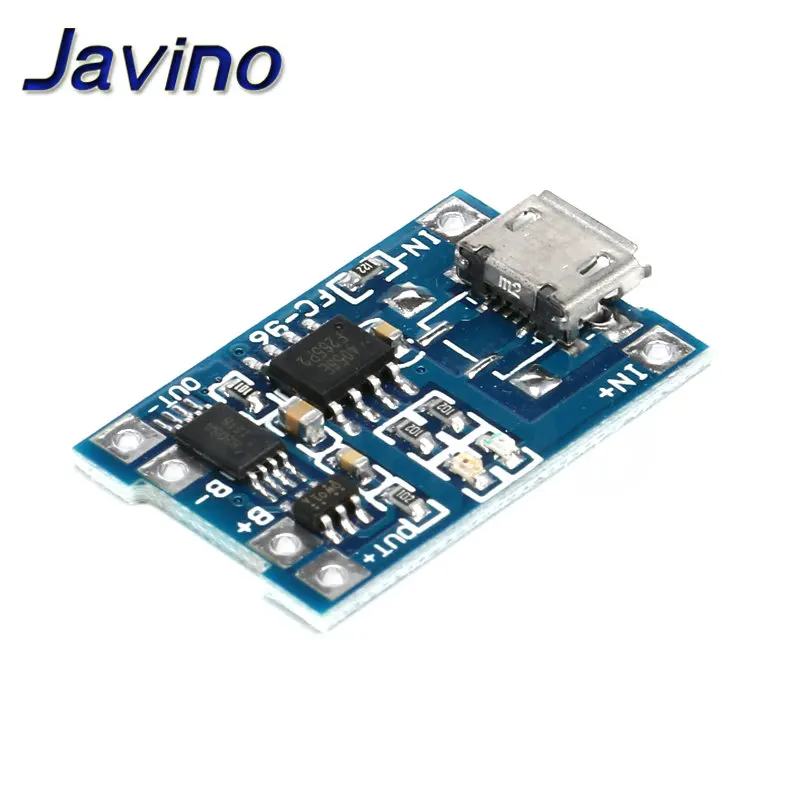
The module's charging functionality is centered around a dedicated integrated circuit, visibly present on the blue PCB. This IC, typically a TP4056 or a similar linear charging controller, manages the constant current/constant voltage (CC/CV) charging profile required for 18650 lithium-ion cells. The input power is supplied via a Micro USB port, a ubiquitous standard that simplifies power sourcing from common 5V USB adapters or computer ports. This simplifies power sourcing.
The charging process is meticulously controlled to prevent overcharging, a critical safety concern for lithium-ion batteries. The circuit dynamically adjusts the charging current based on the battery's state, transitioning from a constant current phase to a constant voltage phase as the battery approaches full capacity. This precise regulation extends battery lifespan and prevents thermal runaway. The module ensures optimal charge cycles.
Compared to rudimentary charging methods that lack dedicated ICs, this module offers a significantly safer and more reliable charging experience. Generic resistors and basic diodes often fail to provide the nuanced CC/CV profile, leading to premature battery degradation or dangerous overcharge conditions. This dedicated solution mitigates those risks effectively. It protects your valuable cells.
Integrated Battery Protection Circuitry
Beyond charging, the module incorporates vital battery protection features. These typically include overcharge protection, over-discharge protection, and over-current protection. These safeguards are implemented through a separate protection IC, often paired with dual MOSFETs, visible on the board. This dual-functionality is a significant advantage.
Overcharge protection prevents the battery voltage from exceeding its safe upper limit, typically 4.2V for 18650 cells. Once this threshold is reached, the charging process is halted, safeguarding the cell from damage and potential hazards. This is a non-negotiable safety feature.
Over-discharge protection disconnects the load when the battery voltage drops below a safe minimum, usually around 2.5V to 3.0V. This prevents irreversible damage to the battery's internal chemistry, which can occur if a lithium-ion cell is deeply discharged. Deep discharge reduces battery capacity. The module ensures battery longevity.
Over-current protection monitors the current drawn from the battery. If the load attempts to draw excessive current, the protection circuit interrupts the power flow, preventing damage to both the battery and the connected device. This is crucial for preventing short circuits. It guards against unexpected surges.
Unlike basic charging boards that only provide a charging function, this module's integrated protection eliminates the need for a separate Battery Management System (BMS) for single-cell applications. This reduces component count, simplifies wiring, and lowers overall project cost. It streamlines your build process.
Connectivity and Indicators
The module features clearly labeled solder pads for input, battery connection, and output. The IN+ and IN
Two LED indicators are typically present: one for charging status (e.g., red) and one for charge complete (e.g., blue or green). These visual cues provide immediate feedback on the battery's charging state, allowing users to monitor the process without external measurement tools. Visual feedback is always helpful. It simplifies operational checks.
The soldering pads appear adequately sized for standard hobbyist wiring, suggesting a reasonable degree of durability for repeated connections. The Micro USB port itself is surface-mounted, a common design choice for compact modules. Its mechanical integrity is critical for reliable power input. Proper soldering is key.
Physical Dimensions and Integration
With dimensions around 17.4mm by 26.1mm (or 27.9mm), this module is exceptionally compact. Its small footprint allows for integration into tight enclosures and miniature projects where space is at a premium. This size makes it ideal for portable devices, wearable electronics, and compact power banks. Small size, big utility.
For example, in a scenario where a custom-built portable speaker requires a rechargeable power source, this module can be seamlessly integrated. Its small form factor does not add significant bulk, preserving the aesthetic and ergonomic design of the final product. It fits almost anywhere. This enables sleek designs.
Compared to larger, more complex BMS boards designed for multi-cell packs, this single-cell module offers a minimalist solution perfectly suited for its intended application. Its simplicity reduces potential points of failure and simplifies the overall circuit design. It is purpose-built for single cells.
Value Proposition and Application Scenarios
At its price point, this module represents exceptional value for money. It provides essential charging and protection functionalities that would otherwise require multiple discrete components or a more expensive, larger BMS. This cost-effectiveness makes it highly attractive for educational projects, prototyping, and mass production of low-cost devices. It's a budget-friendly solution.
Consider a scenario where an old electronic toy or a small portable fan needs a battery upgrade. Instead of discarding the device, this module allows for the integration of a modern 18650 lithium-ion cell, extending its useful life and making it rechargeable via a standard USB cable. This promotes repair over replacement. It breathes new life into old tech.
Furthermore, the module's robust protection features minimize the risk of battery-related incidents, which can be a significant concern with unregulated lithium-ion cells. This inherent safety adds considerable value, especially for devices that may be handled by less experienced users. Safety is paramount. It provides peace of mind.
This module is an indispensable tool for anyone working with single 18650 lithium-ion batteries, offering a reliable, safe, and compact solution for power management. Its ease of use and integrated features make it a superior choice over piecemeal component assemblies. It simplifies complex power needs. The ability to repair and upgrade existing equipment with such an affordable and capable component underscores its utility. Imagine the satisfaction of bringing a cherished gadget back to life, powered by a modern, safely managed lithium-ion cell, all thanks to a small, efficient board like this. This module empowers creators and repairers alike, enabling countless projects to come to fruition with reliable power at their core.