HABOTEST HT601B+PRO Combustible Gas Detector
Official Store Deal
Expert Analysis Overview
The HABOTEST HT601B+PRO is a crucial diagnostic instrument for proactive safety assessments, specifically engineered for home inspectors and maintenance professionals. This device moves beyond simple gas presence indicators, offering quantifiable data essential for thorough property evaluations. Its design prioritizes both precision and practical application in challenging environments. This tool is a professional asset.
The HT601B+PRO model boasts a detection range spanning from 0.00 to 20.00% LEL (Lower Explosive Limit) and 0 to 9999 PPM (Parts Per Million) for combustible gases. It achieves a sensitivity of less than 50 PPM for methane, a common component of natural gas. The Lower Explosive Limit (LEL) represents the minimum concentration of a combustible gas in air that will ignite if an ignition source is present. Conversely, Parts Per Million (PPM) provides a more granular measurement for lower, non-explosive concentrations. This instrument detects a broad spectrum of combustible gases, including methane, propane, butane, alcohol, ammonia, hydrogen, gasoline, hexane, ethylene oxide, naphtha, and paint thinner. It detects many gases. The accuracy is specified at +/-10% FS (Full Scale) for methane, providing a reliable, though not laboratory-grade, indication of gas concentration.
For a home inspector, these specifications translate directly into the ability to identify even minute gas leaks that might otherwise go unnoticed by human senses. The capacity to quantify leaks in both PPM and LEL provides critical data for assessing the severity of a potential hazard. This is vital for client reports. Such precision allows for the early identification of issues behind walls, within ceiling cavities, or in crawl spaces, areas where gas can accumulate dangerously before becoming noticeable through smell. Detecting these hidden leaks is a core responsibility. The ability to differentiate between a trace amount and a potentially explosive concentration is fundamental for risk assessment and guiding immediate safety protocols.
Unlike basic, entry-level gas sniffers that merely indicate the presence or absence of gas with a simple light or tone, the HT601B+PRO offers a more detailed understanding of the leak's concentration. This quantitative measurement is indispensable for prioritizing repairs and for verifying the effectiveness of corrective actions. Less sensitive models often miss smaller, yet still hazardous, leaks, presenting a false sense of security. Furthermore, devices lacking LEL readings cannot adequately inform about explosion risk, a critical piece of information for any safety professional. This detector provides crucial context.
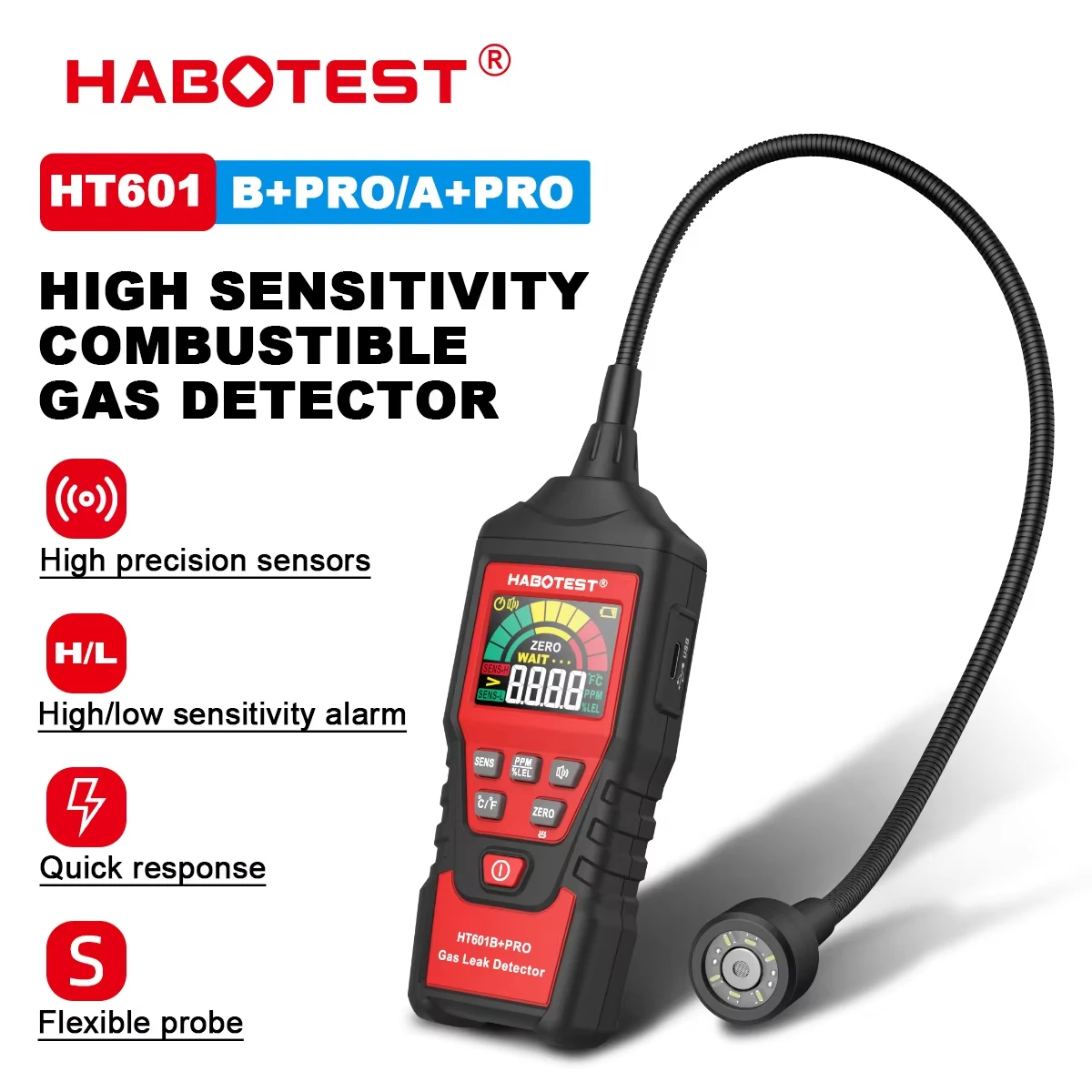
A defining feature of the HT601B+PRO is its approximately 37cm long flexible probe. This component is engineered to bend and hold its shape, allowing the sensor at its tip to be precisely positioned in hard-to-reach locations. The probe is highly adaptable. This flexibility is achieved through a durable, yet malleable, material that resists kinking while maintaining its set position, crucial for navigating complex pipework or tight enclosures.
This flexible design is invaluable for home inspectors who frequently encounter confined and obstructed spaces during their assessments. It enables the precise pinpointing of leak sources behind large appliances like water heaters and furnaces, within tight pipe chases, under floorboards, or inside wall cavities without requiring destructive access. Locating the exact source is paramount. For instance, an inspector can snake the probe into a wall cavity through a small opening to check for gas accumulation, or maneuver it around intricate plumbing to isolate a specific fitting. This capability significantly reduces diagnostic time and improves the accuracy of leak identification, which is crucial for effective remediation and generating precise recommendations for homeowners.
In contrast, gas detectors equipped with rigid or shorter probes severely limit the scope of an inspection, forcing inspectors to rely on less precise methods or even resort to invasive procedures to gain access. Such limitations can lead to missed leak sources in inaccessible areas, compromising the thoroughness and safety of an inspection. The flexible probe offers a distinct advantage, allowing for a more comprehensive and non-destructive survey of potential gas hazards. It reaches where others cannot.
The device features a rapid response time of less than 2 seconds, ensuring almost instantaneous feedback upon detecting gas. It integrates both visual and auditory alarm systems. Visual cues include a simulation strip and digital readout, while an audible alarm provides a clear warning. Safety is paramount. This swiftness is a direct result of the sensor's design and processing speed, minimizing the delay between gas detection and user notification.
This swift response is critical in situations where gas leaks pose an immediate danger, allowing inspectors to take prompt action to ventilate the area or shut off gas supplies. The dual alarm system ensures that alerts are not missed, even in noisy environments where an audible alarm might be drowned out, or in dimly lit spaces where a visual indicator could be overlooked. Clear alerts save lives. For example, if inspecting a noisy boiler room, the visual display provides confirmation even if the audible alarm is masked. This redundancy in notification significantly enhances overall safety during an inspection, providing multiple channels for critical information delivery.
Many standard detectors rely solely on visual indicators or have slower response times, which can delay critical decision-making in hazardous situations. A delay of even a few seconds can be significant when dealing with potentially explosive gases. The HT601B+PRO's quick, multi-sensory alert system positions it as a more reliable tool for urgent leak detection, offering a decisive advantage in time-sensitive safety scenarios. It acts fast.
The HT601B+PRO presents its readings through a clear digital display complemented by analog bars. This combination offers both precise numerical values and an intuitive visual representation of gas concentration levels. An auto-zero function is also included, which allows the device to calibrate itself to the ambient air, ensuring accurate baseline readings. The display is easy to read.
This dual display method makes interpreting gas levels straightforward, even for those less familiar with exact numerical thresholds or the nuances of gas detection. The digital readout provides the specific PPM or LEL value needed for accurate reporting and comparison against safety standards, which is invaluable for documenting findings for clients. The analog bars offer a quick, at-a-glance indication of increasing or decreasing concentrations as the probe moves, helping to quickly narrow down the leak's location. The auto-zero feature ensures consistent accuracy by allowing the device to be calibrated to ambient air conditions before each use, eliminating baseline drift that could lead to false positives or negatives. This ensures reliable data.
Simpler detectors often feature only basic LED indicators or less precise analog gauges, which can make it challenging to discern the exact level of gas present or track changes over time. Such limited displays can lead to ambiguity in reporting and less confident assessments. The HT601B+PRO's comprehensive display aids in more confident assessments and detailed client communication, providing both the "what" and the "how much" of a gas leak. It simplifies complex data.
Weighing approximately 246 grams and measuring 155x60x30mm, the HT601B+PRO is designed for portability and ease of handling during extended inspection periods. It is powered by a 3.7V lithium battery, a common and reliable power source for portable electronics. The device charges via a DC 5V 1A input, which is a standard USB charging specification, making it convenient to power up using common adapters or power banks. Its construction appears robust.
Its compact and lightweight form factor reduces user fatigue, making it suitable for prolonged use across multiple inspection sites without becoming a burden. The integrated rechargeable lithium battery provides reliable power for sustained operation, eliminating the need for constant battery replacements and ensuring the device is ready for use when needed, minimizing downtime. A robust build implies durability, suggesting it can withstand the typical knocks and bumps encountered in a professional inspection environment. This design consideration is vital for professionals who require tools that can withstand the rigors of daily field work and maintain functionality over time.
In contrast, bulkier or less ergonomically designed detectors can become cumbersome, particularly when navigating tight spaces or performing multiple inspections in a single day. Devices relying on disposable batteries often incur higher operating costs over their lifespan and can unexpectedly run out of power mid-inspection, disrupting workflow. The HT601B+PRO addresses these practical concerns directly, offering sustained performance and ease of use in a professional context. It offers sustained performance. This focus on practical field utility enhances its overall value for a working professional.
The HABOTEST HT601B+PRO combustible gas detector stands as a testament to practical engineering for safety-critical applications. Its combination of high sensitivity, a flexible probe, rapid response, and clear data presentation makes it an indispensable asset for home inspectors, HVAC technicians, and anyone responsible for identifying potential gas hazards. Imagine confidently sweeping through a property, knowing that even the most elusive gas leaks will be quickly identified and quantified, allowing for immediate action and comprehensive reporting. This tool empowers professionals to deliver thorough, safety-focused assessments, ultimately protecting properties and lives by providing the capability to detect and address hidden dangers before they escalate. It is a vital safety tool.
Unmasking Invisible Threats: Detection Capabilities
The HT601B+PRO model boasts a detection range spanning from 0.00 to 20.00% LEL (Lower Explosive Limit) and 0 to 9999 PPM (Parts Per Million) for combustible gases. It achieves a sensitivity of less than 50 PPM for methane, a common component of natural gas. The Lower Explosive Limit (LEL) represents the minimum concentration of a combustible gas in air that will ignite if an ignition source is present. Conversely, Parts Per Million (PPM) provides a more granular measurement for lower, non-explosive concentrations. This instrument detects a broad spectrum of combustible gases, including methane, propane, butane, alcohol, ammonia, hydrogen, gasoline, hexane, ethylene oxide, naphtha, and paint thinner. It detects many gases. The accuracy is specified at +/-10% FS (Full Scale) for methane, providing a reliable, though not laboratory-grade, indication of gas concentration.
For a home inspector, these specifications translate directly into the ability to identify even minute gas leaks that might otherwise go unnoticed by human senses. The capacity to quantify leaks in both PPM and LEL provides critical data for assessing the severity of a potential hazard. This is vital for client reports. Such precision allows for the early identification of issues behind walls, within ceiling cavities, or in crawl spaces, areas where gas can accumulate dangerously before becoming noticeable through smell. Detecting these hidden leaks is a core responsibility. The ability to differentiate between a trace amount and a potentially explosive concentration is fundamental for risk assessment and guiding immediate safety protocols.
Unlike basic, entry-level gas sniffers that merely indicate the presence or absence of gas with a simple light or tone, the HT601B+PRO offers a more detailed understanding of the leak's concentration. This quantitative measurement is indispensable for prioritizing repairs and for verifying the effectiveness of corrective actions. Less sensitive models often miss smaller, yet still hazardous, leaks, presenting a false sense of security. Furthermore, devices lacking LEL readings cannot adequately inform about explosion risk, a critical piece of information for any safety professional. This detector provides crucial context.
Navigating the Unseen: Probe Design and Accessibility
A defining feature of the HT601B+PRO is its approximately 37cm long flexible probe. This component is engineered to bend and hold its shape, allowing the sensor at its tip to be precisely positioned in hard-to-reach locations. The probe is highly adaptable. This flexibility is achieved through a durable, yet malleable, material that resists kinking while maintaining its set position, crucial for navigating complex pipework or tight enclosures.
This flexible design is invaluable for home inspectors who frequently encounter confined and obstructed spaces during their assessments. It enables the precise pinpointing of leak sources behind large appliances like water heaters and furnaces, within tight pipe chases, under floorboards, or inside wall cavities without requiring destructive access. Locating the exact source is paramount. For instance, an inspector can snake the probe into a wall cavity through a small opening to check for gas accumulation, or maneuver it around intricate plumbing to isolate a specific fitting. This capability significantly reduces diagnostic time and improves the accuracy of leak identification, which is crucial for effective remediation and generating precise recommendations for homeowners.
In contrast, gas detectors equipped with rigid or shorter probes severely limit the scope of an inspection, forcing inspectors to rely on less precise methods or even resort to invasive procedures to gain access. Such limitations can lead to missed leak sources in inaccessible areas, compromising the thoroughness and safety of an inspection. The flexible probe offers a distinct advantage, allowing for a more comprehensive and non-destructive survey of potential gas hazards. It reaches where others cannot.
Immediate Feedback: Response and Alarm Systems
The device features a rapid response time of less than 2 seconds, ensuring almost instantaneous feedback upon detecting gas. It integrates both visual and auditory alarm systems. Visual cues include a simulation strip and digital readout, while an audible alarm provides a clear warning. Safety is paramount. This swiftness is a direct result of the sensor's design and processing speed, minimizing the delay between gas detection and user notification.
This swift response is critical in situations where gas leaks pose an immediate danger, allowing inspectors to take prompt action to ventilate the area or shut off gas supplies. The dual alarm system ensures that alerts are not missed, even in noisy environments where an audible alarm might be drowned out, or in dimly lit spaces where a visual indicator could be overlooked. Clear alerts save lives. For example, if inspecting a noisy boiler room, the visual display provides confirmation even if the audible alarm is masked. This redundancy in notification significantly enhances overall safety during an inspection, providing multiple channels for critical information delivery.
Many standard detectors rely solely on visual indicators or have slower response times, which can delay critical decision-making in hazardous situations. A delay of even a few seconds can be significant when dealing with potentially explosive gases. The HT601B+PRO's quick, multi-sensory alert system positions it as a more reliable tool for urgent leak detection, offering a decisive advantage in time-sensitive safety scenarios. It acts fast.
Operational Clarity: Display and User Interface
The HT601B+PRO presents its readings through a clear digital display complemented by analog bars. This combination offers both precise numerical values and an intuitive visual representation of gas concentration levels. An auto-zero function is also included, which allows the device to calibrate itself to the ambient air, ensuring accurate baseline readings. The display is easy to read.
This dual display method makes interpreting gas levels straightforward, even for those less familiar with exact numerical thresholds or the nuances of gas detection. The digital readout provides the specific PPM or LEL value needed for accurate reporting and comparison against safety standards, which is invaluable for documenting findings for clients. The analog bars offer a quick, at-a-glance indication of increasing or decreasing concentrations as the probe moves, helping to quickly narrow down the leak's location. The auto-zero feature ensures consistent accuracy by allowing the device to be calibrated to ambient air conditions before each use, eliminating baseline drift that could lead to false positives or negatives. This ensures reliable data.
Simpler detectors often feature only basic LED indicators or less precise analog gauges, which can make it challenging to discern the exact level of gas present or track changes over time. Such limited displays can lead to ambiguity in reporting and less confident assessments. The HT601B+PRO's comprehensive display aids in more confident assessments and detailed client communication, providing both the "what" and the "how much" of a gas leak. It simplifies complex data.
Enduring the Field: Build and Power Management
Weighing approximately 246 grams and measuring 155x60x30mm, the HT601B+PRO is designed for portability and ease of handling during extended inspection periods. It is powered by a 3.7V lithium battery, a common and reliable power source for portable electronics. The device charges via a DC 5V 1A input, which is a standard USB charging specification, making it convenient to power up using common adapters or power banks. Its construction appears robust.
Its compact and lightweight form factor reduces user fatigue, making it suitable for prolonged use across multiple inspection sites without becoming a burden. The integrated rechargeable lithium battery provides reliable power for sustained operation, eliminating the need for constant battery replacements and ensuring the device is ready for use when needed, minimizing downtime. A robust build implies durability, suggesting it can withstand the typical knocks and bumps encountered in a professional inspection environment. This design consideration is vital for professionals who require tools that can withstand the rigors of daily field work and maintain functionality over time.
In contrast, bulkier or less ergonomically designed detectors can become cumbersome, particularly when navigating tight spaces or performing multiple inspections in a single day. Devices relying on disposable batteries often incur higher operating costs over their lifespan and can unexpectedly run out of power mid-inspection, disrupting workflow. The HT601B+PRO addresses these practical concerns directly, offering sustained performance and ease of use in a professional context. It offers sustained performance. This focus on practical field utility enhances its overall value for a working professional.
The HABOTEST HT601B+PRO combustible gas detector stands as a testament to practical engineering for safety-critical applications. Its combination of high sensitivity, a flexible probe, rapid response, and clear data presentation makes it an indispensable asset for home inspectors, HVAC technicians, and anyone responsible for identifying potential gas hazards. Imagine confidently sweeping through a property, knowing that even the most elusive gas leaks will be quickly identified and quantified, allowing for immediate action and comprehensive reporting. This tool empowers professionals to deliver thorough, safety-focused assessments, ultimately protecting properties and lives by providing the capability to detect and address hidden dangers before they escalate. It is a vital safety tool.