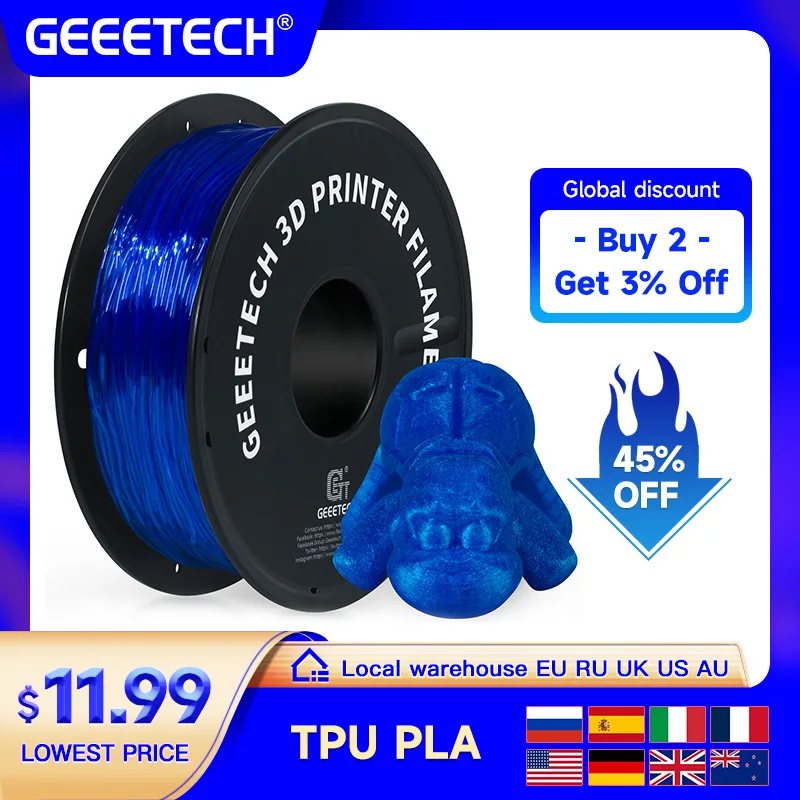
GEEETECH TPU Flexible 3D Printer Filament, 1.75mm, 1kg
Official Store Deal
Expert Analysis Overview
The GEEETECH TPU Flexible Filament is a high-performance material engineered for precision and durability in flexible 3D printing applications. This filament targets users requiring elastic, impact-resistant components, distinguishing itself from more rigid alternatives like PLA or ABS through its inherent flexibility and Shore Hardness 95A rating. Its formulation is designed to minimize common challenges associated with flexible materials, such as warping and inconsistent extrusion, thereby enhancing print reliability and part integrity.
This filament is composed of Thermoplastic Polyurethane (TPU), a polymer known for its elasticity and abrasion resistance. The Shore Hardness of 95A indicates a material that is quite flexible but still retains significant structural integrity, making it suitable for parts that require both give and resilience. This specific hardness allows for a balance between pliability and ease of printing, a critical consideration for flexible filaments.
For users creating functional prototypes or end-use parts that need to bend, compress, or absorb impact, TPU is an ideal choice. Its inherent flexibility means printed objects can withstand repeated stress without fracturing, unlike brittle plastics. Imagine printing custom gaskets, protective cases, or wearable components that conform to irregular shapes and endure daily wear.
Compared to standard rigid filaments, TPU offers a fundamentally different mechanical property profile. While PLA excels in ease of printing and detail, and ABS in heat resistance and strength, neither can replicate the elastic deformation capabilities of TPU. This material fills a crucial niche for applications where flexibility is paramount, providing a distinct advantage over conventional rigid plastics.
High dimensional accuracy and consistency are critical for successful 3D printing, especially with flexible materials. The GEEETECH TPU filament is specified at 1.75mm diameter with high precision, suggesting tight manufacturing tolerances. This precision is vital for consistent material flow through the extruder.
Inconsistent filament diameter can lead to under-extrusion, over-extrusion, or nozzle clogging, particularly problematic with flexible filaments due to their tendency to buckle in the extruder. A consistent diameter ensures that the printer's extrusion motor feeds the exact amount of material required, layer after layer. This results in uniform wall thickness and robust inter-layer adhesion, which are essential for the mechanical performance of flexible parts.
Unlike lower-quality filaments that may exhibit significant diameter variations, this product aims to provide a stable printing experience. Such consistency reduces the likelihood of print failures, saving both material and time. For complex geometries or parts with fine details, reliable material delivery is non-negotiable.
Premium quality is emphasized, with specific claims of no bubbles, precise dimensions, smooth printing, non-toxic composition, and anti-warping properties. These attributes directly address common pain points in 3D printing, particularly with flexible materials.
The absence of bubbles (air pockets) within the filament prevents voids in printed parts, which can compromise structural integrity and surface finish. Bubbles can also cause popping sounds during extrusion and lead to inconsistent flow, making smooth printing difficult. A bubble-free filament ensures a denser, more uniform print.
Smooth printing is a direct result of consistent diameter and material quality, leading to better layer adhesion and a cleaner aesthetic. Non-toxic materials are important for user safety, especially in home or educational environments. Anti-warping characteristics are particularly beneficial for flexible filaments, which can sometimes lift from the print bed if cooling or adhesion is not managed correctly. This feature helps maintain print bed adhesion throughout the printing process.
These quality assurances collectively contribute to a higher success rate for prints. Users can expect fewer failed prints and less post-processing, which translates to efficiency and cost savings. This contrasts sharply with generic filaments that often suffer from inconsistent quality, leading to frustration and wasted material.
Vacuum packaging is employed to protect the filament from moisture absorption. TPU is hygroscopic, meaning it readily absorbs moisture from the air. Moisture-laden filament can lead to steam bubbles forming during extrusion, resulting in poor layer adhesion, stringing, and a rough surface finish.
Properly sealed packaging ensures the filament arrives in optimal condition, ready for immediate use. This is a critical factor for maintaining material quality over time, especially in humid environments. Once opened, storing the filament in a dry box or with desiccant is recommended to preserve its properties.
This proactive approach to packaging extends the shelf life and usability of the filament. Without such protection, even high-quality filament can degrade rapidly, leading to printing issues. The vacuum seal is a simple yet effective measure that significantly impacts print quality and reliability.
The filament is designed for both 3D printers and 3D pens, highlighting its broad applicability. This versatility means the same material can be used for detailed artistic creations with a pen or for functional parts on a desktop FDM printer. The 1.75mm diameter is standard for most consumer-grade FDM printers, ensuring wide compatibility.
For hobbyists and professionals alike, having a single material that performs well across different tools simplifies inventory and workflow. Whether crafting intricate flexible models by hand or producing batches of elastic components, this filament serves multiple purposes. Its ease of use with 3D pens also suggests good flow characteristics at lower temperatures, which is beneficial for manual manipulation.
Many filaments are optimized for one application or another, but this TPU's characteristics make it adaptable. This broad utility offers value by reducing the need for specialized filaments for different tasks. It is a practical choice for workshops with diverse 3D printing needs.
The spool dimensions are specified as 6.5 inches in diameter, 2 inches in width, and a 2.2-inch inner diameter, designed to be compatible with 99% of FDM 3D printers. This universal fit is a significant convenience for users, eliminating concerns about spool holders or printer enclosures.
An incompatible spool can lead to feeding issues, tangles, or even prevent the spool from mounting correctly on the printer. A well-designed spool ensures smooth rotation and consistent filament unwinding throughout the print. This prevents snags and ensures uninterrupted material delivery, which is especially important for long prints.
Unlike some proprietary or oddly sized spools that require adapters or modifications, this standard sizing offers immediate plug-and-play functionality. This attention to detail in the spool design enhances the overall user experience, making the filament accessible to a vast majority of 3D printer owners without additional hassle.
The product is offered with a global discount, including a "Buy 2Get 3% Off" promotion and a general 45% discount, bringing the price to
Material Science and Print Fidelity
This filament is composed of Thermoplastic Polyurethane (TPU), a polymer known for its elasticity and abrasion resistance. The Shore Hardness of 95A indicates a material that is quite flexible but still retains significant structural integrity, making it suitable for parts that require both give and resilience. This specific hardness allows for a balance between pliability and ease of printing, a critical consideration for flexible filaments.
For users creating functional prototypes or end-use parts that need to bend, compress, or absorb impact, TPU is an ideal choice. Its inherent flexibility means printed objects can withstand repeated stress without fracturing, unlike brittle plastics. Imagine printing custom gaskets, protective cases, or wearable components that conform to irregular shapes and endure daily wear.
Compared to standard rigid filaments, TPU offers a fundamentally different mechanical property profile. While PLA excels in ease of printing and detail, and ABS in heat resistance and strength, neither can replicate the elastic deformation capabilities of TPU. This material fills a crucial niche for applications where flexibility is paramount, providing a distinct advantage over conventional rigid plastics.
Extrusion Dynamics and Part Integrity
High dimensional accuracy and consistency are critical for successful 3D printing, especially with flexible materials. The GEEETECH TPU filament is specified at 1.75mm diameter with high precision, suggesting tight manufacturing tolerances. This precision is vital for consistent material flow through the extruder.
Inconsistent filament diameter can lead to under-extrusion, over-extrusion, or nozzle clogging, particularly problematic with flexible filaments due to their tendency to buckle in the extruder. A consistent diameter ensures that the printer's extrusion motor feeds the exact amount of material required, layer after layer. This results in uniform wall thickness and robust inter-layer adhesion, which are essential for the mechanical performance of flexible parts.
Unlike lower-quality filaments that may exhibit significant diameter variations, this product aims to provide a stable printing experience. Such consistency reduces the likelihood of print failures, saving both material and time. For complex geometries or parts with fine details, reliable material delivery is non-negotiable.
Quality Assurance and Print Reliability
Premium quality is emphasized, with specific claims of no bubbles, precise dimensions, smooth printing, non-toxic composition, and anti-warping properties. These attributes directly address common pain points in 3D printing, particularly with flexible materials.
The absence of bubbles (air pockets) within the filament prevents voids in printed parts, which can compromise structural integrity and surface finish. Bubbles can also cause popping sounds during extrusion and lead to inconsistent flow, making smooth printing difficult. A bubble-free filament ensures a denser, more uniform print.
Smooth printing is a direct result of consistent diameter and material quality, leading to better layer adhesion and a cleaner aesthetic. Non-toxic materials are important for user safety, especially in home or educational environments. Anti-warping characteristics are particularly beneficial for flexible filaments, which can sometimes lift from the print bed if cooling or adhesion is not managed correctly. This feature helps maintain print bed adhesion throughout the printing process.
These quality assurances collectively contribute to a higher success rate for prints. Users can expect fewer failed prints and less post-processing, which translates to efficiency and cost savings. This contrasts sharply with generic filaments that often suffer from inconsistent quality, leading to frustration and wasted material.
Packaging and Storage Considerations
Vacuum packaging is employed to protect the filament from moisture absorption. TPU is hygroscopic, meaning it readily absorbs moisture from the air. Moisture-laden filament can lead to steam bubbles forming during extrusion, resulting in poor layer adhesion, stringing, and a rough surface finish.
Properly sealed packaging ensures the filament arrives in optimal condition, ready for immediate use. This is a critical factor for maintaining material quality over time, especially in humid environments. Once opened, storing the filament in a dry box or with desiccant is recommended to preserve its properties.
This proactive approach to packaging extends the shelf life and usability of the filament. Without such protection, even high-quality filament can degrade rapidly, leading to printing issues. The vacuum seal is a simple yet effective measure that significantly impacts print quality and reliability.
Application Versatility and User Experience
The filament is designed for both 3D printers and 3D pens, highlighting its broad applicability. This versatility means the same material can be used for detailed artistic creations with a pen or for functional parts on a desktop FDM printer. The 1.75mm diameter is standard for most consumer-grade FDM printers, ensuring wide compatibility.
For hobbyists and professionals alike, having a single material that performs well across different tools simplifies inventory and workflow. Whether crafting intricate flexible models by hand or producing batches of elastic components, this filament serves multiple purposes. Its ease of use with 3D pens also suggests good flow characteristics at lower temperatures, which is beneficial for manual manipulation.
Many filaments are optimized for one application or another, but this TPU's characteristics make it adaptable. This broad utility offers value by reducing the need for specialized filaments for different tasks. It is a practical choice for workshops with diverse 3D printing needs.
Spool Design and Printer Compatibility
The spool dimensions are specified as 6.5 inches in diameter, 2 inches in width, and a 2.2-inch inner diameter, designed to be compatible with 99% of FDM 3D printers. This universal fit is a significant convenience for users, eliminating concerns about spool holders or printer enclosures.
An incompatible spool can lead to feeding issues, tangles, or even prevent the spool from mounting correctly on the printer. A well-designed spool ensures smooth rotation and consistent filament unwinding throughout the print. This prevents snags and ensures uninterrupted material delivery, which is especially important for long prints.
Unlike some proprietary or oddly sized spools that require adapters or modifications, this standard sizing offers immediate plug-and-play functionality. This attention to detail in the spool design enhances the overall user experience, making the filament accessible to a vast majority of 3D printer owners without additional hassle.
Value Proposition and Economic Considerations
The product is offered with a global discount, including a "Buy 2
1.99. This pricing strategy positions the filament as an accessible option for those seeking flexible materials.
For users who frequently print with TPU, bulk purchasing options can lead to significant savings. The initial investment in a quality filament like this can reduce long-term costs by minimizing print failures and material waste. This is a smart investment.
Compared to premium brands, this filament offers a competitive price point without overtly sacrificing stated quality features. This makes it an attractive option for budget-conscious users or those experimenting with flexible materials for the first time. The value proposition is strong for its category.
Imagine the satisfaction of consistently producing high-quality, flexible parts that meet your exact specifications, without the frustration of common filament issues. Envision creating custom protective gear, durable robot components, or comfortable wearable accessories that perform flawlessly. This filament empowers creators to push the boundaries of their 3D printing projects, delivering reliable results for both functional prototypes and innovative end-use products.
For users who frequently print with TPU, bulk purchasing options can lead to significant savings. The initial investment in a quality filament like this can reduce long-term costs by minimizing print failures and material waste. This is a smart investment.
Compared to premium brands, this filament offers a competitive price point without overtly sacrificing stated quality features. This makes it an attractive option for budget-conscious users or those experimenting with flexible materials for the first time. The value proposition is strong for its category.
Imagine the satisfaction of consistently producing high-quality, flexible parts that meet your exact specifications, without the frustration of common filament issues. Envision creating custom protective gear, durable robot components, or comfortable wearable accessories that perform flawlessly. This filament empowers creators to push the boundaries of their 3D printing projects, delivering reliable results for both functional prototypes and innovative end-use products.