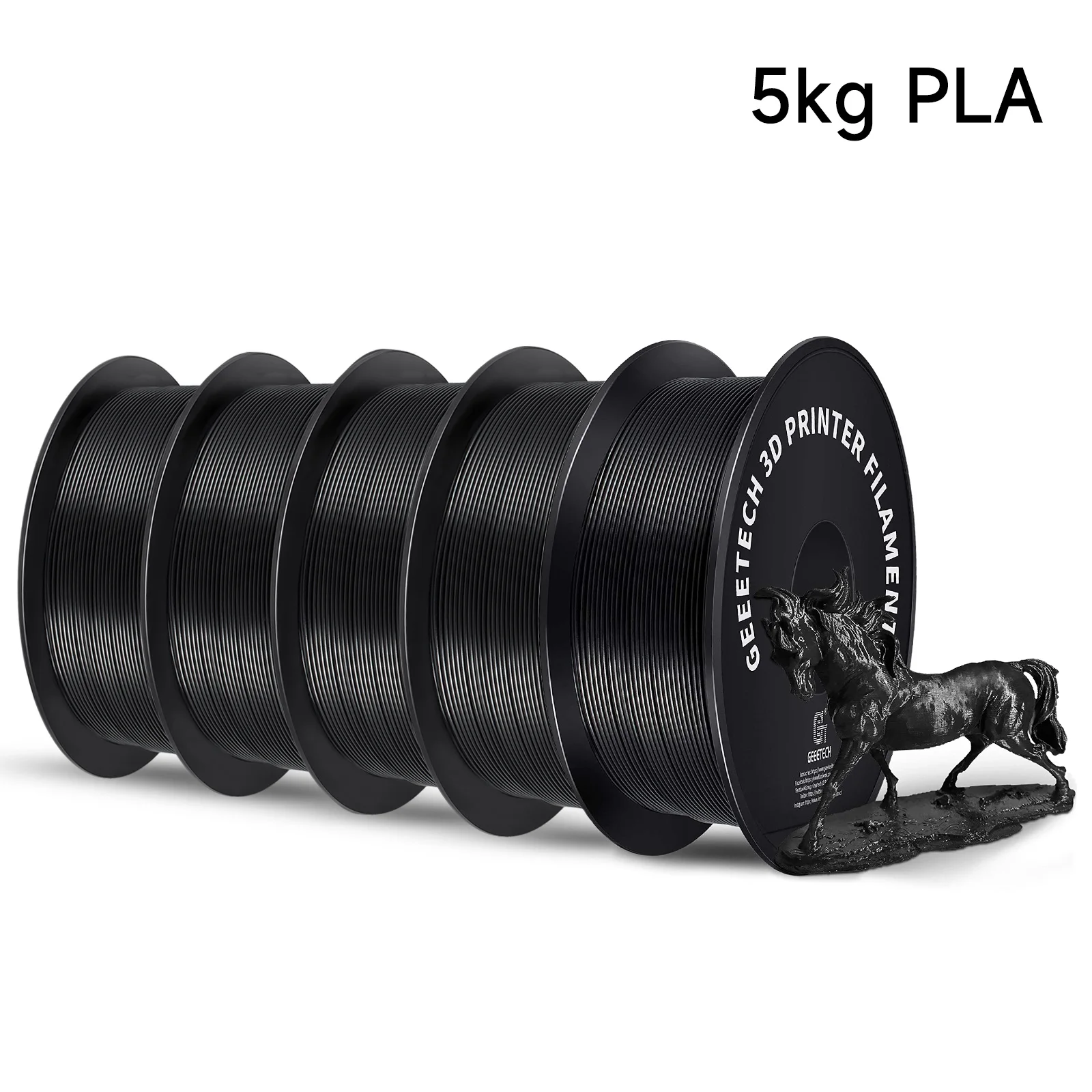
Geeetech 5Kg Standard PLA Filament
Official Store Deal
Expert Analysis Overview
The Foundation of Form: Material Science for Learning
The Geeetech 5Kg Standard PLA Filament is a practical and reliable consumable engineered for educational and hobbyist 3D printing environments. This bulk offering of Polylactic Acid (PLA) filament provides a consistent and accessible material source for numerous projects, making it an excellent choice for classrooms and makerspaces. Its properties are well-suited for repetitive use and learning. The filament's consistent diameter and material composition are crucial for predictable printing outcomes, which is paramount in a learning setting where students are mastering the fundamentals of additive manufacturing.Polylactic Acid, or PLA, is a biodegradable thermoplastic derived from renewable resources like corn starch or sugarcane. This makes it a more environmentally conscious choice compared to petroleum-based plastics. For educational institutions, the eco-friendly aspect aligns well with broader sustainability initiatives, offering a responsible material for student projects. It breaks down more readily than other plastics. This characteristic also contributes to a safer printing environment, as PLA typically emits fewer harmful fumes during extrusion compared to materials like ABS.
Unlike more advanced or specialized filaments that require specific printer setups or advanced user knowledge, standard PLA is known for its user-friendliness. It prints at lower temperatures and generally adheres well to various build surfaces without the need for heated enclosures. This simplicity reduces the barrier to entry for new users, allowing students to focus on design principles and printer operation rather than complex material science. The material's inherent stability during printing minimizes common issues, providing a smoother learning curve for beginners.
Precision in Every Layer: Consistency and Quality
The filament boasts a diameter of 1.75mm with a tight tolerance of ±0.03mm. This precise manufacturing minimizes extrusion inconsistencies, preventing nozzle clogs and ensuring consistent material flow. Such accuracy is vital for producing high-quality prints with smooth surfaces and accurate dimensions.Consistent filament diameter directly translates to more reliable print jobs. When the filament diameter varies, the printer's extruder struggles to maintain a steady flow rate, leading to under-extrusion, over-extrusion, or even nozzle blockages. These issues can ruin prints and cause significant frustration. A tight tolerance ensures that each layer is deposited uniformly, building strong, cohesive models.
Compared to lower-grade filaments that often exhibit wider diameter variations, this consistency significantly reduces print failures. It means less wasted material and more successful prints, which is particularly beneficial in a classroom where resources might be limited and student morale depends on successful outcomes. The stable performance allows educators to spend less time troubleshooting material issues and more time teaching design and engineering principles.
Strength and Flexibility: Mechanical Properties
Images show the filament exhibiting great tensile strength and flexibility. A hand demonstrates bending the filament 360 degrees without breaking. This indicates a robust material that can withstand some stress during and after printing.Good tensile strength means printed parts will be less prone to breaking under pulling forces. Flexibility, on the other hand, suggests that the material can absorb some impact without fracturing, which is valuable for functional prototypes or parts that might experience minor bending. These properties contribute to the durability of printed objects. Students often create functional prototypes.
Many standard PLA filaments can be quite brittle, especially when subjected to bending. The demonstrated flexibility suggests that this Geeetech filament might offer improved resilience compared to more rigid PLA formulations. This enhanced durability can lead to more robust student projects that can be handled and tested without immediate failure, fostering a sense of accomplishment.
Streamlined Workflow: Spool Design and Handling
The product is offered in a substantial 5kg quantity, distributed across multiple spools, likely 5 individual 1kg spools as depicted. This bulk packaging is designed for continuous, high-volume printing operations. The individual spools feature a 7-inch spool diameter, a 2.75-inch spool width, and a 2.4-inch interior spindle diameter.This large quantity reduces the frequency of filament changes, optimizing workflow, especially in busy educational or production environments. Having multiple spools also allows for simultaneous projects or provides ample backup material. The standard spool dimensions ensure compatibility with most FDM 3D printers, simplifying integration into existing setups. No special adapters are needed.
Unlike purchasing smaller, individual 1kg spools, a 5kg bulk purchase offers significant cost savings per kilogram, providing better value over time. This economic advantage is crucial for schools or workshops with tight budgets, allowing for more extensive printing activities without incurring prohibitive material costs. The consistent spool size across the bulk package also simplifies storage and inventory management.
Optimized Printing Parameters: Temperature and Adhesion
The recommended print temperature range is 190°C to 220°C, with 220°C being the suggested optimal. This range is typical for PLA. These temperatures are easily achievable by most FDM 3D printers.Operating within this temperature window ensures proper melting and extrusion of the filament, leading to strong layer adhesion and good print quality. Adhering to the recommended settings minimizes issues like stringing, warping, and poor layer bonding. Proper temperature control is essential for successful prints.
Compared to materials like ABS or Nylon, PLA's lower printing temperatures are safer and more energy-efficient. They also reduce the likelihood of warping, a common challenge with higher-temperature filaments. This ease of printing makes it ideal for beginners, allowing them to achieve successful results quickly and build confidence in their 3D printing skills.
Enhanced Print Quality: Addressing Common Issues
The product highlights several features aimed at improving print quality: precise winding, better layer adhesion, less warping, less stringing, and no bubbles. These characteristics are critical for producing aesthetically pleasing and structurally sound 3D prints.Precise winding prevents tangles and knots on the spool, which can lead to print failures and extruder jams. Better layer adhesion ensures that printed layers bond strongly, creating durable parts. Reduced warping keeps prints flat on the build plate, preventing corners from lifting. Less stringing means cleaner prints with fewer wisps of plastic between features. The absence of bubbles indicates a well-manufactured filament with consistent material density, preventing voids and weak spots in prints.
These combined qualities offer a significant advantage over lower-quality filaments that often suffer from these very issues. For students, encountering fewer print defects means less troubleshooting and more time spent on creative design and iteration. It provides a more positive and productive learning experience, reinforcing the potential of 3D printing rather than its frustrations.
Environmental Responsibility: An Eco-Friendly Choice
The filament is explicitly stated as being eco-friendly. As a PLA material, it is derived from renewable resources and is biodegradable under industrial composting conditions. This aspect is increasingly important for consumers and institutions.Choosing an eco-friendly filament reduces the environmental footprint of 3D printing activities. It promotes sustainable practices and educates users about responsible material selection. This aligns with modern environmental consciousness. It's a responsible material choice.
Unlike traditional plastics that persist in the environment for hundreds of years, PLA offers a more sustainable alternative. For educational settings, emphasizing the use of eco-friendly materials can be an integral part of teaching responsible engineering and design. It encourages a holistic view of product lifecycle and environmental impact.
Comprehensive Packaging: Protection and Information
The filament comes in a sturdy box, shrink-wrapped, and includes clear information on the spool. The packaging protects the filament from moisture and physical damage during transit and storage. It ensures the product arrives in optimal condition.Shrink-wrapping, often with a desiccant packet inside, is crucial for preserving filament quality by preventing moisture absorption. Moisture-laden filament can lead to bubbling, poor layer adhesion, and brittle prints. The clear labeling on the spool provides essential information like material type, diameter, and manufacturer, aiding in proper identification and use.
Well-designed packaging, unlike generic or poorly protected alternatives, ensures the filament maintains its performance characteristics until it is ready for use. This attention to detail reflects a commitment to product quality and user satisfaction. It also simplifies inventory management in a busy lab or classroom, as important details are readily visible.
Imagine a classroom where every student's design comes to life with minimal fuss, where the material consistently performs, and where the focus remains on innovation rather than troubleshooting. This filament provides the reliable foundation for such an environment, enabling seamless learning and creative exploration. It empowers educators to teach with confidence and students to build with success. The consistent quality and bulk quantity ensure that the creative flow is rarely interrupted, allowing for sustained engagement and deeper understanding of additive manufacturing principles. This is an investment in uninterrupted learning and successful project completion, fostering a new generation of makers and engineers. This filament supports ambitious projects.