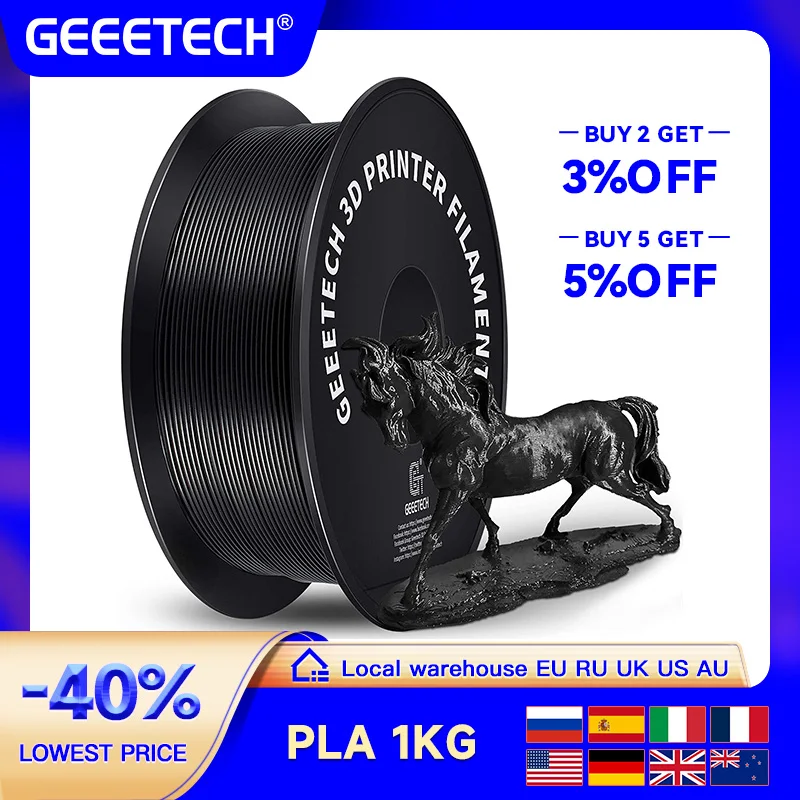
Geeetech 3D Printer Filament PLA PETG 1.75mm 1KG
Official Store Deal
Expert Analysis Overview
The Geeetech 3D Printer Filament is a foundational material engineered for hobbyists and professionals seeking reliable, consistent extrusion in their additive manufacturing projects. This offering, available in both PLA and PETG, addresses critical aspects of 3D printing material quality, from dimensional accuracy to spool management, aiming to minimize common print failures and enhance overall project success.
This filament is presented as "Pure PLA PETG Plastic." This designation implies a commitment to virgin material, free from the inconsistencies often found in recycled or blended filaments. Pure materials ensure predictable melting points and flow characteristics. Such consistency is vital for successful layer adhesion.
PLA, or Polylactic Acid, is a bioplastic derived from renewable resources like corn starch. It is renowned for its ease of printing, minimal warping, and low odor during extrusion, making it a preferred choice for beginners and for creating aesthetic models, prototypes, and educational tools. PETG, Polyethylene Terephthalate Glycol, offers a different set of advantages. It combines the ease of printing of PLA with the strength and durability closer to ABS, providing improved impact resistance, flexibility, and higher temperature tolerance. This makes PETG suitable for functional parts, mechanical components, and outdoor applications where greater resilience is required.
Unlike generic, unbranded filaments that might incorporate recycled plastics leading to inconsistent properties and potential nozzle clogs, this filament's emphasis on purity suggests a higher standard. This purity minimizes contaminants that can compromise print integrity or extruder health. It's a cleaner print path.
The filament maintains a standard diameter of 1.75mm. This dimension is crucial for compatibility with the vast majority of Fused Deposition Modeling (FDM) 3D printers currently on the market. Precise diameter control is paramount for consistent extrusion.
Deviations in filament diameter can lead to a cascade of printing issues, including under-extrusion, over-extrusion, and even nozzle clogging. These problems directly impact layer adhesion, surface finish, and the dimensional accuracy of the printed part. A stable 1.75mm diameter ensures a predictable material flow rate, which is critical for achieving intricate details and robust structures. Every millimeter counts.
Many budget filaments struggle with diameter tolerance, often exhibiting variations of +/0.05mm or more. This filament, by emphasizing its quality, aims to provide a tighter tolerance, likely around +/- 0.02mm. This represents a significant upgrade for users seeking reliable, high-resolution prints without constant calibration or mid-print adjustments.
Images clearly depict a neatly wound spool, with a direct visual comparison highlighting an "Upgrade Neatly-Wound" design against a tangled alternative. The product explicitly claims to be "Tangle-Free." This is a critical feature for uninterrupted printing.
A neatly wound spool directly prevents tangles and snags during the printing process. These issues are a common and frustrating cause of print failures, especially during long, unattended print jobs. An uninterrupted material feed is essential for maintaining consistent print bed adhesion, preventing extruder motor strain, and ensuring the structural integrity of the final object. Smooth operation is key.
Unlike poorly wound spools that can lead to frustrating mid-print failures, wasted material, and even damage to the printer's extruder, this filament's organized winding ensures a smooth, continuous feed. This design directly addresses a major pain point for 3D printer users, offering peace of mind and reducing the need for constant supervision during extended print jobs. It saves time and material.
The product description highlights "vacuum packaging." This detail is often overlooked but is fundamental to filament longevity and print quality. Filaments, particularly PLA and PETG, are hygroscopic.
Being hygroscopic means these materials readily absorb moisture from the surrounding air. Moisture absorption can lead to a range of print quality issues, including bubbling, stringing, poor layer adhesion, and weakened mechanical properties of the printed part. Vacuum sealing, typically accompanied by a desiccant packet, protects the filament from humidity from the factory until it is ready for use. This preserves the material's optimal printing characteristics.
Many filaments are simply shrink-wrapped or come in basic cardboard boxes, offering minimal protection against environmental moisture. The vacuum packaging is an upgrade, preserving the filament's optimal printing characteristics from the factory to the user's printer. This reduces the need for immediate filament drying, a process that can be time-consuming and requires additional equipment.
One image explicitly highlights the filament as "Eco-Friendly, Non-Toxic." This is particularly relevant for PLA, which is derived from renewable resources. The non-toxic nature extends to both PLA and PETG, which are generally considered safe for indoor use.
PLA's derivation from renewable resources like corn starch makes it a more environmentally conscious choice compared to petroleum-based plastics. Its non-toxic nature means it produces fewer harmful fumes during printing, making it suitable for use in home or office environments with proper ventilation. PETG also emits minimal odors and is often used in food-safe applications (though the filament itself is not food-safe without specific post-processing). Safer printing is possible.
While some filaments, like ABS, can emit strong odors and volatile organic compounds (VOCs) requiring robust ventilation, PLA and PETG are generally considered safer for indoor use. This focus on eco-friendliness and non-toxicity positions the filament as a responsible choice for users concerned about their environmental footprint and indoor air quality, offering a healthier printing experience.
Images accompanying the product showcase a diverse range of printed objects: a complex, skeletal rocking chair, a functional prosthetic hand, a detailed toy robot, and a decorative guitar. These examples demonstrate the filament's broad utility.
The range of examples demonstrates the filament's versatility across different applications, from functional prototypes like the prosthetic hand, which requires structural integrity, to intricate artistic pieces like the guitar, which demands good detail retention and surface finish. This suggests the material can handle both practical and aesthetic demands effectively. It handles many tasks.
This broad applicability contrasts with specialized filaments that might excel in one area but prove challenging or unsuitable for others. The ability to produce both robust functional parts and aesthetically pleasing models with the same material offers significant flexibility for makers, reducing the need to stock multiple specialized filament types for different projects. It's a multi-purpose solution.
The filament is offered in a standard 1KG (2.2LBS) spool. The stated price point of 7.99 USD, especially with potential discounts for bulk purchases, positions this product as a highly competitive option in the market.
A 1KG spool is a standard and economical quantity for most 3D printing enthusiasts, providing enough material for multiple projects without the inconvenience of frequent reordering. The competitive price point, particularly for a filament emphasizing quality features like neat winding and vacuum packaging, suggests strong value. This makes it an accessible option.
Compared to smaller spools or significantly more expensive premium brands, a 1KG spool at this price offers an excellent cost-per-gram ratio. This makes it an attractive option for users who print regularly and seek to minimize material costs without sacrificing essential quality. It democratizes reliable printing.
Imagine the satisfaction of initiating a multi-hour print, confident that the filament will feed smoothly, without tangles or inconsistencies, delivering a dimensionally accurate and aesthetically pleasing result. This filament provides the foundational reliability needed to transform digital designs into tangible creations with minimal fuss, allowing creators to focus on innovation rather than troubleshooting material issues. It empowers consistent, high-quality output for every project, from intricate models to robust functional parts, making every print a step closer to perfection.
Material Integrity and Composition
This filament is presented as "Pure PLA PETG Plastic." This designation implies a commitment to virgin material, free from the inconsistencies often found in recycled or blended filaments. Pure materials ensure predictable melting points and flow characteristics. Such consistency is vital for successful layer adhesion.
PLA, or Polylactic Acid, is a bioplastic derived from renewable resources like corn starch. It is renowned for its ease of printing, minimal warping, and low odor during extrusion, making it a preferred choice for beginners and for creating aesthetic models, prototypes, and educational tools. PETG, Polyethylene Terephthalate Glycol, offers a different set of advantages. It combines the ease of printing of PLA with the strength and durability closer to ABS, providing improved impact resistance, flexibility, and higher temperature tolerance. This makes PETG suitable for functional parts, mechanical components, and outdoor applications where greater resilience is required.
Unlike generic, unbranded filaments that might incorporate recycled plastics leading to inconsistent properties and potential nozzle clogs, this filament's emphasis on purity suggests a higher standard. This purity minimizes contaminants that can compromise print integrity or extruder health. It's a cleaner print path.
Precision in Diameter
The filament maintains a standard diameter of 1.75mm. This dimension is crucial for compatibility with the vast majority of Fused Deposition Modeling (FDM) 3D printers currently on the market. Precise diameter control is paramount for consistent extrusion.
Deviations in filament diameter can lead to a cascade of printing issues, including under-extrusion, over-extrusion, and even nozzle clogging. These problems directly impact layer adhesion, surface finish, and the dimensional accuracy of the printed part. A stable 1.75mm diameter ensures a predictable material flow rate, which is critical for achieving intricate details and robust structures. Every millimeter counts.
Many budget filaments struggle with diameter tolerance, often exhibiting variations of +/
Optimized Spool Management
Images clearly depict a neatly wound spool, with a direct visual comparison highlighting an "Upgrade Neatly-Wound" design against a tangled alternative. The product explicitly claims to be "Tangle-Free." This is a critical feature for uninterrupted printing.
A neatly wound spool directly prevents tangles and snags during the printing process. These issues are a common and frustrating cause of print failures, especially during long, unattended print jobs. An uninterrupted material feed is essential for maintaining consistent print bed adhesion, preventing extruder motor strain, and ensuring the structural integrity of the final object. Smooth operation is key.
Unlike poorly wound spools that can lead to frustrating mid-print failures, wasted material, and even damage to the printer's extruder, this filament's organized winding ensures a smooth, continuous feed. This design directly addresses a major pain point for 3D printer users, offering peace of mind and reducing the need for constant supervision during extended print jobs. It saves time and material.
Protective Packaging
The product description highlights "vacuum packaging." This detail is often overlooked but is fundamental to filament longevity and print quality. Filaments, particularly PLA and PETG, are hygroscopic.
Being hygroscopic means these materials readily absorb moisture from the surrounding air. Moisture absorption can lead to a range of print quality issues, including bubbling, stringing, poor layer adhesion, and weakened mechanical properties of the printed part. Vacuum sealing, typically accompanied by a desiccant packet, protects the filament from humidity from the factory until it is ready for use. This preserves the material's optimal printing characteristics.
Many filaments are simply shrink-wrapped or come in basic cardboard boxes, offering minimal protection against environmental moisture. The vacuum packaging is an upgrade, preserving the filament's optimal printing characteristics from the factory to the user's printer. This reduces the need for immediate filament drying, a process that can be time-consuming and requires additional equipment.
Environmental and Safety Considerations
One image explicitly highlights the filament as "Eco-Friendly, Non-Toxic." This is particularly relevant for PLA, which is derived from renewable resources. The non-toxic nature extends to both PLA and PETG, which are generally considered safe for indoor use.
PLA's derivation from renewable resources like corn starch makes it a more environmentally conscious choice compared to petroleum-based plastics. Its non-toxic nature means it produces fewer harmful fumes during printing, making it suitable for use in home or office environments with proper ventilation. PETG also emits minimal odors and is often used in food-safe applications (though the filament itself is not food-safe without specific post-processing). Safer printing is possible.
While some filaments, like ABS, can emit strong odors and volatile organic compounds (VOCs) requiring robust ventilation, PLA and PETG are generally considered safer for indoor use. This focus on eco-friendliness and non-toxicity positions the filament as a responsible choice for users concerned about their environmental footprint and indoor air quality, offering a healthier printing experience.
Versatility in Application
Images accompanying the product showcase a diverse range of printed objects: a complex, skeletal rocking chair, a functional prosthetic hand, a detailed toy robot, and a decorative guitar. These examples demonstrate the filament's broad utility.
The range of examples demonstrates the filament's versatility across different applications, from functional prototypes like the prosthetic hand, which requires structural integrity, to intricate artistic pieces like the guitar, which demands good detail retention and surface finish. This suggests the material can handle both practical and aesthetic demands effectively. It handles many tasks.
This broad applicability contrasts with specialized filaments that might excel in one area but prove challenging or unsuitable for others. The ability to produce both robust functional parts and aesthetically pleasing models with the same material offers significant flexibility for makers, reducing the need to stock multiple specialized filament types for different projects. It's a multi-purpose solution.
Value Proposition and Accessibility
The filament is offered in a standard 1KG (2.2LBS) spool. The stated price point of 7.99 USD, especially with potential discounts for bulk purchases, positions this product as a highly competitive option in the market.
A 1KG spool is a standard and economical quantity for most 3D printing enthusiasts, providing enough material for multiple projects without the inconvenience of frequent reordering. The competitive price point, particularly for a filament emphasizing quality features like neat winding and vacuum packaging, suggests strong value. This makes it an accessible option.
Compared to smaller spools or significantly more expensive premium brands, a 1KG spool at this price offers an excellent cost-per-gram ratio. This makes it an attractive option for users who print regularly and seek to minimize material costs without sacrificing essential quality. It democratizes reliable printing.
Imagine the satisfaction of initiating a multi-hour print, confident that the filament will feed smoothly, without tangles or inconsistencies, delivering a dimensionally accurate and aesthetically pleasing result. This filament provides the foundational reliability needed to transform digital designs into tangible creations with minimal fuss, allowing creators to focus on innovation rather than troubleshooting material issues. It empowers consistent, high-quality output for every project, from intricate models to robust functional parts, making every print a step closer to perfection.