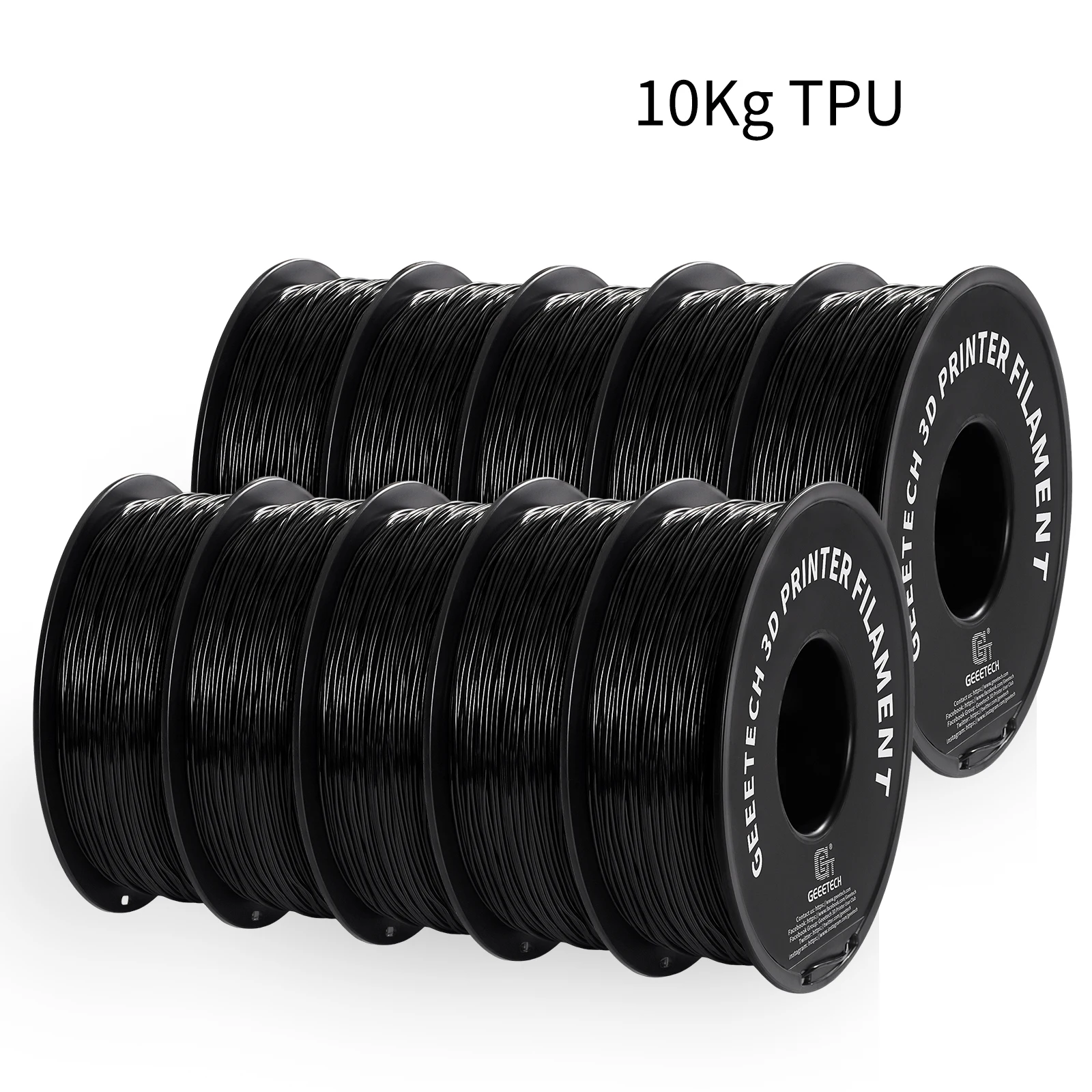
GEEETECH 10Kg TPU 3D Printer Filament, 1.75mm, Shore Hardness 95A
Official Store Deal
Expert Analysis Overview
The GEEETECH 10Kg TPU filament is a flexible thermoplastic polyurethane material engineered for 3D printing enthusiasts and professionals who demand both high elasticity and consistent print quality. This bulk offering is specifically tailored for makers involved in iterative design, custom part fabrication, and those requiring a reliable supply for extensive prototyping or production runs of flexible components.
This TPU filament boasts a Shore Hardness of 95A. This rating places it firmly in the semi-rigid flexible category, offering a balance between pliability and structural integrity. Many standard flexible filaments can be overly soft, leading to feeding issues in certain extruder designs.
For the tinkerer, this specific hardness means easier handling through direct-drive extruders and even some well-tuned Bowden setups. It opens up possibilities for parts that require significant bend without immediate deformation, unlike softer variants that might struggle under minor loads. The Shore Hardness 95A makes it a compelling choice for functional parts that need to absorb impact or flex repeatedly without breaking, a common challenge with more rigid materials.
Compared to extremely soft TPU filaments (e.g., 85A or lower), this 95A variant offers improved printability and layer adhesion, reducing stringing and blobbing. It fills a critical niche for objects needing both flexibility and a degree of stiffness, such as protective cases, seals, or wearable components.
The filament is specified at 1.75mm diameter with high dimensional accuracy. This precision is critical.
Consistent filament diameter directly impacts extrusion rates and, consequently, print quality. Fluctuations can lead to under-extrusion, over-extrusion, and visible imperfections in the final print. Maintaining a tight tolerance, as suggested by the marketing, ensures a smooth and predictable flow through the hotend, minimizing common printing frustrations.
Many generic filaments on the market struggle with diameter consistency, forcing users to constantly adjust flow rates or tolerate inconsistent results. This GEEETECH offering positions itself as a more reliable option, reducing the need for constant monitoring and calibration, which is a significant time-saver in a busy workshop.
This TPU filament is marketed as non-toxic and features vacuum packaging. These details are more than just marketing; they address fundamental concerns for any maker.
Non-toxic materials are crucial, especially when printing items that might come into contact with skin or be used in enclosed spaces. The vacuum packaging, often overlooked, is vital for hygroscopic materials like TPU. Moisture absorption can lead to bubbles, stringing, and degraded mechanical properties in printed parts. Proper storage is paramount.
Imagine printing a flexible gasket for a custom enclosure, only to find it brittle or full of voids due to moisture-laden filament. The proactive vacuum sealing helps prevent such issues, ensuring the material is in optimal condition right out of the box. This attention to storage detail prolongs the filament's shelf life and reduces waste from spoiled spools.
Unlike many budget filaments that might arrive poorly sealed or without clear indications of material safety, this product prioritizes both print quality and user peace of mind. It allows makers to focus on design and function rather than troubleshooting material issues.
The product is offered in a 10kg total package, comprising multiple 1kg spools. This bulk quantity is a direct response to the needs of active 3D printing operations.
Having a substantial supply of filament on hand minimizes downtime. It eliminates the frequent need to reorder and swap spools in the middle of large or continuous print jobs. For a maker running a small production line or engaging in extensive prototyping, a 10kg supply provides significant operational continuity.
Consider the frustration of running out of a specific material mid-project, especially for a specialized filament like TPU. The bulk purchase ensures that creative momentum is maintained, and project timelines are adhered to, avoiding the delays common with smaller, single-spool purchases. This commitment to bulk supply directly supports sustained innovation.
Many hobbyists start with single spools, but as projects scale, the logistical advantages of bulk purchases become clear. This GEEETECH offering allows for a more streamlined workflow, turning what could be a series of small, interrupted tasks into a continuous, efficient process.
The inherent flexibility and inflection resistance of this TPU filament make it suitable for a diverse range of applications. It is designed to withstand repeated bending and compression without breaking, a property crucial for functional prototypes.
This material excels in scenarios where parts need to absorb shock, provide a snug fit, or act as a protective barrier. Think of custom phone cases, flexible hinges, vibration dampeners for electronics, or even comfortable components for wearables. Its durability under stress opens up new avenues for design that rigid plastics simply cannot achieve.
When standard PLA or ABS would crack or snap under dynamic loads, TPU offers a resilient alternative. This allows for the creation of more robust and long-lasting functional prints, expanding the utility of a 3D printer beyond mere aesthetic models. It pushes the boundaries of what can be fabricated on a desktop machine.
Many users find themselves limited by the rigidity of common filaments. This TPU provides an escape from those limitations, enabling the production of parts that truly interact with their environment in a flexible manner. It allows for the creation of components that can be squeezed, twisted, and bent, bringing a new dimension to 3D printed objects.
Key quality attributes highlighted include no bubbles, smooth printing, and anti-warping characteristics. These are essential for a successful printing experience.
Bubbles in the filament indicate moisture or manufacturing defects, leading to weak spots and inconsistent extrusion. Smooth printing implies good flow and minimal friction, reducing nozzle clogging and print failures. Anti-warping properties are particularly beneficial for larger prints, preventing corners from lifting off the build plate, a common issue with many materials.
Imagine starting a 12-hour print of a complex flexible part, only to find it ruined halfway through due to filament bubbles or severe warping. These quality controls aim to mitigate such costly failures, saving both material and valuable printing time. A reliable filament minimizes the need for print restarts and troubleshooting.
Compared to unbranded or lower-quality filaments, where these issues are rampant, GEEETECH's stated focus on these attributes suggests a more consistent and less frustrating printing experience. It provides a foundation for predictable results, allowing makers to iterate designs quickly and confidently.
This GEEETECH TPU filament, with its consistent quality and accessible Shore Hardness, offers significant advantages for the maker community focused on machine modification and custom parts. The reliability of the material means that troubleshooting efforts can focus on printer mechanics rather than filament inconsistencies.
For those who love to modify and improve their machines, this filament provides a stable baseline. When experimenting with custom extruder designs or hotend upgrades, using a filament with known good properties allows for accurate assessment of the modifications. It's a dependable input for developing new printer capabilities.
Many community-driven projects involve designing and sharing custom parts, from tool holders to printer enclosures. The ability to reliably print flexible components like vibration dampeners, cable chains, or even custom grips with this TPU enhances the utility and ergonomics of these community-sourced designs. It enables practical, functional upgrades.
Furthermore, the widespread availability and consistent characteristics of this type of TPU filament mean that community troubleshooting efforts are more effective. When a user encounters an issue, the material itself is less likely to be the unknown variable, allowing for more targeted solutions based on printer settings or hardware configurations. This fosters a more collaborative and productive environment for problem-solving within the 3D printing ecosystem.
Consider the development of a custom direct-drive extruder. The ability to test it with a consistent, flexible filament like this TPU allows the designer to fine-tune gear ratios, motor currents, and cooling without the added complexity of variable material quality. This accelerates the design cycle for printer upgrades.
This filament facilitates experimentation with custom parts that require flexibility. Imagine designing a new type of spring-loaded clamp for a workbench, or a custom protective boot for an electronic component. The 95A Shore Hardness provides enough rigidity for these functional applications, while still offering the necessary give. It empowers makers to bring truly innovative, flexible solutions to life.
With a consistent material, sharing print profiles and troubleshooting tips within the community becomes more straightforward. A setting that works for one user's GEEETECH TPU is more likely to work for another's, fostering a stronger knowledge base and helping new users overcome the learning curve faster. This collaborative spirit is at the heart of the maker movement.
This bulk TPU filament empowers creators to move beyond rigid prototypes, enabling the development of functional, flexible components that enhance existing projects or inspire entirely new ones. It offers a reliable, consistent medium for intricate designs requiring elasticity, ensuring that the only limits are those of imagination and engineering skill. From custom seals to ergonomic grips, this material provides the foundation for durable, adaptable 3D printed solutions, fostering innovation and reducing the frustrations often associated with printing flexible materials. It's a smart investment for any workshop looking to expand its material capabilities and produce truly dynamic parts. With this material, users can expect to consistently achieve intricate, flexible designs, bringing their ambitious projects to tangible reality and contributing robust, custom solutions to their daily challenges.
Unpacking the Filament's Core Properties
This TPU filament boasts a Shore Hardness of 95A. This rating places it firmly in the semi-rigid flexible category, offering a balance between pliability and structural integrity. Many standard flexible filaments can be overly soft, leading to feeding issues in certain extruder designs.
For the tinkerer, this specific hardness means easier handling through direct-drive extruders and even some well-tuned Bowden setups. It opens up possibilities for parts that require significant bend without immediate deformation, unlike softer variants that might struggle under minor loads. The Shore Hardness 95A makes it a compelling choice for functional parts that need to absorb impact or flex repeatedly without breaking, a common challenge with more rigid materials.
Compared to extremely soft TPU filaments (e.g., 85A or lower), this 95A variant offers improved printability and layer adhesion, reducing stringing and blobbing. It fills a critical niche for objects needing both flexibility and a degree of stiffness, such as protective cases, seals, or wearable components.
Dimensional Precision and Consistency
The filament is specified at 1.75mm diameter with high dimensional accuracy. This precision is critical.
Consistent filament diameter directly impacts extrusion rates and, consequently, print quality. Fluctuations can lead to under-extrusion, over-extrusion, and visible imperfections in the final print. Maintaining a tight tolerance, as suggested by the marketing, ensures a smooth and predictable flow through the hotend, minimizing common printing frustrations.
Many generic filaments on the market struggle with diameter consistency, forcing users to constantly adjust flow rates or tolerate inconsistent results. This GEEETECH offering positions itself as a more reliable option, reducing the need for constant monitoring and calibration, which is a significant time-saver in a busy workshop.
Material Integrity and Print Experience
This TPU filament is marketed as non-toxic and features vacuum packaging. These details are more than just marketing; they address fundamental concerns for any maker.
Non-toxic materials are crucial, especially when printing items that might come into contact with skin or be used in enclosed spaces. The vacuum packaging, often overlooked, is vital for hygroscopic materials like TPU. Moisture absorption can lead to bubbles, stringing, and degraded mechanical properties in printed parts. Proper storage is paramount.
Imagine printing a flexible gasket for a custom enclosure, only to find it brittle or full of voids due to moisture-laden filament. The proactive vacuum sealing helps prevent such issues, ensuring the material is in optimal condition right out of the box. This attention to storage detail prolongs the filament's shelf life and reduces waste from spoiled spools.
Unlike many budget filaments that might arrive poorly sealed or without clear indications of material safety, this product prioritizes both print quality and user peace of mind. It allows makers to focus on design and function rather than troubleshooting material issues.
Bulk Supply for Ambitious Projects
The product is offered in a 10kg total package, comprising multiple 1kg spools. This bulk quantity is a direct response to the needs of active 3D printing operations.
Having a substantial supply of filament on hand minimizes downtime. It eliminates the frequent need to reorder and swap spools in the middle of large or continuous print jobs. For a maker running a small production line or engaging in extensive prototyping, a 10kg supply provides significant operational continuity.
Consider the frustration of running out of a specific material mid-project, especially for a specialized filament like TPU. The bulk purchase ensures that creative momentum is maintained, and project timelines are adhered to, avoiding the delays common with smaller, single-spool purchases. This commitment to bulk supply directly supports sustained innovation.
Many hobbyists start with single spools, but as projects scale, the logistical advantages of bulk purchases become clear. This GEEETECH offering allows for a more streamlined workflow, turning what could be a series of small, interrupted tasks into a continuous, efficient process.
Crafting with Flexible Filaments: Practical Applications
The inherent flexibility and inflection resistance of this TPU filament make it suitable for a diverse range of applications. It is designed to withstand repeated bending and compression without breaking, a property crucial for functional prototypes.
This material excels in scenarios where parts need to absorb shock, provide a snug fit, or act as a protective barrier. Think of custom phone cases, flexible hinges, vibration dampeners for electronics, or even comfortable components for wearables. Its durability under stress opens up new avenues for design that rigid plastics simply cannot achieve.
When standard PLA or ABS would crack or snap under dynamic loads, TPU offers a resilient alternative. This allows for the creation of more robust and long-lasting functional prints, expanding the utility of a 3D printer beyond mere aesthetic models. It pushes the boundaries of what can be fabricated on a desktop machine.
Many users find themselves limited by the rigidity of common filaments. This TPU provides an escape from those limitations, enabling the production of parts that truly interact with their environment in a flexible manner. It allows for the creation of components that can be squeezed, twisted, and bent, bringing a new dimension to 3D printed objects.
Ensuring a Smooth Print Journey: Quality Control
Key quality attributes highlighted include no bubbles, smooth printing, and anti-warping characteristics. These are essential for a successful printing experience.
Bubbles in the filament indicate moisture or manufacturing defects, leading to weak spots and inconsistent extrusion. Smooth printing implies good flow and minimal friction, reducing nozzle clogging and print failures. Anti-warping properties are particularly beneficial for larger prints, preventing corners from lifting off the build plate, a common issue with many materials.
Imagine starting a 12-hour print of a complex flexible part, only to find it ruined halfway through due to filament bubbles or severe warping. These quality controls aim to mitigate such costly failures, saving both material and valuable printing time. A reliable filament minimizes the need for print restarts and troubleshooting.
Compared to unbranded or lower-quality filaments, where these issues are rampant, GEEETECH's stated focus on these attributes suggests a more consistent and less frustrating printing experience. It provides a foundation for predictable results, allowing makers to iterate designs quickly and confidently.
The Maker's Advantage: Upgradability and Community
This GEEETECH TPU filament, with its consistent quality and accessible Shore Hardness, offers significant advantages for the maker community focused on machine modification and custom parts. The reliability of the material means that troubleshooting efforts can focus on printer mechanics rather than filament inconsistencies.
For those who love to modify and improve their machines, this filament provides a stable baseline. When experimenting with custom extruder designs or hotend upgrades, using a filament with known good properties allows for accurate assessment of the modifications. It's a dependable input for developing new printer capabilities.
Many community-driven projects involve designing and sharing custom parts, from tool holders to printer enclosures. The ability to reliably print flexible components like vibration dampeners, cable chains, or even custom grips with this TPU enhances the utility and ergonomics of these community-sourced designs. It enables practical, functional upgrades.
Furthermore, the widespread availability and consistent characteristics of this type of TPU filament mean that community troubleshooting efforts are more effective. When a user encounters an issue, the material itself is less likely to be the unknown variable, allowing for more targeted solutions based on printer settings or hardware configurations. This fosters a more collaborative and productive environment for problem-solving within the 3D printing ecosystem.
Consider the development of a custom direct-drive extruder. The ability to test it with a consistent, flexible filament like this TPU allows the designer to fine-tune gear ratios, motor currents, and cooling without the added complexity of variable material quality. This accelerates the design cycle for printer upgrades.
This filament facilitates experimentation with custom parts that require flexibility. Imagine designing a new type of spring-loaded clamp for a workbench, or a custom protective boot for an electronic component. The 95A Shore Hardness provides enough rigidity for these functional applications, while still offering the necessary give. It empowers makers to bring truly innovative, flexible solutions to life.
With a consistent material, sharing print profiles and troubleshooting tips within the community becomes more straightforward. A setting that works for one user's GEEETECH TPU is more likely to work for another's, fostering a stronger knowledge base and helping new users overcome the learning curve faster. This collaborative spirit is at the heart of the maker movement.
This bulk TPU filament empowers creators to move beyond rigid prototypes, enabling the development of functional, flexible components that enhance existing projects or inspire entirely new ones. It offers a reliable, consistent medium for intricate designs requiring elasticity, ensuring that the only limits are those of imagination and engineering skill. From custom seals to ergonomic grips, this material provides the foundation for durable, adaptable 3D printed solutions, fostering innovation and reducing the frustrations often associated with printing flexible materials. It's a smart investment for any workshop looking to expand its material capabilities and produce truly dynamic parts. With this material, users can expect to consistently achieve intricate, flexible designs, bringing their ambitious projects to tangible reality and contributing robust, custom solutions to their daily challenges.