Gdstime 5015 Dual Ball Blower Fan for 3D Printer Cooling
Official Store Deal
Expert Analysis Overview
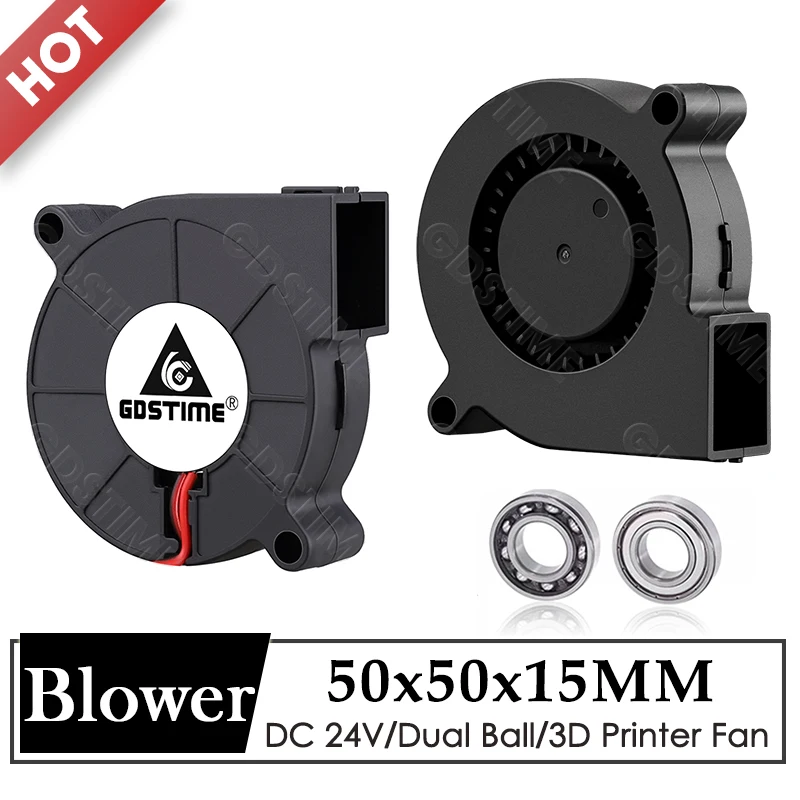
The Gdstime 5015 Blower Fan is a specialized cooling component engineered for precision airflow delivery in demanding 3D printing applications. This radial fan, with its compact 50x50x15mm footprint, is designed to provide targeted cooling, a critical factor in achieving high-quality prints, particularly with materials prone to warping or requiring rapid solidification. Its dual ball bearing construction signifies a commitment to longevity and consistent performance, distinguishing it from less robust alternatives often found in the market. The fan's operational versatility across 5V, 12V, and 24V DC power inputs ensures broad compatibility with various 3D printer mainboards and power supply configurations, making it a flexible upgrade or replacement part for enthusiasts and professionals alike. This cooling solution directly addresses common print quality issues by maintaining optimal thermal conditions around the print nozzle and freshly extruded layers.
The Gdstime 5015 blower fan features a radial design, characterized by its impeller drawing air in axially and expelling it centrifugally at a 90-degree angle. This design is inherently efficient for creating directed, high-pressure airflow. The fan's housing is constructed from a durable black plastic composite, providing structural integrity. Its compact dimensions are ideal for tight integration into existing 3D printer cooling shrouds.
This specific airflow pattern is invaluable for cooling filament as it exits the nozzle, preventing heat creep into the hotend and ensuring rapid layer solidification. Precise cooling minimizes stringing and improves overhang performance. Without adequate and directed cooling, prints can suffer from poor layer adhesion and dimensional inaccuracies.
Unlike axial fans that disperse air broadly, the blower fan's focused output is superior for cooling specific zones, such as the print bed or the extruded plastic itself. This targeted approach is essential for materials like PLA, which benefit from aggressive cooling, and even for ABS, where controlled cooling can mitigate warping.
The fan's internal mechanics are built around a dual ball bearing system. This is a significant design choice for components subjected to continuous operation and varying orientations. Ball bearings reduce friction and wear compared to sleeve bearings.
This bearing type directly translates to an extended operational lifespan and quieter performance over time. Reduced friction means less heat generation within the fan itself, contributing to overall system stability. The fan maintains its rotational speed more consistently.
Many stock 3D printer fans utilize cheaper sleeve bearings, which are prone to premature failure, especially in dusty environments or when mounted in non-horizontal positions. The dual ball bearing design offers a substantial upgrade in durability and reliability, minimizing the need for frequent replacements.
The 50x50x15mm form factor is a common size for 3D printer part cooling fans, allowing for straightforward integration into many popular printer models. The outlet dimensions, measured at approximately 20x17mm, are optimized to channel air effectively. The fan's ability to operate at 5V, 12V, or 24V DC provides exceptional adaptability.
This voltage flexibility means users can select the fan variant that perfectly matches their printer's power supply, avoiding the need for voltage converters or complex wiring modifications. Correct voltage application ensures the fan operates at its intended speed and efficiency. Proper power delivery is paramount for optimal performance.
Standard 3D printers often run on 12V or 24V systems, while smaller, portable, or custom setups might utilize 5V. The availability of multiple voltage options ensures that this high-speed cooler can be incorporated into a wide array of custom builds and commercial machines without compatibility issues. This broadens its utility significantly.
Effective part cooling is not merely about reducing temperature; it is about controlling the thermal gradients during the printing process. The high-speed nature of this blower fan ensures a rapid and consistent air stream. This rapid cooling is vital for bridging and overhangs.
In a scenario where a user is printing intricate models with fine details or challenging geometries, the fan's focused cooling prevents molten plastic from deforming before it solidifies. This leads to sharper edges and more accurate dimensions. Print quality directly correlates with cooling efficiency.
Compared to inadequate cooling solutions, which often result in drooping layers, poor surface finish, and failed prints, the Gdstime 5015 provides the necessary thermal management to achieve professional-grade results. It allows for faster print speeds without compromising structural integrity or aesthetic appeal.
The fan comes with a 250mm wire length, terminating in a standard 2-pin connector. This length offers sufficient reach for most mounting locations within a 3D printer chassis. The wiring is color-coded, red for positive and black for negative, simplifying installation.
Proper wiring is essential to prevent damage to the fan or the printer's mainboard. Users should always verify polarity before connecting. Secure mounting ensures vibration-free operation.
Many aftermarket cooling solutions require custom wiring or adapters. The Gdstime fan's straightforward connection system reduces installation complexity, making it accessible even for users with limited electrical experience. Its robust construction implies fewer failures over its operational life.
The product is backed by an
Engineering for Consistent Airflow
The Gdstime 5015 blower fan features a radial design, characterized by its impeller drawing air in axially and expelling it centrifugally at a 90-degree angle. This design is inherently efficient for creating directed, high-pressure airflow. The fan's housing is constructed from a durable black plastic composite, providing structural integrity. Its compact dimensions are ideal for tight integration into existing 3D printer cooling shrouds.
This specific airflow pattern is invaluable for cooling filament as it exits the nozzle, preventing heat creep into the hotend and ensuring rapid layer solidification. Precise cooling minimizes stringing and improves overhang performance. Without adequate and directed cooling, prints can suffer from poor layer adhesion and dimensional inaccuracies.
Unlike axial fans that disperse air broadly, the blower fan's focused output is superior for cooling specific zones, such as the print bed or the extruded plastic itself. This targeted approach is essential for materials like PLA, which benefit from aggressive cooling, and even for ABS, where controlled cooling can mitigate warping.
Structural Integrity and Material Selection
The fan's internal mechanics are built around a dual ball bearing system. This is a significant design choice for components subjected to continuous operation and varying orientations. Ball bearings reduce friction and wear compared to sleeve bearings.
This bearing type directly translates to an extended operational lifespan and quieter performance over time. Reduced friction means less heat generation within the fan itself, contributing to overall system stability. The fan maintains its rotational speed more consistently.
Many stock 3D printer fans utilize cheaper sleeve bearings, which are prone to premature failure, especially in dusty environments or when mounted in non-horizontal positions. The dual ball bearing design offers a substantial upgrade in durability and reliability, minimizing the need for frequent replacements.
Optimizing Airflow Dynamics
The 50x50x15mm form factor is a common size for 3D printer part cooling fans, allowing for straightforward integration into many popular printer models. The outlet dimensions, measured at approximately 20x17mm, are optimized to channel air effectively. The fan's ability to operate at 5V, 12V, or 24V DC provides exceptional adaptability.
This voltage flexibility means users can select the fan variant that perfectly matches their printer's power supply, avoiding the need for voltage converters or complex wiring modifications. Correct voltage application ensures the fan operates at its intended speed and efficiency. Proper power delivery is paramount for optimal performance.
Standard 3D printers often run on 12V or 24V systems, while smaller, portable, or custom setups might utilize 5V. The availability of multiple voltage options ensures that this high-speed cooler can be incorporated into a wide array of custom builds and commercial machines without compatibility issues. This broadens its utility significantly.
Enhancing Print Quality with Targeted Cooling
Effective part cooling is not merely about reducing temperature; it is about controlling the thermal gradients during the printing process. The high-speed nature of this blower fan ensures a rapid and consistent air stream. This rapid cooling is vital for bridging and overhangs.
In a scenario where a user is printing intricate models with fine details or challenging geometries, the fan's focused cooling prevents molten plastic from deforming before it solidifies. This leads to sharper edges and more accurate dimensions. Print quality directly correlates with cooling efficiency.
Compared to inadequate cooling solutions, which often result in drooping layers, poor surface finish, and failed prints, the Gdstime 5015 provides the necessary thermal management to achieve professional-grade results. It allows for faster print speeds without compromising structural integrity or aesthetic appeal.
Installation and Longevity Considerations
The fan comes with a 250mm wire length, terminating in a standard 2-pin connector. This length offers sufficient reach for most mounting locations within a 3D printer chassis. The wiring is color-coded, red for positive and black for negative, simplifying installation.
Proper wiring is essential to prevent damage to the fan or the printer's mainboard. Users should always verify polarity before connecting. Secure mounting ensures vibration-free operation.
Many aftermarket cooling solutions require custom wiring or adapters. The Gdstime fan's straightforward connection system reduces installation complexity, making it accessible even for users with limited electrical experience. Its robust construction implies fewer failures over its operational life.
Assured Quality and Support
The product is backed by an