Gdstime 40mm Dual Ball Turbo Blower Fan (2-Pack)
Official Store Deal
Expert Analysis Overview
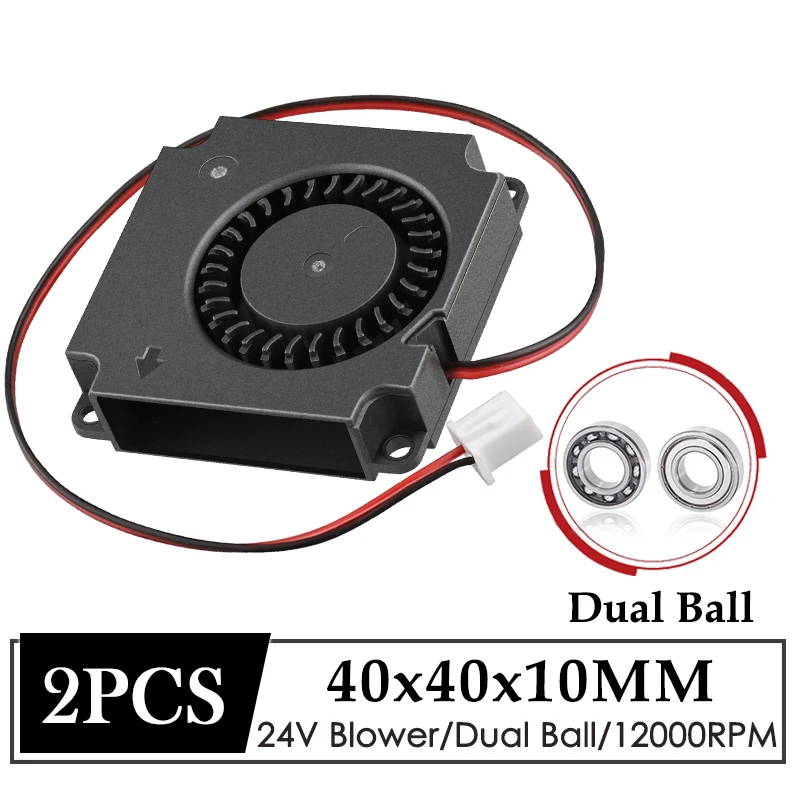
The Gdstime 40mm Turbo Blower is a high-performance, compact cooling solution engineered for demanding thermal management in precision applications like 3D printing. This component directly addresses the critical need for consistent, directed airflow in environments where thermal stability dictates operational success and product quality. Unlike generic cooling fans that often compromise on longevity or airflow, this unit integrates dual ball bearings and a high-speed motor to deliver reliable performance, ensuring consistent results even with challenging materials. It is a foundational upgrade for any serious additive manufacturing setup.
The core function of any cooling fan is to move air efficiently and effectively. This Gdstime blower achieves this with a 40x40x10mm form factor and a 12000 RPM rotational speed. Such a compact design allows for integration into tight spaces, making it ideal for the confined build volumes and intricate mechanics of modern 3D printers and other compact electronic enclosures. Its small footprint is a significant advantage.
The high rotational speed ensures a powerful, focused stream of air, critical for applications where heat needs to be dissipated rapidly from a specific point. In 3D printing, this translates to quickly solidifying extruded filament, preventing issues like heat creep that can lead to nozzle clogs, or poor layer adhesion that compromises structural integrity. Without adequate, directed airflow, thermal runaway or component degradation can occur, leading to costly print failures and reduced equipment lifespan.
Compared to standard axial fans, a turbo blower, also known as a radial or centrifugal fan, excels at generating higher static pressure. This means it can push air through restrictive ducts or heatsinks more effectively, making it ideal for cooling solutions that require directed, concentrated airflow rather than broad ventilation. Axial fans are better for general airflow, but blowers are superior for targeted cooling, such as part cooling in 3D printers where air must be forced through a specific nozzle onto the print.
A key differentiator for this Gdstime blower is its dual ball bearing construction. This is not merely a specification; it is a fundamental design choice impacting the fan's operational life and reliability. Dual ball bearings provide superior support for the fan's impeller shaft, distributing radial and axial loads more evenly across two points.
The presence of two precision ball bearings significantly reduces friction and wear compared to traditional sleeve bearings. This translates directly into an extended lifespan, often several times longer than sleeve bearing counterparts, particularly in applications involving continuous operation, high temperatures, or varied mounting orientations. Reduced friction also contributes to more stable rotation, minimizing vibrations that could affect sensitive equipment like 3D printer print heads, which demand absolute precision. This design choice ensures consistent performance over thousands of hours.
In contrast, sleeve bearings rely on a lubricant film, which can degrade or dry out over time, especially in high-temperature environments or when mounted horizontally, where gravity can accelerate lubricant migration. This degradation leads to increased noise, reduced efficiency, and ultimately, premature failure. The dual ball bearing system mitigates these common points of failure, offering a more robust and reliable cooling solution that requires less maintenance and provides greater peace of mind for continuous operation.
For 3D printing, precise thermal management is non-negotiable for achieving high-quality results. This blower's focused airflow is instrumental in cooling extruded filament rapidly and consistently. Rapid cooling is essential for print quality.
When printing with materials such as ABS, PETG, or Nylon, controlling the cooling rate is paramount to prevent warping, improve layer adhesion, and achieve crisp details on overhangs and bridges. Insufficient cooling can lead to a host of print failures, including stringing, poor surface finish, ghosting artifacts, and structural weaknesses due to inadequate layer bonding. This fan directly addresses these pain points by providing the necessary cooling power to solidify layers quickly and evenly, allowing for better dimensional accuracy and aesthetic quality.
Many entry-level 3D printers come with inadequate cooling solutions, often leading to frustration when attempting to print complex geometries or temperature-sensitive filaments. Upgrading to a high-performance blower like this allows users to push the boundaries of their 3D printing capabilities, enabling successful prints with materials and designs that would otherwise be problematic. It is a significant upgrade for print quality, transforming a basic setup into a more capable and versatile machine.
The 40x40x10mm dimensions make this fan exceptionally versatile across a multitude of applications. Its slim profile allows it to fit into constrained spaces where larger fans would be impractical, such as within custom electronics enclosures, compact server racks, or the intricate tool heads of 3D printers. This compact nature is a significant advantage for designers and hobbyists alike.
The design facilitates seamless integration into custom enclosures, compact electronic projects, or as a direct replacement for existing fans in 3D printers where space is at a premium. The standardized size ensures compatibility with a wide array of mounting brackets and shrouds commonly found in the electronics and additive manufacturing sectors, simplifying upgrades and modifications. This adaptability extends its utility beyond its primary advertised use, making it a valuable component for various DIY and professional projects.
Furthermore, the availability of both DC 12V and 24V versions enhances its adaptability, catering to a broader spectrum of electronic systems. This dual voltage compatibility means it can be seamlessly integrated into various power systems without the need for voltage converters, simplifying installation and reducing potential points of failure. Many 3D printers operate on 24V, while other electronic projects might use 12V, making this fan a flexible choice for diverse applications and reducing inventory complexity for builders.
Mounting the blower requires attention to its directional airflow, which is a characteristic of centrifugal designs. The fan features 3.5mm mounting holes on its corners, designed for secure attachment. Proper alignment is key to maximizing its cooling efficiency.
These holes are precisely sized for standard M3 screws, ensuring a secure and stable fit when integrated into a system. When installing, it is critical to orient the fan so that the exhaust port directs air precisely where cooling is needed, whether it's a specific component, a heatsink, or the freshly extruded filament on a 3D print bed. Incorrect orientation can lead to inefficient cooling, negating the fan's performance benefits and potentially causing thermal issues. Users should consult their device's schematics or experiment with airflow direction to optimize thermal performance.
The 2-pin connector simplifies electrical integration, providing a straightforward positive and negative connection. This standard connection type is widely compatible with many control boards, including those found in 3D printers. For speed control, voltage regulation or a 2-wire Pulse Width Modulation (PWM) signal can be employed, depending on the specific controller and fan model, allowing for dynamic adjustment of airflow based on real-time thermal requirements. This offers flexibility in managing noise and cooling intensity.
The fan's construction is designed for sustained, long-term operation, a critical factor in industrial and hobbyist applications alike. The brushless DC motor is a testament to its intended longevity and reliability. Brushless motors are inherently more durable than their brushed counterparts.
Unlike brushed motors, brushless designs eliminate physical contact between the rotor and stator, removing a primary source of wear and tear, such as carbon brush degradation. This results in quieter operation, higher efficiency due to reduced energy loss from friction, and a significantly longer operational life, especially under continuous load conditions. The absence of brushes also means less maintenance, no brush dust accumulation, and a reduced risk of sparking, making it safer in certain environments where flammable materials might be present.
Beyond longevity, brushless motors offer superior control characteristics, allowing for more precise speed regulation and smoother operation. They are also generally more compact for a given power output, contributing to the fan's overall small footprint. This advanced motor technology ensures that the Gdstime blower can withstand the rigors of constant use without premature failure, providing consistent cooling performance over its extended lifespan.
The fan's casing is engineered to endure the thermal and mechanical stresses of its operating environment. Its robust plastic composition resists thermal stress and maintains structural integrity. This is a critical factor for long-term reliability.
The use of high-grade thermoplastics, typically PBT (Polybutylene Terephthalate), in fan housings is standard for industrial and high-performance cooling solutions. PBT offers excellent mechanical strength, rigidity, and resistance to a wide range of chemicals and solvents, in addition to its crucial thermal stability. This ensures that the fan maintains its structural integrity and aerodynamic efficiency even when exposed to the elevated, fluctuating temperatures common in 3D printing environments or other demanding electronic applications, preventing warping or embrittlement.
Inferior plastics might become brittle, warp, or even melt under sustained heat, leading to fan imbalance, increased noise, or complete failure of the cooling system. The choice of a durable, heat-resistant plastic for the Gdstime blower's housing underscores its design for reliability and continuous operation, providing peace of mind for users who depend on consistent cooling performance in critical applications. This material selection directly contributes to the fan's overall durability and performance consistency.
Investing in reliable cooling components like the Gdstime turbo blower translates into tangible benefits for 3D printing enthusiasts and professionals. It minimizes costly print failures, which can quickly erode the value of a printing project. This is a smart investment for any serious maker.
By ensuring optimal and consistent cooling, users can significantly reduce material waste from failed prints, save valuable printing time that would otherwise be spent reprinting, and achieve higher quality finished products with superior aesthetics and mechanical properties. The dual ball bearing design means fewer replacements and less downtime, further contributing to cost savings over the long term and improving overall operational efficiency. This fan is not just a component; it is an enabler for more ambitious and successful printing projects.
The ability to reliably print with a wider range of filaments, including those that are notoriously difficult to cool or prone to warping, expands the creative and functional possibilities of a 3D printer. This blower empowers users to tackle complex designs with confidence, knowing that their cooling system will perform consistently and effectively. It enhances the overall utility and capability of the 3D printer, allowing for greater innovation and higher-quality output.
Imagine a scenario where complex overhangs print flawlessly, intricate details emerge with crisp precision, and warping becomes a distant memory, even with challenging materials. This level of consistent performance allows for greater experimentation with advanced materials and geometries, ultimately leading to superior final products and a more rewarding additive manufacturing experience. The Gdstime 40mm Turbo Blower is a foundational upgrade for any serious 3D printing setup, ensuring that thermal challenges do not impede creative vision or operational efficiency.
Precision Airflow Engineering
The core function of any cooling fan is to move air efficiently and effectively. This Gdstime blower achieves this with a 40x40x10mm form factor and a 12000 RPM rotational speed. Such a compact design allows for integration into tight spaces, making it ideal for the confined build volumes and intricate mechanics of modern 3D printers and other compact electronic enclosures. Its small footprint is a significant advantage.
The high rotational speed ensures a powerful, focused stream of air, critical for applications where heat needs to be dissipated rapidly from a specific point. In 3D printing, this translates to quickly solidifying extruded filament, preventing issues like heat creep that can lead to nozzle clogs, or poor layer adhesion that compromises structural integrity. Without adequate, directed airflow, thermal runaway or component degradation can occur, leading to costly print failures and reduced equipment lifespan.
Compared to standard axial fans, a turbo blower, also known as a radial or centrifugal fan, excels at generating higher static pressure. This means it can push air through restrictive ducts or heatsinks more effectively, making it ideal for cooling solutions that require directed, concentrated airflow rather than broad ventilation. Axial fans are better for general airflow, but blowers are superior for targeted cooling, such as part cooling in 3D printers where air must be forced through a specific nozzle onto the print.
Bearing Longevity and Operational Stability
A key differentiator for this Gdstime blower is its dual ball bearing construction. This is not merely a specification; it is a fundamental design choice impacting the fan's operational life and reliability. Dual ball bearings provide superior support for the fan's impeller shaft, distributing radial and axial loads more evenly across two points.
The presence of two precision ball bearings significantly reduces friction and wear compared to traditional sleeve bearings. This translates directly into an extended lifespan, often several times longer than sleeve bearing counterparts, particularly in applications involving continuous operation, high temperatures, or varied mounting orientations. Reduced friction also contributes to more stable rotation, minimizing vibrations that could affect sensitive equipment like 3D printer print heads, which demand absolute precision. This design choice ensures consistent performance over thousands of hours.
In contrast, sleeve bearings rely on a lubricant film, which can degrade or dry out over time, especially in high-temperature environments or when mounted horizontally, where gravity can accelerate lubricant migration. This degradation leads to increased noise, reduced efficiency, and ultimately, premature failure. The dual ball bearing system mitigates these common points of failure, offering a more robust and reliable cooling solution that requires less maintenance and provides greater peace of mind for continuous operation.
Thermal Regulation for Advanced Filaments
For 3D printing, precise thermal management is non-negotiable for achieving high-quality results. This blower's focused airflow is instrumental in cooling extruded filament rapidly and consistently. Rapid cooling is essential for print quality.
When printing with materials such as ABS, PETG, or Nylon, controlling the cooling rate is paramount to prevent warping, improve layer adhesion, and achieve crisp details on overhangs and bridges. Insufficient cooling can lead to a host of print failures, including stringing, poor surface finish, ghosting artifacts, and structural weaknesses due to inadequate layer bonding. This fan directly addresses these pain points by providing the necessary cooling power to solidify layers quickly and evenly, allowing for better dimensional accuracy and aesthetic quality.
Many entry-level 3D printers come with inadequate cooling solutions, often leading to frustration when attempting to print complex geometries or temperature-sensitive filaments. Upgrading to a high-performance blower like this allows users to push the boundaries of their 3D printing capabilities, enabling successful prints with materials and designs that would otherwise be problematic. It is a significant upgrade for print quality, transforming a basic setup into a more capable and versatile machine.
Compact Integration and Adaptability
The 40x40x10mm dimensions make this fan exceptionally versatile across a multitude of applications. Its slim profile allows it to fit into constrained spaces where larger fans would be impractical, such as within custom electronics enclosures, compact server racks, or the intricate tool heads of 3D printers. This compact nature is a significant advantage for designers and hobbyists alike.
The design facilitates seamless integration into custom enclosures, compact electronic projects, or as a direct replacement for existing fans in 3D printers where space is at a premium. The standardized size ensures compatibility with a wide array of mounting brackets and shrouds commonly found in the electronics and additive manufacturing sectors, simplifying upgrades and modifications. This adaptability extends its utility beyond its primary advertised use, making it a valuable component for various DIY and professional projects.
Furthermore, the availability of both DC 12V and 24V versions enhances its adaptability, catering to a broader spectrum of electronic systems. This dual voltage compatibility means it can be seamlessly integrated into various power systems without the need for voltage converters, simplifying installation and reducing potential points of failure. Many 3D printers operate on 24V, while other electronic projects might use 12V, making this fan a flexible choice for diverse applications and reducing inventory complexity for builders.
Installation Considerations
Mounting the blower requires attention to its directional airflow, which is a characteristic of centrifugal designs. The fan features 3.5mm mounting holes on its corners, designed for secure attachment. Proper alignment is key to maximizing its cooling efficiency.
These holes are precisely sized for standard M3 screws, ensuring a secure and stable fit when integrated into a system. When installing, it is critical to orient the fan so that the exhaust port directs air precisely where cooling is needed, whether it's a specific component, a heatsink, or the freshly extruded filament on a 3D print bed. Incorrect orientation can lead to inefficient cooling, negating the fan's performance benefits and potentially causing thermal issues. Users should consult their device's schematics or experiment with airflow direction to optimize thermal performance.
The 2-pin connector simplifies electrical integration, providing a straightforward positive and negative connection. This standard connection type is widely compatible with many control boards, including those found in 3D printers. For speed control, voltage regulation or a 2-wire Pulse Width Modulation (PWM) signal can be employed, depending on the specific controller and fan model, allowing for dynamic adjustment of airflow based on real-time thermal requirements. This offers flexibility in managing noise and cooling intensity.
Durability Under Continuous Load
The fan's construction is designed for sustained, long-term operation, a critical factor in industrial and hobbyist applications alike. The brushless DC motor is a testament to its intended longevity and reliability. Brushless motors are inherently more durable than their brushed counterparts.
Unlike brushed motors, brushless designs eliminate physical contact between the rotor and stator, removing a primary source of wear and tear, such as carbon brush degradation. This results in quieter operation, higher efficiency due to reduced energy loss from friction, and a significantly longer operational life, especially under continuous load conditions. The absence of brushes also means less maintenance, no brush dust accumulation, and a reduced risk of sparking, making it safer in certain environments where flammable materials might be present.
Beyond longevity, brushless motors offer superior control characteristics, allowing for more precise speed regulation and smoother operation. They are also generally more compact for a given power output, contributing to the fan's overall small footprint. This advanced motor technology ensures that the Gdstime blower can withstand the rigors of constant use without premature failure, providing consistent cooling performance over its extended lifespan.
Material Composition and Heat Resistance
The fan's casing is engineered to endure the thermal and mechanical stresses of its operating environment. Its robust plastic composition resists thermal stress and maintains structural integrity. This is a critical factor for long-term reliability.
The use of high-grade thermoplastics, typically PBT (Polybutylene Terephthalate), in fan housings is standard for industrial and high-performance cooling solutions. PBT offers excellent mechanical strength, rigidity, and resistance to a wide range of chemicals and solvents, in addition to its crucial thermal stability. This ensures that the fan maintains its structural integrity and aerodynamic efficiency even when exposed to the elevated, fluctuating temperatures common in 3D printing environments or other demanding electronic applications, preventing warping or embrittlement.
Inferior plastics might become brittle, warp, or even melt under sustained heat, leading to fan imbalance, increased noise, or complete failure of the cooling system. The choice of a durable, heat-resistant plastic for the Gdstime blower's housing underscores its design for reliability and continuous operation, providing peace of mind for users who depend on consistent cooling performance in critical applications. This material selection directly contributes to the fan's overall durability and performance consistency.
The Value Proposition in Additive Manufacturing
Investing in reliable cooling components like the Gdstime turbo blower translates into tangible benefits for 3D printing enthusiasts and professionals. It minimizes costly print failures, which can quickly erode the value of a printing project. This is a smart investment for any serious maker.
By ensuring optimal and consistent cooling, users can significantly reduce material waste from failed prints, save valuable printing time that would otherwise be spent reprinting, and achieve higher quality finished products with superior aesthetics and mechanical properties. The dual ball bearing design means fewer replacements and less downtime, further contributing to cost savings over the long term and improving overall operational efficiency. This fan is not just a component; it is an enabler for more ambitious and successful printing projects.
The ability to reliably print with a wider range of filaments, including those that are notoriously difficult to cool or prone to warping, expands the creative and functional possibilities of a 3D printer. This blower empowers users to tackle complex designs with confidence, knowing that their cooling system will perform consistently and effectively. It enhances the overall utility and capability of the 3D printer, allowing for greater innovation and higher-quality output.
Imagine a scenario where complex overhangs print flawlessly, intricate details emerge with crisp precision, and warping becomes a distant memory, even with challenging materials. This level of consistent performance allows for greater experimentation with advanced materials and geometries, ultimately leading to superior final products and a more rewarding additive manufacturing experience. The Gdstime 40mm Turbo Blower is a foundational upgrade for any serious 3D printing setup, ensuring that thermal challenges do not impede creative vision or operational efficiency.