FYSETC H36 v1.3 High-Temp Klipper Tool Board
Official Store Deal
Expert Analysis Overview
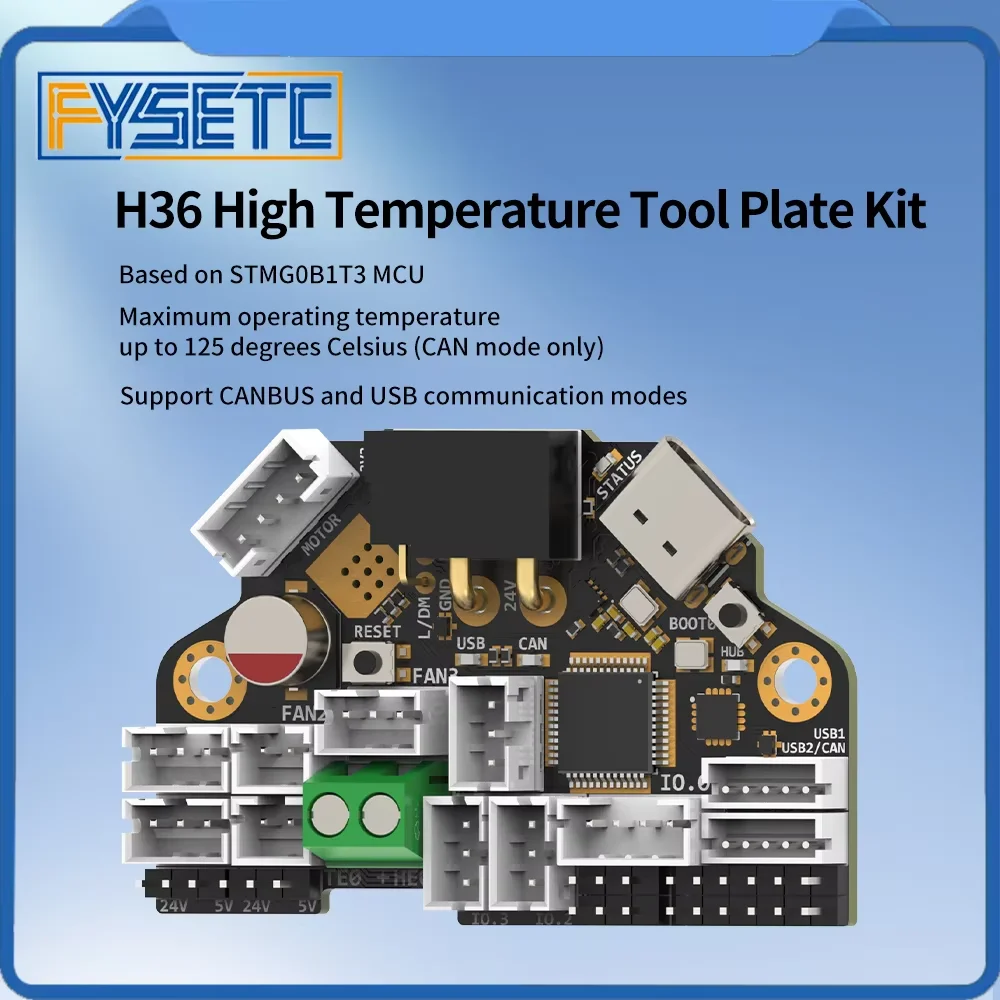
The FYSETC H36 v1.3 High Temperature Tool Plate Kit is a specialized control board designed for advanced 3D printer enthusiasts seeking to push the boundaries of extrusion systems. This board offers a robust, high-temperature tolerant solution for toolhead control, particularly valuable in enclosed, heated build chambers. Its focus on CANBUS communication and high thermal resilience sets it apart from more conventional, general-purpose tool boards. Tinkerers will find its open-source Klipper compatibility especially appealing, providing an ideal platform for custom modifications and performance tuning.
The heart of the FYSETC H36 v1.3 is the STM32G0B1T3 MCU, a powerful microcontroller underpinning its advanced capabilities. This specific chip choice indicates a commitment to reliable processing and efficient operation, crucial for precise motor control and sensor feedback in demanding 3D printing applications. High-speed calculations are essential for Klipper firmware, allowing for complex motion planning and real-time adjustments that improve print quality and speed. The microcontroller's robust design ensures consistent performance even under strenuous workloads.
This board boasts a maximum operating temperature of up to 125 degrees Celsius when utilizing CAN mode. This extreme heat resistance directly addresses a significant pain point for advanced users: maintaining stable electronics within actively heated build enclosures, common for printing high-performance engineering plastics like ABS, ASA, Nylon, or polycarbonate. These materials require elevated ambient temperatures to prevent warping and ensure proper layer adhesion, conditions that can quickly degrade or cause failures in generic tool boards. This resilience prevents thermal runaway errors and component degradation.
Unlike standard tool boards often limited to 60-80°C, the H36 v1.3's enhanced thermal tolerance provides a distinct advantage. This allows for sustained, high-temperature printing without compromising the integrity or performance of the toolhead electronics, a common bottleneck for high-performance builds. For those constantly battling heat creep or seeking to optimize their printer for advanced materials, this feature alone represents a substantial upgrade, enabling consistent, high-quality output even in thermally challenging environments. The board simply performs.
Communication flexibility is a cornerstone of the H36 v1.3, offering both CANBUS and USB communication modes. The inclusion of CANBUS is particularly noteworthy for the maker community, offering a modern, robust, and scalable solution for toolhead communication. CANBUS significantly reduces wiring complexity, replacing numerous individual wires with a single twisted pair for power and data, simplifying cable management for any build.
The implications of CANBUS for a tinkerer are profound. Reduced wire bulk means less drag on the printhead, potentially improving acceleration and print quality by minimizing moving mass. It also offers superior noise immunity compared to traditional ribbon cables, which can be susceptible to electromagnetic interference from stepper motors, heaters, and fans. This results in more reliable data transmission, a critical factor for consistent print performance and preventing communication errors that lead to print failures. Data integrity is paramount.
Conventional USB connections, while ubiquitous, often introduce limitations in cable length and susceptibility to electrical noise over longer runs, making them less ideal for large-format printers. The CANBUS alternative, by contrast, supports much longer cable lengths and provides a more resilient data link, making it ideal for larger printers or setups where the control board is situated further from the toolhead. This allows for greater flexibility in machine design and component placement, a boon for custom builds and future expansions without extensive rewiring. It is a cleaner solution.
Integrated TMC2209 stepper motor drivers handle the extrusion motor, ensuring smooth and silent operation. The TMC2209 drivers are widely respected in the 3D printing community for their quiet performance and advanced features like StealthChop2 for silent movement and SpreadCycle for dynamic motor control, which contribute to high-quality prints and reduced motor noise. This eliminates the need for external stepper drivers on the toolhead, streamlining design.
The board's compatibility with NEMA14/36mm motors directly targets popular direct-drive extruder setups. These compact motors are favored for their light weight, which minimizes inertia on the printhead, allowing for faster accelerations and decelerations without introducing ringing or ghosting artifacts. The direct integration of the driver and motor support on the tool board simplifies wiring and mechanical assembly, leading to a more compact and efficient toolhead design. Less weight means faster prints.
Compared to systems relying on Bowden extruders or heavier NEMA17 motors on the toolhead, the H36 v1.3, when paired with a NEMA14/36mm motor, facilitates a lighter, more agile printhead. This setup is particularly beneficial for high-speed printing and achieving finer detail, as it reduces the moving mass that the printer's motion system must contend with. Such optimization is key for competitive printing performance and pushing the limits of print speed and quality. This enables superior motion.
The FYSETC H36 v1.3 provides a comprehensive array of input and output options, crucial for customization and advanced sensor integration. It includes multiple fan headers (Fan1, Fan2, Fan3), each capable of supplying up to 0.5A, and a higher-power Fan4 (up to 1.5A). This generous allocation allows for dedicated part cooling fans, hotend cooling, and even auxiliary enclosure ventilation, all controlled directly from the tool board. Precise cooling is critical.
Beyond fans, the board offers multiple IO pins (IO0+4, IO0+2, IO0+1), which are invaluable for tinkerers. These pins can be configured for various functions, such as connecting inductive probes for bed leveling, optical endstops for precise homing, custom LEDs for toolhead illumination, or even a nozzle camera for remote monitoring. The flexibility of these general-purpose inputs and outputs allows for a high degree of personalization, letting users integrate unique features into their printer builds without external boards. Customization is simplified.
Standard tool boards often offer a more limited selection of IO, forcing users to compromise on sensor choices or rely on external breakout boards, adding complexity and bulk. The H36 v1.3's expanded IO capabilities ensure that builders are not constrained by the board's design when implementing advanced features like automated bed leveling with specific probe types (e.g., Klicky probe) or custom filament runout sensors. This makes it a more future-proof and adaptable solution for evolving printer designs. It's truly versatile hardware.
Running Klipper firmware is a fundamental aspect of the FYSETC H36 v1.3's appeal. Klipper is an open-source 3D printer firmware that offloads complex motion planning calculations from the printer's mainboard to a more powerful host computer (like a Raspberry Pi). This architecture allows for significantly higher step rates and more precise control, leading to smoother movements and potentially faster print speeds. It truly unlocks performance.
For the community-driven tinkerer, Klipper offers unparalleled flexibility and control over printer kinematics. Its configuration is handled via a simple text file, making it easy to experiment with different settings, fine-tune performance, and integrate custom macros for specific tasks. The Klipper ecosystem is vast, with an active community constantly developing new features and offering extensive troubleshooting support, making it an ideal platform for continuous improvement and learning. Community support is strong.
Many entry-level boards come with proprietary firmware or older Marlin versions that lack Klipper's advanced capabilities and open-source modding potential. The H36 v1.3's native Klipper compatibility means users can immediately tap into this powerful ecosystem, unlocking advanced features like input shaping (to reduce ringing artifacts), pressure advance (for consistent extrusion), and precise temperature control. This is not just a feature; it's a gateway to advanced printer optimization and a vibrant community of fellow makers. It's an essential upgrade.
The design of the FYSETC H36 v1.3 prioritizes ease of installation, making it suitable for 36-round motors and not limited by extruder head model. This thoughtful design simplifies the upgrade process for many existing direct-drive setups, allowing for a quick swap or integration into new builds. The compact form factor and clear labeling of connectors facilitate quick and efficient assembly, reducing potential wiring errors and setup headaches. Installation is straightforward.
The ability to integrate seamlessly with various extruder head models is a significant advantage. It means users are not locked into a specific brand or design, encouraging experimentation with different hotends (like V6, Rapido, Dragon), nozzles, and extruder gears without needing to adapt the electronics. This adaptability is crucial for the maker who frequently tests new components or designs custom extrusion systems, offering unparalleled freedom. It's a truly versatile piece of hardware.
Unlike some specialized tool boards that require specific mounting plates or proprietary connectors, the H36 v1.3's broad compatibility ensures a smoother integration experience. This reduces the need for extensive modifications or custom-fabricated parts during installation, allowing tinkerers to focus more on tuning their printer's performance rather than battling compatibility issues. The mechanical and electrical interfaces are designed for universal application within its motor class. This saves valuable time.
This tool board represents a significant step up for anyone serious about optimizing their 3D printer for performance and reliability, especially in high-temperature scenarios. Its robust design and Klipper-centric approach empower users to achieve print quality and speed often reserved for much more expensive, integrated systems. The investment in a board like the H36 v1.3 is an investment in future-proofing a printer's capabilities and expanding its material versatility. It's a smart upgrade.
The value derived from its thermal resilience and CANBUS integration far outweighs the initial cost for the target user. Imagine printing exotic materials like ULTEM or PEEK in a 70°C enclosure, knowing your tool board electronics are not just surviving but thriving, maintaining optimal performance. This peace of mind allows for consistent, high-quality output, reducing failed prints and wasted filament, ultimately saving money and frustration in the long run. The board simply performs.
This board isn't merely a component; it's a foundation for innovation. With its high-temperature tolerance, efficient CANBUS communication, and Klipper compatibility, builders gain the freedom to experiment with advanced materials, push print speeds, and integrate custom functionalities without being held back by electrical or thermal limitations. Envision your printer, not just printing, but excelling with every complex part you design, opening up new possibilities for creation and precision.
Engineering for Extreme Environments
The heart of the FYSETC H36 v1.3 is the STM32G0B1T3 MCU, a powerful microcontroller underpinning its advanced capabilities. This specific chip choice indicates a commitment to reliable processing and efficient operation, crucial for precise motor control and sensor feedback in demanding 3D printing applications. High-speed calculations are essential for Klipper firmware, allowing for complex motion planning and real-time adjustments that improve print quality and speed. The microcontroller's robust design ensures consistent performance even under strenuous workloads.
This board boasts a maximum operating temperature of up to 125 degrees Celsius when utilizing CAN mode. This extreme heat resistance directly addresses a significant pain point for advanced users: maintaining stable electronics within actively heated build enclosures, common for printing high-performance engineering plastics like ABS, ASA, Nylon, or polycarbonate. These materials require elevated ambient temperatures to prevent warping and ensure proper layer adhesion, conditions that can quickly degrade or cause failures in generic tool boards. This resilience prevents thermal runaway errors and component degradation.
Unlike standard tool boards often limited to 60-80°C, the H36 v1.3's enhanced thermal tolerance provides a distinct advantage. This allows for sustained, high-temperature printing without compromising the integrity or performance of the toolhead electronics, a common bottleneck for high-performance builds. For those constantly battling heat creep or seeking to optimize their printer for advanced materials, this feature alone represents a substantial upgrade, enabling consistent, high-quality output even in thermally challenging environments. The board simply performs.
Connectivity and Communication Excellence
Communication flexibility is a cornerstone of the H36 v1.3, offering both CANBUS and USB communication modes. The inclusion of CANBUS is particularly noteworthy for the maker community, offering a modern, robust, and scalable solution for toolhead communication. CANBUS significantly reduces wiring complexity, replacing numerous individual wires with a single twisted pair for power and data, simplifying cable management for any build.
The implications of CANBUS for a tinkerer are profound. Reduced wire bulk means less drag on the printhead, potentially improving acceleration and print quality by minimizing moving mass. It also offers superior noise immunity compared to traditional ribbon cables, which can be susceptible to electromagnetic interference from stepper motors, heaters, and fans. This results in more reliable data transmission, a critical factor for consistent print performance and preventing communication errors that lead to print failures. Data integrity is paramount.
Conventional USB connections, while ubiquitous, often introduce limitations in cable length and susceptibility to electrical noise over longer runs, making them less ideal for large-format printers. The CANBUS alternative, by contrast, supports much longer cable lengths and provides a more resilient data link, making it ideal for larger printers or setups where the control board is situated further from the toolhead. This allows for greater flexibility in machine design and component placement, a boon for custom builds and future expansions without extensive rewiring. It is a cleaner solution.
Precision Motor Control
Integrated TMC2209 stepper motor drivers handle the extrusion motor, ensuring smooth and silent operation. The TMC2209 drivers are widely respected in the 3D printing community for their quiet performance and advanced features like StealthChop2 for silent movement and SpreadCycle for dynamic motor control, which contribute to high-quality prints and reduced motor noise. This eliminates the need for external stepper drivers on the toolhead, streamlining design.
The board's compatibility with NEMA14/36mm motors directly targets popular direct-drive extruder setups. These compact motors are favored for their light weight, which minimizes inertia on the printhead, allowing for faster accelerations and decelerations without introducing ringing or ghosting artifacts. The direct integration of the driver and motor support on the tool board simplifies wiring and mechanical assembly, leading to a more compact and efficient toolhead design. Less weight means faster prints.
Compared to systems relying on Bowden extruders or heavier NEMA17 motors on the toolhead, the H36 v1.3, when paired with a NEMA14/36mm motor, facilitates a lighter, more agile printhead. This setup is particularly beneficial for high-speed printing and achieving finer detail, as it reduces the moving mass that the printer's motion system must contend with. Such optimization is key for competitive printing performance and pushing the limits of print speed and quality. This enables superior motion.
Expanding Possibilities: Input and Output
The FYSETC H36 v1.3 provides a comprehensive array of input and output options, crucial for customization and advanced sensor integration. It includes multiple fan headers (Fan1, Fan2, Fan3), each capable of supplying up to 0.5A, and a higher-power Fan4 (up to 1.5A). This generous allocation allows for dedicated part cooling fans, hotend cooling, and even auxiliary enclosure ventilation, all controlled directly from the tool board. Precise cooling is critical.
Beyond fans, the board offers multiple IO pins (IO0+4, IO0+2, IO0+1), which are invaluable for tinkerers. These pins can be configured for various functions, such as connecting inductive probes for bed leveling, optical endstops for precise homing, custom LEDs for toolhead illumination, or even a nozzle camera for remote monitoring. The flexibility of these general-purpose inputs and outputs allows for a high degree of personalization, letting users integrate unique features into their printer builds without external boards. Customization is simplified.
Standard tool boards often offer a more limited selection of IO, forcing users to compromise on sensor choices or rely on external breakout boards, adding complexity and bulk. The H36 v1.3's expanded IO capabilities ensure that builders are not constrained by the board's design when implementing advanced features like automated bed leveling with specific probe types (e.g., Klicky probe) or custom filament runout sensors. This makes it a more future-proof and adaptable solution for evolving printer designs. It's truly versatile hardware.
Klipper Firmware: The Tinkerer's OS
Running Klipper firmware is a fundamental aspect of the FYSETC H36 v1.3's appeal. Klipper is an open-source 3D printer firmware that offloads complex motion planning calculations from the printer's mainboard to a more powerful host computer (like a Raspberry Pi). This architecture allows for significantly higher step rates and more precise control, leading to smoother movements and potentially faster print speeds. It truly unlocks performance.
For the community-driven tinkerer, Klipper offers unparalleled flexibility and control over printer kinematics. Its configuration is handled via a simple text file, making it easy to experiment with different settings, fine-tune performance, and integrate custom macros for specific tasks. The Klipper ecosystem is vast, with an active community constantly developing new features and offering extensive troubleshooting support, making it an ideal platform for continuous improvement and learning. Community support is strong.
Many entry-level boards come with proprietary firmware or older Marlin versions that lack Klipper's advanced capabilities and open-source modding potential. The H36 v1.3's native Klipper compatibility means users can immediately tap into this powerful ecosystem, unlocking advanced features like input shaping (to reduce ringing artifacts), pressure advance (for consistent extrusion), and precise temperature control. This is not just a feature; it's a gateway to advanced printer optimization and a vibrant community of fellow makers. It's an essential upgrade.
Streamlined Integration and Setup
The design of the FYSETC H36 v1.3 prioritizes ease of installation, making it suitable for 36-round motors and not limited by extruder head model. This thoughtful design simplifies the upgrade process for many existing direct-drive setups, allowing for a quick swap or integration into new builds. The compact form factor and clear labeling of connectors facilitate quick and efficient assembly, reducing potential wiring errors and setup headaches. Installation is straightforward.
The ability to integrate seamlessly with various extruder head models is a significant advantage. It means users are not locked into a specific brand or design, encouraging experimentation with different hotends (like V6, Rapido, Dragon), nozzles, and extruder gears without needing to adapt the electronics. This adaptability is crucial for the maker who frequently tests new components or designs custom extrusion systems, offering unparalleled freedom. It's a truly versatile piece of hardware.
Unlike some specialized tool boards that require specific mounting plates or proprietary connectors, the H36 v1.3's broad compatibility ensures a smoother integration experience. This reduces the need for extensive modifications or custom-fabricated parts during installation, allowing tinkerers to focus more on tuning their printer's performance rather than battling compatibility issues. The mechanical and electrical interfaces are designed for universal application within its motor class. This saves valuable time.
The Maker's Advantage
This tool board represents a significant step up for anyone serious about optimizing their 3D printer for performance and reliability, especially in high-temperature scenarios. Its robust design and Klipper-centric approach empower users to achieve print quality and speed often reserved for much more expensive, integrated systems. The investment in a board like the H36 v1.3 is an investment in future-proofing a printer's capabilities and expanding its material versatility. It's a smart upgrade.
The value derived from its thermal resilience and CANBUS integration far outweighs the initial cost for the target user. Imagine printing exotic materials like ULTEM or PEEK in a 70°C enclosure, knowing your tool board electronics are not just surviving but thriving, maintaining optimal performance. This peace of mind allows for consistent, high-quality output, reducing failed prints and wasted filament, ultimately saving money and frustration in the long run. The board simply performs.
This board isn't merely a component; it's a foundation for innovation. With its high-temperature tolerance, efficient CANBUS communication, and Klipper compatibility, builders gain the freedom to experiment with advanced materials, push print speeds, and integrate custom functionalities without being held back by electrical or thermal limitations. Envision your printer, not just printing, but excelling with every complex part you design, opening up new possibilities for creation and precision.