FOTEK Single Phase Solid State Relay (SSR) Module
Official Store Deal
Expert Analysis Overview
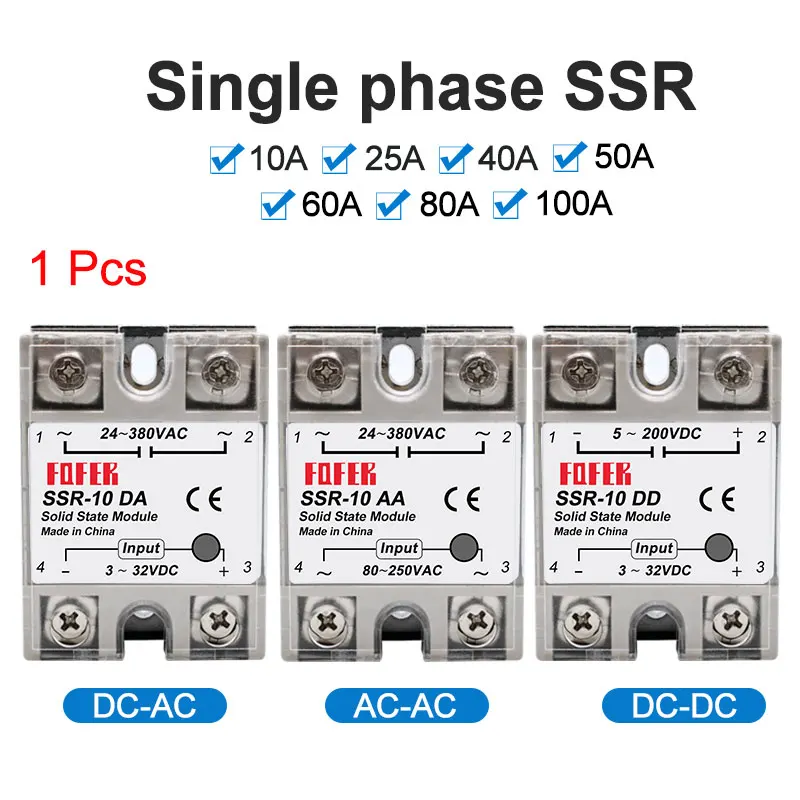
The FOTEK Single Phase Solid State Relay (SSR) Module is a critical component for precise and reliable electrical switching, designed for industrial and automation applications demanding high-speed, silent, and long-lasting operation. This range of SSRs offers various configurations, including DC-AC (DA), AC-AC (AA), and DC-DC (DD) models, catering to diverse control and load voltage requirements. Unlike traditional electromechanical relays prone to contact wear and arcing, these solid state modules provide a non-contact switching solution, significantly enhancing system longevity and operational stability. The visible CE certification indicates adherence to European safety and performance standards, a crucial consideration for professional electrical installations.
The FOTEK SSR modules are available in three primary configurations: SSR-DA (DC-AC), SSR-AA (AC-AC), and SSR-DD (DC-DC). Each type is engineered for specific input and output voltage characteristics, ensuring compatibility with a wide array of control systems and load types. The SSR-DA and SSR-DD models accept a control voltage range of 3-32VDC, making them ideal for integration with low-voltage control circuits such as PLCs, microcontrollers, or DC power supplies. The SSR-AA variant, conversely, is designed for AC control, accepting 80-250VAC input, which is suitable for systems utilizing line voltage for control signals. This versatility allows electricians to select the precise relay type for their specific application, optimizing both control signal compatibility and load management.
These relays are not just simple switches. They represent a significant upgrade in control technology. The control current for all models is specified at 5-20mA, indicating a low power draw on the control circuit, which is beneficial for sensitive electronics and power-efficient designs. This minimal current requirement ensures that the control signal itself does not impose undue stress on the driving circuitry. The ability to handle various control inputs means these SSRs can be seamlessly integrated into existing and new electrical systems, providing a robust interface between low-power control logic and high-power loads. This is a key advantage in complex automation setups.
Compared to standard electromechanical relays, which rely on physical contacts that can degrade over time, SSRs offer superior switching speed and an extended operational lifespan. The absence of moving parts eliminates mechanical wear, contact bounce, and the associated electrical noise. This non-contact operation translates directly into reduced maintenance requirements and increased reliability, particularly in applications involving frequent switching cycles. For instance, in heating control systems or motor start/stop sequences, the rapid and silent switching of an SSR far surpasses the capabilities and endurance of a mechanical counterpart, preventing costly downtime.
The physical construction of the FOTEK SSR modules, as observed, features a robust grey housing with clear terminal covers, indicating a design focused on both protection and ease of inspection. The dimensions of approximately 45mm x 62mm x 24mm suggest a compact form factor, allowing for efficient use of space within control panels and enclosures. The screw terminals are clearly labeled for input and output connections, facilitating straightforward wiring. Proper terminal tightening is essential for safe operation.
While the housing provides a degree of protection, the nature of solid-state switching inherently generates heat, especially under higher load currents. The specification of a maximum on-state voltage drop of <1.6V is critical; this voltage drop across the internal semiconductor switch, when multiplied by the load current, determines the power dissipated as heat. For example, a 40A relay operating at full load would dissipate approximately 64 watts (1.6V * 40A), which is a substantial amount of heat requiring active management. This heat must be effectively dissipated to prevent thermal runaway and premature device failure.
Unlike lower-current relays, these higher-amperage SSRs (10A to 100A) necessitate the use of an external heatsink. The visible mounting holes on the base of the relay are designed for secure attachment to a heatsink, which then transfers the generated heat away from the semiconductor junction. Neglecting proper thermal management is a common cause of SSR failure and can lead to dangerous overheating. Therefore, when specifying these relays, electricians must factor in the appropriate heatsink size and, for higher current applications, potentially forced-air cooling to maintain the operating temperature within the specified -30°C to 40°C range. This ensures the relay's long-term reliability and prevents thermal degradation.
The presence of the CE mark on the FOTEK SSR modules signifies compliance with European health, safety, and environmental protection standards. This certification is a fundamental indicator of product quality and safety, particularly for electrical components that handle significant power. For professional installations, using CE-certified components is often a regulatory requirement and always a best practice, ensuring that the device has undergone necessary testing and meets stringent performance criteria. This provides assurance regarding the product's fundamental design and manufacturing quality.
Electrical integrity is further underscored by the specified maximum off-state leakage current of <5mA. This low leakage current is crucial for safety, as it minimizes the current flowing through the load when the relay is in the 'off' state. While a small leakage current is inherent in solid-state devices, keeping it below 5mA ensures that most loads will not inadvertently activate or experience residual power when they are supposed to be completely de-energized. This is particularly important for sensitive equipment or safety-critical applications where unintended activation could pose a hazard. A low leakage current prevents phantom power issues.
Proper selection of the SSR based on the load voltage and current is paramount for safety and performance. The load voltage ranges, such as 24-380VAC for AC models and 5-200VDC for DC models, must be strictly adhered to. Over-voltage conditions can lead to immediate failure, while under-voltage might prevent proper operation. Similarly, selecting an SSR with an appropriate current rating, ideally with a safety margin above the continuous operating current of the load, prevents overloading and excessive heat generation. This careful matching of relay specifications to application requirements is a cornerstone of safe and reliable electrical system design, preventing potential electrical fires and ensuring the longevity of both the relay and the connected equipment.
These single-phase solid state relays find extensive use across various industrial and commercial applications where precise and reliable switching of AC or DC loads is required. Common applications include temperature control systems for ovens, incubators, and plastic molding machines, where rapid and accurate heating element switching is essential to maintain tight temperature tolerances. The silent operation of SSRs is also highly valued in environments sensitive to noise, such as medical equipment or office automation. This makes them suitable for diverse settings.
Another significant application area is motor control, particularly for frequent start/stop operations of small to medium-sized motors. While larger motors typically use contactors, SSRs are excellent for precise control of smaller motors, pumps, or fans, offering extended life compared to mechanical contactors in high-cycle applications. Their ability to switch at the zero-crossing point of the AC waveform (for AC models) also helps to reduce electrical noise and surge currents, protecting both the load and the power supply. This zero-crossing feature is a subtle but powerful benefit.
Furthermore, these SSRs are indispensable in lighting control systems, especially for dimming or switching high-power lighting arrays, and in power supply switching for various electronic equipment. The broad range of current ratings, from 10A up to 100A, means that a suitable FOTEK SSR can be selected for loads ranging from small resistive heaters to more substantial inductive loads, provided appropriate derating and thermal management are applied. This flexibility makes them a go-to component for electricians designing robust and efficient control circuits, offering a reliable alternative to traditional switching methods.
Correct installation is paramount for the safe and effective operation of any solid state relay. The four screw terminals are clearly marked for input (control) and output (load) connections, simplifying the wiring process. However, electricians must ensure that the correct polarity is observed for DC control and DC load models to prevent damage. The input terminals (typically 3 and 4) connect to the control circuit, while the output terminals (1 and 2) connect in series with the load and the power source. Wire gauge selection is critical.
For the load connections, it is imperative to use wire gauges that are appropriately rated for the maximum continuous load current the SSR will handle. Undersized wiring can lead to overheating, insulation breakdown, and potential fire hazards. The use of crimped spade or ring terminals is recommended for secure connections to the screw terminals, ensuring low resistance and preventing loose wires. A loose connection can cause arcing and localized heating, compromising the integrity of the circuit. This attention to detail is non-negotiable.
Beyond wiring, the physical mounting of the SSR, particularly its attachment to a heatsink, requires careful attention. The base of the SSR must make firm, flat contact with the heatsink, often with the aid of thermal paste to maximize heat transfer efficiency. The heatsink itself must be adequately sized for the relay's current rating and ambient operating temperature. Failure to provide sufficient cooling will inevitably lead to premature failure of the SSR, regardless of its electrical specifications. Integrating these SSRs into a control panel requires careful planning for airflow and heat dissipation, ensuring the entire system operates within safe temperature limits for optimal performance and longevity.
The inherent design of solid state relays, lacking moving parts, contributes significantly to their long-term reliability and reduced maintenance requirements compared to electromechanical relays. The absence of mechanical wear means there are no contacts to pit, arc, or fuse, which are common failure modes for traditional relays, especially in high-cycle applications. This translates into a much longer operational life, often measured in millions of cycles, making them a cost-effective solution over the lifespan of an industrial system. This durability is a major selling point.
While SSRs are generally maintenance-free, periodic inspection of the wiring connections and the heatsink for dust accumulation is advisable. Dust can impede airflow and reduce the heatsink's efficiency, leading to higher operating temperatures. Ensuring that the control voltage remains within the specified range is also important, as out-of-spec control signals can lead to erratic behavior or damage. The robust design, coupled with proper installation and thermal management, ensures that these FOTEK SSRs will provide years of trouble-free service.
Imagine a control system operating with unwavering precision, where every switch is executed silently and reliably, day in and day out. These FOTEK SSR modules enable such a reality, providing the backbone for efficient automation and robust power management. Investing in these relays means securing a future of stable operations, reduced downtime, and enhanced safety for your electrical infrastructure, allowing you to focus on productivity rather than constant maintenance. This is the capability these modules deliver.
Core Switching Capabilities
The FOTEK SSR modules are available in three primary configurations: SSR-DA (DC-AC), SSR-AA (AC-AC), and SSR-DD (DC-DC). Each type is engineered for specific input and output voltage characteristics, ensuring compatibility with a wide array of control systems and load types. The SSR-DA and SSR-DD models accept a control voltage range of 3-32VDC, making them ideal for integration with low-voltage control circuits such as PLCs, microcontrollers, or DC power supplies. The SSR-AA variant, conversely, is designed for AC control, accepting 80-250VAC input, which is suitable for systems utilizing line voltage for control signals. This versatility allows electricians to select the precise relay type for their specific application, optimizing both control signal compatibility and load management.
These relays are not just simple switches. They represent a significant upgrade in control technology. The control current for all models is specified at 5-20mA, indicating a low power draw on the control circuit, which is beneficial for sensitive electronics and power-efficient designs. This minimal current requirement ensures that the control signal itself does not impose undue stress on the driving circuitry. The ability to handle various control inputs means these SSRs can be seamlessly integrated into existing and new electrical systems, providing a robust interface between low-power control logic and high-power loads. This is a key advantage in complex automation setups.
Compared to standard electromechanical relays, which rely on physical contacts that can degrade over time, SSRs offer superior switching speed and an extended operational lifespan. The absence of moving parts eliminates mechanical wear, contact bounce, and the associated electrical noise. This non-contact operation translates directly into reduced maintenance requirements and increased reliability, particularly in applications involving frequent switching cycles. For instance, in heating control systems or motor start/stop sequences, the rapid and silent switching of an SSR far surpasses the capabilities and endurance of a mechanical counterpart, preventing costly downtime.
Structural Integrity and Thermal Management
The physical construction of the FOTEK SSR modules, as observed, features a robust grey housing with clear terminal covers, indicating a design focused on both protection and ease of inspection. The dimensions of approximately 45mm x 62mm x 24mm suggest a compact form factor, allowing for efficient use of space within control panels and enclosures. The screw terminals are clearly labeled for input and output connections, facilitating straightforward wiring. Proper terminal tightening is essential for safe operation.
While the housing provides a degree of protection, the nature of solid-state switching inherently generates heat, especially under higher load currents. The specification of a maximum on-state voltage drop of <1.6V is critical; this voltage drop across the internal semiconductor switch, when multiplied by the load current, determines the power dissipated as heat. For example, a 40A relay operating at full load would dissipate approximately 64 watts (1.6V * 40A), which is a substantial amount of heat requiring active management. This heat must be effectively dissipated to prevent thermal runaway and premature device failure.
Unlike lower-current relays, these higher-amperage SSRs (10A to 100A) necessitate the use of an external heatsink. The visible mounting holes on the base of the relay are designed for secure attachment to a heatsink, which then transfers the generated heat away from the semiconductor junction. Neglecting proper thermal management is a common cause of SSR failure and can lead to dangerous overheating. Therefore, when specifying these relays, electricians must factor in the appropriate heatsink size and, for higher current applications, potentially forced-air cooling to maintain the operating temperature within the specified -30°C to 40°C range. This ensures the relay's long-term reliability and prevents thermal degradation.
Safety Compliance and Electrical Integrity
The presence of the CE mark on the FOTEK SSR modules signifies compliance with European health, safety, and environmental protection standards. This certification is a fundamental indicator of product quality and safety, particularly for electrical components that handle significant power. For professional installations, using CE-certified components is often a regulatory requirement and always a best practice, ensuring that the device has undergone necessary testing and meets stringent performance criteria. This provides assurance regarding the product's fundamental design and manufacturing quality.
Electrical integrity is further underscored by the specified maximum off-state leakage current of <5mA. This low leakage current is crucial for safety, as it minimizes the current flowing through the load when the relay is in the 'off' state. While a small leakage current is inherent in solid-state devices, keeping it below 5mA ensures that most loads will not inadvertently activate or experience residual power when they are supposed to be completely de-energized. This is particularly important for sensitive equipment or safety-critical applications where unintended activation could pose a hazard. A low leakage current prevents phantom power issues.
Proper selection of the SSR based on the load voltage and current is paramount for safety and performance. The load voltage ranges, such as 24-380VAC for AC models and 5-200VDC for DC models, must be strictly adhered to. Over-voltage conditions can lead to immediate failure, while under-voltage might prevent proper operation. Similarly, selecting an SSR with an appropriate current rating, ideally with a safety margin above the continuous operating current of the load, prevents overloading and excessive heat generation. This careful matching of relay specifications to application requirements is a cornerstone of safe and reliable electrical system design, preventing potential electrical fires and ensuring the longevity of both the relay and the connected equipment.
Application Versatility in Industrial Settings
These single-phase solid state relays find extensive use across various industrial and commercial applications where precise and reliable switching of AC or DC loads is required. Common applications include temperature control systems for ovens, incubators, and plastic molding machines, where rapid and accurate heating element switching is essential to maintain tight temperature tolerances. The silent operation of SSRs is also highly valued in environments sensitive to noise, such as medical equipment or office automation. This makes them suitable for diverse settings.
Another significant application area is motor control, particularly for frequent start/stop operations of small to medium-sized motors. While larger motors typically use contactors, SSRs are excellent for precise control of smaller motors, pumps, or fans, offering extended life compared to mechanical contactors in high-cycle applications. Their ability to switch at the zero-crossing point of the AC waveform (for AC models) also helps to reduce electrical noise and surge currents, protecting both the load and the power supply. This zero-crossing feature is a subtle but powerful benefit.
Furthermore, these SSRs are indispensable in lighting control systems, especially for dimming or switching high-power lighting arrays, and in power supply switching for various electronic equipment. The broad range of current ratings, from 10A up to 100A, means that a suitable FOTEK SSR can be selected for loads ranging from small resistive heaters to more substantial inductive loads, provided appropriate derating and thermal management are applied. This flexibility makes them a go-to component for electricians designing robust and efficient control circuits, offering a reliable alternative to traditional switching methods.
Installation Considerations and System Integration
Correct installation is paramount for the safe and effective operation of any solid state relay. The four screw terminals are clearly marked for input (control) and output (load) connections, simplifying the wiring process. However, electricians must ensure that the correct polarity is observed for DC control and DC load models to prevent damage. The input terminals (typically 3 and 4) connect to the control circuit, while the output terminals (1 and 2) connect in series with the load and the power source. Wire gauge selection is critical.
For the load connections, it is imperative to use wire gauges that are appropriately rated for the maximum continuous load current the SSR will handle. Undersized wiring can lead to overheating, insulation breakdown, and potential fire hazards. The use of crimped spade or ring terminals is recommended for secure connections to the screw terminals, ensuring low resistance and preventing loose wires. A loose connection can cause arcing and localized heating, compromising the integrity of the circuit. This attention to detail is non-negotiable.
Beyond wiring, the physical mounting of the SSR, particularly its attachment to a heatsink, requires careful attention. The base of the SSR must make firm, flat contact with the heatsink, often with the aid of thermal paste to maximize heat transfer efficiency. The heatsink itself must be adequately sized for the relay's current rating and ambient operating temperature. Failure to provide sufficient cooling will inevitably lead to premature failure of the SSR, regardless of its electrical specifications. Integrating these SSRs into a control panel requires careful planning for airflow and heat dissipation, ensuring the entire system operates within safe temperature limits for optimal performance and longevity.
Long-Term Reliability and Maintenance
The inherent design of solid state relays, lacking moving parts, contributes significantly to their long-term reliability and reduced maintenance requirements compared to electromechanical relays. The absence of mechanical wear means there are no contacts to pit, arc, or fuse, which are common failure modes for traditional relays, especially in high-cycle applications. This translates into a much longer operational life, often measured in millions of cycles, making them a cost-effective solution over the lifespan of an industrial system. This durability is a major selling point.
While SSRs are generally maintenance-free, periodic inspection of the wiring connections and the heatsink for dust accumulation is advisable. Dust can impede airflow and reduce the heatsink's efficiency, leading to higher operating temperatures. Ensuring that the control voltage remains within the specified range is also important, as out-of-spec control signals can lead to erratic behavior or damage. The robust design, coupled with proper installation and thermal management, ensures that these FOTEK SSRs will provide years of trouble-free service.
Imagine a control system operating with unwavering precision, where every switch is executed silently and reliably, day in and day out. These FOTEK SSR modules enable such a reality, providing the backbone for efficient automation and robust power management. Investing in these relays means securing a future of stable operations, reduced downtime, and enhanced safety for your electrical infrastructure, allowing you to focus on productivity rather than constant maintenance. This is the capability these modules deliver.