FNIRSI LCR-P1 Component Tester
Official Store Deal
Expert Analysis Overview
Precision Diagnostics: The FNIRSI LCR-P1 Advantage
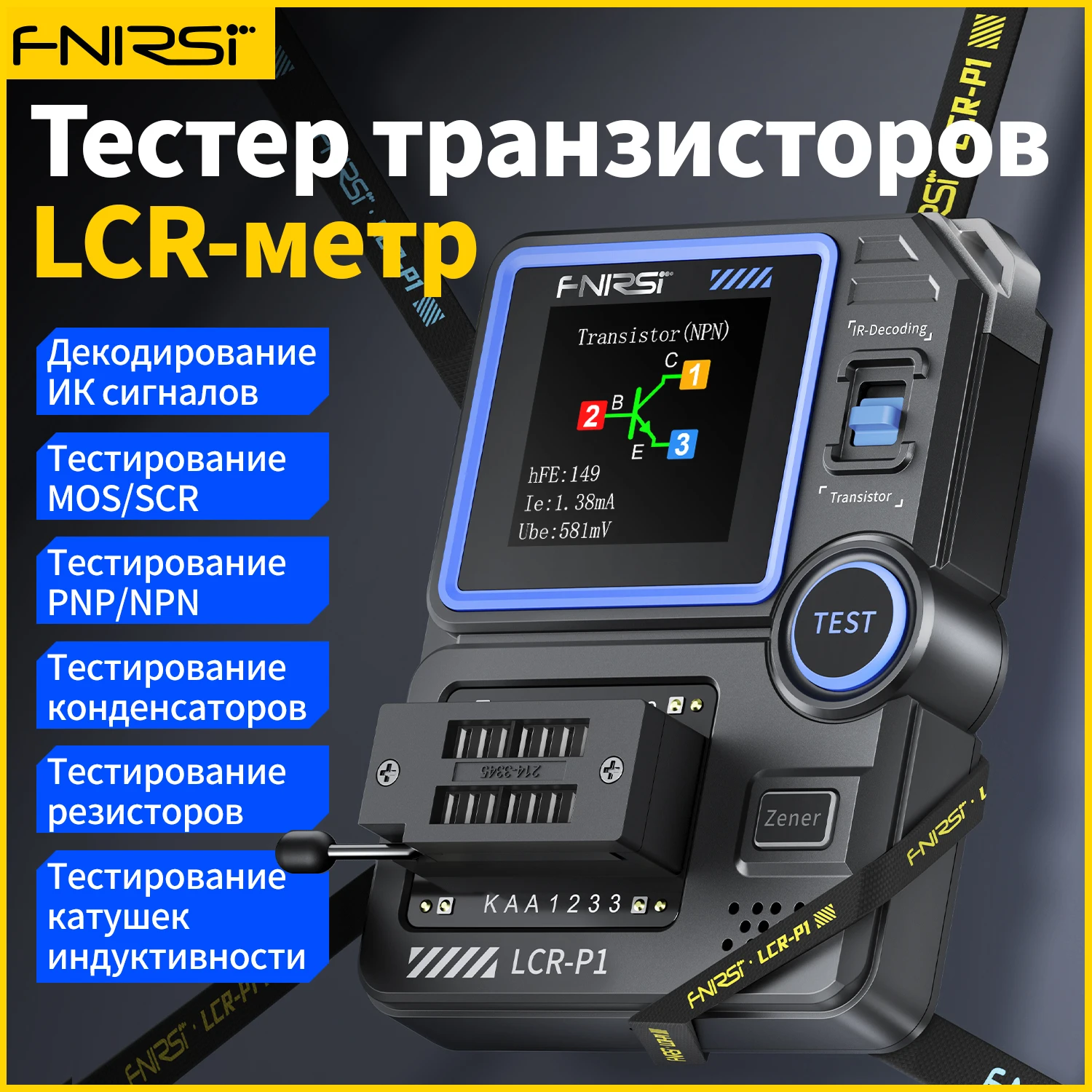
The FNIRSI LCR-P1 is a highly capable, compact component tester engineered for electronics enthusiasts and professionals demanding rapid, accurate diagnostics of a wide array of electronic components. This device streamlines the often-tedious process of identifying and verifying transistors, capacitors, resistors, inductors, and diodes, making it an indispensable tool for troubleshooting and circuit development. Its design prioritizes both precision and user convenience, offering a significant upgrade over traditional, less specialized testing methods.Traditional multimeters often provide only basic measurements, requiring manual calculation and interpretation for component identification. The LCR-P1, conversely, automatically recognizes component types and pin configurations, presenting clear, actionable data directly on its display. This capability drastically reduces diagnostic time and minimizes potential errors, allowing users to focus on the repair or design task at hand rather than wrestling with complex test procedures. It is a time-saver.
Compared to entry-level component testers that might offer limited functionality or slower processing, the LCR-P1 stands out with its comprehensive testing suite and intelligent automation. The device's ability to decode IR signals, for instance, extends its utility beyond passive and active component testing, offering a valuable diagnostic feature for remote controls and other infrared-controlled systems. This broadens its application scope considerably, making it a more versatile investment for any electronics workbench.
Unveiling Component Integrity: Transistors, Capacitors, and Beyond
The LCR-P1 provides detailed analysis for a broad spectrum of components. It accurately identifies and measures NPN and PNP bipolar junction transistors (BJTs), N-channel and P-channel MOSFETs, JFETs, diodes, and SCRs. For each active component, the tester displays critical parameters such as gain (hFE), leakage current, and forward voltage drop, offering a complete picture of its operational health. This is crucial for performance.Understanding these parameters is vital for circuit design and repair. A transistor's hFE, for example, determines its amplification capability, while leakage current can indicate internal damage or degradation. The LCR-P1 presents this data clearly, allowing users to quickly assess if a component meets specifications or requires replacement. It simplifies complex analysis.
Many generic multimeters can test for basic continuity or resistance, but they fall short when it comes to detailed semiconductor analysis. The LCR-P1 fills this gap, providing specific, relevant data that enables precise fault isolation. This level of detail is often only available from much more expensive, dedicated test equipment, making the LCR-P1 an exceptionally cost-effective solution for advanced diagnostics.
Passive Component Precision: Resistors, Inductors, and Capacitors
Beyond semiconductors, the LCR-P1 excels in characterizing passive components. It measures resistance with high accuracy, identifies inductance values for coils and chokes, and determines capacitance for various capacitor types, including electrolytic, ceramic, and film capacitors. The device also provides equivalent series resistance (ESR) measurements for capacitors, a critical parameter for evaluating their health and performance, especially in power supply circuits. ESR is a key indicator.Accurate measurement of these passive components is fundamental to ensuring circuit stability and performance. An out-of-spec resistor can alter voltage dividers, an incorrect inductor can detune an RF circuit, and a high-ESR capacitor can lead to ripple and instability in power delivery. The LCR-P1 delivers the precision needed to catch these subtle but significant issues before they cause larger problems. It prevents costly errors.
Unlike basic LCR meters that might only provide a single value, the LCR-P1's comprehensive display and automatic identification simplify the process. Users don't need to manually select component types or ranges; the device handles it, presenting the data in an easy-to-understand format. This automation significantly speeds up the testing process, allowing for continuous component diagnostics across numerous parts without user fatigue.
Infrared Signal Decoding: Beyond Electrical Parameters
A unique feature of the LCR-P1 is its capability for infrared (IR) signal decoding. This allows the device to capture and display the protocol and data of IR remote control signals, typically based on the NEC protocol. This functionality is invaluable for troubleshooting remote controls, verifying IR transmitter operation, or even reverse-engineering IR commands for custom automation projects. It decodes quickly.Imagine a scenario where a remote control stops working, and the issue isn't obvious. Instead of guessing, the LCR-P1 can confirm if the remote is transmitting a valid IR signal, helping to differentiate between a faulty remote and a receiver problem. This diagnostic capability saves significant time and effort, preventing unnecessary component replacements. It pinpoints the fault.
Most general-purpose electronic testers do not include IR decoding functionality. This specialized feature positions the LCR-P1 as a more complete diagnostic tool for modern electronics, where IR communication is still prevalent. It adds a layer of utility that extends its value beyond purely electrical component testing, making it a versatile asset for diverse troubleshooting tasks.
Engineered for Endurance: Ruggedness and Overload Protection
The physical construction of the FNIRSI LCR-P1 suggests a design focused on durability and practical use in a workshop environment. Its compact, handheld form factor is ideal for portability, allowing technicians to carry it easily between workstations or to field service calls. The visible materials imply a robust casing, capable of withstanding the rigors of daily use. It fits in a hand.Overload protection is a critical safety and longevity feature integrated into the LCR-P1. This mechanism safeguards the internal circuitry from damage when a component with unexpected voltage or current is connected, preventing costly repairs or premature device failure. This protection ensures the tester remains reliable over its operational lifespan, even in demanding diagnostic scenarios. It protects the investment.
Unlike some delicate testing instruments that require extreme care, the LCR-P1's design and protective features suggest it is built to perform continuous component diagnostics without constant worry. This ruggedness allows users to perform multiple test sessions throughout the day, confident in the device's resilience. It is a tool for the long haul.
Modular Test Panels: Adaptability for Diverse Components
The LCR-P1 features interchangeable test panels, enhancing its versatility. The primary interface includes a Zero Insertion Force (ZIF) socket, which is ideal for quickly testing through-hole components without soldering. Additionally, test hook probes are provided, allowing for in-circuit testing or connection to surface-mount devices (SMDs) via adapter boards. This offers flexibility.The ZIF socket ensures components are inserted and removed with minimal wear, preserving both the component leads and the tester's socket over many uses. For components that cannot fit into the ZIF socket or require connection to existing circuitry, the test hooks provide a convenient and secure connection. This adaptability is key for a comprehensive testing workflow. It connects easily.
Many basic component testers offer only one method of connection, limiting their utility. The LCR-P1's modular approach, with both a ZIF socket and test hooks, means users are not restricted by component package type or testing environment. This design choice significantly broadens the range of components that can be effectively tested, making it a more adaptable and efficient tool for any electronics project.
Streamlined Operation: Automatic Recognition and Pinout Detection
One of the most significant time-saving features of the LCR-P1 is its automatic component recognition and pinout detection. Upon connecting a component and initiating a test, the device instantly identifies the component type (e.g., NPN transistor, diode, resistor) and graphically displays its pin configuration (emitter, base, collector for a transistor; anode, cathode for a diode). This saves time.This automation eliminates the need for users to consult datasheets or manually determine pin assignments, which can be a time-consuming and error-prone process, especially for unfamiliar components. The clear graphical representation on the screen provides immediate, unambiguous information, allowing for quicker diagnosis and more efficient workflow. It reduces guesswork.
Compared to older methods where technicians might spend valuable minutes identifying component leads with a multimeter, the LCR-P1 provides an instant, visual solution. This efficiency is particularly beneficial when working with a large batch of components or troubleshooting complex boards where speed is critical. It accelerates the diagnostic process, allowing users to perform continuous component diagnostics with ease.
Enduring Power for Extended Sessions
While specific battery capacity details are not explicitly listed, the compact nature and typical use case of such a device imply a focus on efficient power management. The ability to perform multiple test sessions without frequent recharging is crucial for portability and productivity in a workshop or field setting. A reliable power source ensures uninterrupted workflow. It runs efficiently.For technicians who need to diagnose electronic components throughout the day, a tester with robust battery life is essential. Frequent interruptions for charging can disrupt workflow and reduce overall efficiency. The LCR-P1's design aims to provide sufficient operational time to endure through multiple test sessions, ensuring it is ready when needed. It minimizes downtime.
Unlike devices that might drain quickly, requiring constant connection to a power source, the LCR-P1 is designed for on-the-go utility. This allows users to perform continuous component diagnostics in various locations without being tethered to an outlet. The focus on power efficiency supports its role as a portable, reliable diagnostic tool, ready for any task.