FNIRSI LC1020E Handheld LCR Digital Bridge
Official Store Deal
Expert Analysis Overview
The FNIRSI LC1020E Handheld LCR Digital Bridge is a precise diagnostic tool engineered for electronics enthusiasts, repair technicians, and quality control professionals who demand accurate component analysis. This device excels at identifying and characterizing passive electronic components, offering a robust solution for troubleshooting and verification tasks. Its design prioritizes both portability and comprehensive measurement capabilities, making it an indispensable asset for maintaining the integrity of electronic systems.
This LCR meter provides a comprehensive suite of measurements, including inductance (L), capacitance (C), resistance (R), and impedance (Z). The large, clear display presents these primary parameters with exceptional clarity. Users gain immediate insight into the fundamental electrical properties of a component.
Beyond basic values, the LC1020E also measures secondary parameters such as reactance (X), dissipation factor (D), quality factor (Q), and Equivalent Series Resistance (ESR). These advanced metrics are crucial for a thorough understanding of component performance, especially in resonant circuits or power supply filtering applications. A simple press of a button cycles through these detailed readings.
Compared to simpler multimeters that only offer basic resistance and capacitance checks, this dedicated LCR meter provides a far more granular and accurate assessment. It offers the depth required for professional diagnostics, moving beyond mere continuity tests.
Accuracy is paramount in component testing. The LC1020E boasts a basic accuracy of up to 0.05%, a significant improvement over many entry-level devices. This level of precision ensures that critical component values are determined with high confidence.
Such high precision is vital when dealing with tight tolerance components or when matching parts for sensitive circuits. Even minute deviations can impact circuit performance. The device provides reliable data for critical decisions.
Standard handheld meters often struggle to achieve this level of accuracy, frequently exhibiting deviations that can lead to misdiagnosis or incorrect component selection. The FNIRSI LC1020E positions itself as a superior alternative for demanding applications.
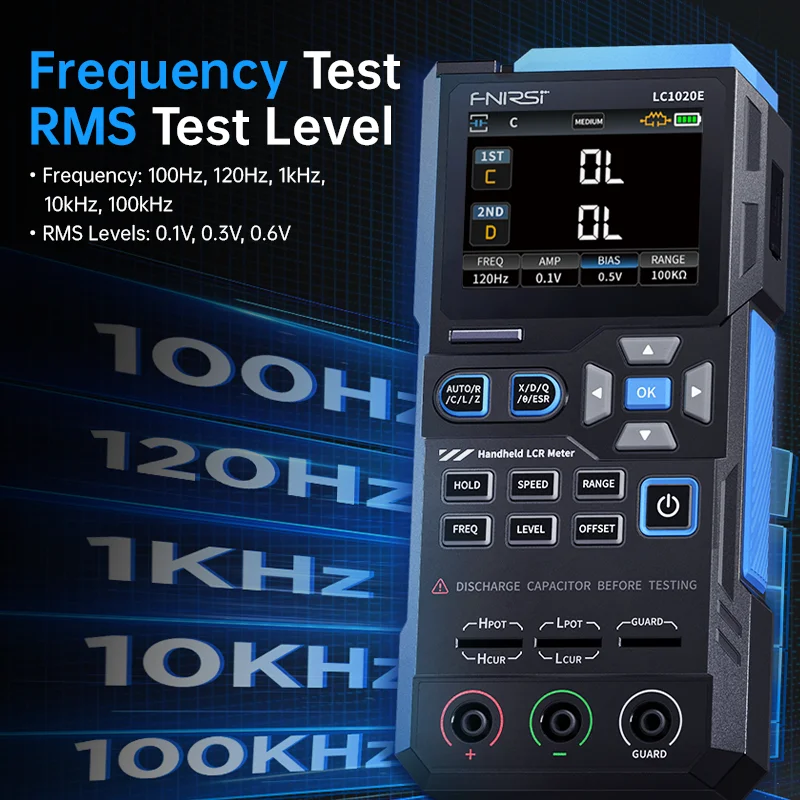
The instrument supports a wide range of test frequencies, from 100Hz to 100kHz. This flexibility allows for component characterization across various operating conditions. Different frequencies reveal different aspects of a component's behavior.
Testing at multiple frequencies is essential for understanding how components behave in AC circuits, where their properties can change significantly with frequency. This is particularly relevant for inductors and capacitors. The user can select the optimal frequency for the component under test.
Many basic LCR meters are limited to a single or very few fixed test frequencies, which can provide an incomplete picture of component performance. The LC1020E's broad frequency range offers a more complete diagnostic profile.
With RMS test levels ranging from 0.1V to 0.6V, the LC1020E accommodates a variety of component types. This adjustable test voltage prevents damage to sensitive components while ensuring sufficient signal for accurate measurements on others. It is a thoughtful design.
Selecting the appropriate test level is crucial for both accuracy and component safety. Too high a voltage can stress or damage delicate parts, while too low a voltage might result in noisy or unreliable readings. The user maintains control.
Less sophisticated testers often employ a fixed test voltage, which can be a compromise. The ability to adjust the test level makes this device more adaptable and safer for a wider array of electronic components.
One of the standout features is its Auto Component Identification. The device intelligently identifies the type of component (resistor, inductor, or capacitor) and automatically switches to the appropriate measurement mode. This streamlines the testing process considerably.
This automatic detection saves time and reduces the potential for user error, especially when working with unmarked or unknown components. It simplifies the workflow. The user simply connects the component.
Unlike manual LCR bridges where the user must pre-select the component type, the LC1020E's auto-identification feature enhances efficiency and ease of use, making it ideal for rapid prototyping or repair work.
The Sorting & Comparison Mode allows users to preset nominal values and tolerance limits. The device then performs one-click sorting tests, quickly identifying abnormal components. This feature significantly enhances efficiency in quality control or batch testing scenarios.
This mode is invaluable for tasks such as matching components for stereo amplifiers, filtering out faulty parts from a batch, or ensuring consistency in production. It flags out-of-spec items instantly. Quality control becomes much faster.
Manual sorting of components is a tedious and error-prone process. The LC1020E automates this, providing a reliable and efficient method for maintaining component quality standards, a true time-saver for any inspector.
The inclusion of an Internal Bias Voltage is a critical feature for accurate testing of certain components, particularly electrolytic capacitors or diodes. Applying an internal bias helps to reduce measurement fluctuations and stabilize readings. It ensures precise testing.
This bias voltage is crucial for components whose characteristics are voltage-dependent, providing a more realistic and stable measurement environment. It minimizes external influences. Stable readings are essential.
Many entry-level LCR meters lack this internal bias capability, leading to less accurate or fluctuating readings for components that require it. The LC1020E's design addresses this common limitation, offering superior measurement integrity.
The physical design of the FNIRSI LC1020E suggests a focus on durability and user-friendliness. Its compact, handheld form factor makes it suitable for fieldwork or crowded workbenches. The robust casing protects internal electronics.
The device features a clear, backlit LCD screen that displays multiple parameters simultaneously, ensuring readability in various lighting conditions. The tactile buttons are well-placed for intuitive operation. Navigation is straightforward.
Unlike bulky benchtop LCR meters, this handheld unit offers unparalleled portability without sacrificing significant functionality. Its ergonomic design facilitates comfortable long-term use, a key consideration for technicians.
The device includes multiple input ports, indicating compatibility with various test leads and fixtures, such as Kelvin clips or SMD tweezers. This versatility allows users to adapt the meter to different component sizes and types. Adaptability is a core strength.
This broad compatibility ensures that the LC1020E can be integrated into existing test setups or expanded with specialized probes as needed. It supports a flexible workflow. Users can customize their testing approach.
Some handheld meters are limited to basic test leads, restricting their utility for specialized components like tiny surface-mount devices. The FNIRSI LC1020E's array of connection options broadens its application scope significantly.
For the home inspector, this tool translates directly into enhanced diagnostic capabilities for electronic systems within a property. While not a thermal camera for wall leaks, it is invaluable for assessing the health of control boards in HVAC systems, appliances, or even smart home devices. It allows for precise identification of failing capacitors or resistors that could lead to system malfunctions or even electrical hotspots over time. The ability to generate detailed component readings means an inspector can document specific component failures, providing concrete evidence for repair recommendations or client reports. This shifts the focus from merely identifying a symptom to pinpointing the exact electronic root cause, elevating the inspector's diagnostic authority.
Imagine confidently identifying a failing capacitor on a furnace control board, preventing a costly breakdown in the dead of winter. Picture quickly sorting through salvaged components for a DIY repair, knowing each part meets specification. Envision providing clients with precise data on why their smart home hub is intermittently failing, backed by accurate component measurements. This tool empowers users to move beyond guesswork, offering a level of diagnostic certainty that transforms troubleshooting from a challenge into a precise, data-driven process.
Unveiling Component Health
This LCR meter provides a comprehensive suite of measurements, including inductance (L), capacitance (C), resistance (R), and impedance (Z). The large, clear display presents these primary parameters with exceptional clarity. Users gain immediate insight into the fundamental electrical properties of a component.
Beyond basic values, the LC1020E also measures secondary parameters such as reactance (X), dissipation factor (D), quality factor (Q), and Equivalent Series Resistance (ESR). These advanced metrics are crucial for a thorough understanding of component performance, especially in resonant circuits or power supply filtering applications. A simple press of a button cycles through these detailed readings.
Compared to simpler multimeters that only offer basic resistance and capacitance checks, this dedicated LCR meter provides a far more granular and accurate assessment. It offers the depth required for professional diagnostics, moving beyond mere continuity tests.
Precision Under Scrutiny
Accuracy is paramount in component testing. The LC1020E boasts a basic accuracy of up to 0.05%, a significant improvement over many entry-level devices. This level of precision ensures that critical component values are determined with high confidence.
Such high precision is vital when dealing with tight tolerance components or when matching parts for sensitive circuits. Even minute deviations can impact circuit performance. The device provides reliable data for critical decisions.
Standard handheld meters often struggle to achieve this level of accuracy, frequently exhibiting deviations that can lead to misdiagnosis or incorrect component selection. The FNIRSI LC1020E positions itself as a superior alternative for demanding applications.
Dynamic Test Frequencies
The instrument supports a wide range of test frequencies, from 100Hz to 100kHz. This flexibility allows for component characterization across various operating conditions. Different frequencies reveal different aspects of a component's behavior.
Testing at multiple frequencies is essential for understanding how components behave in AC circuits, where their properties can change significantly with frequency. This is particularly relevant for inductors and capacitors. The user can select the optimal frequency for the component under test.
Many basic LCR meters are limited to a single or very few fixed test frequencies, which can provide an incomplete picture of component performance. The LC1020E's broad frequency range offers a more complete diagnostic profile.
Adaptive Test Levels
With RMS test levels ranging from 0.1V to 0.6V, the LC1020E accommodates a variety of component types. This adjustable test voltage prevents damage to sensitive components while ensuring sufficient signal for accurate measurements on others. It is a thoughtful design.
Selecting the appropriate test level is crucial for both accuracy and component safety. Too high a voltage can stress or damage delicate parts, while too low a voltage might result in noisy or unreliable readings. The user maintains control.
Less sophisticated testers often employ a fixed test voltage, which can be a compromise. The ability to adjust the test level makes this device more adaptable and safer for a wider array of electronic components.
Intelligent Component Identification
One of the standout features is its Auto Component Identification. The device intelligently identifies the type of component (resistor, inductor, or capacitor) and automatically switches to the appropriate measurement mode. This streamlines the testing process considerably.
This automatic detection saves time and reduces the potential for user error, especially when working with unmarked or unknown components. It simplifies the workflow. The user simply connects the component.
Unlike manual LCR bridges where the user must pre-select the component type, the LC1020E's auto-identification feature enhances efficiency and ease of use, making it ideal for rapid prototyping or repair work.
Streamlined Sorting and Comparison
The Sorting & Comparison Mode allows users to preset nominal values and tolerance limits. The device then performs one-click sorting tests, quickly identifying abnormal components. This feature significantly enhances efficiency in quality control or batch testing scenarios.
This mode is invaluable for tasks such as matching components for stereo amplifiers, filtering out faulty parts from a batch, or ensuring consistency in production. It flags out-of-spec items instantly. Quality control becomes much faster.
Manual sorting of components is a tedious and error-prone process. The LC1020E automates this, providing a reliable and efficient method for maintaining component quality standards, a true time-saver for any inspector.
Internal Bias Voltage for Precision
The inclusion of an Internal Bias Voltage is a critical feature for accurate testing of certain components, particularly electrolytic capacitors or diodes. Applying an internal bias helps to reduce measurement fluctuations and stabilize readings. It ensures precise testing.
This bias voltage is crucial for components whose characteristics are voltage-dependent, providing a more realistic and stable measurement environment. It minimizes external influences. Stable readings are essential.
Many entry-level LCR meters lack this internal bias capability, leading to less accurate or fluctuating readings for components that require it. The LC1020E's design addresses this common limitation, offering superior measurement integrity.
Robust Build and Ergonomic Design
The physical design of the FNIRSI LC1020E suggests a focus on durability and user-friendliness. Its compact, handheld form factor makes it suitable for fieldwork or crowded workbenches. The robust casing protects internal electronics.
The device features a clear, backlit LCD screen that displays multiple parameters simultaneously, ensuring readability in various lighting conditions. The tactile buttons are well-placed for intuitive operation. Navigation is straightforward.
Unlike bulky benchtop LCR meters, this handheld unit offers unparalleled portability without sacrificing significant functionality. Its ergonomic design facilitates comfortable long-term use, a key consideration for technicians.
Connectivity and Expandability
The device includes multiple input ports, indicating compatibility with various test leads and fixtures, such as Kelvin clips or SMD tweezers. This versatility allows users to adapt the meter to different component sizes and types. Adaptability is a core strength.
This broad compatibility ensures that the LC1020E can be integrated into existing test setups or expanded with specialized probes as needed. It supports a flexible workflow. Users can customize their testing approach.
Some handheld meters are limited to basic test leads, restricting their utility for specialized components like tiny surface-mount devices. The FNIRSI LC1020E's array of connection options broadens its application scope significantly.
Value Proposition for the Home Inspector
For the home inspector, this tool translates directly into enhanced diagnostic capabilities for electronic systems within a property. While not a thermal camera for wall leaks, it is invaluable for assessing the health of control boards in HVAC systems, appliances, or even smart home devices. It allows for precise identification of failing capacitors or resistors that could lead to system malfunctions or even electrical hotspots over time. The ability to generate detailed component readings means an inspector can document specific component failures, providing concrete evidence for repair recommendations or client reports. This shifts the focus from merely identifying a symptom to pinpointing the exact electronic root cause, elevating the inspector's diagnostic authority.
Imagine confidently identifying a failing capacitor on a furnace control board, preventing a costly breakdown in the dead of winter. Picture quickly sorting through salvaged components for a DIY repair, knowing each part meets specification. Envision providing clients with precise data on why their smart home hub is intermittently failing, backed by accurate component measurements. This tool empowers users to move beyond guesswork, offering a level of diagnostic certainty that transforms troubleshooting from a challenge into a precise, data-driven process.