Flashforge AD5X Bimetallic Hardened Steel Nozzle Kit
Official Store Deal
Expert Analysis Overview
Precision Engineering for Advanced Extrusion
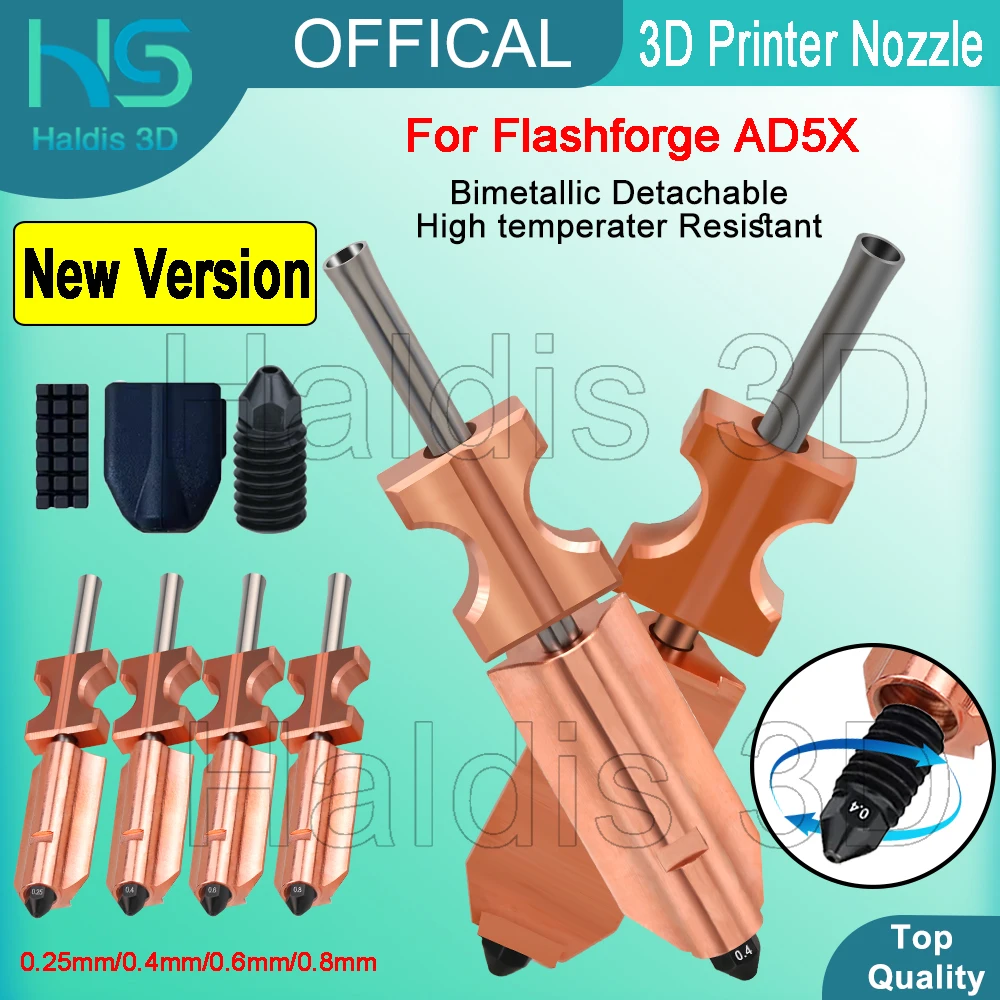
The Flashforge AD5X Bimetallic Hardened Steel Nozzle Kit is a precision-engineered extrusion system designed for advanced 3D printing applications requiring exceptional thermal stability and material versatility. This kit presents a sophisticated extrusion solution, meticulously integrating a hardened steel tip, a chromium-zirconium-copper hot-pressed block, and a titanium alloy throat pipe. This bimetallic construction is visually evident in the distinct material transitions, showcasing a deliberate design choice for optimized performance. The kit includes multiple nozzle diameters, specifically 0.25mm, 0.4mm, 0.6mm, and 0.8mm, providing a range of options for diverse printing needs. Each component plays a critical role.This material composition directly addresses the thermal and mechanical stresses inherent in high-performance 3D printing. The hardened steel tip offers exceptional resistance to abrasive filaments, preventing the premature wear that often degrades print quality and dimensional accuracy over time. This wear resistance is crucial for maintaining consistent extrusion. The chromium-zirconium-copper block, known for its high thermal conductivity, facilitates rapid and uniform heat transfer to the filament. This ensures a consistent melt pool and stable extrusion temperature, which are paramount for successful prints. The titanium alloy throat pipe, conversely, minimizes heat creep, preventing filament softening too high in the hotend and reducing the risk of clogs. This combination ensures stable, reliable extrusion.
Unlike standard brass nozzles, which quickly succumb to wear when printing carbon fiber, glass fiber, or metal-filled composites, this hardened steel variant maintains its orifice integrity over extended periods. Brass nozzles also struggle with the high temperatures required for engineering polymers, often deforming or degrading. This bimetallic design provides the necessary thermal separation and durability to handle such demanding conditions. It represents a significant upgrade for users pushing the boundaries of their 3D printing capabilities. The material choice is deliberate.
Unlocking Material Capabilities
The product explicitly states compatibility with a broad spectrum of materials, a critical factor for any serious 3D printing setup. These include common thermoplastics like PLA, ABS, PET, TPU, PP, and PC, which cover a wide array of general-purpose and flexible printing needs. Crucially, this nozzle extends its compatibility to high-performance polymers such as nylon, PEEK, and PEL. The high-temperature resistant rating is a prominent feature, directly enabling the use of these specialized filaments. This broadens the printer's utility.This extensive material compatibility allows users to transcend the limitations of conventional FDM printing, which often restricts filament choices. Printing PEEK, for instance, demands precise and stable high temperatures, often exceeding 400°C, which this nozzle's bimetallic structure is specifically engineered to provide without thermal degradation. The ability to reliably process abrasive composites without significant nozzle degradation means greater freedom in material selection for functional prototypes and end-use parts. This expands design possibilities for engineers and product developers. It allows for stronger components.
Generic hotends often restrict users to lower-temperature filaments, limiting the mechanical properties and environmental resistance of printed objects. The capacity to reliably extrude engineering-grade materials like PEEK and PEL positions this nozzle as a critical component for industrial prototyping, specialized tooling, and high-performance end-use applications where material strength and thermal resistance are paramount. This capability broadens the printer's utility beyond hobbyist applications. It enables professional-grade output.
Optimized Flow Dynamics and Print Efficiency
A key performance metric highlighted by the manufacturer is a high-flow capability of 32mm³/s. This figure indicates a significant volumetric throughput, allowing for faster material deposition. The range of nozzle diameters, from a fine 0.25mm to a robust 0.8mm, is also clearly presented, offering versatility in print resolution and speed. This flow rate is impressive.A 32mm³/s flow rate translates directly into reduced print times for larger objects or when using wider extrusion widths, without compromising print quality. This efficiency is particularly beneficial for rapid prototyping cycles where speed is paramount, allowing for quicker iteration and design validation. The availability of multiple nozzle sizes allows for granular control over print resolution and speed. A 0.25mm nozzle enables intricate details and fine features, while a 0.8mm nozzle facilitates quick, strong infills and robust structural components. This versatility is a major asset.
Many stock nozzles provide significantly lower flow rates, extending print durations unnecessarily and limiting productivity. The optimized internal geometry and thermal characteristics of this bimetallic design ensure that even at high flow rates, material melting and extrusion remain consistent. This prevents common issues like under-extrusion or inconsistent layer lines, which can plague high-speed prints with lesser nozzles. It maintains part integrity. This design is efficient.
Structural Integrity and Simplified Maintenance
The "New Style" design, clearly depicted in comparative graphics, features a removable nozzle tip and an integrated heat dissipation block for the throat. The construction emphasizes a "one-piece interference fit" for the throat and heating block, a crucial detail for long-term reliability. This is a visible design choice that offers practical benefits.The removable nozzle tip drastically simplifies maintenance procedures. Instead of requiring the replacement of the entire hotend assembly due to a worn or damaged nozzle, only the small, inexpensive tip requires changing. This significantly reduces operational costs and minimizes printer downtime, making it a more economical and user-friendly solution. The one-piece interference fit between the throat and heating block eliminates common failure points like material leakage at threaded connections, which can lead to messy prints, filament waste, and potential damage to the hotend. This ensures a clean, reliable extrusion path. The dedicated heat dissipation block actively manages the thermal gradient, preventing heat creep into the cold end. This prevents heat creep.
Traditional hotends often involve complex assemblies prone to filament leaks at connection points, leading to messy prints and difficult clean-up. The "Old Style" comparison image clearly shows a fixed nozzle, highlighting the maintenance advantage of the new removable design. This modularity is a distinct improvement, offering both convenience and enhanced reliability compared to older, less integrated designs. It's a smart engineering decision.
Thermal Management and Print Stability
The product images explicitly detail a "Structural Upgrade" focusing on the heating block's ability to "heat and cool quickly." Arrows visually represent heat flow, illustrating the efficiency of the thermal design. The "Throat and Heating Block" diagram further emphasizes the one-piece interference fit, which contributes to thermal stability by eliminating gaps where heat could escape or fluctuate. This design is thermally optimized.Rapid heating and cooling capabilities are critical for maintaining a stable printing temperature, especially during complex prints with varying layer times, intricate geometries, or frequent retraction cycles. This thermal responsiveness minimizes temperature fluctuations, which can lead to inconsistent layer adhesion, warping, or poor surface finish. The integrated design ensures thermal stability across the entire melt zone, providing a consistent environment for filament processing. This directly impacts print quality.
Many hotends struggle with thermal lag, resulting in temperature oscillations that compromise print quality, particularly with temperature-sensitive filaments or during rapid changes in extrusion. This upgraded structure provides a more consistent thermal environment, allowing the printer to maintain precise temperature control even under dynamic printing conditions. It directly contributes to print success by reducing common thermal-related print defects. This stability is paramount.
Long-Term Value and Operational Efficiency
The product is presented as a "New Version" with clear advantages over an "Old Style," underscoring its improved design and functionality. The emphasis is on durability and high-temperature resistance, which are key indicators of a product built for longevity and demanding use. While the price point is not explicitly in the summary, the features suggest an investment in performance. This is a durable component.Investing in a high-quality bimetallic nozzle like this translates into significant long-term savings and enhanced operational efficiency. Reduced nozzle wear means fewer replacements, minimizing recurring costs and maintenance efforts. The expanded ability to print a wider range of materials broadens the printer's utility, allowing for more diverse projects without needing additional hardware. Furthermore, the enhanced reliability and reduced likelihood of clogs or print failures save both expensive filament and valuable printing time. This improves overall operational efficiency.
While the initial cost may be higher than a basic brass nozzle, the extended lifespan, reduced maintenance, and expanded material capabilities offer a superior return on investment for serious 3D printing enthusiasts or professionals. It prevents costly print failures and allows for the creation of higher-value parts. This strategic upgrade positions the Flashforge AD5X as a more capable and reliable machine, justifying the investment through consistent, high-quality output and reduced operational headaches. It's a wise investment.
Imagine the satisfaction of consistently producing high-strength, dimensionally accurate parts from advanced engineering polymers, knowing your Flashforge AD5X is equipped for any challenge. Visualize seamless transitions between fine detail and rapid prototyping, all while experiencing fewer clogs and minimal maintenance. This upgrade transforms your 3D printing workflow, enabling you to bring complex designs to life with unparalleled reliability and precision, pushing the boundaries of what your machine can achieve.