Filament Vacuum Storage Kit with Electric Pump
Official Store Deal
Expert Analysis Overview
Precision Filament Preservation System
The Filament Vacuum Storage Kit is a specialized preservation system engineered for 3D printing enthusiasts and professionals who demand optimal material integrity. This comprehensive kit addresses the critical issue of filament hygroscopy, a primary cause of print failures and diminished part quality. It provides a robust solution for maintaining filament in a dry, stable environment, directly impacting the dimensional accuracy and mechanical properties of printed objects.
Mitigating Material Degradation
Filament, particularly materials like PETG, Nylon, and ABS, readily absorbs moisture from the ambient air. This absorption leads to a range of printing issues, including stringing, bubbling, poor layer adhesion, and ultimately, weakened parts. The vacuum storage system actively removes air and moisture, creating a controlled micro-environment for each spool. This proactive approach prevents the degradation that often plagues open-air filament storage.
Standard filament storage methods, such as simply leaving spools on a printer or in unsealed containers, offer minimal protection against humidity. This kit, by contrast, employs a double-zipper vacuum bag and a dedicated pumping mechanism to establish a significantly lower moisture content around the filament. This is a substantial upgrade over passive desiccant boxes, which only absorb existing moisture rather than actively preventing its ingress.
Core Components and Design
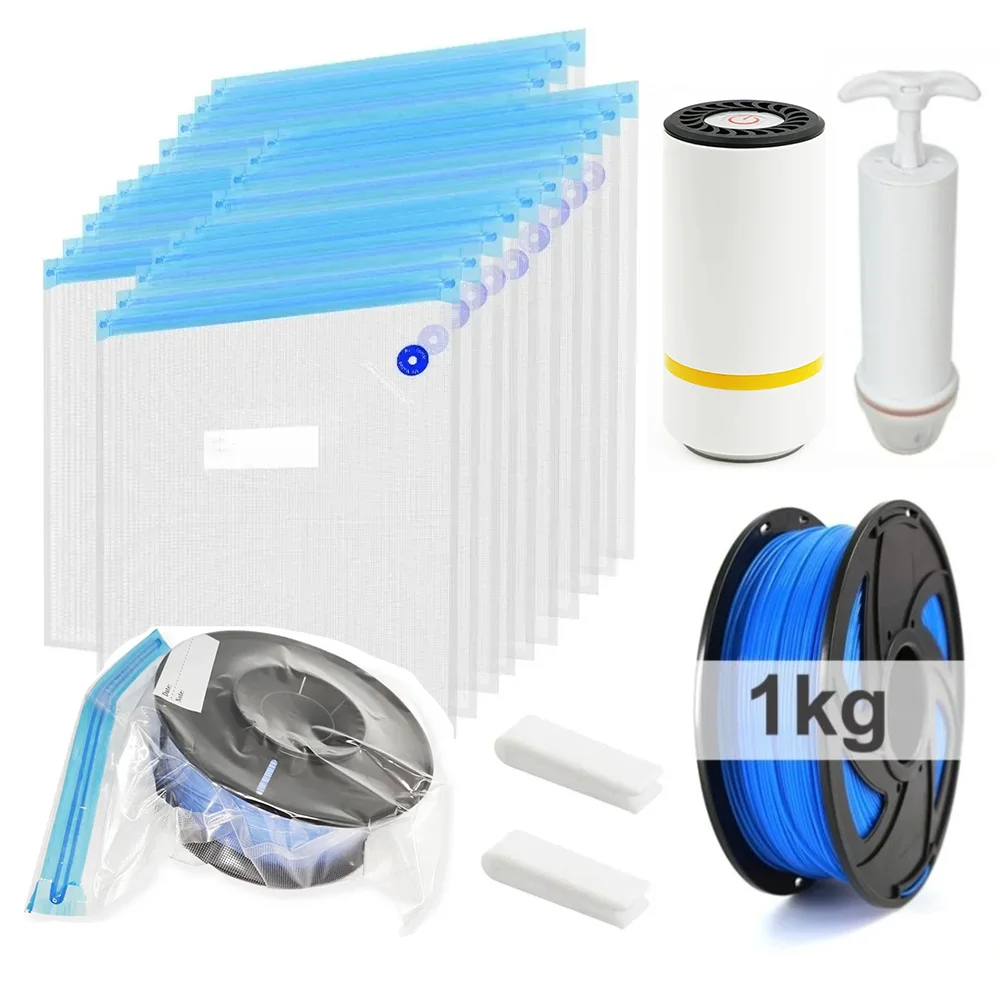
The kit's primary components include a substantial quantity of vacuum-sealable bags, a manual hand pump, and an optional USB rechargeable electric automatic pump. Each bag features a clear, durable construction, allowing for easy identification of filament type and color without compromising the seal. The dimensions of each bag are approximately 300mm x 340mm, accommodating most standard 1kg (and some 0.5kg) filament spools.
The bags are designed with a double zipper seal, providing enhanced air-tightness compared to single-track closures. A sealing clip (referred to as an "Easy Lock" in the visual guide) is included to ensure a complete and secure closure along the double zipper. This clip simplifies the sealing process, making it less prone to user error. The integrated pumping valve is a one-way mechanism, allowing air extraction while preventing re-entry.
Unlike generic food storage vacuum bags, these are specifically sized and designed for filament spools. The robust material composition of the bags is engineered to withstand the vacuum pressure over extended periods, ensuring long-term protection. This specialized design minimizes the risk of punctures or seal failures that might occur with less durable alternatives.
Pumping Mechanisms: Manual vs. Electric
The kit offers two methods for vacuum creation: a manual hand pump and an electric automatic pump. The manual pump is a straightforward, piston-driven device that requires user effort to extract air. It is a reliable, low-tech solution for occasional use or when power is unavailable. The manual pump is compact.
The USB rechargeable electric automatic pump represents a significant convenience upgrade. This device automates the air extraction process with a single button press, rapidly drawing air from the bag until a sufficient vacuum is achieved. Its USB rechargeability ensures portability and eliminates the need for disposable batteries. This electric option dramatically reduces the time and effort involved in sealing multiple filament spools, making it ideal for users with larger filament inventories or frequent sealing requirements.
Compared to manual-only systems, the electric pump offers consistent vacuum pressure across all bags. This consistency is vital for optimal moisture control. The electric pump's efficiency allows for quick processing of multiple spools, a clear advantage for busy workshops or production environments.
Operational Simplicity and User Experience
Operating the system is intuitive. Users place the filament spool, along with a desiccant pack and humidity indicator card (not included but highly recommended for comprehensive monitoring), into the vacuum bag. The bag is then sealed using the provided clip, ensuring the double zipper is fully engaged. The pump, either manual or electric, is then placed over the air valve, and air is extracted until the bag visibly compresses around the spool.
The inclusion of a label area for notes on each bag is a practical feature. This allows users to record important information such as filament type, color, purchase date, or last vacuum seal date. Such organizational tools are often overlooked in generic storage solutions but are invaluable for managing a diverse filament inventory. This simple addition streamlines workflow.
This system simplifies a critical maintenance task for 3D printing. It transforms a potentially cumbersome process into a quick, repeatable action. The ease of use encourages consistent filament care, which directly translates to fewer print failures and higher quality output.
Long-Term Value and Performance Implications
The investment in a filament vacuum storage system like this translates directly into improved print quality and reduced material waste. By preventing moisture absorption, users can expect more consistent extrusion, better layer adhesion, and stronger final parts. This is particularly crucial for printing intricate models or functional components where material integrity is paramount.
Consider the cost of failed prints due to moisture-laden filament. Each failed print wastes material, time, and energy. This system acts as an insurance policy against such losses, extending the usable life of expensive filament spools. The long-term savings from preventing material degradation and print failures far outweigh the initial cost of the kit.
Unlike relying solely on passive desiccant, which eventually saturates and requires regeneration or replacement, this active vacuum system provides a more dynamic defense against humidity. It ensures that filament remains in a pristine state, ready for immediate use, thereby minimizing pre-print drying times and maximizing printer uptime. This capability is essential for maintaining a high standard of output.
Imagine retrieving a spool of exotic or expensive filament, knowing it is as dry and ready to print as the day it was manufactured. This system provides that assurance, allowing for greater confidence in print outcomes and the ability to tackle more ambitious projects without concern for material quality degradation. The ability to preserve filament effectively means less frustration and more successful prints, ultimately enhancing the entire 3D printing experience. This is a critical asset for any serious maker or professional. The consistent performance will be noticeable.