FC 2.54mm Pitch Female IDC Socket Connectors
Official Store Deal
Expert Analysis Overview
Precision Interconnection: FC 2.54mm Pitch Female IDC Socket Connectors
The FC 2.54mm Pitch Female IDC Socket Connectors are essential electrical components designed for reliable ribbon cable termination in low-voltage digital and control applications. These connectors are not merely passive links; they represent a critical interface where signal integrity and mechanical robustness converge. Their design facilitates rapid, mass termination, a significant advantage in production environments.
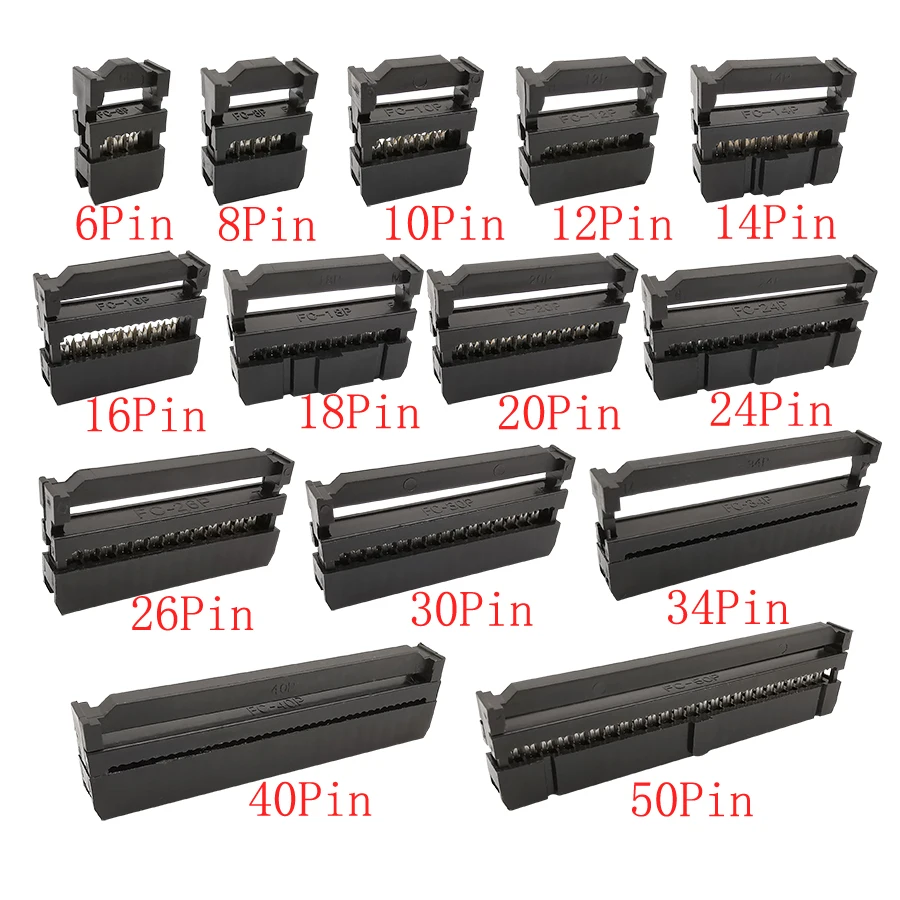
The visual evidence clearly displays a range of pin counts, from 6-pin up to 50-pin configurations. This extensive selection ensures compatibility with a broad spectrum of ribbon cable widths and corresponding circuit requirements. Each connector features a standardized 2.54mm (0.1-inch) pitch, a ubiquitous standard in electronics for prototyping and production alike. This pitch consistency is vital for ensuring proper alignment with standard header pins and breadboards.
Unlike traditional crimp or solder connections that demand individual wire preparation, IDC technology simplifies the process. The insulation displacement contacts pierce the ribbon cable's insulation, establishing electrical contact without stripping. This method drastically reduces assembly time and minimizes the potential for human error in repetitive tasks. It is a time-saving solution.
Engineering for Reliable Connectivity
The core functionality of these IDC sockets hinges on the quality of their internal contacts. While not visible, the design principle dictates that sharp, precisely formed metal contacts must reliably cut through the wire insulation to establish a gas-tight connection with the conductor. This gas-tight seal is paramount for preventing oxidation and ensuring long-term electrical stability, especially in environments susceptible to moisture or corrosive elements.
Proper termination is critical for preventing electrical fires and ensuring safety standard compliance. A poorly seated wire or an incomplete insulation displacement can lead to high resistance points, generating heat under load. This heat can degrade insulation, melt plastic, and ultimately result in a short circuit or open circuit condition. The integrity of the connection directly impacts the safety of the entire system.
Compared to hand-soldered connections, which can introduce variability due to operator skill and solder joint quality, IDC offers a more consistent and repeatable connection when performed with the correct tooling. This consistency is a significant advantage for mass production and maintaining uniform product quality. It reduces manufacturing defects.
Material Integrity and Durability
The connector housings are constructed from a robust black plastic, likely a thermoplastic polymer such as PBT or Nylon. This material choice is typical for electrical connectors due to its excellent insulating properties, mechanical strength, and resistance to common solvents and temperature fluctuations. The visible molding appears clean, suggesting a consistent manufacturing process.
Durability in these components is not just about physical resilience; it also pertains to the ability to withstand repeated mating cycles without degradation of electrical performance. The housing provides structural support for the contacts, ensuring they remain aligned and protected from physical stress. A sturdy housing prevents accidental disconnections.
In contrast to cheaper, brittle plastics, a quality thermoplastic housing will resist cracking under moderate stress and maintain its form factor over time. This is particularly important in applications where connectors might be frequently plugged and unplugged for maintenance or configuration changes. The material choice directly influences the connector's lifespan and reliability in the field.
Application Versatility and System Integration
These IDC connectors are primarily designed for flat ribbon cables, which are commonly used for internal data and control signals within electronic devices. Their compact form factor and standardized pitch make them ideal for connecting circuit boards, display modules, sensors, and various peripheral components. They simplify complex wiring harnesses.
Verifying wire gauge accuracy is essential for optimal performance. The IDC contacts are designed for specific wire gauges, typically 28 AWG or 26 AWG stranded ribbon cable. Using an incorrect wire gauge can lead to either insufficient contact (if the wire is too small) or damage to the connector (if the wire is too large). This compatibility ensures a secure electrical and mechanical bond.
Consider a scenario where a control board needs to interface with multiple sensors. Using these IDC connectors with a ribbon cable allows for a clean, organized, and space-efficient wiring solution compared to individual discrete wires. This modularity simplifies assembly and troubleshooting, making system integration more manageable. It streamlines the wiring process.
Operational Considerations and Best Practices
While IDC connectors offer ease of assembly, proper technique and tooling are non-negotiable for reliable connections. A dedicated IDC crimping tool ensures even pressure across all contacts, leading to a uniform and secure termination. Hand-pressing or using improvised tools can result in intermittent connections or damaged contacts.
Checking terminal quality, though not directly visible in the images, is a critical aspect of any electrical connector. High-quality terminals are typically made from phosphor bronze or brass, often plated with tin or gold for improved conductivity and corrosion resistance. These materials ensure low contact resistance and long-term reliability. Poor quality terminals can lead to signal degradation.
For applications requiring higher current loads, these IDC connectors may not be the optimal choice. Their primary strength lies in signal and low-power control applications. For power distribution, alternative connectors designed for larger wire gauges and higher current ratings should be considered. Understanding the current limitations is vital for system safety.
The Value Proposition for Electrical Professionals
For electricians and electronics technicians, these FC IDC connectors represent a practical solution for efficient project completion. The ability to quickly and reliably terminate multi-conductor ribbon cables saves valuable labor time, which translates directly into cost savings on projects. This efficiency is a key benefit.
The standardization of the 2.54mm pitch ensures broad compatibility with existing components and development boards, reducing the need for custom solutions. This interoperability simplifies inventory management and allows for greater flexibility in design and repair. It integrates seamlessly into standard workflows.
Imagine completing a complex wiring harness in a fraction of the time, confident in the integrity of each connection. These connectors empower professionals to achieve consistent, high-quality results with greater speed and less effort, allowing focus to shift to more intricate aspects of system design and implementation. This efficiency enhances overall project timelines and reliability, ensuring that electrical systems are not only functional but also safely and professionally assembled. The peace of mind from reliable connections is invaluable.