eSUN PLA-Basic High Speed 3D Filament
Official Store Deal
Expert Analysis Overview
eSUN PLA-Basic High Speed Filament is an optimized 3D printing material engineered for rapid prototyping and high-volume production, specifically appealing to makers seeking efficiency without compromising print quality. This filament positions itself as a crucial upgrade for enthusiasts and professionals looking to push the boundaries of their FDM machines.
The filament is explicitly marketed for "High Speed Printing," with claims of achieving print speeds between 250-300 mm/s. This performance is notably compatible with advanced machines like the Bambu P1 series, which, when using a 0.4mm nozzle, can reach a maximum volume flow rate of 25-30 mm³/s. Such specifications indicate a material formulated to keep pace with modern, high-throughput 3D printers.
For print farm operators or hobbyists with tight deadlines, these speeds translate directly into significantly faster project completion. Rapid iterations become not just possible, but the norm, allowing for quicker design cycles and increased output. This capability is particularly beneficial when developing custom parts or modifications that require multiple test prints to perfect.
Standard PLA often struggles to maintain quality at speeds exceeding 100-150 mm/s, frequently exhibiting issues like skipped layers, poor adhesion, or ghosting. The eSUN PLA-Basic, by contrast, is engineered to mitigate these problems, offering a substantial performance upgrade over generic filaments that would otherwise bottleneck a high-speed printer.
Visual evidence, such as the comparison images, highlights a "Non Wire Drawing" characteristic, demonstrating a cleaner print with significantly less stringing compared to regular PLA. This is supported by the stated "Faster Cooling Good Fluidity," with a Melt Flow Index (MFI) of 3.5-4.5 g/10min at 190°C and 2.16kg. The MFI value indicates the material's ability to flow smoothly through the nozzle.
Faster cooling and good fluidity directly translate to cleaner, more precise prints that require minimal post-processing. Reduced stringing and improved layer adhesion mean less time spent trimming, sanding, or fixing imperfections. For creators of custom parts, this means functional components can be produced with higher accuracy and better aesthetic finish right off the print bed.
Generic PLA often presents challenges with stringing and blobbing, particularly when print temperatures are optimized for flow or when printing intricate geometries. This eSUN filament directly addresses these common frustrations, offering a more reliable and visually superior outcome, which is a significant advantage for detailed custom designs or functional prototypes.
This product is a PLA-Basic filament, supplied on a 1KG spool with a standard 1.75MM diameter. PLA, or Polylactic Acid, remains one of the most popular 3D printing materials due to its ease of use and environmental considerations, being derived from renewable resources like corn starch.
PLA's inherent characteristics make it an excellent choice for general prototyping, educational projects, and non-functional aesthetic prints. Its ease of printing, lower warping tendencies, and relative biodegradability offer a good balance for everyday printing needs. The "High Cost-Effective" claim suggests a favorable price-to-performance ratio, making it an economical choice for volume printing.
Compared to more specialized engineering filaments, PLA-Basic provides an accessible and budget-friendly entry point for a wide range of projects. While it may not offer the extreme strength or heat resistance of ABS or PETG, its printability and cost make it a staple. A consistent diameter, as implied by the quality claims, is crucial for reliable extrusion and preventing clogs, a common issue with lower-quality filaments.
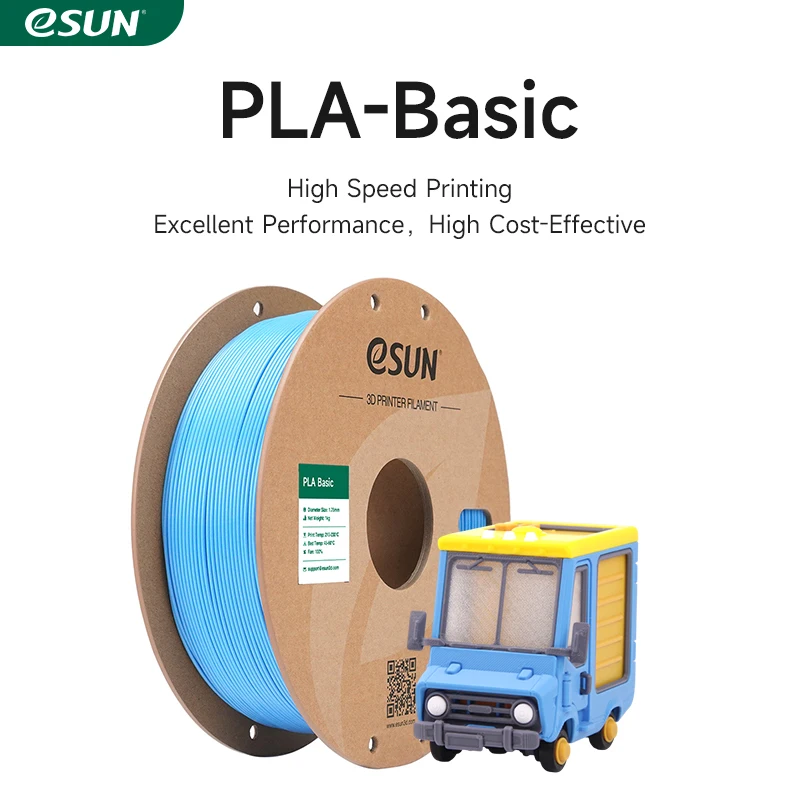
The filament is wound onto a cardboard spool, a detail visible in the product images. This design choice stands in contrast to the more traditional plastic spools prevalent in the 3D printing market. The spool also features a QR code, likely for product information or quality control traceability.
Utilizing cardboard spools reflects an increasing industry trend towards more environmentally conscious packaging. For makers, this means easier disposal and a reduced ecological footprint, as cardboard is widely recyclable. This small detail contributes to a more sustainable workshop environment.
Many filament manufacturers still rely on plastic spools, which can accumulate quickly and contribute to plastic waste. The shift to cardboard, while seemingly minor, represents a thoughtful consideration for the broader impact of 3D printing. It also often means a lighter spool, potentially reducing shipping costs slightly.
For the maker and tinkerer, a high-speed, reliable filament like eSUN PLA-Basic opens up new avenues for creativity and problem-solving. The ability to quickly print custom parts is invaluable for modifying existing machines, developing bespoke enclosures for electronics, or creating unique tools for specific tasks. The rapid turnaround time encourages experimentation, allowing for faster design-test-iterate cycles.
Reliable filament also simplifies troubleshooting. When print failures occur, a consistent material helps isolate the problem to the printer's mechanics or settings, rather than introducing variables from inconsistent filament quality. This enables the community to share solutions and refine printer profiles more effectively, contributing to a collective knowledge base.
Consistent and high-quality filament is fundamental to improving and maintaining a 3D printer over time. Optimal flow and cooling properties aid in calibrating extrusion settings, fine-tuning retraction, and pushing the printer's speed limits without compromising print integrity. This allows makers to continually upgrade their machines, knowing the material won't be the weakest link in their setup.
The combination of "Excellent Performance" and "High Cost-Effective" positions this filament as a smart investment for any active 3D printing enthusiast. The balance struck between speed and quality means that projects can be completed faster without sacrificing the desired finish or structural integrity.
Reduced print failures, owing to better fluidity and less stringing, directly translate into less wasted material and fewer wasted hours. This efficiency means more successful prints per spool and a higher overall output, which can be particularly advantageous for those running small-scale production or fulfilling custom orders. The initial cost per kilogram becomes less significant when considering the enhanced productivity and reduced frustration.
Standard filaments often force a compromise: either print slowly for quality or quickly for speed, accepting potential defects. This eSUN PLA-Basic filament aims to bridge that gap, offering a solution that allows for both. This means less time babysitting prints and more time designing, innovating, and bringing ideas to life, ultimately maximizing the return on investment in a 3D printer.
Imagine the satisfaction of seeing complex designs materialize on the print bed in record time, with smooth surfaces and crisp details, ready for immediate use or assembly. The workshop hums with efficient productivity, and ideas move from concept to tangible object with unprecedented speed. This filament allows for more experimentation, more successful projects, and ultimately, more creative freedom. The potential for rapid iteration of custom components, from robotics parts to household fixes, becomes an accessible reality. This ensures that the flow of innovation in your personal projects or small business remains uninterrupted. It's about spending less time waiting and more time creating, pushing the boundaries of what is achievable with desktop 3D printing. This empowers users to modify and improve their machines with custom-printed parts, knowing the material can keep up with their ambitious designs and rigorous testing cycles.
Accelerated Prototyping Capabilities
The filament is explicitly marketed for "High Speed Printing," with claims of achieving print speeds between 250-300 mm/s. This performance is notably compatible with advanced machines like the Bambu P1 series, which, when using a 0.4mm nozzle, can reach a maximum volume flow rate of 25-30 mm³/s. Such specifications indicate a material formulated to keep pace with modern, high-throughput 3D printers.
For print farm operators or hobbyists with tight deadlines, these speeds translate directly into significantly faster project completion. Rapid iterations become not just possible, but the norm, allowing for quicker design cycles and increased output. This capability is particularly beneficial when developing custom parts or modifications that require multiple test prints to perfect.
Standard PLA often struggles to maintain quality at speeds exceeding 100-150 mm/s, frequently exhibiting issues like skipped layers, poor adhesion, or ghosting. The eSUN PLA-Basic, by contrast, is engineered to mitigate these problems, offering a substantial performance upgrade over generic filaments that would otherwise bottleneck a high-speed printer.
Fidelity in Rapid Production
Visual evidence, such as the comparison images, highlights a "Non Wire Drawing" characteristic, demonstrating a cleaner print with significantly less stringing compared to regular PLA. This is supported by the stated "Faster Cooling Good Fluidity," with a Melt Flow Index (MFI) of 3.5-4.5 g/10min at 190°C and 2.16kg. The MFI value indicates the material's ability to flow smoothly through the nozzle.
Faster cooling and good fluidity directly translate to cleaner, more precise prints that require minimal post-processing. Reduced stringing and improved layer adhesion mean less time spent trimming, sanding, or fixing imperfections. For creators of custom parts, this means functional components can be produced with higher accuracy and better aesthetic finish right off the print bed.
Generic PLA often presents challenges with stringing and blobbing, particularly when print temperatures are optimized for flow or when printing intricate geometries. This eSUN filament directly addresses these common frustrations, offering a more reliable and visually superior outcome, which is a significant advantage for detailed custom designs or functional prototypes.
Material Integrity and Consistency
This product is a PLA-Basic filament, supplied on a 1KG spool with a standard 1.75MM diameter. PLA, or Polylactic Acid, remains one of the most popular 3D printing materials due to its ease of use and environmental considerations, being derived from renewable resources like corn starch.
PLA's inherent characteristics make it an excellent choice for general prototyping, educational projects, and non-functional aesthetic prints. Its ease of printing, lower warping tendencies, and relative biodegradability offer a good balance for everyday printing needs. The "High Cost-Effective" claim suggests a favorable price-to-performance ratio, making it an economical choice for volume printing.
Compared to more specialized engineering filaments, PLA-Basic provides an accessible and budget-friendly entry point for a wide range of projects. While it may not offer the extreme strength or heat resistance of ABS or PETG, its printability and cost make it a staple. A consistent diameter, as implied by the quality claims, is crucial for reliable extrusion and preventing clogs, a common issue with lower-quality filaments.
Thoughtful Spool Design
The filament is wound onto a cardboard spool, a detail visible in the product images. This design choice stands in contrast to the more traditional plastic spools prevalent in the 3D printing market. The spool also features a QR code, likely for product information or quality control traceability.
Utilizing cardboard spools reflects an increasing industry trend towards more environmentally conscious packaging. For makers, this means easier disposal and a reduced ecological footprint, as cardboard is widely recyclable. This small detail contributes to a more sustainable workshop environment.
Many filament manufacturers still rely on plastic spools, which can accumulate quickly and contribute to plastic waste. The shift to cardboard, while seemingly minor, represents a thoughtful consideration for the broader impact of 3D printing. It also often means a lighter spool, potentially reducing shipping costs slightly.
Empowering the Maker Community
For the maker and tinkerer, a high-speed, reliable filament like eSUN PLA-Basic opens up new avenues for creativity and problem-solving. The ability to quickly print custom parts is invaluable for modifying existing machines, developing bespoke enclosures for electronics, or creating unique tools for specific tasks. The rapid turnaround time encourages experimentation, allowing for faster design-test-iterate cycles.
Reliable filament also simplifies troubleshooting. When print failures occur, a consistent material helps isolate the problem to the printer's mechanics or settings, rather than introducing variables from inconsistent filament quality. This enables the community to share solutions and refine printer profiles more effectively, contributing to a collective knowledge base.
Consistent and high-quality filament is fundamental to improving and maintaining a 3D printer over time. Optimal flow and cooling properties aid in calibrating extrusion settings, fine-tuning retraction, and pushing the printer's speed limits without compromising print integrity. This allows makers to continually upgrade their machines, knowing the material won't be the weakest link in their setup.
Operational Efficiency and Cost-Effectiveness
The combination of "Excellent Performance" and "High Cost-Effective" positions this filament as a smart investment for any active 3D printing enthusiast. The balance struck between speed and quality means that projects can be completed faster without sacrificing the desired finish or structural integrity.
Reduced print failures, owing to better fluidity and less stringing, directly translate into less wasted material and fewer wasted hours. This efficiency means more successful prints per spool and a higher overall output, which can be particularly advantageous for those running small-scale production or fulfilling custom orders. The initial cost per kilogram becomes less significant when considering the enhanced productivity and reduced frustration.
Standard filaments often force a compromise: either print slowly for quality or quickly for speed, accepting potential defects. This eSUN PLA-Basic filament aims to bridge that gap, offering a solution that allows for both. This means less time babysitting prints and more time designing, innovating, and bringing ideas to life, ultimately maximizing the return on investment in a 3D printer.
Imagine the satisfaction of seeing complex designs materialize on the print bed in record time, with smooth surfaces and crisp details, ready for immediate use or assembly. The workshop hums with efficient productivity, and ideas move from concept to tangible object with unprecedented speed. This filament allows for more experimentation, more successful projects, and ultimately, more creative freedom. The potential for rapid iteration of custom components, from robotics parts to household fixes, becomes an accessible reality. This ensures that the flow of innovation in your personal projects or small business remains uninterrupted. It's about spending less time waiting and more time creating, pushing the boundaries of what is achievable with desktop 3D printing. This empowers users to modify and improve their machines with custom-printed parts, knowing the material can keep up with their ambitious designs and rigorous testing cycles.