eSUN eTPU-95A Flexible 3D Printer Filament
Official Store Deal
Expert Analysis Overview
eSUN eTPU-95A is a high-performance, flexible filament designed for 3D printing, offering a compelling blend of elasticity, strength, and ease of use. This material is a superior choice for educators and hobbyists alike, providing reliable results for functional prototypes and durable components.
eSUN eTPU-95A is a thermoplastic polyurethane filament, specifically engineered for its unique combination of flexibility and durability. This particular grade, 95A Shore hardness, positions it as a semi-flexible material, capable of significant bending and compression without permanent deformation. It is a robust material.
This filament is particularly well-suited for applications requiring shock absorption, vibration dampening, or parts that need to withstand repeated flexing. Unlike rigid filaments such as PLA or ABS, TPU's inherent elasticity allows for the creation of components that can deform under stress and return to their original shape, expanding design possibilities.
Compared to other flexible filaments on the market, the 95A Shore hardness strikes a balance. Softer TPUs can be more challenging to print, while harder ones offer less flexibility. This specific hardness makes it accessible for a wider range of 3D printers and users, including those new to flexible materials.
The eTPU-95A filament exhibits high toughness and exceptional impact resistance. These properties are critical for parts that will experience physical stress or repeated handling. High toughness means the material can absorb considerable energy before fracturing.
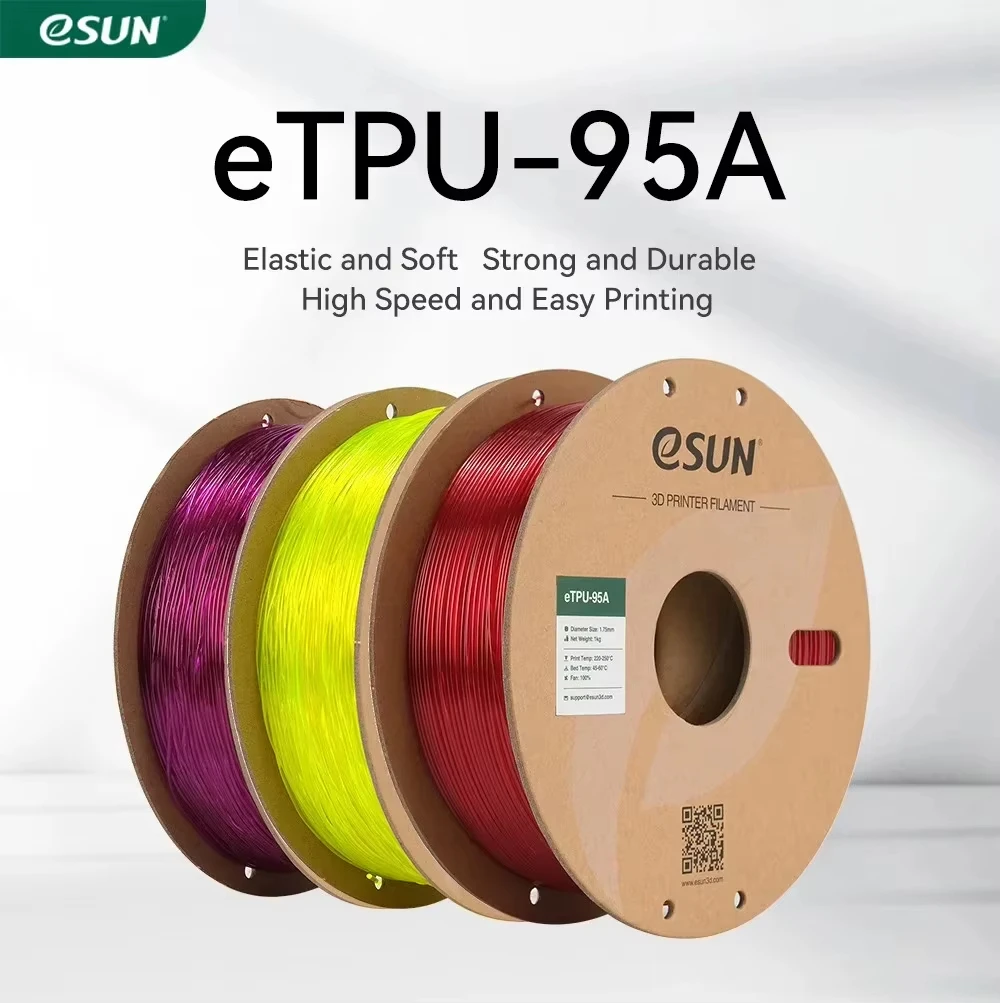
Visual evidence suggests an elongation at break exceeding 800%, indicating remarkable stretchability. This characteristic is vital for creating parts like gaskets, protective cases, or wearable items where significant deformation is expected. The material resists tearing effectively.
Standard rigid filaments, like PLA, often fail catastrophically under impact or bending stress due to their brittle nature. The eTPU-95A, in contrast, flexes and absorbs the force, leading to a much longer lifespan for printed objects in demanding environments. This resilience is a key differentiator.
This filament is marketed for 'Easy Printing' and 'High Speed Printing,' which are significant advantages for flexible materials. Flexible filaments are notoriously difficult to print at high speeds due to their tendency to buckle or jam in the extruder path. Its high liquidity is a benefit.
Ultra-high liquidity and high flow characteristics enable faster print speeds without compromising print quality. This means less time spent waiting for prints to complete, increasing productivity for both individual projects and classroom settings. Faster prints are always welcome.
Compatibility with both direct drive and Bowden extruder printers broadens its accessibility. While direct drive extruders are generally preferred for flexible filaments due to the shorter, more constrained filament path, the eTPU-95A's formulation allows for successful printing even with Bowden setups, which are common on many entry-level printers. This expands its user base considerably.
For STEM educators, the eSUN eTPU-95A filament presents distinct advantages for teaching 3D printing. Its 'Easy Printing' nature reduces the common frustrations students encounter when working with flexible materials, fostering a more positive learning experience. Fewer failed prints mean more learning.
The durability and flexibility of the printed objects make them ideal for hands-on projects that require functional components. Students can design and print parts that are meant to be handled, bent, or even dropped without immediate breakage, allowing for iterative design and practical application. This promotes experimental learning.
Furthermore, the consistent printability of this filament helps simplify the slicing workflow. Educators can provide more standardized settings, reducing the need for extensive troubleshooting during class time and allowing students to focus on design principles rather than print parameters. This streamlines instruction.
Achieving optimal results with eTPU-95A involves careful consideration of slicing parameters, though its 'easy printing' nature minimizes complexity. Typical flexible filament settings include higher print temperatures and slower speeds than rigid materials, but this filament allows for speed increases. Retraction settings are also critical.
For Bowden setups, minimizing retraction distance and speed helps prevent filament stretching and jamming. Direct drive extruders can handle slightly more aggressive retraction. Ensuring proper bed adhesion is also essential for flexible materials, often achieved with a heated bed and an adhesive like glue stick or painter's tape. A clean bed is important.
Experimentation with infill patterns and density can further fine-tune the flexibility and strength of the final print. Lower infill can result in more flexible parts, while higher infill increases rigidity and strength. These adjustments allow for diverse part characteristics.
The eTPU-95A filament opens up a wide array of practical applications beyond simple decorative prints. Its properties make it suitable for manufacturing functional prototypes, custom protective gear, and flexible joints. Imagine a world of possibilities.
Consider creating custom phone cases that absorb impact, durable drone parts that resist crashes, or even flexible robotic components. The material's resilience ensures that these parts perform reliably in real-world scenarios, offering significant value over brittle alternatives. This expands design horizons.
For educators, this means students can move beyond theoretical design to creating tangible, functional objects that solve real problems. This fosters critical thinking and problem-solving skills, making the learning experience more engaging and impactful. Real-world applications are key.
Imagine designing and printing custom gaskets that perfectly seal a prototype, knowing they will withstand repeated compression. Envision creating flexible components for a student robotics project that can absorb unexpected impacts without failing. Picture producing durable, ergonomic grips for tools that enhance user comfort and longevity.
With eSUN eTPU-95A filament, these applications become readily achievable. The material's balance of elasticity, strength, and printability empowers users to push the boundaries of functional 3D printing. It simplifies the process, making advanced material properties accessible to a broader audience, from seasoned engineers to budding student innovators. The potential for innovation is vast.
The Flexible Frontier: Defining eTPU-95A
eSUN eTPU-95A is a thermoplastic polyurethane filament, specifically engineered for its unique combination of flexibility and durability. This particular grade, 95A Shore hardness, positions it as a semi-flexible material, capable of significant bending and compression without permanent deformation. It is a robust material.
This filament is particularly well-suited for applications requiring shock absorption, vibration dampening, or parts that need to withstand repeated flexing. Unlike rigid filaments such as PLA or ABS, TPU's inherent elasticity allows for the creation of components that can deform under stress and return to their original shape, expanding design possibilities.
Compared to other flexible filaments on the market, the 95A Shore hardness strikes a balance. Softer TPUs can be more challenging to print, while harder ones offer less flexibility. This specific hardness makes it accessible for a wider range of 3D printers and users, including those new to flexible materials.
Engineering for Resilience: Material Properties
The eTPU-95A filament exhibits high toughness and exceptional impact resistance. These properties are critical for parts that will experience physical stress or repeated handling. High toughness means the material can absorb considerable energy before fracturing.
Visual evidence suggests an elongation at break exceeding 800%, indicating remarkable stretchability. This characteristic is vital for creating parts like gaskets, protective cases, or wearable items where significant deformation is expected. The material resists tearing effectively.
Standard rigid filaments, like PLA, often fail catastrophically under impact or bending stress due to their brittle nature. The eTPU-95A, in contrast, flexes and absorbs the force, leading to a much longer lifespan for printed objects in demanding environments. This resilience is a key differentiator.
Streamlined Fabrication: Printing Dynamics
This filament is marketed for 'Easy Printing' and 'High Speed Printing,' which are significant advantages for flexible materials. Flexible filaments are notoriously difficult to print at high speeds due to their tendency to buckle or jam in the extruder path. Its high liquidity is a benefit.
Ultra-high liquidity and high flow characteristics enable faster print speeds without compromising print quality. This means less time spent waiting for prints to complete, increasing productivity for both individual projects and classroom settings. Faster prints are always welcome.
Compatibility with both direct drive and Bowden extruder printers broadens its accessibility. While direct drive extruders are generally preferred for flexible filaments due to the shorter, more constrained filament path, the eTPU-95A's formulation allows for successful printing even with Bowden setups, which are common on many entry-level printers. This expands its user base considerably.
Classroom Integration: Educational Advantages
For STEM educators, the eSUN eTPU-95A filament presents distinct advantages for teaching 3D printing. Its 'Easy Printing' nature reduces the common frustrations students encounter when working with flexible materials, fostering a more positive learning experience. Fewer failed prints mean more learning.
The durability and flexibility of the printed objects make them ideal for hands-on projects that require functional components. Students can design and print parts that are meant to be handled, bent, or even dropped without immediate breakage, allowing for iterative design and practical application. This promotes experimental learning.
Furthermore, the consistent printability of this filament helps simplify the slicing workflow. Educators can provide more standardized settings, reducing the need for extensive troubleshooting during class time and allowing students to focus on design principles rather than print parameters. This streamlines instruction.
Optimizing Your Workflow: Slicing and Settings
Achieving optimal results with eTPU-95A involves careful consideration of slicing parameters, though its 'easy printing' nature minimizes complexity. Typical flexible filament settings include higher print temperatures and slower speeds than rigid materials, but this filament allows for speed increases. Retraction settings are also critical.
For Bowden setups, minimizing retraction distance and speed helps prevent filament stretching and jamming. Direct drive extruders can handle slightly more aggressive retraction. Ensuring proper bed adhesion is also essential for flexible materials, often achieved with a heated bed and an adhesive like glue stick or painter's tape. A clean bed is important.
Experimentation with infill patterns and density can further fine-tune the flexibility and strength of the final print. Lower infill can result in more flexible parts, while higher infill increases rigidity and strength. These adjustments allow for diverse part characteristics.
Beyond the Spool: Practical Applications
The eTPU-95A filament opens up a wide array of practical applications beyond simple decorative prints. Its properties make it suitable for manufacturing functional prototypes, custom protective gear, and flexible joints. Imagine a world of possibilities.
Consider creating custom phone cases that absorb impact, durable drone parts that resist crashes, or even flexible robotic components. The material's resilience ensures that these parts perform reliably in real-world scenarios, offering significant value over brittle alternatives. This expands design horizons.
For educators, this means students can move beyond theoretical design to creating tangible, functional objects that solve real problems. This fosters critical thinking and problem-solving skills, making the learning experience more engaging and impactful. Real-world applications are key.
The Future of Flexible Design
Imagine designing and printing custom gaskets that perfectly seal a prototype, knowing they will withstand repeated compression. Envision creating flexible components for a student robotics project that can absorb unexpected impacts without failing. Picture producing durable, ergonomic grips for tools that enhance user comfort and longevity.
With eSUN eTPU-95A filament, these applications become readily achievable. The material's balance of elasticity, strength, and printability empowers users to push the boundaries of functional 3D printing. It simplifies the process, making advanced material properties accessible to a broader audience, from seasoned engineers to budding student innovators. The potential for innovation is vast.