ERYONE PETG Carbon Fiber 3D Printer Filament
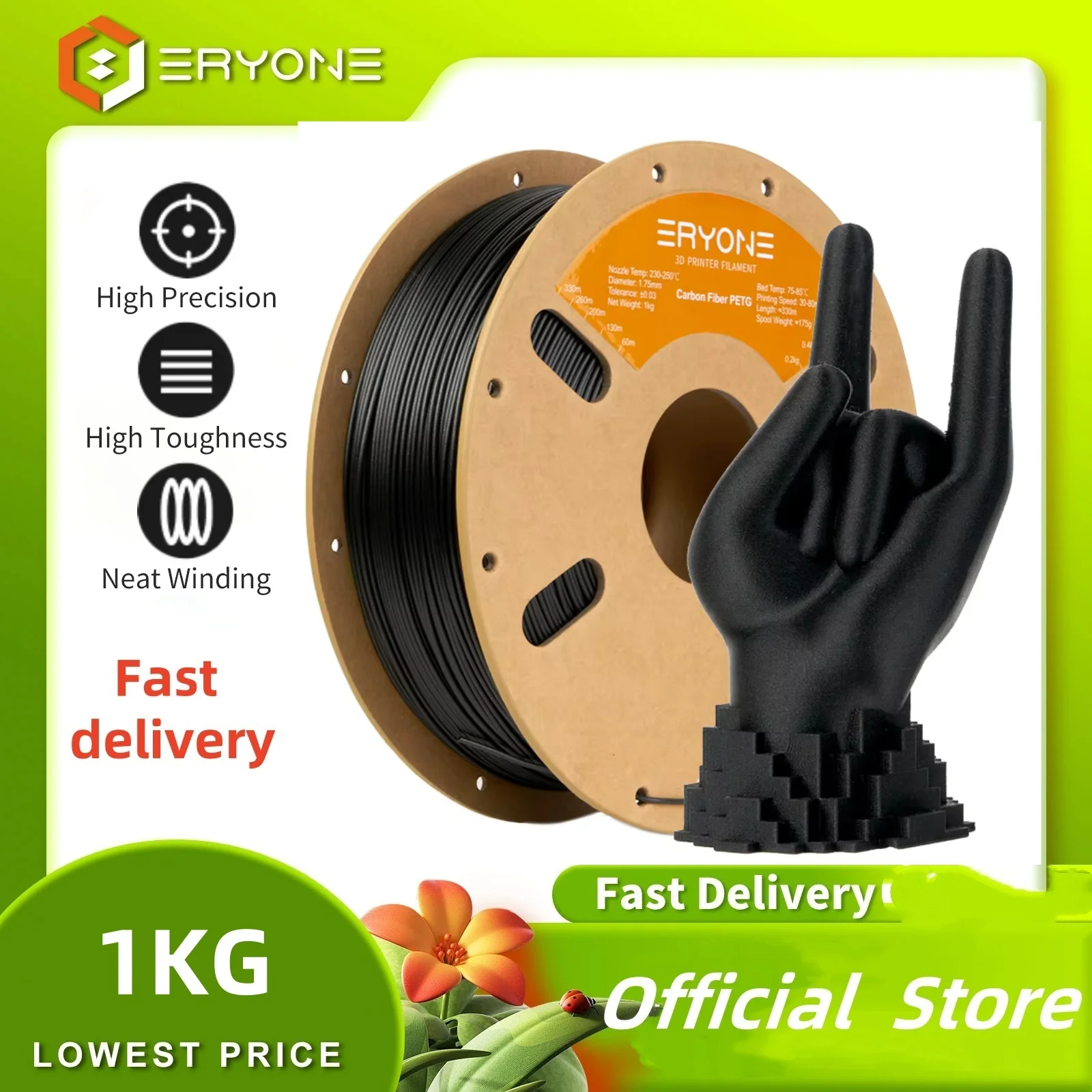
Official Store Deal
Expert Analysis Overview
The ERYONE PETG Carbon Fiber Filament is a high-performance material designed for makers who demand enhanced structural integrity and a distinctive aesthetic from their 3D prints. It is a compelling upgrade for functional parts and prototypes, moving beyond the capabilities of standard PETG.
This filament integrates 15% carbon fiber, a composite inclusion visible as fine, dark flecks within the material on the spool. This blend fundamentally alters the mechanical properties of the base PETG polymer. The carbon fiber strands act as reinforcement, significantly increasing the material's tensile strength and rigidity. This creates prints that are notably stiffer and less prone to flexing under load.
Printing with carbon fiber composites requires careful consideration of equipment. The abrasive nature of carbon fiber necessitates a hardened steel nozzle to prevent premature wear on standard brass nozzles. This is a small but critical investment for consistent, high-quality output. The material offers a unique surface finish, transitioning from a glossier PETG to a more aesthetic matte appearance.
Unlike pure PETG, which is known for its good layer adhesion and moderate flexibility, the carbon fiber variant pushes into a different performance bracket. It offers a bridge between the ease of printing PETG and the mechanical robustness often associated with materials like ABS or Nylon, but with reduced warping tendencies. This capability allows for more ambitious functional designs.
Each spool contains 1 kilogram of 1.75mm diameter filament, manufactured with high precision to maintain tight dimensional tolerances. Consistent filament diameter is vital for reliable extrusion and accurate print dimensions. Deviations can lead to under-extrusion, stringing, or nozzle clogging.
Eryone emphasizes a neat winding process, which is crucial for preventing tangles and snags during long print jobs. A well-wound spool ensures uninterrupted material feed into the extruder, reducing print failures and material waste. This attention to winding detail minimizes common frustrations for any 3D printer operator.
The filament's composition is engineered to mitigate common printing issues. Claims of "no bubble" and "no warping" suggest good moisture control during manufacturing and a stable thermal expansion profile. These characteristics are particularly beneficial when printing larger objects or parts with intricate geometries, where dimensional stability is paramount. Fewer failed prints save both time and material.
The carbon fiber integration results in significantly improved mechanical properties. Prints exhibit high toughness, meaning they are resilient to impact and less brittle than many other rigid filaments. This makes the material suitable for parts that will experience mechanical stress or occasional drops.
Demonstrations of a 3D printed object being used to strike a surface without shattering highlight this enhanced toughness. Such resilience is critical for end-use functional parts, tools, or protective casings. The material's inherent strength allows for thinner wall sections without compromising structural integrity.
Compared to standard PLA or even unreinforced PETG, this carbon fiber variant offers a substantial upgrade in durability. It allows makers to create parts that function effectively in more demanding environments, expanding the range of applications for desktop 3D printing. The ability to produce strong, tough prints opens up new design possibilities.
The unique surface texture, a blend between smooth and matte, provides an appealing aesthetic. This finish can often mask layer lines more effectively than glossy filaments, giving prints a more professional, machined look. The dark, often black or grey, color palette is typical of carbon fiber composites and exudes a high-tech, industrial feel.
The visual appeal is a significant factor for many projects, particularly those that are not purely functional. A clean, matte finish can elevate the perceived quality of a printed object. This can be particularly advantageous for prototypes or custom enclosures where appearance matters as much as performance.
Unlike shiny plastics, the subdued matte finish of carbon fiber PETG can reduce glare and fingerprints, maintaining a cleaner look over time. This characteristic contributes to the overall premium feel of the printed parts. It offers an aesthetic that differs notably from the often glossy or semi-glossy finish of unreinforced filaments.
Printing with PETG-CF generally follows similar parameters to standard PETG, albeit with some adjustments for the carbon fiber content. Optimal nozzle temperatures typically range from 230-250°C, and a heated bed around 70-90°C is usually recommended. Good bed adhesion is crucial for preventing print failures from lifting.
Adjusting retraction settings is important to minimize stringing, a common PETG characteristic. The carbon fiber can sometimes help reduce stringing slightly by increasing the material's viscosity. Experimentation with print speed and fan cooling is also advised to achieve the best surface quality and mechanical properties.
Post-processing carbon fiber PETG prints can be similar to regular PETG, involving sanding, painting, or coating if desired. However, the inherent matte finish often means less post-processing is needed for a presentable finish. The material's rigidity also makes it more amenable to tapping and threading for mechanical assembly, a significant advantage for functional designs.
The ERYONE PETG Carbon Fiber filament is positioned as a premium offering, reflecting the added cost and performance benefits of carbon fiber. At approximately $39.83 for a 1kg spool, it represents a cost-effective solution for achieving advanced material properties without investing in industrial-grade printers or more exotic filaments. The value lies in the enhanced capabilities it brings to a standard desktop setup.
Investing in this type of filament allows makers to push the boundaries of their projects, creating parts that were previously difficult or impossible with standard plastics. This expands the practical applications of a 3D printer, making it a more versatile tool for prototyping, functional parts, and even low-volume manufacturing. The long-term return on investment comes from producing more reliable and higher-performing components.
Compared to sourcing custom-machined parts or using weaker materials that might fail prematurely, this filament offers a durable and customizable alternative. The ability to iterate and produce strong, impact-resistant parts quickly at home provides significant cost and time savings. This enables rapid development cycles for complex projects, fostering continuous innovation within the maker community.
Imagine bringing to life custom drone frames that shrug off minor crashes, robust jig and fixture components for your workshop, or intricate robot parts that endure rigorous testing. This filament empowers creators to build with confidence, knowing their designs will stand up to real-world demands, offering a tangible leap in project capability and longevity. It transforms conceptual designs into durable, functional realities, expanding the horizons of personal fabrication.
Engineering with Advanced Composites
This filament integrates 15% carbon fiber, a composite inclusion visible as fine, dark flecks within the material on the spool. This blend fundamentally alters the mechanical properties of the base PETG polymer. The carbon fiber strands act as reinforcement, significantly increasing the material's tensile strength and rigidity. This creates prints that are notably stiffer and less prone to flexing under load.
Printing with carbon fiber composites requires careful consideration of equipment. The abrasive nature of carbon fiber necessitates a hardened steel nozzle to prevent premature wear on standard brass nozzles. This is a small but critical investment for consistent, high-quality output. The material offers a unique surface finish, transitioning from a glossier PETG to a more aesthetic matte appearance.
Unlike pure PETG, which is known for its good layer adhesion and moderate flexibility, the carbon fiber variant pushes into a different performance bracket. It offers a bridge between the ease of printing PETG and the mechanical robustness often associated with materials like ABS or Nylon, but with reduced warping tendencies. This capability allows for more ambitious functional designs.
Material Science and Print Consistency
Each spool contains 1 kilogram of 1.75mm diameter filament, manufactured with high precision to maintain tight dimensional tolerances. Consistent filament diameter is vital for reliable extrusion and accurate print dimensions. Deviations can lead to under-extrusion, stringing, or nozzle clogging.
Eryone emphasizes a neat winding process, which is crucial for preventing tangles and snags during long print jobs. A well-wound spool ensures uninterrupted material feed into the extruder, reducing print failures and material waste. This attention to winding detail minimizes common frustrations for any 3D printer operator.
The filament's composition is engineered to mitigate common printing issues. Claims of "no bubble" and "no warping" suggest good moisture control during manufacturing and a stable thermal expansion profile. These characteristics are particularly beneficial when printing larger objects or parts with intricate geometries, where dimensional stability is paramount. Fewer failed prints save both time and material.
Crafting with Enhanced Properties
The carbon fiber integration results in significantly improved mechanical properties. Prints exhibit high toughness, meaning they are resilient to impact and less brittle than many other rigid filaments. This makes the material suitable for parts that will experience mechanical stress or occasional drops.
Demonstrations of a 3D printed object being used to strike a surface without shattering highlight this enhanced toughness. Such resilience is critical for end-use functional parts, tools, or protective casings. The material's inherent strength allows for thinner wall sections without compromising structural integrity.
Compared to standard PLA or even unreinforced PETG, this carbon fiber variant offers a substantial upgrade in durability. It allows makers to create parts that function effectively in more demanding environments, expanding the range of applications for desktop 3D printing. The ability to produce strong, tough prints opens up new design possibilities.
Aesthetic and Tactile Qualities
The unique surface texture, a blend between smooth and matte, provides an appealing aesthetic. This finish can often mask layer lines more effectively than glossy filaments, giving prints a more professional, machined look. The dark, often black or grey, color palette is typical of carbon fiber composites and exudes a high-tech, industrial feel.
The visual appeal is a significant factor for many projects, particularly those that are not purely functional. A clean, matte finish can elevate the perceived quality of a printed object. This can be particularly advantageous for prototypes or custom enclosures where appearance matters as much as performance.
Unlike shiny plastics, the subdued matte finish of carbon fiber PETG can reduce glare and fingerprints, maintaining a cleaner look over time. This characteristic contributes to the overall premium feel of the printed parts. It offers an aesthetic that differs notably from the often glossy or semi-glossy finish of unreinforced filaments.
Printing Dynamics and Post-Processing
Printing with PETG-CF generally follows similar parameters to standard PETG, albeit with some adjustments for the carbon fiber content. Optimal nozzle temperatures typically range from 230-250°C, and a heated bed around 70-90°C is usually recommended. Good bed adhesion is crucial for preventing print failures from lifting.
Adjusting retraction settings is important to minimize stringing, a common PETG characteristic. The carbon fiber can sometimes help reduce stringing slightly by increasing the material's viscosity. Experimentation with print speed and fan cooling is also advised to achieve the best surface quality and mechanical properties.
Post-processing carbon fiber PETG prints can be similar to regular PETG, involving sanding, painting, or coating if desired. However, the inherent matte finish often means less post-processing is needed for a presentable finish. The material's rigidity also makes it more amenable to tapping and threading for mechanical assembly, a significant advantage for functional designs.
Value Proposition for the Maker
The ERYONE PETG Carbon Fiber filament is positioned as a premium offering, reflecting the added cost and performance benefits of carbon fiber. At approximately $39.83 for a 1kg spool, it represents a cost-effective solution for achieving advanced material properties without investing in industrial-grade printers or more exotic filaments. The value lies in the enhanced capabilities it brings to a standard desktop setup.
Investing in this type of filament allows makers to push the boundaries of their projects, creating parts that were previously difficult or impossible with standard plastics. This expands the practical applications of a 3D printer, making it a more versatile tool for prototyping, functional parts, and even low-volume manufacturing. The long-term return on investment comes from producing more reliable and higher-performing components.
Compared to sourcing custom-machined parts or using weaker materials that might fail prematurely, this filament offers a durable and customizable alternative. The ability to iterate and produce strong, impact-resistant parts quickly at home provides significant cost and time savings. This enables rapid development cycles for complex projects, fostering continuous innovation within the maker community.
Imagine bringing to life custom drone frames that shrug off minor crashes, robust jig and fixture components for your workshop, or intricate robot parts that endure rigorous testing. This filament empowers creators to build with confidence, knowing their designs will stand up to real-world demands, offering a tangible leap in project capability and longevity. It transforms conceptual designs into durable, functional realities, expanding the horizons of personal fabrication.