EARU EAMT1 Multifunction Timer Relay
Official Store Deal
Expert Analysis Overview
Precision Timing: The EARU EAMT1 Multifunction Relay Examined
The EARU EAMT1 multifunction timer relay is a highly adaptable control module engineered for diverse industrial and home automation applications requiring precise timing sequences. This device stands out as a cost-effective solution for integrating complex timing logic into existing electrical systems, mitigating the need for multiple single-function relays. Its wide operational voltage range and extensive timing capabilities position it as a versatile component for maintenance technicians and system integrators alike.Core Mechanics: Engineering Underpinning
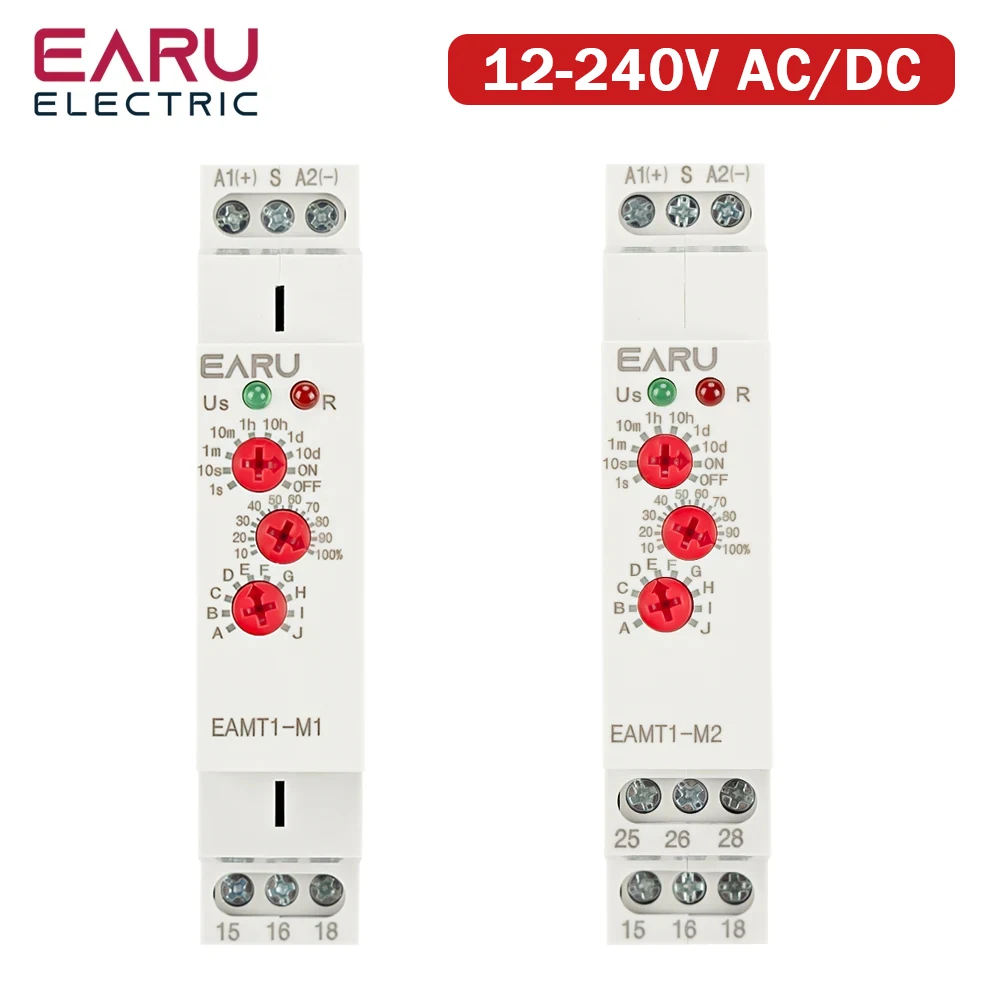
The visual data confirms a robust design, featuring clearly labeled terminals for power input (A1, A2), trigger (S), and two sets of changeover contacts (15-16-18 and 25-26-28). These screw terminals are critical for secure wire connections. Proper torque application is essential.Such a terminal block configuration facilitates straightforward integration into various control circuits, ensuring reliable signal transmission. Unlike push-in or spring-clamp terminals often found in consumer-grade devices, screw terminals offer a more permanent and vibration-resistant connection, vital for industrial environments.
Compared to standard single-function relays, the EAMT1's dual changeover contacts provide enhanced flexibility, allowing for more intricate control schemes without additional hardware. This capability is a significant upgrade for complex automation tasks.
Operational Modalities: Orchestrating Time
The relay offers an impressive 10 adjustable delay functions, ranging from basic 'On Delay' (A) to more sophisticated 'Pulse Generator' (J) and 'Latching Relay' (I) modes. Each function is selectable via a rotary knob, providing tangible control over the timing behavior. This broad functionality addresses a wide spectrum of automation challenges.These diverse modes enable the relay to perform tasks such as sequential motor starts, timed lighting control, or even simple security system delays. The ability to switch between these functions on a single device streamlines inventory and simplifies system design. Many applications benefit from this versatility.
Generic timer relays often provide only one or two fixed functions, limiting their utility and forcing technicians to stock multiple relay types. The EAMT1 consolidates this functionality, offering a comprehensive timing toolkit within a single compact unit. This reduces complexity and potential points of failure.
Timing Precision: Setting the Interval
Two red rotary potentiometers are visible on the front face, dedicated to time setting. The upper knob selects the delay gear (e.g., 's' for seconds, 'm' for minutes, 'h' for hours, 'd' for days, 'ON', 'OFF'), while the lower knob provides fine adjustment of the delay time from 10% to 100%. This dual-knob approach allows for precise calibration.This granular control over timing is crucial for applications where exact delays are paramount, such as process control or machinery sequencing. The ability to set delays from 0.1 seconds up to 10 days covers virtually all common timing requirements. Fine-tuning is straightforward.
Many entry-level timers offer only coarse adjustments or limited time ranges, often forcing compromises in application design. The EAMT1's wide range and fine adjustment capabilities surpass these limitations, providing a more robust and adaptable timing solution. This is a clear advantage for precision-dependent tasks.
Power Adaptability: Universal Input
A key specification highlighted is the wide voltage range of AC/DC 12-240V (50-60Hz). This broad compatibility means the relay can be powered by virtually any common control voltage found in industrial or residential settings. This flexibility simplifies procurement and installation.Such a universal input voltage eliminates the need for specific relay variants for different power supplies, reducing complexity in system design and maintenance. Technicians can stock a single type of relay for various projects. This saves time and resources.
In contrast, many specialized relays are limited to a narrow voltage band (e.g., 24V DC or 230V AC), requiring careful selection and increasing the likelihood of ordering incorrect parts. The EAMT1's wide range is a significant convenience. It simplifies inventory management.
Durability and Longevity: Built for Service
The product parameters indicate a mechanical life of 1x10^7 operations and an electrical life (AC1) of 1x10^5 operations. These figures suggest a component designed for sustained performance in demanding environments. Such ratings are indicative of quality internal components.These high cycle ratings are essential for applications involving frequent switching, ensuring the relay maintains its operational integrity over extended periods. A long operational life minimizes downtime and replacement costs. Reliability is paramount in automation.
Compared to cheaper, lower-rated relays that might fail prematurely under continuous use, the EAMT1's specifications point to a more durable and reliable option. Investing in components with higher life ratings reduces long-term maintenance burdens. This is a smart economic choice.
Visual Feedback: Status Indicators
Green and red LED indicators are present on the front panel. The green LED signals the supply status (Us), confirming the relay is powered. The red LED indicates the output status, showing when the relay contacts have switched. These indicators provide immediate visual feedback.These simple visual cues are invaluable for troubleshooting and system monitoring, allowing technicians to quickly ascertain the operational state of the relay without needing additional test equipment. A quick glance confirms functionality. This saves diagnostic time.
Many basic relays lack such clear status indicators, making diagnostics more challenging and time-consuming. The EAMT1's integrated LEDs enhance user experience and simplify maintenance tasks. They are a practical addition.
Installation Convenience: DIN Rail Mounting
The form factor is clearly designed for DIN rail mounting, a standard in industrial control panels. This allows for quick, secure, and organized installation alongside other modular components. The compact 18mm width is space-efficient.DIN rail mounting provides a standardized and scalable method for organizing control components within an enclosure, facilitating neat wiring and easy expansion or replacement. This modularity is a cornerstone of modern control panel design. Installation is simplified.
Unlike relays requiring individual panel mounting or custom enclosures, the DIN rail compatibility of the EAMT1 ensures seamless integration into professional control systems. This adherence to industry standards is a significant advantage. It promotes system consistency.
Environmental Resilience: Operating Conditions
The specified operating temperature range of -20°C to +55°C indicates the relay's suitability for a broad array of environmental conditions. A pollution degree of 2 suggests it is appropriate for most typical industrial indoor environments. This wide range enhances application flexibility.This robust temperature tolerance allows the relay to function reliably in unconditioned spaces or within enclosures where temperatures might fluctuate significantly. It ensures consistent performance across various climates. Extreme conditions are handled.
Some electronic components are sensitive to temperature extremes, limiting their deployment. The EAMT1's specified operating range demonstrates a design capable of handling common industrial temperature variations. This broadens its potential applications.
The Upgrade Frame: Beyond Basic Timing
Unlike single-function, fixed-voltage relays that often necessitate complex wiring or multiple units for intricate timing sequences, the EARU EAMT1 integrates ten distinct timing functions and a universal AC/DC 12-240V input into a single, compact DIN rail module. This design ensures unparalleled versatility and simplifies system architecture, allowing technicians to manage diverse automation tasks with a single component. The EAMT1 transforms what could be a cluttered control panel into an organized, efficient system, offering a significant upgrade in capability and ease of maintenance over conventional alternatives. Its robust mechanical and electrical life ratings further ensure long-term, reliable operation, reducing the total cost of ownership compared to less durable options.Imagine a control panel where complex timing sequences are managed by a single, clearly labeled device, easily configured with intuitive rotary knobs. Envision the reduction in spare parts inventory, knowing one relay can serve multiple purposes across various voltage requirements. This EARU EAMT1 timer relay provides the foundational reliability and operational flexibility necessary to streamline automation projects, ensuring precise control and minimizing troubleshooting efforts for years to come. It is a smart investment for any technician or engineer seeking to optimize their electrical control systems. This device simplifies complex timing challenges.