EARU EACT Series Modular AC Contactor for DIN Rail
Official Store Deal
Expert Analysis Overview
Precision Switching Dynamics: The EARU EACT Series
The EARU EACT Series Modular AC Contactor is a foundational electrical switching component, meticulously engineered for reliable power control in residential and light commercial automation systems. This device serves as a critical interface for managing higher current loads with a low-power control signal, bridging the gap between smart home controllers and robust electrical appliances. Its modular design simplifies integration into existing DIN rail setups, a significant advantage for system builders.
Core Functionality and Contact Configurations
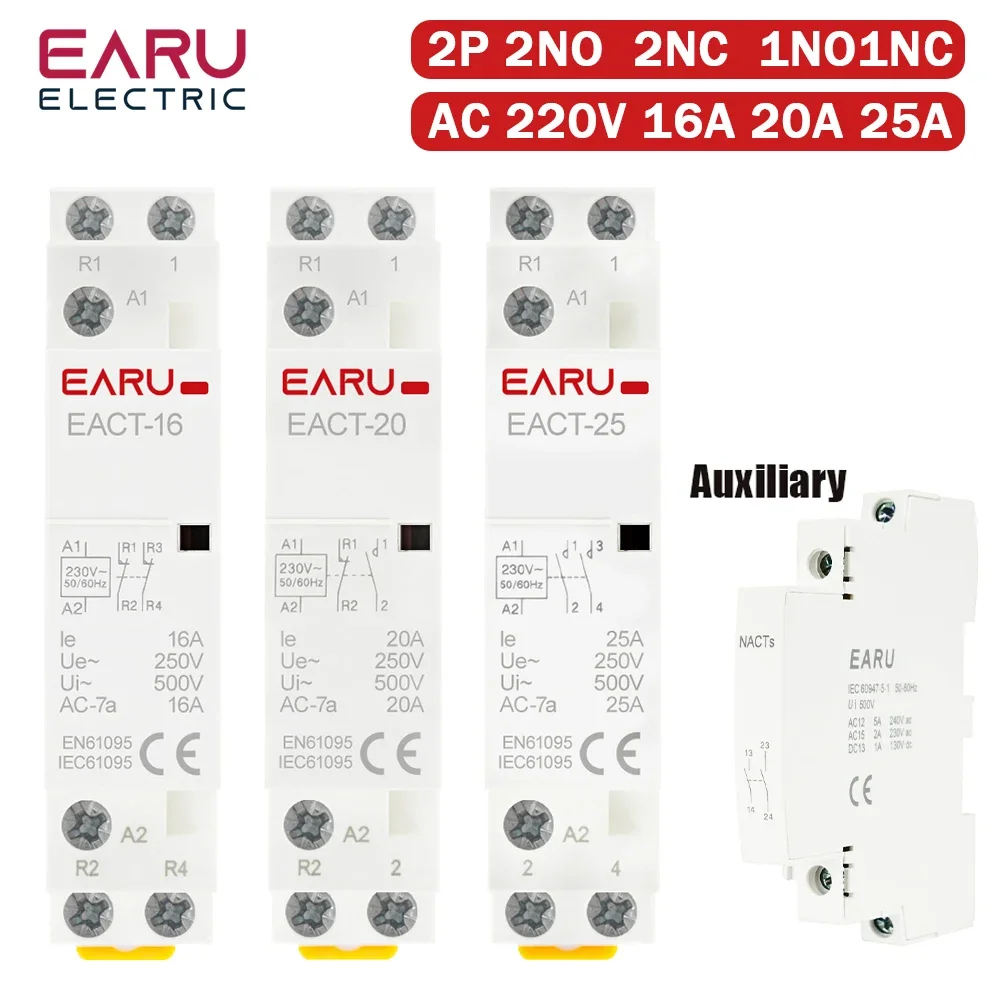
These contactors are designed to handle various load requirements, available in 16A, 20A, and 25A ratings. Each model operates on a standard AC 220V/230V, 50/60Hz supply, making them suitable for most household and light industrial applications. The availability of 2P (2-pole) configurations with options like 2NO (normally open), 2NC (normally closed), or 1NO1NC (one normally open, one normally closed) contacts provides flexibility. This versatility allows for diverse control schemes. For instance, a 2NO configuration is ideal for direct load switching, while 1NO1NC offers status indication capabilities alongside power control.
Unlike traditional, bulkier relays that demand significant panel space, the EARU EACT series offers a compact, DIN-rail mountable solution. This design choice directly addresses the common pain point of limited enclosure space in modern electrical installations. The streamlined form factor ensures a cleaner, more organized panel layout, which is crucial for both aesthetics and ease of maintenance. The compact footprint is a clear benefit.
Structural Integrity and Installation
The physical dimensions of the main contactor are 18mm wide, 81mm high, and 66mm deep, conforming to standard DIN rail module sizes. The auxiliary contact module is even slimmer at 9mm wide. These precise measurements ensure seamless integration onto a 35mm DIN rail, a ubiquitous standard in electrical panels. The visible plastic housing appears robust, suggesting adequate protection for the internal electrical components against dust and minor impacts.
Installation involves simple terminal connections for both the coil and the main contacts. The clear labeling on the device, as depicted in the product imagery, aids in correct wiring, reducing the potential for installation errors. This clarity is particularly beneficial for DIY enthusiasts or technicians working under time constraints. Proper connection is straightforward.
Compared to generic, unbranded contactors, the EARU EACT series emphasizes clear dimensional specifications and contact configurations. This transparency in design details allows installers to plan their panel layouts with greater accuracy, avoiding last-minute fitment issues. The standardized sizing ensures compatibility across various electrical enclosures.
Operational Versatility and Performance Metrics
The operational parameters of these contactors are well-defined, indicating a focus on reliability. A rated frequency of 50/60Hz covers global power standards. The insulation voltage (Ui) of 500VAC and rated impulse withstand voltage (Uimp) of 2.5kV (for 12/24/48VAC) highlight the device's capability to withstand electrical transients and provide safe isolation. This robust insulation is critical for preventing electrical breakdown and ensuring long-term operational safety. Safety is paramount.
With an electrical life of 100,000 cycles, these contactors are built for sustained, frequent operation. This high cycle count translates directly into extended service life, minimizing the need for premature replacements and reducing maintenance overhead. For applications like smart home lighting or HVAC control, where switching occurs multiple times a day, this durability offers significant long-term value. Fewer replacements save money.
Many entry-level switching devices often have lower electrical life ratings, leading to earlier failure in high-demand scenarios. The EARU EACT series, by contrast, positions itself as a more durable alternative, offering a better return on investment over its operational lifespan. This enhanced reliability is a key differentiator in a competitive market.
Thermal Management and Environmental Resilience
The operating temperature range of -5°C to +60°C indicates a broad environmental tolerance. This makes the contactors suitable for installation in various indoor environments, from climate-controlled server rooms to less regulated utility closets. Effective thermal management is crucial for preventing premature component degradation. The specified range is adequate for most residential settings.
Furthermore, the degree of protection (IEC 61095): IP20 signifies protection against solid objects larger than 12.5mm, but no protection against liquids. This IP rating is typical for components designed for installation within an enclosed electrical panel, where they are shielded from direct exposure to moisture or dust. Panel integration is key.
While some industrial-grade contactors offer higher IP ratings for harsh environments, the IP20 rating of the EARU EACT series is perfectly acceptable and cost-effective for its intended application in household and light commercial panels. It avoids unnecessary over-engineering for environments where it will already be protected, thus keeping the unit affordable. This is a logical trade-off.
Auxiliary Contact Integration
An auxiliary contact module (NCACT-x) is available, providing additional contact points for more complex control logic or status feedback. This module offers 2NO, 1NO1NC contact configurations, rated for AC-12 240V (resistive load <5A) and AC-15 230V (inductive load <2A). DC-13 130V (inductive load <1A) is also supported. The ability to easily add auxiliary contacts expands the functionality of the main contactor without requiring separate, bulky relays. This modularity is a significant design advantage.
This feature allows for advanced automation scenarios, such as interlocking circuits, providing feedback to a building management system, or creating manual override switches. For example, a smart home system could use the main contactor to switch a boiler, while an auxiliary contact signals the boiler's operational status back to the central controller. Complex control is simplified.
Many basic contactors lack integrated auxiliary contact options, forcing users to implement external, often less elegant, solutions. The EARU EACT's dedicated auxiliary module streamlines the system design and reduces wiring complexity, offering a more professional and integrated solution. This design choice enhances system flexibility.
The Value Proposition in Modern Automation
The EARU EACT series offers a compelling value proposition for anyone looking to automate electrical loads reliably and efficiently. Its robust specifications, combined with a modular, DIN rail-mounted design, make it an excellent choice for smart homes, hotels, and small commercial buildings. The focus on durability and ease of installation translates into lower total cost of ownership. This is a smart investment.
Imagine a scenario where your smart home system effortlessly manages your high-power appliances, from water heaters to electric vehicle chargers, all controlled by reliable, compact contactors that blend seamlessly into your electrical panel. This system operates quietly and efficiently, providing peace of mind and energy savings. The ability to expand functionality with auxiliary contacts means your automation system can grow with your needs, adapting to new demands without a complete overhaul. This is the future of intelligent power management, delivered with precision and dependability, ensuring your electrical infrastructure is not just functional, but truly smart and resilient.