EARU DC Solar Molded Case Circuit Breaker
Official Store Deal
Expert Analysis Overview
Essential Protection for DC Photovoltaic Systems
The EARU DC Solar Molded Case Circuit Breaker (MCCB) is a critical safety device engineered for direct current (DC) photovoltaic (PV) and battery isolation applications. This device is designed to safeguard DC circuits from the damaging effects of overloads and short circuits, ensuring the longevity and operational integrity of solar power installations. Its robust construction and adherence to safety standards make it a reliable choice for professional and prosumer solar setups.
Core Functionality and Design Principles
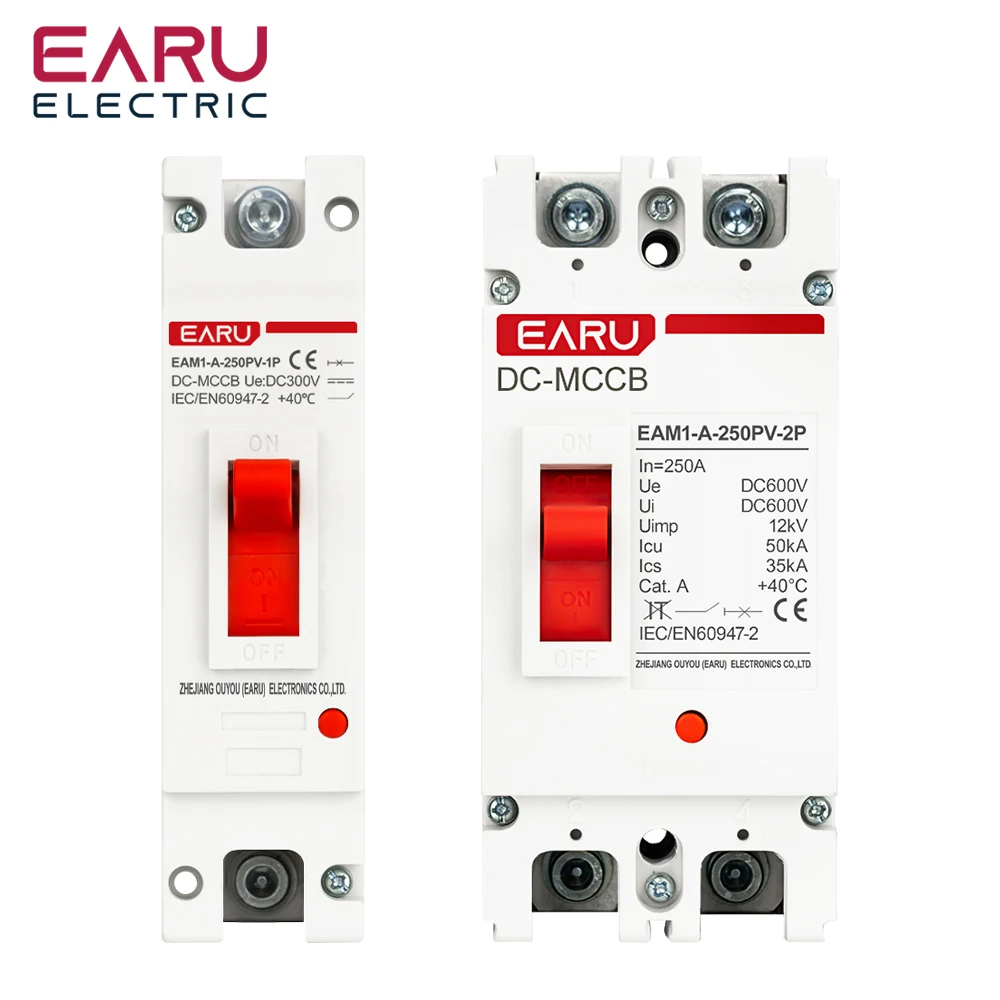
The primary function of this DC MCCB is to provide rapid and reliable circuit interruption when fault conditions arise. It acts as an automatic switch that protects electrical circuits from damage caused by excessive current, which can result from an overload or a short circuit. The visible red switching handle clearly indicates the breaker's status, offering immediate visual feedback on the circuit's condition.
Unlike standard AC circuit breakers, this unit is specifically calibrated for DC systems, which present unique challenges due to the absence of a zero-crossing point in the current waveform. DC arcs are more difficult to extinguish, necessitating specialized designs for effective interruption. The EARU MCCB addresses this with its internal architecture, optimized for DC fault clearing.
This specialized design ensures that, in the event of a fault, the circuit is disconnected quickly and safely. The rapid disconnection prevents potential damage to expensive solar panels, inverters, and battery banks. It's a vital component for system stability.
Construction and Durability
The construction of the EARU DC MCCB emphasizes both safety and longevity. The shell is manufactured from nylon flame retardant material, a critical feature for electrical safety. This material exhibits high fire resistance and insulation durability, significantly reducing the risk of fire propagation in the event of an internal fault.
High-conductivity silver contacts are employed within the breaker. Silver is chosen for its superior electrical conductivity and resistance to oxidation, which ensures efficient current transfer and minimizes power loss. Strong contacts are essential for reliable operation.
These material choices contribute directly to the breaker's overall reliability and safety profile. The use of flame-retardant materials provides an additional layer of protection against thermal events, a common concern in high-power electrical systems. This is a significant upgrade over lesser-quality plastics that might melt or ignite under fault conditions.
Performance Metrics and Safety Compliance
The performance specifications of the EARU DC MCCB are clearly detailed, indicating its suitability for demanding DC applications. Available in 1P/2P configurations, it supports rated currents from 100A up to 250A, with rated voltages up to DC600V for 2P models and DC300V for 1P models. The breaking capacity of 50kA is a robust rating, signifying its ability to safely interrupt very high fault currents without catastrophic failure.
The tripping time is specified as less than 0.1 seconds, ensuring immediate disconnection upon detecting an overload or short circuit. This rapid response is crucial for minimizing damage to connected equipment and preventing electrical fires. A quick trip is paramount.
Certification with CE standards indicates compliance with European safety, health, and environmental protection requirements. This certification provides assurance that the product meets recognized international safety benchmarks. The mechanical life of ≥80000 cycles and electrical life of ≥20000 cycles suggest a durable and long-lasting device, capable of numerous operations over its lifespan. These figures represent a substantial operational lifespan compared to many entry-level circuit protection devices.
Installation and User Experience
The EARU DC MCCB features a double insulation install design, incorporating an insulated internal structure. This design simplifies the installation process and allows users to install accessories with greater ease and safety. The insulated structure minimizes the risk of accidental contact with live parts during installation or maintenance.
Its large handle design is engineered for high-hardness operation, offering resistance to compression and wear. This ergonomic design ensures that the operating handle is not easily damaged and provides a secure grip for manual switching. A firm grip is always safer.
The inclusion of spacers for 2P models is a thoughtful addition, facilitating proper mounting and ensuring adequate clearance. The clear parametric diagrams provided for different current ratings (100A/125A and 160A/200A/250A) assist in selecting the correct physical size for the installation space. These details are crucial for proper integration into existing or new electrical panels.
Overload and Short-Circuit Protection
This MCCB provides comprehensive protection against both overload and short-circuit conditions. Overload protection prevents damage when the current exceeds the rated capacity for an extended period, while short-circuit protection immediately disconnects the circuit during a sudden, massive surge of current. The device's ability to disconnect quickly, within 0.1 seconds, is a testament to its protective capabilities.
In a scenario where a short circuit occurs, the circuit breaker will disconnect instantly. This rapid response is vital for preventing severe damage to wiring, components, and potential fire hazards. Such immediate action is a core safety feature.
Compared to fuses, which require replacement after each fault, a circuit breaker can be reset, offering a more convenient and cost-effective solution for repeated fault conditions. This reset capability enhances operational efficiency and reduces downtime in solar installations. It's a clear advantage for maintenance.
Terminal Quality and Wire Gauge Considerations
The visible terminals on the EARU DC MCCB appear robust, designed to securely accommodate appropriate wire gauges for the specified current ratings. Proper terminal quality is paramount for maintaining low resistance connections and preventing hotspots, which can lead to energy loss and fire risks. The terminals are designed for direct connection, ensuring a solid electrical path.
For a 100A or 250A circuit, selecting the correct wire gauge is non-negotiable. The breaker's current rating dictates the minimum wire size required to safely carry the load without overheating. Users must consult electrical codes and standards to ensure proper wire sizing for their specific application. Incorrect wire gauge can lead to dangerous overheating.
This attention to terminal design and the implied need for correct wire gauge selection underscores the product's focus on safety. The terminals are built to withstand the mechanical forces of tightening and the electrical stresses of high current flow. This ensures a reliable connection point.
The Long-Term Value Proposition
Investing in a high-quality DC MCCB like the EARU model translates into significant long-term value. The initial cost is offset by the protection it provides to expensive solar equipment, preventing costly repairs or replacements due to electrical faults. Its durability and reliable performance contribute to a lower total cost of ownership over the lifespan of the solar system.
Moreover, the peace of mind that comes with knowing your electrical system is protected by a certified and robust device is invaluable. The compliance with CE standards and the specified mechanical and electrical life cycles indicate a product built for endurance. This device is built to last.
Imagine a solar power system operating with unwavering reliability, protected by a device that stands guard against electrical anomalies. This circuit breaker ensures that your investment in renewable energy remains secure, delivering consistent power without the constant worry of electrical hazards. It allows for continuous energy generation, safeguarding both equipment and personnel, and providing a foundation of safety for years of sustainable operation.