Dual-Channel 18650/21700 Battery Capacity & Resistance Tester
Official Store Deal
Expert Analysis Overview
The Dual-Channel 18650/21700 Battery Capacity & Resistance Tester is a focused diagnostic instrument engineered for hobbyists and professionals requiring precise evaluation of common cylindrical lithium-ion cells. This device moves beyond simple voltage checks, offering comprehensive insights into battery health through its charging, discharging, and internal resistance measurement capabilities. It provides a critical tool for anyone managing battery packs, ensuring optimal performance and safety for various applications.
This tester provides a critical suite of diagnostic functions for 18650 and 21700 lithium-ion batteries. It measures cumulative capacity in mAh, cumulative energy in MWh, and internal resistance in mR. These metrics are fundamental for assessing the true condition of a battery, far beyond what a basic multimeter can offer. Understanding these values helps in identifying weak cells within a pack, preventing premature failures, and maximizing the lifespan of battery-powered devices. The unit offers real-time voltage and current readings. This is crucial for monitoring the charging and discharging process.
Unlike simpler load testers that only discharge, this unit integrates both charging and discharging cycles. This allows for a more accurate capacity measurement, as it accounts for the full charge and discharge curve. The automatic mode supports up to nine charging/discharging cycles, which is invaluable for conditioning new cells or rejuvenating older ones. Such multi-cycle testing provides a more reliable assessment of a battery's actual usable capacity under repeated stress. It offers a clear picture of cell degradation.
The internal resistance measurement is particularly noteworthy. High internal resistance indicates a battery struggling to deliver current efficiently, leading to heat generation and reduced performance under load. For power tool users or those building custom battery packs, identifying cells with elevated internal resistance is paramount for safety and efficiency. This tester makes that critical diagnostic accessible, preventing potential issues before they arise. It’s a smart investment for long-term battery health.
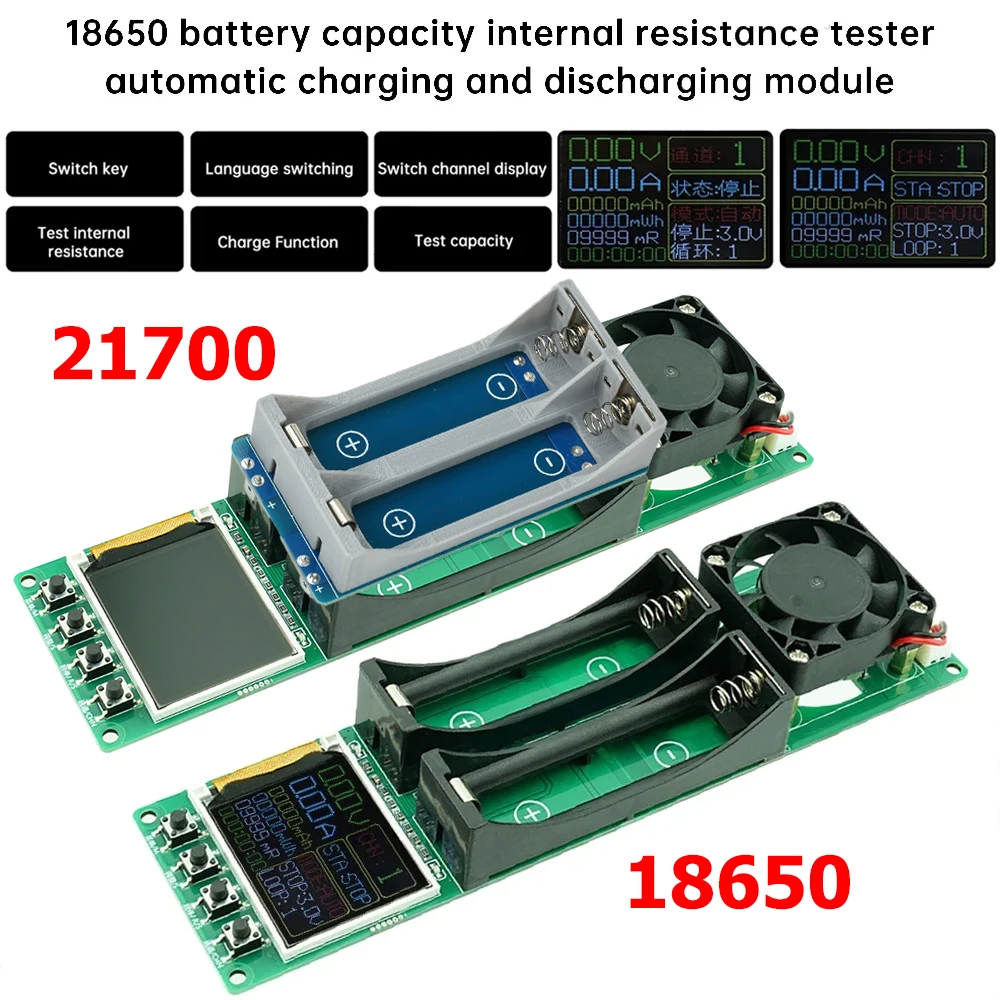
The physical design of this battery tester emphasizes functionality and practicality for a workshop environment. It features two independent channels, each with its own battery holder, allowing simultaneous testing of two cells. This dual-channel capability significantly boosts efficiency when processing multiple batteries. The holders are designed to accommodate both 18650 and 21700 cells, offering versatility for common lithium-ion battery types. They secure the cells firmly.
A prominent feature is the integrated cooling fan. This fan is essential during discharge cycles, where significant heat can be generated, especially at higher currents. Effective heat dissipation protects both the battery under test and the tester's internal components, ensuring consistent and accurate measurements over extended periods. Without active cooling, prolonged discharge tests could lead to thermal runaway or inaccurate readings due to temperature fluctuations. The fan helps maintain operational stability.
The main board, visible in the product images, appears to be a robust PCB with clearly labeled components. The connections for power (Type-C 5V and solder joints) offer flexible integration into a workbench setup. The overall construction suggests a tool built for repeated use rather than a delicate laboratory instrument. While not designed for extreme drops, its open-board layout with a protective casing around the display and battery slots suggests a practical approach to durability in a typical workshop setting. It handles daily demands well.
The user interface is driven by a clear digital display that presents all relevant data simultaneously. Real-time voltage, current, cumulative capacity, cumulative energy, internal resistance, accumulated running time, and cycle counts are all visible at a glance. This eliminates the need to cycle through menus to find critical information, streamlining the testing process. The display is bright and legible, even in varied lighting conditions, which is a significant advantage in a busy workshop. It provides immediate feedback.
Control is managed through a set of intuitive buttons: Adjustment/S button, Menu/M button, Start-stop/R/S button, and Channel/CHN button. These controls allow users to navigate through different testing modes (e.g., automatic, charge, discharge, internal resistance), adjust parameters like stop voltage, and select which channel to operate. The presence of dedicated channel status indicators (lights for stop, running, complete) further enhances operational clarity, making it easy to track the progress of each battery test without constant screen monitoring. It’s simple to operate.
Unlike many entry-level testers that offer limited modes, this unit provides a comprehensive suite of functions. The ability to set a stop discharging low voltage is a crucial safety feature, preventing over-discharge that can permanently damage lithium-ion cells. The automatic cycling mode simplifies batch testing and characterization, a task that would otherwise be tedious and prone to error if performed manually. This level of control and feedback makes the tester a powerful diagnostic tool, enabling users to confidently assess and manage their battery inventory. It optimizes battery performance.
For anyone heavily reliant on 18650 or 21700 batteries, this tester represents a significant return on investment. The ability to accurately measure capacity and internal resistance means identifying weak or failing cells before they compromise an entire battery pack or device. This preventative maintenance extends the life of valuable batteries and prevents costly damage to equipment. It's an essential tool for maintaining the integrity of battery-powered systems, from flashlights to custom power banks. It saves money in the long run.
Compared to the generic, single-function battery checkers, this device offers a multi-faceted diagnostic approach. The integration of charging, discharging, and internal resistance testing into a single unit streamlines the workflow and provides a holistic view of battery health. This saves time and reduces the need for multiple specialized tools. For a carpenter building custom battery packs for cordless tools, or a hobbyist managing RC batteries, the efficiency gains are substantial. It’s a comprehensive solution.
The competitive pricing of this unit, considering its dual-channel capability and advanced features, positions it as an accessible yet powerful tool. It democratizes sophisticated battery diagnostics, making it available to a broader audience beyond professional labs. The detailed data provided by the display empowers users to make informed decisions about their batteries, ensuring optimal performance and safety. Imagine confidently assembling a battery pack, knowing each cell has been thoroughly vetted for capacity and internal resistance, leading to reliable and long-lasting power for your projects. This tester provides that assurance, making every battery decision an informed one and enhancing the overall quality and safety of your work. It truly elevates your battery management capabilities.
Unveiling Cell Health: Comprehensive Battery Diagnostics
This tester provides a critical suite of diagnostic functions for 18650 and 21700 lithium-ion batteries. It measures cumulative capacity in mAh, cumulative energy in MWh, and internal resistance in mR. These metrics are fundamental for assessing the true condition of a battery, far beyond what a basic multimeter can offer. Understanding these values helps in identifying weak cells within a pack, preventing premature failures, and maximizing the lifespan of battery-powered devices. The unit offers real-time voltage and current readings. This is crucial for monitoring the charging and discharging process.
Unlike simpler load testers that only discharge, this unit integrates both charging and discharging cycles. This allows for a more accurate capacity measurement, as it accounts for the full charge and discharge curve. The automatic mode supports up to nine charging/discharging cycles, which is invaluable for conditioning new cells or rejuvenating older ones. Such multi-cycle testing provides a more reliable assessment of a battery's actual usable capacity under repeated stress. It offers a clear picture of cell degradation.
The internal resistance measurement is particularly noteworthy. High internal resistance indicates a battery struggling to deliver current efficiently, leading to heat generation and reduced performance under load. For power tool users or those building custom battery packs, identifying cells with elevated internal resistance is paramount for safety and efficiency. This tester makes that critical diagnostic accessible, preventing potential issues before they arise. It’s a smart investment for long-term battery health.
Workshop Readiness: Design and Durability
The physical design of this battery tester emphasizes functionality and practicality for a workshop environment. It features two independent channels, each with its own battery holder, allowing simultaneous testing of two cells. This dual-channel capability significantly boosts efficiency when processing multiple batteries. The holders are designed to accommodate both 18650 and 21700 cells, offering versatility for common lithium-ion battery types. They secure the cells firmly.
A prominent feature is the integrated cooling fan. This fan is essential during discharge cycles, where significant heat can be generated, especially at higher currents. Effective heat dissipation protects both the battery under test and the tester's internal components, ensuring consistent and accurate measurements over extended periods. Without active cooling, prolonged discharge tests could lead to thermal runaway or inaccurate readings due to temperature fluctuations. The fan helps maintain operational stability.
The main board, visible in the product images, appears to be a robust PCB with clearly labeled components. The connections for power (Type-C 5V and solder joints) offer flexible integration into a workbench setup. The overall construction suggests a tool built for repeated use rather than a delicate laboratory instrument. While not designed for extreme drops, its open-board layout with a protective casing around the display and battery slots suggests a practical approach to durability in a typical workshop setting. It handles daily demands well.
Operational Clarity: Understanding Your Power Sources
The user interface is driven by a clear digital display that presents all relevant data simultaneously. Real-time voltage, current, cumulative capacity, cumulative energy, internal resistance, accumulated running time, and cycle counts are all visible at a glance. This eliminates the need to cycle through menus to find critical information, streamlining the testing process. The display is bright and legible, even in varied lighting conditions, which is a significant advantage in a busy workshop. It provides immediate feedback.
Control is managed through a set of intuitive buttons: Adjustment/S button, Menu/M button, Start-stop/R/S button, and Channel/CHN button. These controls allow users to navigate through different testing modes (e.g., automatic, charge, discharge, internal resistance), adjust parameters like stop voltage, and select which channel to operate. The presence of dedicated channel status indicators (lights for stop, running, complete) further enhances operational clarity, making it easy to track the progress of each battery test without constant screen monitoring. It’s simple to operate.
Unlike many entry-level testers that offer limited modes, this unit provides a comprehensive suite of functions. The ability to set a stop discharging low voltage is a crucial safety feature, preventing over-discharge that can permanently damage lithium-ion cells. The automatic cycling mode simplifies batch testing and characterization, a task that would otherwise be tedious and prone to error if performed manually. This level of control and feedback makes the tester a powerful diagnostic tool, enabling users to confidently assess and manage their battery inventory. It optimizes battery performance.
The Value Proposition: Investing in Longevity
For anyone heavily reliant on 18650 or 21700 batteries, this tester represents a significant return on investment. The ability to accurately measure capacity and internal resistance means identifying weak or failing cells before they compromise an entire battery pack or device. This preventative maintenance extends the life of valuable batteries and prevents costly damage to equipment. It's an essential tool for maintaining the integrity of battery-powered systems, from flashlights to custom power banks. It saves money in the long run.
Compared to the generic, single-function battery checkers, this device offers a multi-faceted diagnostic approach. The integration of charging, discharging, and internal resistance testing into a single unit streamlines the workflow and provides a holistic view of battery health. This saves time and reduces the need for multiple specialized tools. For a carpenter building custom battery packs for cordless tools, or a hobbyist managing RC batteries, the efficiency gains are substantial. It’s a comprehensive solution.
The competitive pricing of this unit, considering its dual-channel capability and advanced features, positions it as an accessible yet powerful tool. It democratizes sophisticated battery diagnostics, making it available to a broader audience beyond professional labs. The detailed data provided by the display empowers users to make informed decisions about their batteries, ensuring optimal performance and safety. Imagine confidently assembling a battery pack, knowing each cell has been thoroughly vetted for capacity and internal resistance, leading to reliable and long-lasting power for your projects. This tester provides that assurance, making every battery decision an informed one and enhancing the overall quality and safety of your work. It truly elevates your battery management capabilities.