DIHOOL DC Circuit Breaker
Official Store Deal
Expert Analysis Overview
Essential DC Circuit Protection
The DIHOOL DC Circuit Breaker is a critical safety component designed for robust protection in low-voltage DC electrical systems. This device is engineered to safeguard circuits against both overload and short-circuit conditions, a fundamental requirement for the integrity and longevity of DC installations. Its design specifically addresses the unique challenges of direct current interruption, distinguishing it from standard AC circuit breakers.
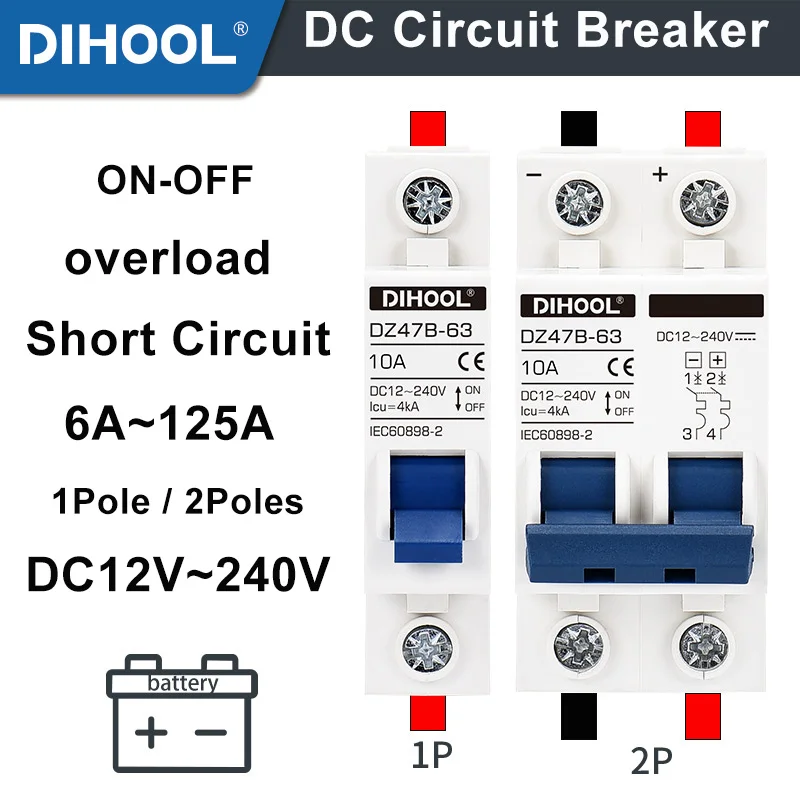
Visible markings indicate a broad operating range. The breakers are available in 1-pole (1P) and 2-pole (2P) configurations, accommodating various circuit designs. Amperage ratings span from 6A to 125A, providing flexibility for diverse applications. Voltage compatibility extends from DC12V up to DC240V, making these units suitable for a wide array of battery, solar photovoltaic (PV), and automotive electrical systems.
These specifications imply a versatile application profile. Users can deploy these breakers in off-grid solar setups to protect charge controllers and battery banks, in RVs or marine vessels for auxiliary power circuits, or in industrial DC control systems. The ability to handle up to 240V DC is particularly beneficial for larger solar arrays where higher string voltages are common, ensuring that the entire system remains protected from potentially damaging electrical faults. Proper sizing is paramount.
Safeguarding DC Circuits
The primary function of any circuit breaker is to interrupt current flow when a fault occurs, preventing damage to equipment and mitigating fire hazards. For DC systems, this interruption is more complex than for AC systems due to the continuous nature of direct current, which does not naturally cross zero. DC breakers like the DIHOOL DZ47B series are specifically designed with arc-quenching mechanisms to rapidly extinguish the sustained arc that forms upon interruption.
This specialized design ensures that when an overload or short circuit is detected, the breaker trips reliably and safely. The internal mechanism forces the arc into an arc chute, where it is cooled and elongated until it extinguishes. This rapid response is vital for protecting sensitive DC components such as solar panels, inverters, and battery management systems from irreversible damage. A tripped breaker prevents catastrophic failure.
Unlike generic AC breakers sometimes repurposed for DC applications, these dedicated DC units provide the necessary safety margin. Using an AC breaker in a DC circuit can lead to a failure to clear the fault, resulting in sustained arcing, overheating, and a significant risk of fire. The DIHOOL DZ47B series offers a purpose-built solution, adhering to the safety standards required for direct current environments. This is a critical distinction for electrical safety.
Deployment and Integration
Installation of these DC circuit breakers follows standard DIN rail mounting practices, which is a common and convenient method for electrical enclosures. The compact form factor, with dimensions of 18mm width for 1P and 36mm for 2P units, allows for efficient use of space within distribution boxes or combiner boxes. The overall height of 80mm is also standard for miniature circuit breakers.
Connecting wiring to the breaker terminals requires careful attention to polarity and proper torque. The visible screw terminals are designed for secure wire termination, which is essential for maintaining low resistance and preventing hot spots. Correct wire gauge selection, matching the circuit's expected current load and the breaker's rating, is non-negotiable for safe operation. Loose connections are a fire risk.
For solar PV systems, these breakers are typically installed between the solar panels and the charge controller, and between the charge controller and the battery bank. In battery systems, they protect the main battery output and individual loads. The provided wiring diagram illustrates a common setup, showing breakers protecting both the solar input and the load output from a charge controller. This visual aid simplifies initial setup.
Reliability Under Load
The DZ47B series designation, along with CE certification, indicates adherence to certain European safety and performance standards. While specific UL ratings are not explicitly visible, the CE mark suggests a baseline level of quality and compliance for the European market. The robust construction, visible in the product images, implies a durable device capable of withstanding the rigors of continuous operation in various environments.
Consistent performance under varying load conditions is a hallmark of a reliable circuit breaker. These units are designed to trip accurately at their rated current, preventing overloads without nuisance tripping. The mechanical ON-OFF switch provides a clear visual indication of the breaker's status and allows for manual isolation of circuits for maintenance or troubleshooting. This functionality is straightforward.
Compared to fuses, which are single-use devices, circuit breakers offer the advantage of being resettable. After a fault is cleared, the breaker can be reset, restoring power without the need for replacement. This convenience translates to reduced downtime and lower operational costs over the lifespan of the electrical system. It is a significant operational benefit.
Technical Specifications and Compliance
The product images clearly display key technical data, including the model number DZ47B, current ratings, and voltage ranges. The presence of both 1P and 2P options allows for protection of single positive lines or both positive and negative lines in a DC circuit, depending on the system's grounding scheme and safety requirements. Two-pole breakers are often preferred for complete isolation.
Compliance with standards such as IEC60898-2, as indicated on the breaker labels, confirms that the device meets international specifications for miniature circuit breakers for DC operation. This standard specifically addresses the performance requirements for DC circuit breakers, including their ability to interrupt short-circuit currents and withstand specified voltages. Such certifications are crucial for system designers.
Understanding these technical details is essential for proper system design and installation. An electrician or competent DIY enthusiast can confidently select the appropriate breaker based on the system's maximum operating current, short-circuit current capacity, and voltage. Undersized breakers will trip prematurely, while oversized breakers may fail to protect the circuit effectively. Precision in selection is key.
Value Proposition for DC Systems
Investing in dedicated DC circuit breakers like the DIHOOL DZ47B series is a proactive measure against costly equipment damage and potential safety hazards. The relatively low price point, especially considering the critical role these devices play, makes them an accessible and essential component for any DC electrical project. This is not an area for compromise.
By preventing overcurrents and short circuits, these breakers extend the life of expensive components such as batteries, solar charge controllers, and inverters. The cost of replacing a damaged inverter or a degraded battery bank far outweighs the initial investment in proper circuit protection. This represents a clear return on investment through preventative maintenance. Long-term savings are substantial.
Imagine the peace of mind knowing your solar array or battery system is protected by components specifically designed for its unique electrical characteristics. Envision a scenario where an unexpected fault occurs, and instead of a catastrophic failure, a simple breaker trip isolates the issue, allowing for quick diagnosis and resolution. This level of protection ensures the continuous, safe operation of your DC power infrastructure, allowing you to focus on the benefits of your renewable energy or off-grid setup without constant worry about electrical integrity. This breaker provides that assurance.