DentXXX Sectional Saddle Matrix System Kit 1.330
Official Store Deal
Expert Analysis Overview
Crafting the Perfect Contour: A Foundation for Finish
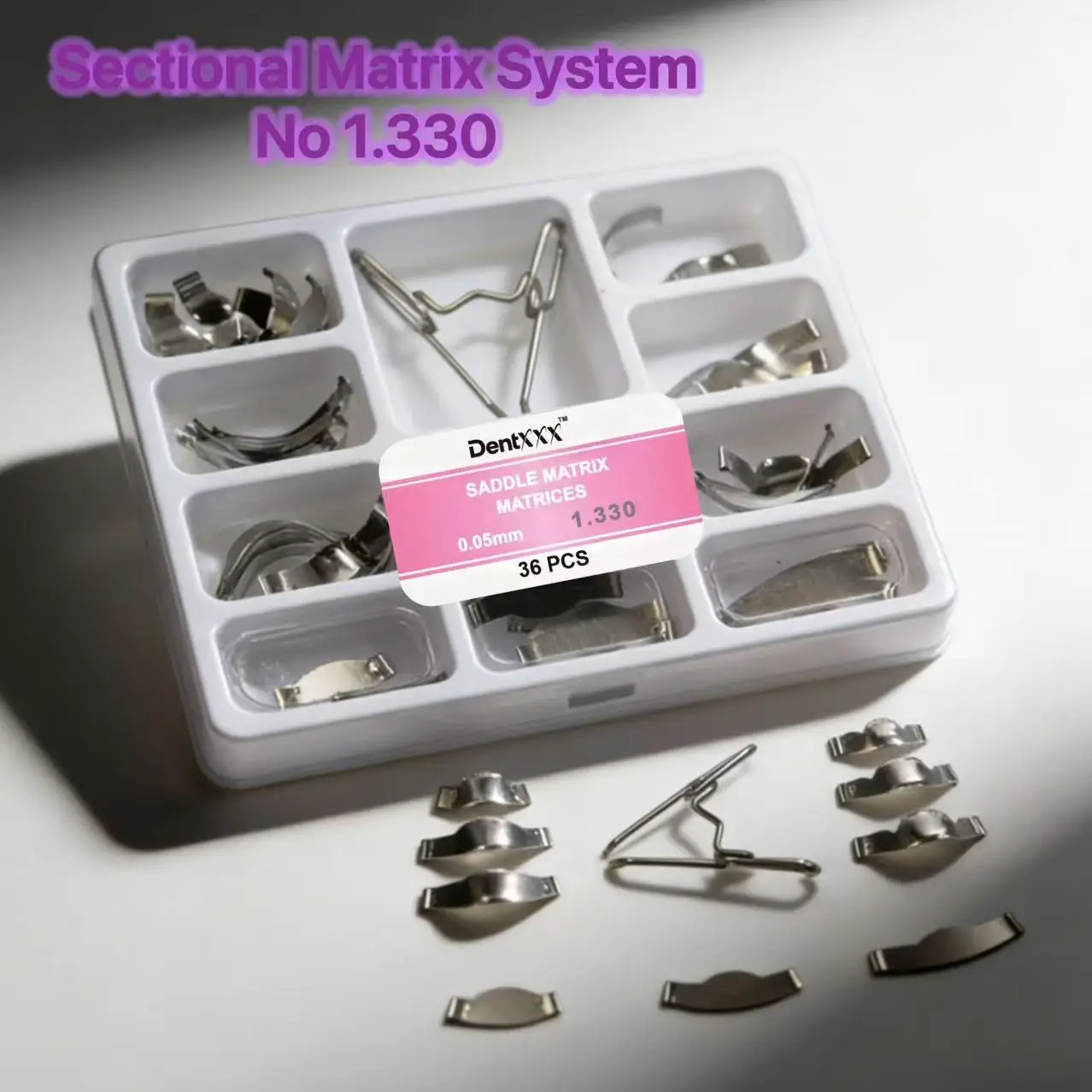
The DentXXX Sectional Saddle Matrix System Kit 1.330 is a specialized dental instrument designed for precise anatomical contouring during composite restorations. This system is engineered for dental professionals who prioritize accuracy and a superior final finish in their restorative work. Its fundamental purpose is to establish ideal proximal contacts and contours, which are critical for both the functional longevity and aesthetic integration of a restoration.
The visible components, particularly the matrices themselves, exhibit a highly polished surface. This inherent smoothness is not merely cosmetic; it directly translates to the quality of the restoration's surface. A matrix with a flawless surface minimizes the potential for composite material to adhere unevenly, ensuring a cleaner separation and reducing the need for aggressive post-operative finishing. This directly supports the goal of achieving a mirror finish on the final restoration, a hallmark of meticulous dental work.
Compared to traditional circumferential matrix bands, sectional matrices offer a distinct advantage in their ability to adapt more closely to the natural curvature of the tooth. This anatomical fidelity is paramount. It means less material overhang, fewer areas requiring extensive abrasive work, and ultimately, a more predictable and polished outcome. The system facilitates a smoother transition from the natural tooth structure to the restorative material, which is crucial for preventing plaque accumulation and promoting gingival health.
The Anatomy of Precision: Examining the Components
This 36-piece kit includes a variety of saddle matrices and a tension ring, all housed within a compact, organized case. The matrices themselves are the core of the system, varying in shape and size to accommodate diverse tooth morphologies and cavity preparations. Their design is specific.
The matrices are specified at a thickness of 0.05mm. This extremely thin profile is a deliberate design choice, minimizing the space occupied by the matrix itself within the interproximal area. This thinness is critical for achieving tight, accurate contact points between the restored tooth and its adjacent counterpart. Without this precision, gaps can form, leading to food impaction and subsequent complications.
Furthermore, the tension ring, a reusable component, is engineered to provide consistent and controlled separation force. This force is essential for holding the matrix firmly against the tooth structure and creating the necessary space for the composite material to be packed without voids. The spring-loaded mechanism of the ring maintains constant pressure, which is vital for the stability of the matrix during the restorative procedure. This consistent pressure helps prevent movement, ensuring the matrix remains in its intended position throughout the packing and curing process.
Durability Under Pressure: Material Science in Dentistry
The visible metallic components, including the matrices and the tension ring, appear to be constructed from high-grade stainless steel. This material choice is standard for dental instruments due to its inherent properties. Stainless steel offers excellent corrosion resistance, which is indispensable in the moist, chemically active environment of the oral cavity and during sterilization processes. Its strength is also a key factor.
This material's durability ensures that the matrices can withstand the forces of placement and removal without deforming prematurely. The tension ring, in particular, relies on the elastic properties of stainless steel to maintain its spring tension over repeated uses. A material that loses its spring would compromise the system's effectiveness, leading to inadequate tooth separation and poor contact points. The visible polish on these components further suggests a quality finish that resists pitting and simplifies cleaning.
For a metal polisher, the quality of the base material is everything. The implied high-grade stainless steel suggests a material that can be repeatedly cleaned and sterilized without degradation, maintaining its structural integrity and surface finish. This longevity translates to a better return on investment for the dental practice, as components do not need frequent replacement due to material fatigue or corrosion. The smooth, non-porous surface of stainless steel also contributes to its hygienic properties, as it resists bacterial adhesion, which is a critical consideration in any medical application.
Seamless Integration: Achieving Optimal Restoration Margins
Proper application of the sectional matrix system is crucial for achieving seamless restoration margins. The system works by first selecting the appropriately sized matrix band for the tooth being restored. This selection process is vital. The band is then placed interproximally, conforming to the tooth's contour.
Once the matrix is in place, a dental wedge is typically inserted from the lingual or buccal aspect to secure the matrix at the gingival margin and provide additional separation. The wedge also helps to prevent gingival overhangs, a common issue in composite restorations that can lead to periodontal problems. The final step involves placing the tension ring, which applies a controlled separating force to the adjacent teeth, creating a tight contact point and ensuring the matrix is held firmly against the prepared tooth surface. This precise fit is what allows for a smooth, continuous surface.
The goal is to create a restoration that requires minimal post-operative adjustment and polishing. By achieving an accurate anatomical form and tight contact points from the outset, the need for aggressive grinding or contouring of the cured composite is significantly reduced. This not only saves chair time but also preserves more of the natural tooth structure and reduces the risk of iatrogenic damage to adjacent teeth or soft tissues. The precision offered by this system directly contributes to the ease with which a final, high-gloss polish can be achieved, as there are fewer irregularities to correct.
Beyond Form: The Role in Achieving a Mirror Polish
While the primary function of a matrix system is to provide a wall for the restorative material, its contribution to the final polish cannot be overstated. A well-adapted matrix minimizes the formation of 'flash' or excess composite material beyond the cavity margins. Flash is a common problem.
When flash occurs, it must be removed, often requiring burs and abrasive strips. This removal process, if not executed with extreme care, can introduce microscopic scratches or even gouges into the newly placed restoration or the adjacent tooth structure. The 0.05mm thinness of these matrices, combined with their anatomical shapes, significantly reduces the likelihood of flash. This means less need for aggressive post-operative abrasion, preserving the integrity of the restoration's surface.
For a metal polisher, the less material that needs to be removed, the better the starting surface for achieving a mirror finish. This system sets the stage for a superior polish by creating a smooth, well-contoured surface from the moment the composite is cured. It allows the practitioner to move directly to fine polishing and buffing steps, rather than spending time on gross material removal. This efficiency and precision are key to achieving a restoration that not only looks natural but also feels smooth to the patient's tongue, resisting staining and plaque accumulation over time.
Operational Efficiency: Streamlining the Restoration Process
The use of a well-designed sectional matrix system like the DentXXX No. 1.330 can significantly streamline the composite restoration workflow. The organized presentation of the 36 pieces in a compartmentalized case allows for quick identification and selection of the appropriate matrix. This saves valuable time.
Efficient selection and placement contribute to a smoother procedure, reducing overall chair time for the patient and increasing productivity for the dental professional. The consistent performance of the tension ring, maintaining firm tooth separation and matrix adaptation, minimizes the need for adjustments during the procedure. This reliability is a major benefit.
Furthermore, the predictable results achieved with this system reduce the likelihood of needing to redo or significantly rework a restoration due to poor contacts or contours. This translates to fewer follow-up appointments for adjustments and a higher level of patient satisfaction. The system's design supports a methodical approach to restorative dentistry, ensuring that each step contributes positively to the final outcome, from initial preparation to the final polish.
Investment in Excellence: Long-Term Value for the Practitioner
Considering the price point and the comprehensive nature of the kit, the DentXXX Sectional Saddle Matrix System represents a sound investment for any dental practice focused on high-quality composite restorations. The durability of the stainless steel components, particularly the reusable tension ring, ensures a long service life under proper care and sterilization protocols. This reduces ongoing consumable costs.
The value extends beyond the initial purchase price. The ability to consistently produce anatomically correct, highly polished restorations enhances a practice's reputation and patient trust. Patients appreciate restorations that are comfortable, functional, and aesthetically pleasing, and this system directly supports achieving those outcomes. It's an investment in patient satisfaction.
By minimizing the need for extensive post-operative finishing and reducing the incidence of complications like overhangs or open contacts, the system contributes to the overall efficiency and profitability of the practice. It allows dental professionals to deliver superior results with greater confidence and less effort, ultimately translating into a more rewarding and less stressful clinical experience. The long-term benefits far outweigh the initial outlay, making it a strategic addition to any modern dental toolkit.
The Polished Outcome
Imagine the satisfaction of completing a composite restoration, knowing that every contour is perfectly formed, every margin seamlessly integrated, and the surface gleams with a natural, mirror-like finish. Envision your patients leaving your practice with restorations that not only feel comfortable and function flawlessly but also blend imperceptibly with their natural dentition. This system empowers you to achieve such consistent, high-quality results, elevating your craft and ensuring lasting patient smiles. The precision and finish this kit enables will become a signature of your work, reflecting meticulous attention to detail and a commitment to excellence in every restoration. This is the tangible benefit of integrating a superior sectional matrix system into your daily practice, transforming routine procedures into works of art that stand the test of time and scrutiny. The smooth, polished surfaces you achieve will speak volumes about the quality of care provided, fostering trust and loyalty among your patient base. This is the enduring legacy of precision tooling, manifested in every perfectly contoured and polished restoration. The ease with which you achieve these results will allow you to focus more on the artistry of dentistry, rather than the tedious correction of imperfections.