Creality K1/K1 Max Ceramic Hotend Upgrade Kit
Official Store Deal
Expert Analysis Overview
Precision Thermal Engineering for Advanced 3D Printing
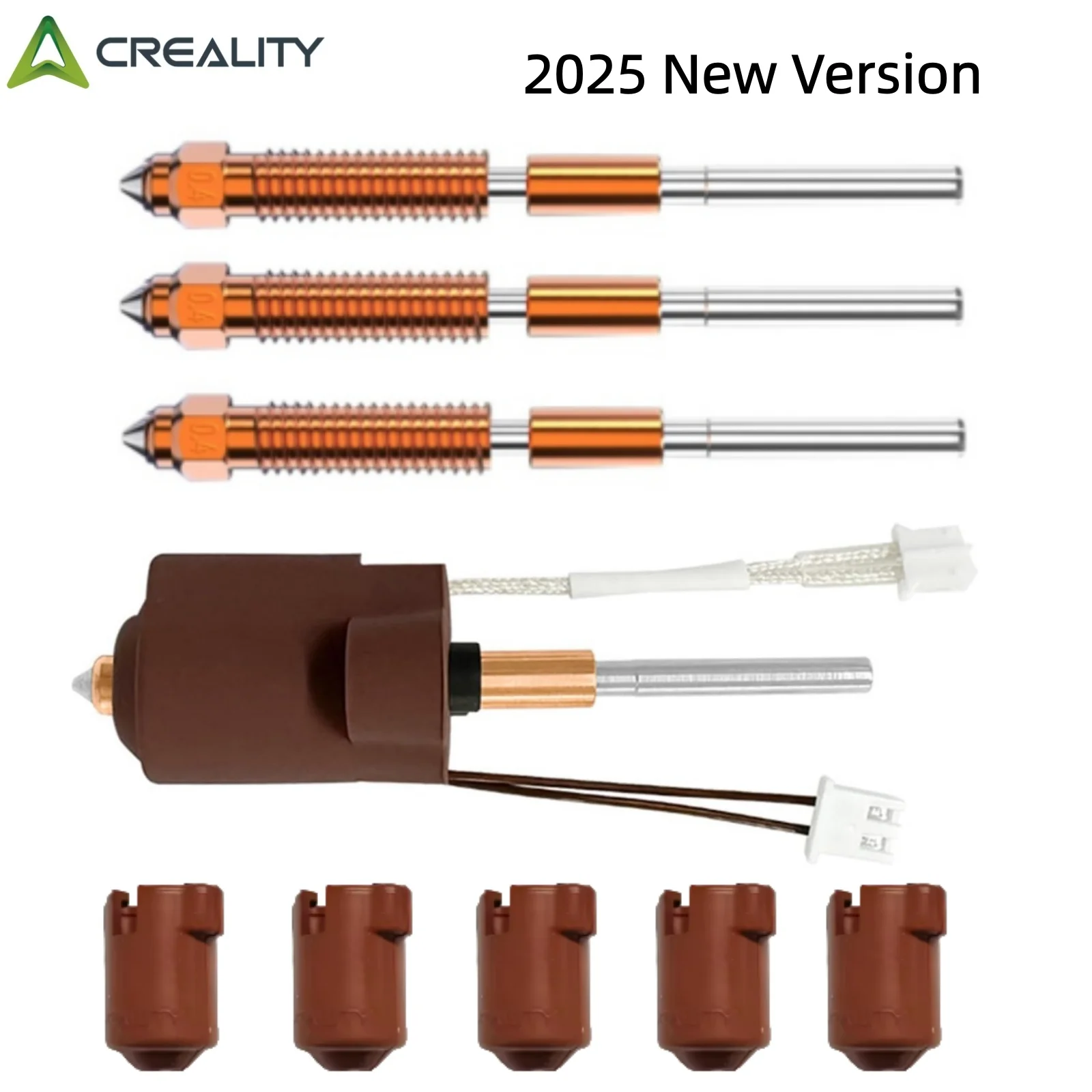
The Creality K1/K1 Max Ceramic Hotend Upgrade Kit is a significant performance enhancement component engineered for Creality K1 and K1 Max 3D printers, specifically targeting improved thermal management and print reliability for demanding applications. This 2025 New Version addresses critical limitations of previous designs, offering a more stable and efficient extrusion system. The kit represents a focused effort to elevate the printing capabilities of Creality's flagship core-XY machines.
Enhanced Thermal Performance
The visual evidence, particularly Image 3, clearly depicts a hotend assembly featuring a glowing ceramic heating element, emphasizing "High Thermal Conductivity Uniform Heating." This design incorporates a 360° surround ceramic heater. Such a configuration ensures rapid and consistent heat distribution across the entire melt zone.
Traditional hotends often rely on cartridge heaters inserted into aluminum blocks, which can lead to temperature gradients and localized hot spots. The ceramic heating approach minimizes these inconsistencies, providing a more stable thermal environment for the filament. This directly translates to superior layer adhesion, reduced warping, and improved dimensional accuracy, particularly crucial when printing intricate geometries or large parts where thermal stability is paramount.
Compared to standard heating blocks, the ceramic element offers a faster heat-up time and more precise temperature control. This efficiency not only speeds up the printing process but also contributes to energy savings over extended print jobs. The consistent temperature profile is a distinct advantage for materials with narrow processing windows, ensuring optimal melt viscosity and flow.
Optimized Filament Path and Flow Dynamics
Image 4 provides a detailed breakdown of the heat break's internal design, highlighting "Smooth inner walls" with a roughness Ra<0.4, ensuring "smooth filament feeding." This meticulous surface finish is critical for minimizing friction as the filament travels through the heat break. Reduced friction prevents premature wear on the filament and mitigates issues like heat creep, where heat migrates up the cold end, causing filament softening and jamming.
Further, the image emphasizes "Precision machining" with "no burns at the opening, stable printing with reduced clogging." This level of manufacturing quality ensures that the filament path is free from imperfections that could snag or abrade the material. A consistent, unimpeded filament flow is fundamental for achieving uniform extrusion and preventing common print failures such as under-extrusion or nozzle clogs. This is a direct counterpoint to lower-quality heat breaks that often exhibit rougher internal surfaces, leading to increased back pressure and inconsistent extrusion.
Finally, the "Tight fit" described in Image 4, ensuring "no leakage," is vital for maintaining consistent pressure within the melt zone. Any gaps or loose connections can lead to filament oozing or leakage, resulting in messy prints, wasted material, and potential damage to the hotend components. The precise tolerances of this kit prevent such issues, ensuring that all molten plastic is directed through the nozzle orifice. This engineering precision is a significant upgrade from generic components where fitment can be less exact, often requiring user intervention to prevent leaks.
Addressing Connectivity and Reliability
Image 2 explicitly details the evolution from "Old nozzle" to "New nozzle" connections, specifically addressing a prevalent issue: "Due to the old K1 series of nozzle motherboard and nozzle kit heating tube and thermistor line is easy to connect the wire loose lead to 2564 error problems." The new design has been "upgraded to snap link method." This is a direct response to a known pain point for K1 and K1 Max users.
The snap-link connection system provides a more secure and reliable electrical interface for both the thermistor and the ceramic heating element. Loose connections are a primary cause of intermittent heating, inaccurate temperature readings, and ultimately, print failures or error codes like the 2564 error. This upgrade significantly enhances the long-term stability of the hotend's electrical system. It is a robust solution.
However, this improvement comes with a critical compatibility note: the new snap-link printhead kit "must be matched with the new snap link printhead motherboard to use." This implies that users upgrading from an older K1/K1 Max hotend will also need to acquire the compatible motherboard. While an additional investment, this ensures the entire system operates with optimal reliability, preventing future connectivity issues and guaranteeing stable thermal control. This integrated approach minimizes potential points of failure.
Broad Material Compatibility
Image 5 showcases the hotend's capability with a wide array of filaments, including PLA, ABS, PETG, TPU, PP, PC, PLA-CF, PA-CF, and PET-CF. This extensive compatibility list underscores the hotend's robust design and high-temperature capabilities. The ability to reliably print engineering-grade and fiber-reinforced materials is a key differentiator.
Many standard hotends struggle with abrasive filaments like carbon fiber-filled (CF) materials, which can rapidly wear down brass nozzles and heat breaks. The implied premium materials and precision construction of this kit suggest enhanced durability against such abrasive filaments. This broad material support expands the utility of the K1/K1 Max printers, allowing users to tackle a wider range of projects requiring specific material properties. It opens new possibilities for functional prototyping and end-use parts.
For users who frequently experiment with different filament types, the quick-swap design, combined with this broad compatibility, streamlines the workflow. Changing from a standard PLA print to a high-temperature PC-CF print becomes a less daunting task, reducing downtime and increasing productivity. This hotend is built for versatility.
Streamlined Maintenance and Installation
The overall design, as seen across Images 1 and 6, suggests a quick-swap mechanism for the nozzle and heat break assembly. This modularity simplifies routine maintenance and part replacement. Instead of disassembling multiple components and dealing with threaded connections, the entire hotend unit can be swapped out with minimal effort. This is a significant time-saver.
This ease of maintenance is particularly beneficial in production environments or for users who frequently change nozzle sizes or materials. Reduced downtime for maintenance directly contributes to higher machine utilization and overall efficiency. The integrated nature of the heat break and nozzle also minimizes potential points of leakage, as fewer threaded interfaces are involved. This design prioritizes user convenience.
Imagine consistently producing dimensionally accurate engineering parts with complex materials, free from the frustration of loose connections or inconsistent heating. This hotend kit provides the foundation for reliable, high-quality 3D printing, allowing users to push the boundaries of their Creality K1 or K1 Max without compromise. The investment in this upgraded system translates directly into more successful prints, less wasted material, and a significantly smoother prototyping workflow.