Creality Ender-3 V3 SE 3D Printer
Official Store Deal
Expert Analysis Overview
The Creality Ender-3 V3 SE is a refined entry-level FDM 3D printer tailored for aspiring makers and hobbyists seeking a reliable platform with significant upgrade potential. This machine stands out in a crowded market by integrating features often found in higher-tier models, making advanced 3D printing more accessible. Its design prioritizes ease of use from the first print, yet it retains the hackability characteristic of the Ender series.
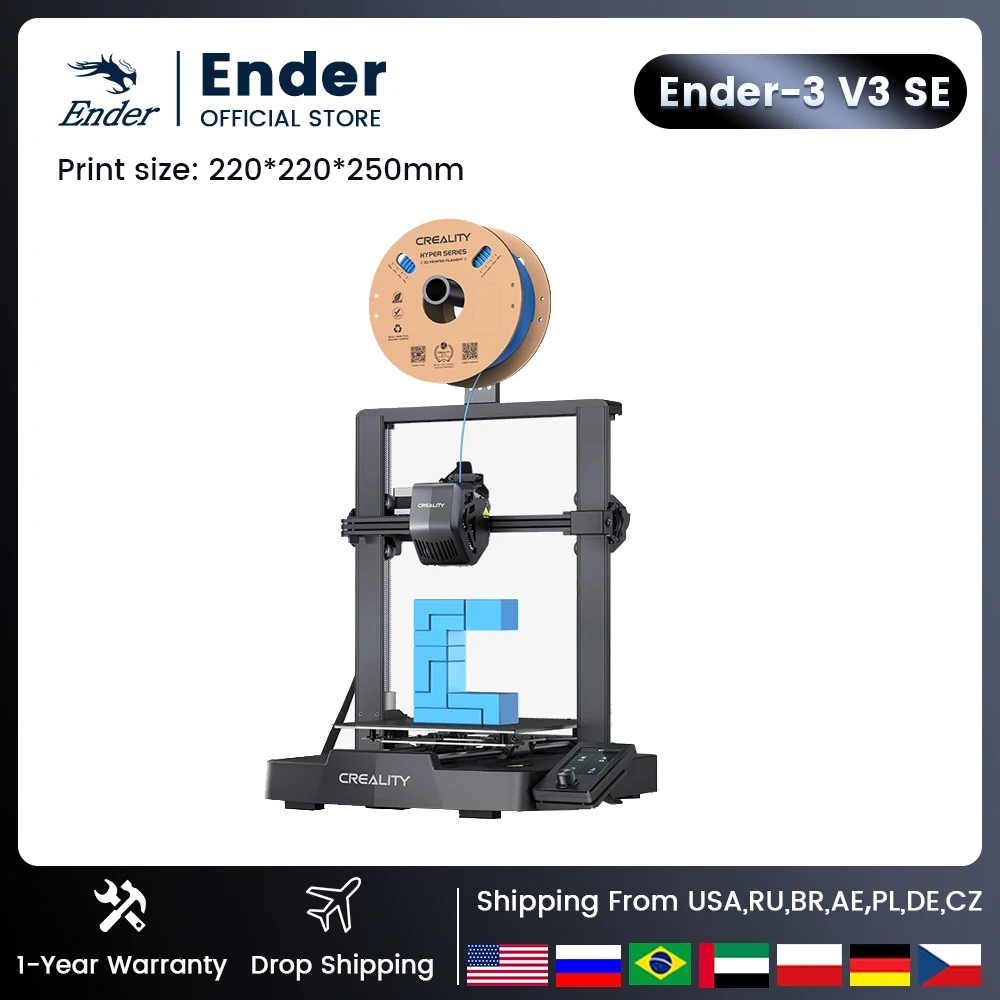
The most immediately noticeable upgrade on the Ender-3 V3 SE is the inclusion of Creality's Sprite direct drive extruder. This component is positioned directly above the hotend, a critical design choice. This close proximity ensures the filament path is exceptionally short and controlled.
In practical application, a direct drive system offers superior control over filament pushing and pulling compared to traditional Bowden setups. Users experience more consistent extrusion, which translates to cleaner prints with fewer artifacts like stringing or blobbing. This is particularly evident when working with finicky materials.
Older or more budget-oriented FDM printers often utilize a Bowden extruder, where the motor is mounted on the frame and pushes filament through a long PTFE tube. While simpler, Bowden systems can struggle with flexible filaments due to compression within the tube, making them prone to jams or inconsistent flow. The Sprite direct drive largely eliminates these frustrations, broadening the range of materials a maker can confidently experiment with.
Visual inspection confirms the Ender-3 V3 SE incorporates a dual Z-axis lead screw design. Two independent vertical screws guide the print gantry, offering enhanced stability. This is a subtle but profound improvement.
Operating with dual Z-axes prevents the gantry from tilting or sagging on one side, which is a common issue with single Z-axis machines, especially as print height increases or the print head moves rapidly. The result is consistently level layers across the entire print, minimizing Z-wobble artifacts. Print quality visibly improves.
Many entry-level printers cut costs by using a single lead screw for the Z-axis, which can introduce instability and require manual bracing or aftermarket modifications to achieve comparable rigidity. The integrated dual Z-axis on the V3 SE provides a solid foundation from the start, reducing the need for immediate structural upgrades and ensuring a more reliable printing experience.
The product description highlights worry-free auto leveling. While the specific sensor type (e.g., CR Touch) isn't explicitly visible in all images, its inclusion signifies a major quality-of-life improvement. This system automatically probes the print bed at multiple points.
The primary benefit of auto-leveling is the elimination of tedious manual bed calibration. For new users, getting the first layer right is often the biggest hurdle, leading to failed prints and frustration. An automatic system ensures optimal bed adhesion by compensating for minor imperfections or tilts in the print surface.
Compared to printers requiring manual adjustment of bed screws, the auto-leveling feature drastically simplifies the setup process. This means less time fiddling with calibration and more time actually printing, allowing makers to focus on design and experimentation rather than troubleshooting initial layer issues. It is a true time-saver.
The Ender-3 V3 SE is designed for faster printing speeds. While specific numerical benchmarks are not provided, this capability is typically achieved through a combination of optimized motion systems, more powerful stepper motors, and refined firmware algorithms. Quicker print times are a significant advantage.
For makers, faster printing translates directly to quicker iteration cycles. Prototyping new designs or producing multiple parts becomes significantly more efficient. This speed can dramatically reduce the overall time spent on projects, allowing for more creative output within the same timeframe.
Many older or less optimized printers operate at slower, more conservative speeds to maintain print quality, often making large or complex prints multi-day affairs. The V3 SE aims to strike a balance, offering improved speed without necessarily sacrificing the detail and finish expected from modern FDM machines. It reduces waiting periods.
The printer offers a 220 x 220 x 250 mm build volume. This dimension represents the maximum physical space available for printing objects. It is a common and highly practical size for a desktop 3D printer.
This build volume is ample for a vast array of projects, from functional parts like enclosures and brackets to decorative items, cosplay components, or educational models. It allows for printing moderately sized objects in one piece, reducing the need for complex model segmentation and assembly post-printing.
While industrial-scale printers offer much larger volumes, they come at a significantly higher cost and footprint. For most hobbyists and small-scale producers, 220x220x250mm provides plenty of creative freedom. It is a practical size.
Creality's Ender series is renowned for its massive and active community. This printer benefits from a vast ecosystem of users, forums, and online resources. Such a community is invaluable for troubleshooting, sharing tips, and discovering modifications.
For a tinkerer, this means an almost endless supply of printable upgrades, custom firmware options, and detailed guides for maintenance or performance enhancements. If a problem arises, chances are someone else has encountered it and documented a solution. This collective knowledge reduces barriers to experimentation.
Unlike proprietary systems with limited third-party support, the Ender-3 V3 SE is an open platform. This fosters a culture of continuous improvement, where users can experiment with different hotends, build plates, or even entirely new tool heads. The machine evolves with the user's skill set and project demands.
The visible frame components appear to be constructed from anodized aluminum extrusions. This material choice is standard for quality FDM printers, providing a rigid and stable framework. The overall aesthetic is clean and functional, with integrated wiring channels.
This robust construction minimizes vibrations during printing, which directly contributes to higher print quality and dimensional accuracy. Flimsier plastic frames or poorly assembled structures can introduce unwanted movement, leading to ghosting or ringing artifacts on prints. A solid frame is foundational.
Compared to some bare-bones DIY kits, the Ender-3 V3 SE presents a more finished and integrated appearance. The design looks purposeful, suggesting attention to detail in its engineering. It is a compact unit.
A knob-controlled LCD screen is visible on the printer's base. This interface provides intuitive navigation through menus and settings. While not a color touchscreen, physical controls are often favored for their reliability and tactile feedback.
The simple interface allows users to select print files, monitor progress, adjust temperatures, and perform basic operations directly from the printer without needing a connected computer for every task. This standalone capability enhances convenience.
Most modern Creality printers offer standard connectivity options like SD card slots and USB ports for print file transfer. This flexibility ensures compatibility with various workflows. Easy file management streamlines the entire printing process.
The power supply appears integrated into the printer's base. This design choice contributes to a more compact footprint and reduces cable clutter on the workspace. An integrated power supply makes the printer easier to move and set up.
External power bricks can be cumbersome, taking up additional desk space and adding to cable management challenges. The integrated approach results in a cleaner, more organized setup. It is a thoughtful design element.
This makes the Ender-3 V3 SE a good candidate for temporary setups or smaller workshops where space is at a premium. The streamlined power solution contributes to the overall user-friendly nature of the machine. It fits well on a desk.
The open-frame design of the Ender-3 V3 SE provides excellent accessibility to its components. This is a significant advantage for maintenance, cleaning, and future upgrades. Access simplifies troubleshooting.
For a maker who plans to delve into the mechanics of their printer, easy access to the hotend, extruder, and motion system is invaluable. Replacing nozzles, clearing jams, or upgrading parts becomes a less daunting task. This design encourages user involvement and understanding.
Unlike fully enclosed printers that can sometimes make internal access difficult, the V3 SE's open structure ensures that all critical areas are within reach. This promotes longevity and user confidence in maintaining their machine over time. It is designed for hands-on users.
Imagine transforming digital designs into tangible objects with confidence, knowing your machine handles the tricky parts, leaving you free to innovate. This printer offers a gateway to endless creative projects, from practical household fixes to intricate artistic endeavors, all while being part of a vibrant global community ready to share insights and modifications. It empowers creation.
Unpacking the Core Capabilities
Extrusion Precision: The Sprite Direct Drive
The most immediately noticeable upgrade on the Ender-3 V3 SE is the inclusion of Creality's Sprite direct drive extruder. This component is positioned directly above the hotend, a critical design choice. This close proximity ensures the filament path is exceptionally short and controlled.
In practical application, a direct drive system offers superior control over filament pushing and pulling compared to traditional Bowden setups. Users experience more consistent extrusion, which translates to cleaner prints with fewer artifacts like stringing or blobbing. This is particularly evident when working with finicky materials.
Older or more budget-oriented FDM printers often utilize a Bowden extruder, where the motor is mounted on the frame and pushes filament through a long PTFE tube. While simpler, Bowden systems can struggle with flexible filaments due to compression within the tube, making them prone to jams or inconsistent flow. The Sprite direct drive largely eliminates these frustrations, broadening the range of materials a maker can confidently experiment with.
Structural Integrity: The Dual Z-axis Advantage
Visual inspection confirms the Ender-3 V3 SE incorporates a dual Z-axis lead screw design. Two independent vertical screws guide the print gantry, offering enhanced stability. This is a subtle but profound improvement.
Operating with dual Z-axes prevents the gantry from tilting or sagging on one side, which is a common issue with single Z-axis machines, especially as print height increases or the print head moves rapidly. The result is consistently level layers across the entire print, minimizing Z-wobble artifacts. Print quality visibly improves.
Many entry-level printers cut costs by using a single lead screw for the Z-axis, which can introduce instability and require manual bracing or aftermarket modifications to achieve comparable rigidity. The integrated dual Z-axis on the V3 SE provides a solid foundation from the start, reducing the need for immediate structural upgrades and ensuring a more reliable printing experience.
Effortless Calibration: Worry-Free Auto Leveling
The product description highlights worry-free auto leveling. While the specific sensor type (e.g., CR Touch) isn't explicitly visible in all images, its inclusion signifies a major quality-of-life improvement. This system automatically probes the print bed at multiple points.
The primary benefit of auto-leveling is the elimination of tedious manual bed calibration. For new users, getting the first layer right is often the biggest hurdle, leading to failed prints and frustration. An automatic system ensures optimal bed adhesion by compensating for minor imperfections or tilts in the print surface.
Compared to printers requiring manual adjustment of bed screws, the auto-leveling feature drastically simplifies the setup process. This means less time fiddling with calibration and more time actually printing, allowing makers to focus on design and experimentation rather than troubleshooting initial layer issues. It is a true time-saver.
Accelerated Production: Faster Printing Speeds
The Ender-3 V3 SE is designed for faster printing speeds. While specific numerical benchmarks are not provided, this capability is typically achieved through a combination of optimized motion systems, more powerful stepper motors, and refined firmware algorithms. Quicker print times are a significant advantage.
For makers, faster printing translates directly to quicker iteration cycles. Prototyping new designs or producing multiple parts becomes significantly more efficient. This speed can dramatically reduce the overall time spent on projects, allowing for more creative output within the same timeframe.
Many older or less optimized printers operate at slower, more conservative speeds to maintain print quality, often making large or complex prints multi-day affairs. The V3 SE aims to strike a balance, offering improved speed without necessarily sacrificing the detail and finish expected from modern FDM machines. It reduces waiting periods.
Generous Canvas: The Build Volume
The printer offers a 220 x 220 x 250 mm build volume. This dimension represents the maximum physical space available for printing objects. It is a common and highly practical size for a desktop 3D printer.
This build volume is ample for a vast array of projects, from functional parts like enclosures and brackets to decorative items, cosplay components, or educational models. It allows for printing moderately sized objects in one piece, reducing the need for complex model segmentation and assembly post-printing.
While industrial-scale printers offer much larger volumes, they come at a significantly higher cost and footprint. For most hobbyists and small-scale producers, 220x220x250mm provides plenty of creative freedom. It is a practical size.
The Maker's Ecosystem and Upgrade Path
Creality's Ender series is renowned for its massive and active community. This printer benefits from a vast ecosystem of users, forums, and online resources. Such a community is invaluable for troubleshooting, sharing tips, and discovering modifications.
For a tinkerer, this means an almost endless supply of printable upgrades, custom firmware options, and detailed guides for maintenance or performance enhancements. If a problem arises, chances are someone else has encountered it and documented a solution. This collective knowledge reduces barriers to experimentation.
Unlike proprietary systems with limited third-party support, the Ender-3 V3 SE is an open platform. This fosters a culture of continuous improvement, where users can experiment with different hotends, build plates, or even entirely new tool heads. The machine evolves with the user's skill set and project demands.
Visual Build Quality and Aesthetics
The visible frame components appear to be constructed from anodized aluminum extrusions. This material choice is standard for quality FDM printers, providing a rigid and stable framework. The overall aesthetic is clean and functional, with integrated wiring channels.
This robust construction minimizes vibrations during printing, which directly contributes to higher print quality and dimensional accuracy. Flimsier plastic frames or poorly assembled structures can introduce unwanted movement, leading to ghosting or ringing artifacts on prints. A solid frame is foundational.
Compared to some bare-bones DIY kits, the Ender-3 V3 SE presents a more finished and integrated appearance. The design looks purposeful, suggesting attention to detail in its engineering. It is a compact unit.
User Interface and Connectivity
A knob-controlled LCD screen is visible on the printer's base. This interface provides intuitive navigation through menus and settings. While not a color touchscreen, physical controls are often favored for their reliability and tactile feedback.
The simple interface allows users to select print files, monitor progress, adjust temperatures, and perform basic operations directly from the printer without needing a connected computer for every task. This standalone capability enhances convenience.
Most modern Creality printers offer standard connectivity options like SD card slots and USB ports for print file transfer. This flexibility ensures compatibility with various workflows. Easy file management streamlines the entire printing process.
Power and Portability
The power supply appears integrated into the printer's base. This design choice contributes to a more compact footprint and reduces cable clutter on the workspace. An integrated power supply makes the printer easier to move and set up.
External power bricks can be cumbersome, taking up additional desk space and adding to cable management challenges. The integrated approach results in a cleaner, more organized setup. It is a thoughtful design element.
This makes the Ender-3 V3 SE a good candidate for temporary setups or smaller workshops where space is at a premium. The streamlined power solution contributes to the overall user-friendly nature of the machine. It fits well on a desk.
Maintenance and Long-Term Use
The open-frame design of the Ender-3 V3 SE provides excellent accessibility to its components. This is a significant advantage for maintenance, cleaning, and future upgrades. Access simplifies troubleshooting.
For a maker who plans to delve into the mechanics of their printer, easy access to the hotend, extruder, and motion system is invaluable. Replacing nozzles, clearing jams, or upgrading parts becomes a less daunting task. This design encourages user involvement and understanding.
Unlike fully enclosed printers that can sometimes make internal access difficult, the V3 SE's open structure ensures that all critical areas are within reach. This promotes longevity and user confidence in maintaining their machine over time. It is designed for hands-on users.
Imagine transforming digital designs into tangible objects with confidence, knowing your machine handles the tricky parts, leaving you free to innovate. This printer offers a gateway to endless creative projects, from practical household fixes to intricate artistic endeavors, all while being part of a vibrant global community ready to share insights and modifications. It empowers creation.