CRAFTRON Bambu Lab X1/P1P/P1S Hardened Steel & Brass Nozzles
Official Store Deal
Expert Analysis Overview
Precision Extrusion Engineering
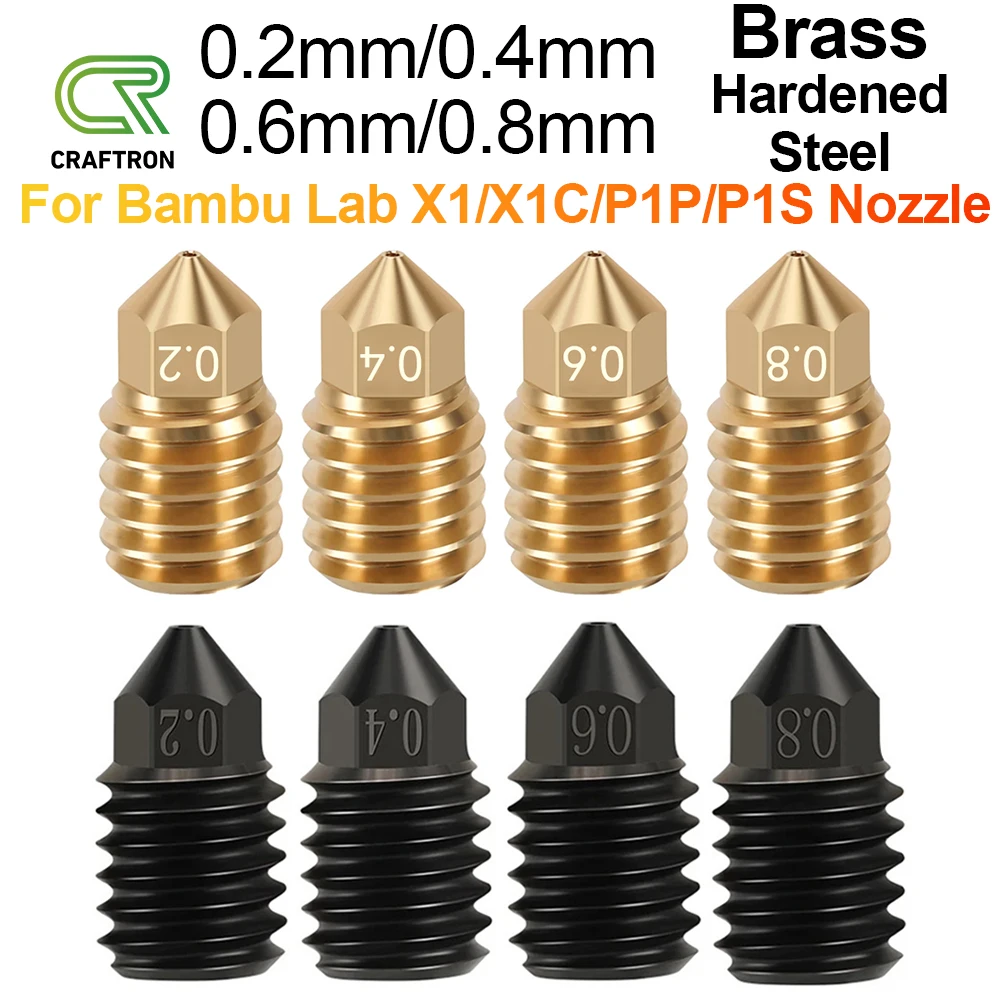
CRAFTRON's nozzle set for Bambu Lab X1, X1C, P1P, and P1S 3D printers is a critical upgrade for enthusiasts and professionals seeking enhanced print quality and material versatility. This collection of brass and hardened steel nozzles, available in 0.2mm, 0.4mm, 0.6mm, and 0.8mm diameters, addresses the core requirements for precise filament extrusion across a broad spectrum of 3D printing applications. Each nozzle is engineered to integrate seamlessly with the specified Bambu Lab hotends, ensuring consistent performance.
The visible construction of these nozzles highlights two primary material choices: brass and hardened steel. Brass nozzles are traditionally favored for their excellent thermal conductivity, which facilitates rapid and uniform heating of standard filaments such as PLA, PETG, and ABS. This material choice is a staple in 3D printing due to its balance of performance and cost-effectiveness. It melts plastic efficiently.
In contrast, the hardened steel variants are designed to withstand the abrasive nature of specialized filaments. Materials infused with carbon fiber, glass fiber, or metal particles can rapidly wear down softer brass nozzles, leading to inconsistent extrusion and premature failure. The hardened steel option provides a robust solution, significantly extending nozzle lifespan when working with these challenging composites. This directly translates to reduced maintenance and more reliable long-term printing for demanding projects.
Material Versatility and Thermal Dynamics
The selection of nozzle diameters—0.2mm, 0.4mm, 0.6mm, and 0.8mm—offers a comprehensive range for various printing needs. A 0.2mm nozzle is ideal for achieving extremely fine details and intricate geometries, crucial for miniature models or highly aesthetic prints where layer lines must be minimized. This small aperture demands precise control.
Conversely, the larger 0.6mm and 0.8mm nozzles are optimized for faster printing and stronger parts, particularly useful for functional prototypes or large-scale objects where speed and structural integrity are paramount. These larger diameters allow for thicker extrusion widths, reducing overall print time and increasing part strength by promoting better layer adhesion. The 0.4mm nozzle serves as a versatile standard, balancing detail and speed for everyday printing tasks.
The internal design of these nozzles, particularly the copper alloy material highlighted for its fast thermal conductivity, is pivotal for consistent extrusion. Higher thermal conductivity ensures that the filament maintains a uniform temperature as it passes through the nozzle, preventing temperature fluctuations that can lead to inconsistent layer adhesion and surface finish. This uniform heating is essential.
This optimized thermal transfer directly impacts the structural integrity of printed parts, promoting superior layer-to-layer adhesion. In practical terms, this means fewer delamination issues and stronger final products, especially critical for mechanical parts or components subjected to stress. Compared to nozzles with less efficient thermal properties, these designs minimize the risk of cold spots that can compromise print quality and reliability.
Longevity and Maintenance Protocols
A significant design improvement featured is the upgrade to a hardened steel threaded nozzle, contrasting with older, often irreplaceable integrated hot end designs. The original hot ends frequently required replacement of the entire assembly if the nozzle wore out or became clogged, leading to higher maintenance costs and increased downtime. This was a common frustration.
The new detachable, threaded nozzle design allows for easy and cost-effective replacement of only the nozzle component. This modularity is a substantial benefit, simplifying maintenance procedures and reducing the overall operational cost of the 3D printer. The threads are coated with glue to effectively prevent filament leakage, a common issue with poorly sealed nozzle connections. Users are advised to preheat the hot end before replacement to facilitate easier removal and installation, ensuring the integrity of the threads and preventing damage.
Compatibility is a key aspect, with the nozzles designed for Bambu Lab X1, X1C, P1P, and P1S printers. The visual information also indicates compatibility with various TZ Hot End versions, including TZ 2.0, TZ 3.0, TZ E3, and TZ V6 2.0. This broad compatibility ensures that users with different hot end configurations can leverage these upgraded nozzles. This broadens the user base.
Such extensive compatibility minimizes the guesswork for users, providing confidence that these nozzles will integrate smoothly into their existing setups. Unlike more restrictive nozzle systems that limit upgrades to specific hot end models, this design offers greater flexibility and future-proofing for printer modifications. It simplifies the upgrade path.
The Economic Imperative of Component Upgrades
The rounded chamfer design and perfect aperture are critical for filament feeding and extrusion consistency. A well-designed chamfer guides the filament smoothly into the melt zone, reducing friction and preventing potential jams or blockages. This smooth entry is vital for uninterrupted printing, especially during long print jobs.
The precision-machined aperture ensures a consistent and accurate extrusion diameter, directly impacting the dimensional accuracy and surface finish of the printed object. Inconsistent apertures can lead to varying line widths, affecting both the aesthetic quality and the functional fit of parts. This level of precision is non-negotiable for engineering applications where tight tolerances are required. It ensures repeatable results.
Investing in high-quality nozzles like these offers a significant return on investment through improved print success rates, reduced material waste, and extended printer component lifespan. The ability to reliably print with abrasive materials using hardened steel nozzles, for instance, opens up new possibilities for creating functional parts that would otherwise be impractical or too costly with standard brass nozzles. This expands creative potential.
Imagine the satisfaction of consistently producing dimensionally accurate parts, free from common printing artifacts, across a diverse range of materials. Consider the efficiency gained from fewer failed prints and less time spent on troubleshooting. These nozzles provide the foundational precision required for advanced 3D printing, enabling users to push the boundaries of their creative and technical projects with confidence and reliability, transforming ambitious designs into tangible realities.