Comgrow Dual Spool Filament Dryer and Storage Box
Official Store Deal
Expert Analysis Overview
The Comgrow Dual Spool Filament Dryer and Storage Box is an essential peripheral designed for serious 3D printing enthusiasts and professionals who demand consistent material quality and print reliability. This device directly addresses the critical issue of moisture absorption in 3D printing filaments, a pervasive problem that significantly degrades print quality and leads to costly failures. By actively drying and maintaining filament in an optimal state, this unit ensures that even the most hygroscopic materials can be printed with precision and consistency, a capability crucial for producing dimensionally accurate engineering parts and minimizing overall print failures.
Filament moisture is a primary culprit behind numerous 3D printing defects. When hygroscopic materials like Nylon, PVA, or even PLA absorb ambient humidity, their molecular structure changes, leading to a host of issues during extrusion. These problems manifest as stringing, bubbling, poor layer adhesion, brittle prints, and inconsistent extrusion, all of which compromise the structural integrity and aesthetic finish of a printed object. This dryer actively removes that moisture.
The Comgrow dryer offers precise temperature control, a feature critical for effective and safe filament drying. Different filament types require specific temperature ranges to release absorbed moisture without degrading the material itself. For instance, PLA and wood-infused filaments benefit from temperatures between 40-50°C, a range that gently extracts water molecules without causing the filament to soften excessively or fuse. More robust materials like ABS, PVA, and PA (Nylon) necessitate higher temperatures, typically 50-55°C, to effectively drive out moisture due to their higher glass transition temperatures and greater moisture affinity. The unit's ability to maintain these specific temperature profiles ensures that each filament type is dried optimally, preserving its mechanical properties and printability. This precision is vital.
The programmable timer, extending up to 99 hours, provides granular control over the drying duration. This allows users to tailor the drying cycle to the specific needs of their filament, considering factors such as the material type, the level of moisture absorption, and the ambient humidity. A short drying cycle might suffice for slightly damp PLA, while heavily saturated Nylon could require a much longer period. The digital display clearly shows the remaining time and current temperature, offering transparent operational feedback. This level of control prevents both under-drying, which leaves moisture in the filament, and over-drying, which can make some filaments brittle.
The Comgrow unit is more than just a dryer; it functions as a sealed storage solution. Once filament is dried, it is imperative to protect it from re-absorbing moisture from the environment. The sealed design of the box creates a microclimate that shields the filament from ambient humidity, ensuring that the drying effort is not immediately undone. This sealed environment is a significant advantage over simply drying filament and then exposing it to the air again. It maintains the filament's pristine condition.
Furthermore, the dryer doubles as an inline filament holder, feeding directly to the 3D printer. This capability is particularly beneficial for long prints or for printing with highly hygroscopic materials. By keeping the filament within the controlled, dry environment right up to the extruder, the system prevents any moisture re-absorption during the printing process itself. This continuous dry feed is instrumental in achieving consistent extrusion and superior print quality, especially for demanding applications where material consistency is non-negotiable. It streamlines the workflow.
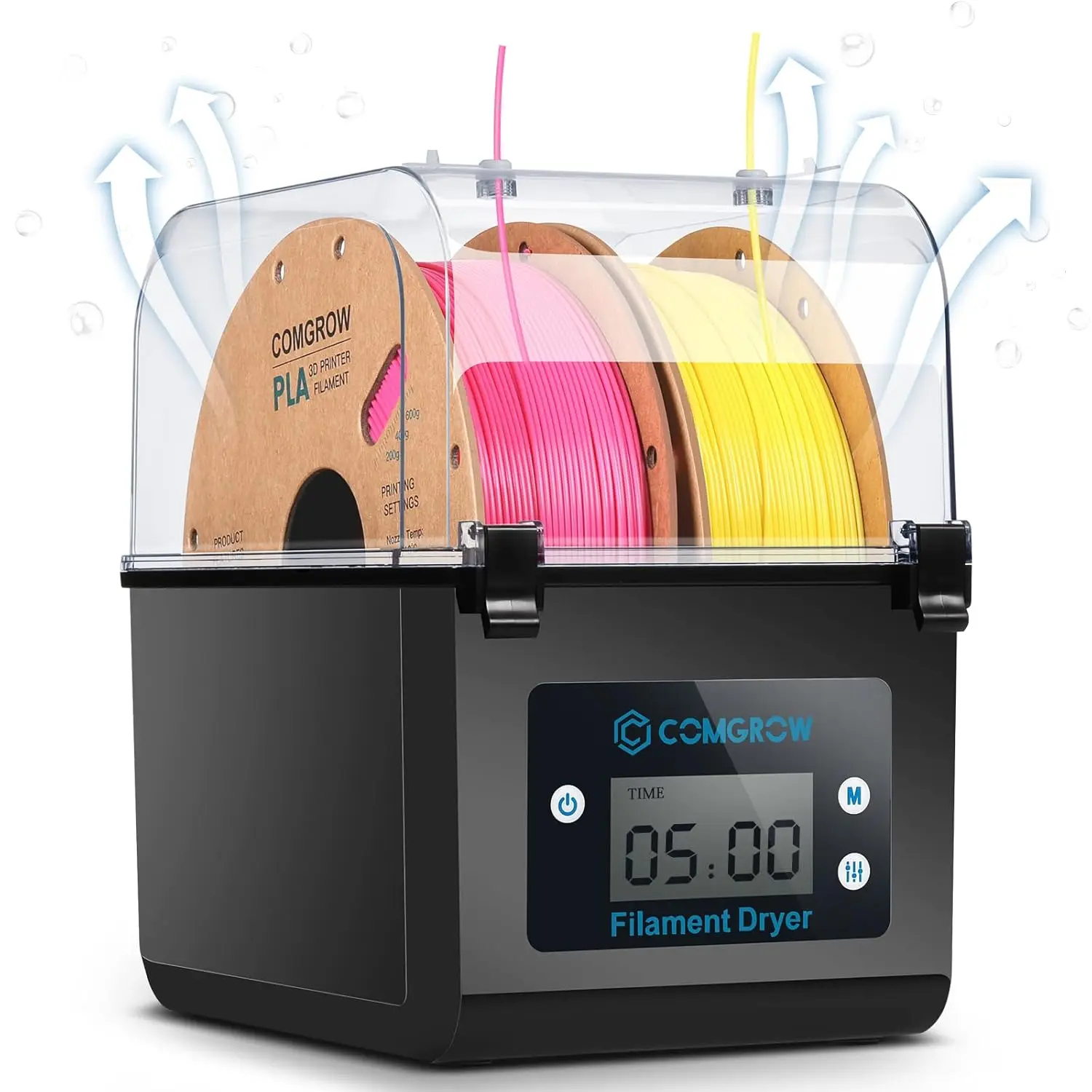
The physical design of the Comgrow dryer emphasizes both functionality and user convenience. Its compact, black housing with a transparent lid allows for easy visual inspection of the spools inside without interrupting the drying process. The clear lid also features integrated air vents, which are crucial for the efficient release of moisture vapor during drying. Without these vents, the humid air would simply become trapped, hindering the drying process. Proper ventilation is key.
A standout feature is its large capacity, accommodating two 1kg spools simultaneously. This dual-spool capability significantly enhances workflow efficiency, particularly for users who frequently print with multiple colors, different materials, or undertake large projects requiring more than one spool. The inner dimensions of 9.29 x 6.49 x 9.13 inches (236 x 165 x 232 mm) confirm its ability to house standard 1kg spools comfortably. Unlike single-spool dryers that necessitate swapping spools, this dual capacity reduces downtime and allows for continuous operation. It saves time.
This increased capacity is a direct upgrade from many entry-level single-spool dryers. For users running a small print farm or those with multiple printers, the ability to dry two spools at once means less waiting and more printing. It also provides flexibility for drying two different filament types concurrently, provided their optimal drying temperatures are similar or can be managed sequentially. The design prioritizes throughput.
The digital display on the front panel provides essential information at a glance. It shows the set temperature and the remaining drying time, allowing users to monitor the process without guesswork. The inclusion of a
Maintaining Material Integrity: The Core Function
Filament moisture is a primary culprit behind numerous 3D printing defects. When hygroscopic materials like Nylon, PVA, or even PLA absorb ambient humidity, their molecular structure changes, leading to a host of issues during extrusion. These problems manifest as stringing, bubbling, poor layer adhesion, brittle prints, and inconsistent extrusion, all of which compromise the structural integrity and aesthetic finish of a printed object. This dryer actively removes that moisture.
Precision Drying for Optimal Performance
The Comgrow dryer offers precise temperature control, a feature critical for effective and safe filament drying. Different filament types require specific temperature ranges to release absorbed moisture without degrading the material itself. For instance, PLA and wood-infused filaments benefit from temperatures between 40-50°C, a range that gently extracts water molecules without causing the filament to soften excessively or fuse. More robust materials like ABS, PVA, and PA (Nylon) necessitate higher temperatures, typically 50-55°C, to effectively drive out moisture due to their higher glass transition temperatures and greater moisture affinity. The unit's ability to maintain these specific temperature profiles ensures that each filament type is dried optimally, preserving its mechanical properties and printability. This precision is vital.
The programmable timer, extending up to 99 hours, provides granular control over the drying duration. This allows users to tailor the drying cycle to the specific needs of their filament, considering factors such as the material type, the level of moisture absorption, and the ambient humidity. A short drying cycle might suffice for slightly damp PLA, while heavily saturated Nylon could require a much longer period. The digital display clearly shows the remaining time and current temperature, offering transparent operational feedback. This level of control prevents both under-drying, which leaves moisture in the filament, and over-drying, which can make some filaments brittle.
Beyond Drying: Integrated Storage and Delivery
The Comgrow unit is more than just a dryer; it functions as a sealed storage solution. Once filament is dried, it is imperative to protect it from re-absorbing moisture from the environment. The sealed design of the box creates a microclimate that shields the filament from ambient humidity, ensuring that the drying effort is not immediately undone. This sealed environment is a significant advantage over simply drying filament and then exposing it to the air again. It maintains the filament's pristine condition.
Furthermore, the dryer doubles as an inline filament holder, feeding directly to the 3D printer. This capability is particularly beneficial for long prints or for printing with highly hygroscopic materials. By keeping the filament within the controlled, dry environment right up to the extruder, the system prevents any moisture re-absorption during the printing process itself. This continuous dry feed is instrumental in achieving consistent extrusion and superior print quality, especially for demanding applications where material consistency is non-negotiable. It streamlines the workflow.
Engineering for Consistency: Design and Capacity
The physical design of the Comgrow dryer emphasizes both functionality and user convenience. Its compact, black housing with a transparent lid allows for easy visual inspection of the spools inside without interrupting the drying process. The clear lid also features integrated air vents, which are crucial for the efficient release of moisture vapor during drying. Without these vents, the humid air would simply become trapped, hindering the drying process. Proper ventilation is key.
Dual Spool Efficiency
A standout feature is its large capacity, accommodating two 1kg spools simultaneously. This dual-spool capability significantly enhances workflow efficiency, particularly for users who frequently print with multiple colors, different materials, or undertake large projects requiring more than one spool. The inner dimensions of 9.29 x 6.49 x 9.13 inches (236 x 165 x 232 mm) confirm its ability to house standard 1kg spools comfortably. Unlike single-spool dryers that necessitate swapping spools, this dual capacity reduces downtime and allows for continuous operation. It saves time.
This increased capacity is a direct upgrade from many entry-level single-spool dryers. For users running a small print farm or those with multiple printers, the ability to dry two spools at once means less waiting and more printing. It also provides flexibility for drying two different filament types concurrently, provided their optimal drying temperatures are similar or can be managed sequentially. The design prioritizes throughput.
Environmental Control and Monitoring
The digital display on the front panel provides essential information at a glance. It shows the set temperature and the remaining drying time, allowing users to monitor the process without guesswork. The inclusion of a