Cloudray CO2 ZnSe Focus Lens for Laser Engraving
Official Store Deal
Expert Analysis Overview
The Precision Imperative: Cloudray CO2 ZnSe Focus Lens
The Cloudray CO2 ZnSe Focus Lens is a critical optical component engineered for high-precision CO2 laser engraving and cutting systems, targeting professionals and advanced hobbyists who require exceptional beam quality and repeatable processing accuracy. This lens is not merely a passive element; it is the linchpin of a laser system's ability to deliver consistent, high-fidelity results. Its design and material selection directly influence the quality of the final product, making it an indispensable tool for demanding applications. Precision is paramount.Unlike generic optics that often introduce aberrations or suffer from rapid degradation, this Cloudray lens is meticulously crafted to maintain optical integrity over extended operational periods. The metrologist's perspective emphasizes the importance of every micron in laser processing, where even slight deviations can lead to significant material waste or compromised output quality. This lens addresses those concerns head-on, providing the foundational accuracy required for intricate work.
Optical Core: ZnSe and PVD Coating
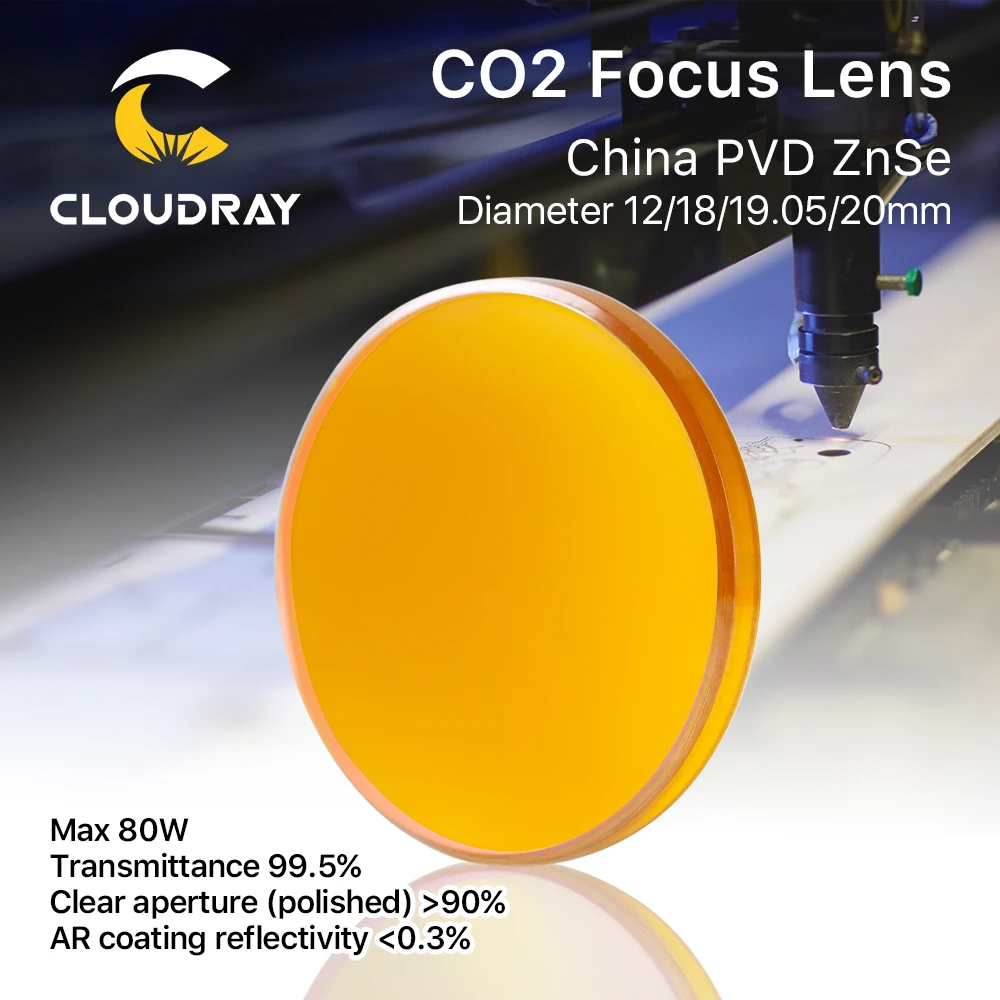
The lens's core material is China PVD ZnSe, optimized for the 10.6µm CO2 laser wavelength. It boasts an impressive transmittance of 99.5%, with an anti-reflection (AR) coating reflectivity of less than 0.3%. These figures are not just specifications; they represent the efficiency with which laser energy is transmitted through the lens to the workpiece.Zinc Selenide (ZnSe) is a preferred material for CO2 laser optics due to its high transparency at the 10.6µm wavelength and its excellent thermal conductivity. This combination allows the lens to handle significant laser power without excessive heating, which could otherwise distort the optical path. The Physical Vapor Deposition (PVD) AR coating further enhances performance by minimizing surface reflections. This means more of the laser's power reaches the material, translating into faster cutting speeds or deeper engraving with the same power setting. Imagine a complex cutting job where every watt counts; this lens ensures maximum energy delivery.
Compared to standard, uncoated or lower-grade ZnSe lenses, the PVD coating significantly reduces reflection losses. This enhancement means a more stable laser output, which is crucial for maintaining consistent cut depths and engraving details across large workpieces. It is a substantial upgrade.
Dimensional Fidelity: The Metrologist's View
This focus lens is available in multiple diameters: 12mm, 18mm, 19.05mm, and 20mm, with a tight diameter tolerance of +0/-0.1mm. A range of focal lengths is offered, including 38.1mm (1.5 inches), 50.8mm (2 inches), 63.5mm (2.5 inches), 76.2mm (3 inches), 101.6mm (4 inches), and 127mm (5 inches), each with a focal length tolerance of +/-2%. These precise measurements are critical.The tight diameter tolerances ensure a secure and centered fit within the laser head, preventing beam misalignment that can lead to uneven cuts or wasted material. A precisely manufactured focal length, within a tight +/-2% tolerance, guarantees that the laser's energy converges exactly where intended. This is vital for achieving sharp kerfs and clean edges, allowing for repeatable results that are essential in any production environment. The ability to measure down to the micron is not just a theoretical concept; it is a practical necessity for achieving superior output.
Generic lenses often exhibit wider focal length tolerances, leading to variations in cutting depth and engraving quality. This Cloudray lens, with its controlled focal length, provides the repeatable results essential for production environments where every micron counts. Consistency is key.
Endurance Under Energy: Power Handling and Surface Quality
The lens is rated for a maximum power handling of 80W, making it suitable for a wide array of mid-power CO2 laser systems. Its clear aperture, which is the usable optical area, is polished to greater than 90%. The surface quality is specified as 20-10 scratch-dig.Scratch-dig is a standard optical specification that quantifies the number and severity of surface imperfections. A 20-10 rating indicates a very high-quality surface, meaning minimal scratches (20) and digs (10). These imperfections, even microscopic, can scatter laser light, reduce transmission, and create hot spots that degrade the lens over time. The robust ZnSe material, combined with a high-quality AR coating and superior surface finish, resists thermal stress and minor surface imperfections. This resilience extends the operational lifespan of the lens, reducing the frequency of replacements. The lens maintains its optical properties even under sustained operation, ensuring consistent performance.
Unlike cheaper alternatives that can pit or degrade rapidly under continuous laser exposure, this lens is designed for sustained performance. Its ability to handle up to 80W ensures compatibility with a wide range of mid-power CO2 laser systems, offering a significant upgrade in reliability. It endures.
Installation and Beam Path Optimization
Proper installation is crucial for maximizing the lens's performance. The convex face of the lens must always face the laser tube, while the concave face should be oriented towards the material being cut or engraved. This specific orientation is not arbitrary; it is engineered to minimize optical aberrations.Spherical aberration occurs when light rays passing through different parts of a spherical lens do not converge at a single focal point. By orienting the convex side towards the divergent laser beam and the concave side towards the material, the lens design effectively corrects for this aberration, ensuring a tighter, more consistent focal spot. A smaller, more intense focal spot translates directly into finer detail, cleaner cuts, and more efficient material removal. Picture a delicate engraving where every line must be razor-sharp; correct lens orientation makes this possible.
Adhering to the recommended orientation maximizes the lens's inherent optical advantages, delivering superior results compared to haphazard setups. This simple step ensures optimal performance.
Economic Impact: Value Beyond Price
The high transmittance, low reflectivity, and precise tolerances of this lens directly translate into tangible economic benefits. These are not just abstract numbers; they represent real-world savings and increased productivity.Investing in a high-quality focus lens directly impacts operational efficiency and material yield. Reduced material waste from miscuts, faster processing times due to efficient power delivery, and consistently high-quality output all contribute to a rapid return on investment. Consider a workshop processing hundreds of parts daily; even a small improvement in efficiency per part accumulates into substantial savings. The lens becomes a force multiplier for the laser system, enhancing its overall capability and profitability.
While the initial cost might be slightly higher than entry-level options, the long-term savings from reduced downtime, fewer rejected parts, and extended lens life make this a more economical choice. It is an upgrade that pays for itself through enhanced capability and consistent, measurable results.