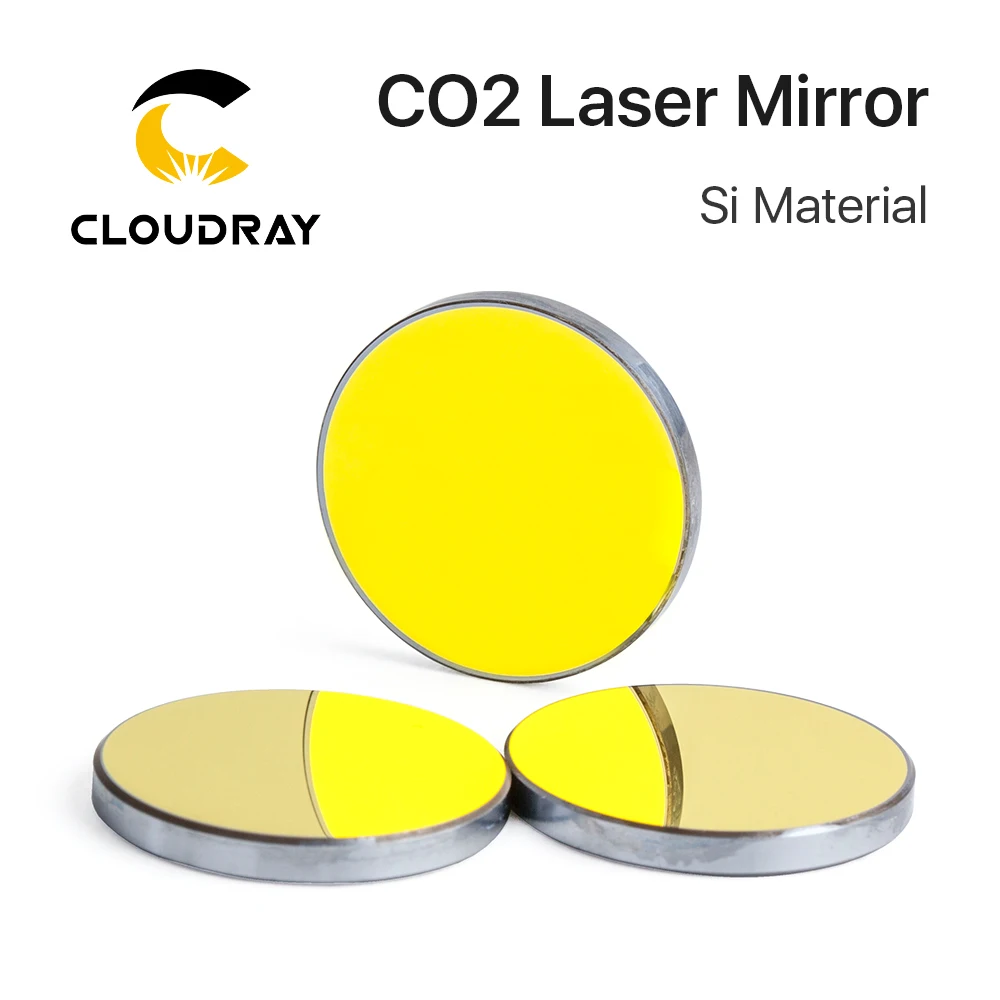
Cloudray CO2 Laser Si Reflective Mirrors
Official Store Deal
Expert Analysis Overview
Precision in Optical Path Management
The Cloudray CO2 Laser Si Reflective Mirror is a critical optical component engineered for precise beam steering within CO2 laser systems. This device is aimed at professionals and hobbyists requiring high reflectivity and durability for laser engraving, cutting, and marking applications. Its silicon substrate, enhanced with a gold-plated reflective surface, ensures minimal energy loss and consistent beam delivery. The metrological integrity of such mirrors is paramount for achieving repeatable and accurate laser processing results.
The Foundation of Reflectivity: Silicon Substrate
The core material of these mirrors is silicon (Si). Silicon offers a robust and stable foundation for optical coatings. Its thermal properties are particularly advantageous in high-power laser environments.
Silicon's low thermal expansion coefficient helps maintain optical flatness even under significant thermal load. This stability is crucial for preserving beam quality and preventing focal shift during extended operation. The material choice directly impacts the longevity and performance consistency of the mirror.
Compared to less stable substrates, silicon provides superior resistance to thermal deformation. This translates to more consistent laser output and reduced need for frequent recalibration. It is a reliable choice for demanding industrial applications.
Gold Plating: The Reflective Standard
Each mirror features a gold-plated reflective surface. Gold is renowned for its high reflectivity in the infrared spectrum, specifically around the 10.6 µm wavelength characteristic of CO2 lasers. This coating is applied with precision.
The gold layer maximizes the reflection of the CO2 laser beam, ensuring that nearly all incident laser energy is directed along the optical path. This high efficiency minimizes power loss, allowing the laser system to operate at its peak performance. Energy transfer is optimized.
Unlike bare silicon or other metallic coatings, gold offers exceptional reflectivity for CO2 wavelengths. This makes it a standard choice for high-performance CO2 laser optics. The coating thickness and uniformity are critical for optimal function.
Dimensional Accuracy and Consistency
These mirrors are available in several standard diameters: 19.05 mm (0.75 inch), 20 mm (0.79 inch), 25 mm (0.98 inch), 30 mm (1.18 inch), and 38.1 mm (1.5 inch). Thicknesses are specified as 3 mm (0.12 inch) for smaller diameters and 5 mm (0.2 inch) for larger ones. Such precise dimensions are vital.
Accurate sizing ensures proper fitment within standard laser mirror mounts and optical systems. Deviations in diameter or thickness can lead to misalignment, beam clipping, or instability in the optical path. Precision manufacturing is essential for seamless integration.
Generic mirrors often exhibit wider manufacturing tolerances, complicating installation and alignment. These specified dimensions indicate a commitment to industry standards, simplifying replacement and system upgrades. Consistency is key.
Power Handling Capabilities
The mirrors are rated for CO2 laser power outputs ranging from 0 to 300 Watts. This broad power handling capacity makes them suitable for a wide array of CO2 laser machines, from entry-level engravers to more powerful industrial cutters. Power management is critical.
Operating within the specified power range ensures the mirror's integrity and prevents thermal damage to the gold coating or silicon substrate. Exceeding this limit can lead to coating degradation, reduced reflectivity, and ultimately, mirror failure. Proper power matching extends component life.
Lower-grade mirrors may struggle with sustained high-power operation, leading to premature failure or inconsistent performance. The 300W rating signifies a robust design capable of handling significant thermal loads. This is a substantial capability.
Optical Path Integration
In a typical CO2 laser system, these mirrors function as beam steering elements. They redirect the laser beam from the laser tube through a series of reflections to the focusing lens. Each reflection must be precise.
Maintaining the exact angle of incidence and reflection is crucial for delivering the laser beam accurately to the workpiece. Any deviation, even at the micron level, can result in significant positional errors at the focal point. The optical path demands exactitude.
Unlike systems relying on fewer reflective elements, a multi-mirror setup requires each component to perform flawlessly. The cumulative effect of minor imperfections can severely degrade system performance. These mirrors are designed to minimize such cumulative errors.
Maintenance and Longevity
Proper maintenance is essential for preserving the high reflectivity and extending the lifespan of these mirrors. The cleaning protocol involves using an air bulb for loose contaminants, acetone with lens tissue for smudges, and distilled vinegar with a cotton swab for acidic residues, followed by a dry swab. Regular cleaning is vital.
Neglecting proper cleaning can lead to the accumulation of dust, debris, or residues on the mirror surface. These contaminants absorb laser energy, causing localized heating, coating damage, and a significant reduction in reflectivity. A clean surface ensures optimal performance.
Many users overlook the specific cleaning requirements for optical components, leading to scratches or chemical damage. Adhering to the recommended cleaning procedure, which avoids abrasive materials and harsh solvents, protects the delicate gold coating. This extends operational life.
Metrological Considerations for Performance
From a metrological perspective, the performance of these mirrors hinges on several key parameters: surface flatness, coating uniformity, and reflectivity percentage. Each parameter contributes to the overall system accuracy. Flatness is paramount.
Surface flatness directly impacts the wavefront distortion of the reflected beam. A mirror with superior flatness ensures the laser beam maintains its collimation and focusability, which is critical for achieving fine details and consistent cut depths. Deviations are measured in fractions of a wavelength.
Coating uniformity ensures consistent reflectivity across the entire mirror surface. Inconsistent coating can lead to hot spots or areas of reduced reflection, compromising beam quality and potentially damaging the mirror. Reflectivity percentage, typically over 99% for gold-plated Si mirrors at 10.6 µm, quantifies the efficiency of energy transfer. High reflectivity minimizes power loss.
For applications demanding micron-level precision, the mirror's contribution to the overall system's repeatability is significant. Any slight variation in the mirror's optical properties over time or due to thermal cycling can introduce errors. Therefore, the stability of the silicon substrate and the durability of the gold coating are critical for maintaining calibration. These components are fundamental to system accuracy.
Imagine a laser system consistently producing intricate designs with unparalleled precision, where every cut and engraving is exactly as intended. The reliability of the Cloudray CO2 Laser Si Reflective Mirrors ensures that your laser's power is efficiently delivered, minimizing waste and maximizing the quality of your output. This translates to fewer reworks, faster production times, and a superior finished product, allowing you to focus on innovation rather than calibration headaches.