Cleqee P6100 100MHz Oscilloscope Probe Set
Official Store Deal
Expert Analysis Overview
The Cleqee P6100 oscilloscope probe set is an essential diagnostic tool designed for electronics technicians and hobbyists requiring precise signal acquisition up to 100MHz. This dual-probe package provides a foundational capability for waveform analysis, crucial for debugging and verifying circuit performance in a wide array of applications.
Oscilloscope probes are the critical interface between a circuit under test and the measurement instrument. The P6100 set, with its 100MHz bandwidth, ensures that signals within this frequency range are captured with fidelity. This bandwidth specification is a key performance indicator, dictating the highest frequency component of a signal that the probe can accurately transmit to the oscilloscope without significant attenuation or distortion. For many digital and analog circuits, 100MHz provides ample headroom for accurate observation.
The visible construction of the probes suggests a standard coaxial cable design, optimized for impedance matching. Proper impedance matching is paramount for minimizing reflections and ensuring signal integrity, especially at higher frequencies. The probe tips appear robust, designed for repeated contact with test points. This is a practical consideration.
In real-world scenarios, a 100MHz bandwidth allows for the analysis of common clock signals, data lines, and power supply ripple in microcontrollers, audio circuits, and basic RF applications. Without adequate bandwidth, fast-changing signals would appear distorted or attenuated, leading to misinterpretations of circuit behavior. Compared to lower-bandwidth probes, which might only extend to 20MHz or 60MHz, the P6100 offers a significantly broader operational range, making it suitable for more complex and higher-speed systems.
Each P6100 probe features 1X/10X adjustable attenuation. This switchable input voltage ratio is a fundamental aspect of oscilloscope probing. In the 1X setting, the probe passes the signal directly to the oscilloscope, offering maximum sensitivity but a lower input impedance, which can load the circuit under test. The 10X setting, conversely, attenuates the signal by a factor of ten, increasing the input impedance and reducing the capacitive loading on the circuit. This is vital for accurate measurements.
The ability to switch between these modes provides significant flexibility. For low-voltage signals where maximum amplitude is needed, 1X is appropriate. For higher voltages or sensitive circuits where minimal loading is desired, 10X is the preferred mode. This dual functionality extends the utility of the probes across a broader range of test conditions, preventing signal distortion and potential damage to the oscilloscope's input stage.
Many entry-level probes offer only a fixed attenuation, limiting their versatility. The P6100's switchable attenuation elevates its practical application, allowing users to adapt to different measurement requirements without needing multiple specialized probes. This adaptability is a clear advantage.
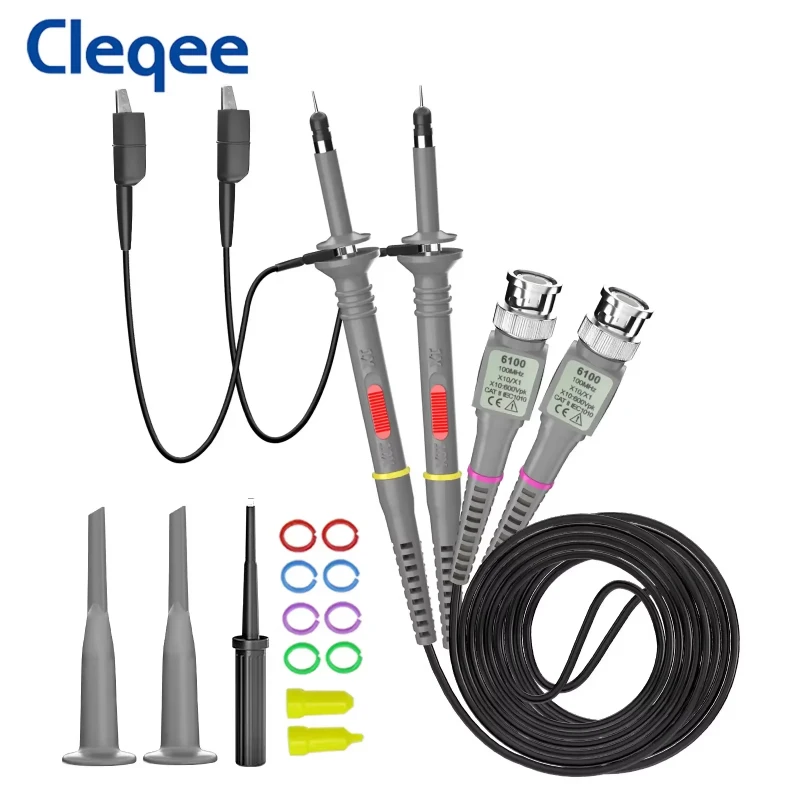
The visual inspection of the Cleqee P6100 probes reveals a functional and practical design. The probe bodies are constructed from what appears to be a durable plastic composite, providing a comfortable grip for extended use. The gray color scheme with red and blue accents on the BNC connectors and attenuation switches offers clear visual differentiation and a professional aesthetic. The cables themselves appear to be of a reasonable thickness, suggesting good shielding and mechanical resilience.
Ergonomics play a subtle yet significant role in measurement accuracy. A probe that is uncomfortable to hold can lead to unsteady hands, increasing the risk of short circuits or inaccurate contact. The P6100's design seems to prioritize ease of use, with a tapered body that fits well in the hand. The attenuation switch is positioned for easy thumb access, allowing for quick adjustments during live measurements. This thoughtful design minimizes user fatigue.
Compared to older, bulkier probe designs, the P6100 appears streamlined. The included accessories, such as the ground leads and various tip attachments, enhance its utility. These components are standard for oscilloscope probes, indicating a complete package ready for immediate deployment. The overall impression is one of practical engineering, focused on reliable performance rather than superfluous features.
The probes terminate in BNC connectors, a ubiquitous standard in test and measurement equipment. BNC connectors are known for their secure, twist-lock mechanism, which ensures a stable electrical connection and prevents accidental disconnections during testing. This robust connection is critical for maintaining signal integrity, especially when dealing with high-frequency signals where even minor impedance mismatches can introduce errors.
The quality of the BNC connector directly impacts the repeatability of measurements. A loose or poorly constructed connector can introduce noise or intermittent contact, leading to unreliable data. The visible metal construction of the BNC connectors on the P6100 probes suggests a durable interface, capable of withstanding numerous connection and disconnection cycles. This is a fundamental requirement for any frequently used test equipment.
Many budget probes might compromise on connector quality, leading to frustrating intermittent issues. The P6100's use of standard, seemingly well-constructed BNC connectors provides a level of assurance regarding signal path stability. This adherence to industry standards simplifies integration into existing lab setups and ensures compatibility with a wide range of oscilloscopes.
For any metrologist, the ability to achieve repeatable results is paramount. While the P6100 probes are passive devices, their performance is heavily dependent on proper compensation. Each probe includes a compensation adjustment screw, typically located near the BNC connector. This adjustment allows users to match the probe's capacitance to the input capacitance of the specific oscilloscope channel it is connected to. Correct compensation ensures a flat frequency response and accurate waveform reproduction.
The process of probe compensation is a critical step before any serious measurement. It involves connecting the probe to a square wave calibration signal (usually provided by the oscilloscope itself) and adjusting the trimmer until the square wave appears perfectly flat, without overshoot or undershoot. This ensures that the probe accurately transmits both low and high-frequency components of the signal. Without this, measurements would be inherently flawed.
Unlike highly specialized, individually calibrated probes that come with detailed calibration certificates, the P6100 is a general-purpose tool. Its accuracy relies on the user performing proper compensation. However, once compensated, the inherent design of a passive probe allows for consistent performance within its specified bandwidth. This makes it a reliable choice for routine measurements, provided the compensation is periodically checked.
The product images show a range of accessories accompanying the probes, including ground leads with alligator clips, various tip covers, and possibly a hook tip. These accessories enhance the practicality and safety of the probes. The ground lead is essential for establishing a common reference point for measurements, preventing ground loops and ensuring accurate voltage readings. Different tip covers allow for probing various test points, from fine-pitch IC pins to larger component leads.
The inclusion of multiple accessories in a single package adds significant value. Users do not need to source these components separately, making the probes ready for use right out of the box. The hook tip, for instance, is particularly useful for hands-free probing of through-hole components, allowing the user to focus on oscilloscope settings or other tasks. This thoughtful bundling improves the overall user experience.
Many basic probe sets might omit some of these crucial accessories, forcing users to purchase them separately. The Cleqee P6100's comprehensive accessory kit positions it as a more complete solution for general-purpose electronics work. This attention to practical detail underscores its utility for both beginners and experienced technicians.
At its price point, the Cleqee P6100 probe set offers exceptional value for money, especially considering it includes two 100MHz probes. For hobbyists, students, or small labs, acquiring two capable probes at this cost significantly lowers the barrier to entry for serious circuit analysis. This allows for dual-channel measurements, enabling comparisons between different points in a circuit, phase analysis, and more complex debugging techniques. Two probes are better than one.
The long-term value of these probes lies in their durability and consistent performance within their specified limits. While not designed for extreme precision or ultra-high-frequency applications, they reliably perform the core function of signal acquisition for a vast majority of electronics projects. Investing in a pair of these probes means having a dependable toolset that will serve well through countless hours of experimentation and troubleshooting.
Compared to single, higher-priced probes of similar specifications, the P6100 set provides a cost-effective solution for expanding measurement capabilities. This makes it an ideal choice for those building out their test bench or needing to replace worn-out probes without a significant financial outlay. The ability to perform differential measurements or compare input/output signals simultaneously is a powerful capability that this dual-probe set readily provides.
Imagine effortlessly connecting to two critical points in your circuit, instantly visualizing their phase relationship and amplitude differences on your oscilloscope. This set empowers you to quickly diagnose timing issues, verify signal propagation, and gain a deeper understanding of your electronic designs, all without the frustration of inadequate or unreliable measurement tools. The clarity and confidence in your measurements will accelerate your projects and enhance your diagnostic capabilities.
Precision in Signal Acquisition
Oscilloscope probes are the critical interface between a circuit under test and the measurement instrument. The P6100 set, with its 100MHz bandwidth, ensures that signals within this frequency range are captured with fidelity. This bandwidth specification is a key performance indicator, dictating the highest frequency component of a signal that the probe can accurately transmit to the oscilloscope without significant attenuation or distortion. For many digital and analog circuits, 100MHz provides ample headroom for accurate observation.
The visible construction of the probes suggests a standard coaxial cable design, optimized for impedance matching. Proper impedance matching is paramount for minimizing reflections and ensuring signal integrity, especially at higher frequencies. The probe tips appear robust, designed for repeated contact with test points. This is a practical consideration.
In real-world scenarios, a 100MHz bandwidth allows for the analysis of common clock signals, data lines, and power supply ripple in microcontrollers, audio circuits, and basic RF applications. Without adequate bandwidth, fast-changing signals would appear distorted or attenuated, leading to misinterpretations of circuit behavior. Compared to lower-bandwidth probes, which might only extend to 20MHz or 60MHz, the P6100 offers a significantly broader operational range, making it suitable for more complex and higher-speed systems.
Attenuation and Voltage Handling
Each P6100 probe features 1X/10X adjustable attenuation. This switchable input voltage ratio is a fundamental aspect of oscilloscope probing. In the 1X setting, the probe passes the signal directly to the oscilloscope, offering maximum sensitivity but a lower input impedance, which can load the circuit under test. The 10X setting, conversely, attenuates the signal by a factor of ten, increasing the input impedance and reducing the capacitive loading on the circuit. This is vital for accurate measurements.
The ability to switch between these modes provides significant flexibility. For low-voltage signals where maximum amplitude is needed, 1X is appropriate. For higher voltages or sensitive circuits where minimal loading is desired, 10X is the preferred mode. This dual functionality extends the utility of the probes across a broader range of test conditions, preventing signal distortion and potential damage to the oscilloscope's input stage.
Many entry-level probes offer only a fixed attenuation, limiting their versatility. The P6100's switchable attenuation elevates its practical application, allowing users to adapt to different measurement requirements without needing multiple specialized probes. This adaptability is a clear advantage.
Build Quality and Ergonomics
The visual inspection of the Cleqee P6100 probes reveals a functional and practical design. The probe bodies are constructed from what appears to be a durable plastic composite, providing a comfortable grip for extended use. The gray color scheme with red and blue accents on the BNC connectors and attenuation switches offers clear visual differentiation and a professional aesthetic. The cables themselves appear to be of a reasonable thickness, suggesting good shielding and mechanical resilience.
Ergonomics play a subtle yet significant role in measurement accuracy. A probe that is uncomfortable to hold can lead to unsteady hands, increasing the risk of short circuits or inaccurate contact. The P6100's design seems to prioritize ease of use, with a tapered body that fits well in the hand. The attenuation switch is positioned for easy thumb access, allowing for quick adjustments during live measurements. This thoughtful design minimizes user fatigue.
Compared to older, bulkier probe designs, the P6100 appears streamlined. The included accessories, such as the ground leads and various tip attachments, enhance its utility. These components are standard for oscilloscope probes, indicating a complete package ready for immediate deployment. The overall impression is one of practical engineering, focused on reliable performance rather than superfluous features.
Connector Reliability
The probes terminate in BNC connectors, a ubiquitous standard in test and measurement equipment. BNC connectors are known for their secure, twist-lock mechanism, which ensures a stable electrical connection and prevents accidental disconnections during testing. This robust connection is critical for maintaining signal integrity, especially when dealing with high-frequency signals where even minor impedance mismatches can introduce errors.
The quality of the BNC connector directly impacts the repeatability of measurements. A loose or poorly constructed connector can introduce noise or intermittent contact, leading to unreliable data. The visible metal construction of the BNC connectors on the P6100 probes suggests a durable interface, capable of withstanding numerous connection and disconnection cycles. This is a fundamental requirement for any frequently used test equipment.
Many budget probes might compromise on connector quality, leading to frustrating intermittent issues. The P6100's use of standard, seemingly well-constructed BNC connectors provides a level of assurance regarding signal path stability. This adherence to industry standards simplifies integration into existing lab setups and ensures compatibility with a wide range of oscilloscopes.
Calibration and Repeatability
For any metrologist, the ability to achieve repeatable results is paramount. While the P6100 probes are passive devices, their performance is heavily dependent on proper compensation. Each probe includes a compensation adjustment screw, typically located near the BNC connector. This adjustment allows users to match the probe's capacitance to the input capacitance of the specific oscilloscope channel it is connected to. Correct compensation ensures a flat frequency response and accurate waveform reproduction.
The process of probe compensation is a critical step before any serious measurement. It involves connecting the probe to a square wave calibration signal (usually provided by the oscilloscope itself) and adjusting the trimmer until the square wave appears perfectly flat, without overshoot or undershoot. This ensures that the probe accurately transmits both low and high-frequency components of the signal. Without this, measurements would be inherently flawed.
Unlike highly specialized, individually calibrated probes that come with detailed calibration certificates, the P6100 is a general-purpose tool. Its accuracy relies on the user performing proper compensation. However, once compensated, the inherent design of a passive probe allows for consistent performance within its specified bandwidth. This makes it a reliable choice for routine measurements, provided the compensation is periodically checked.
Accessories and Practicality
The product images show a range of accessories accompanying the probes, including ground leads with alligator clips, various tip covers, and possibly a hook tip. These accessories enhance the practicality and safety of the probes. The ground lead is essential for establishing a common reference point for measurements, preventing ground loops and ensuring accurate voltage readings. Different tip covers allow for probing various test points, from fine-pitch IC pins to larger component leads.
The inclusion of multiple accessories in a single package adds significant value. Users do not need to source these components separately, making the probes ready for use right out of the box. The hook tip, for instance, is particularly useful for hands-free probing of through-hole components, allowing the user to focus on oscilloscope settings or other tasks. This thoughtful bundling improves the overall user experience.
Many basic probe sets might omit some of these crucial accessories, forcing users to purchase them separately. The Cleqee P6100's comprehensive accessory kit positions it as a more complete solution for general-purpose electronics work. This attention to practical detail underscores its utility for both beginners and experienced technicians.
Value Proposition for the Electronics Enthusiast
At its price point, the Cleqee P6100 probe set offers exceptional value for money, especially considering it includes two 100MHz probes. For hobbyists, students, or small labs, acquiring two capable probes at this cost significantly lowers the barrier to entry for serious circuit analysis. This allows for dual-channel measurements, enabling comparisons between different points in a circuit, phase analysis, and more complex debugging techniques. Two probes are better than one.
The long-term value of these probes lies in their durability and consistent performance within their specified limits. While not designed for extreme precision or ultra-high-frequency applications, they reliably perform the core function of signal acquisition for a vast majority of electronics projects. Investing in a pair of these probes means having a dependable toolset that will serve well through countless hours of experimentation and troubleshooting.
Compared to single, higher-priced probes of similar specifications, the P6100 set provides a cost-effective solution for expanding measurement capabilities. This makes it an ideal choice for those building out their test bench or needing to replace worn-out probes without a significant financial outlay. The ability to perform differential measurements or compare input/output signals simultaneously is a powerful capability that this dual-probe set readily provides.
Imagine effortlessly connecting to two critical points in your circuit, instantly visualizing their phase relationship and amplitude differences on your oscilloscope. This set empowers you to quickly diagnose timing issues, verify signal propagation, and gain a deeper understanding of your electronic designs, all without the frustration of inadequate or unreliable measurement tools. The clarity and confidence in your measurements will accelerate your projects and enhance your diagnostic capabilities.