CKCTINNER M6 Type K Thermocouple Sensor
Official Store Deal
Expert Analysis Overview
Precision Thermal Acquisition for Industrial Control
The CKCTINNER M6 Type K Thermocouple is a robust, industrial-grade temperature sensor engineered for precise and reliable thermal monitoring in demanding environments. This device is critical for applications requiring accurate thermal feedback for process control and safety. Its design prioritizes both measurement integrity and mechanical stability. The sensor provides essential data for system optimization.Sensing Element Integrity: The Type K Advantage
This thermocouple utilizes a Type K sensing element, a widely recognized standard in industrial temperature measurement. Type K thermocouples are composed of nickel-chromium (Chromel) and nickel-aluminum (Alumel) alloys. This specific alloy combination offers a broad temperature range and a relatively linear voltage output. The specified operational range of 0-400°C makes it suitable for numerous common industrial processes. This range covers many heating and cooling applications. The inherent stability of Type K materials contributes to consistent readings over time.Unlike less common or specialized thermocouple types, the Type K offers a balance of sensitivity, range, and cost-effectiveness. Its thermoelectric properties are well-documented and understood, simplifying integration into existing control systems. The predictable voltage response ensures accurate conversion to temperature values. This is crucial for maintaining process parameters. The Type K element is a workhorse in thermal sensing.
For metrological applications, the choice of Type K is often driven by its established performance characteristics. While not offering the extreme high-temperature capabilities of Type R or S, its accuracy within the 0-400°C window is highly reliable. Repeatability is a key factor here. This makes it an excellent choice for general-purpose temperature monitoring where extreme precision at very high temperatures is not the primary concern. Its widespread adoption also means easier calibration and replacement.
Mechanical Integration: The M6 Threaded Probe
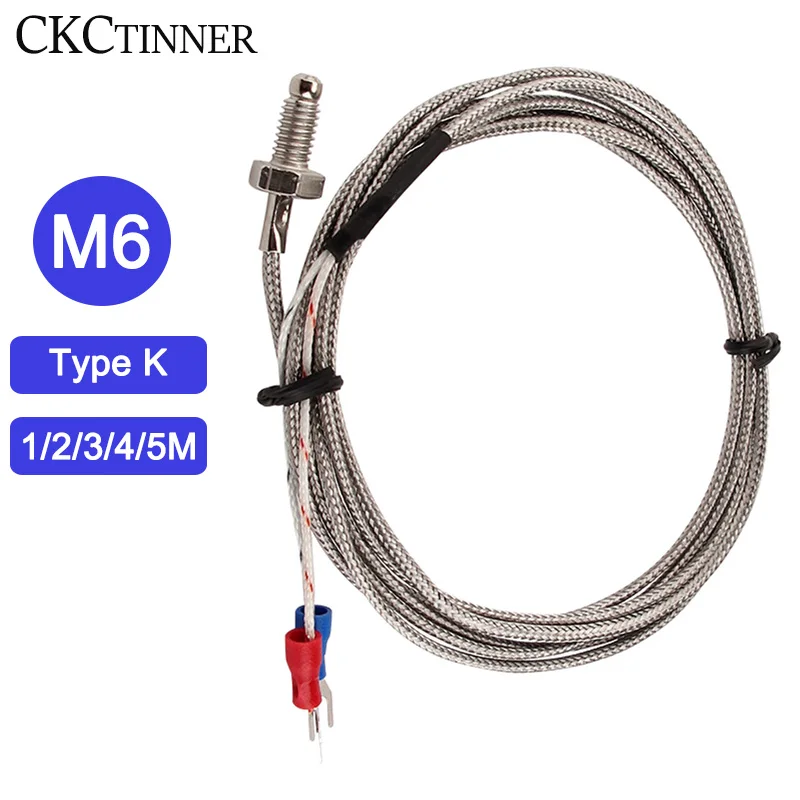
The sensor features an M6 threaded probe, indicating a 6mm diameter metric thread for secure mounting. This threaded design ensures a stable and consistent physical connection to the measurement point. A secure connection minimizes external influences on the sensor tip. The M6 thread is a common standard in industrial hardware. This facilitates straightforward installation into compatible ports or thermowells. Proper mechanical coupling is vital for accurate thermal transfer.This screw-in design provides superior thermal contact compared to surface-mounted or clamp-on sensors. The direct contact with the process medium or surface enhances the speed and accuracy of temperature readings. It also prevents accidental dislodgement, which is critical in operational environments. The probe's dimensions, including a 17mm thread length and 6mm diameter tip, are clearly indicated. These dimensions allow for precise fitment planning. The robust construction withstands typical industrial vibrations.
Compared to simple immersion probes, the M6 threaded variant offers a more permanent and robust installation. This reduces the likelihood of measurement errors due to probe movement or poor contact. For applications requiring continuous, unattended monitoring, this mechanical stability is indispensable. It ensures the sensor remains precisely where it needs to be. This design choice reflects a focus on long-term operational reliability.
Material Science & Durability: Sheathed for Longevity
The thermocouple cable is protected by a braided metal sheath, visible in the product imagery. This metallic braiding provides significant mechanical protection against abrasion, cuts, and general wear and tear. It also offers a degree of electromagnetic interference (EMI) shielding. This is important in electrically noisy industrial settings. The sheath enhances the overall lifespan of the sensor. Its flexibility allows for routing in complex installations.This protective layer is crucial for maintaining the integrity of the internal conductors, which are susceptible to damage. The visible construction implies a stainless steel or similar alloy for the probe tip and threaded section. Such materials offer good corrosion resistance and high-temperature stability. These properties are essential for sustained performance in industrial environments. The probe's construction is designed for resilience.
Unlike unshielded or PVC-jacketed cables, the braided metal sheath significantly extends the sensor's operational life in harsh conditions. It prevents premature failure due to physical stress or environmental exposure. While not typically rated for direct immersion in highly corrosive liquids without additional protection, it excels in dry, abrasive, or high-temperature air applications. This material choice is a clear upgrade for industrial longevity.
Connectivity & System Compatibility: Standardized Terminals
The sensor terminates in spade connectors, which are a common and versatile connection type for screw terminals. These connectors ensure a secure electrical connection to a temperature controller, data logger, or other measurement device. The red and blue color coding on the terminals typically indicates polarity. This simplifies correct wiring. Proper polarity is essential for accurate readings.Spade terminals are favored for their ease of installation and removal, allowing for quick maintenance or sensor replacement. They provide a large contact area, minimizing resistance and ensuring reliable signal transmission. This direct connection method reduces potential points of failure. The terminals are crimped securely to the braided cable. This ensures a robust electrical interface.
Many industrial temperature controllers and PLCs are designed with screw terminal blocks that readily accept spade connectors. This universal compatibility reduces the need for specialized adapters or re-termination, streamlining system integration. Unlike proprietary connectors, spade terminals offer broad interoperability. This makes the sensor a flexible component in various setups.
Metrological Performance: Accuracy and Repeatability
As a metrologist, the primary concern for any temperature sensor is its accuracy and repeatability. While specific calibration data is not provided, Type K thermocouples are known for their consistent performance within their specified range. The robust M6 threaded design ensures the sensing junction is held firmly in place. This minimizes measurement variability due to probe movement. Consistent placement is vital for repeatable results.Repeatability refers to the sensor's ability to produce the same output for the same input temperature under the same conditions. The stable mechanical mounting and the inherent properties of the Type K alloy contribute significantly to this. For critical process control, repeatable results are paramount. This allows for reliable trend analysis and alarm triggering. The sensor's design supports high data integrity.
Achieving precise temperature control often hinges on the resolution of the sensor's output and the controller's input. While the thermocouple itself generates an analog voltage, the quality of this signal directly impacts the digital resolution achievable by the connected instrument. A stable, low-noise signal from the sensor is crucial. This enables the controller to measure down to the micron of temperature change. This sensor provides a solid foundation for accurate data logging capability.
Operational Envelope: From Ambient to Process Heat
The specified temperature range of 0-400°C defines the operational envelope of this thermocouple. This range encompasses a vast array of industrial and laboratory applications. It is suitable for monitoring ovens, furnaces, kilns, and various heating elements. The sensor can also track ambient temperatures within heated enclosures. Its versatility is a significant asset.Understanding the thermal limits is critical for both sensor longevity and measurement accuracy. Operating within this range ensures the Type K element performs optimally, providing reliable voltage outputs. Exceeding the upper limit can lead to decalibration or permanent damage to the sensor. The lower limit of 0°C indicates it is not designed for cryogenic applications. This is a common characteristic for Type K. The sensor is optimized for heat processes.
Compared to RTDs (Resistance Temperature Detectors) which offer higher accuracy but a narrower range, or thermistors which are limited to even smaller ranges, the Type K thermocouple provides a practical balance. Its ability to handle temperatures up to 400°C makes it a workhorse in many manufacturing and research settings. This broad utility reduces the need for multiple sensor types. It simplifies inventory and system design.
Economic Value: A Prudent Investment in Data Integrity
At a price point of approximately $0.96 USD, this CKCTINNER M6 Type K Thermocouple represents an exceptionally cost-effective solution for temperature sensing. The low initial investment makes it accessible for both small-scale projects and large industrial deployments. This affordability does not compromise its fundamental functionality. It delivers essential measurement capability.Value framing for such a component shifts from sticker price to the long-term return on investment (ROI) in data integrity and process control. A reliable temperature sensor prevents costly production errors, ensures product quality, and optimizes energy consumption. The cost-per-use over its lifespan is remarkably low. This makes it a smart operational expenditure. Investing in accurate sensors pays dividends.
Unlike generic, unbranded alternatives that might offer inconsistent performance or premature failure, this product, while budget-friendly, appears to adhere to standard Type K specifications. The visible quality of the braided sheath and M6 threading suggests a commitment to functional durability. This minimizes the risk of unexpected downtime. It is a sensible choice for budget-conscious operations. The sensor offers significant value.