BSIDE Portable Digital Lux Meter
Official Store Deal
Expert Analysis Overview
Illuminating Environments: A Home Inspector's Perspective
The BSIDE Portable Digital Lux Meter is a compact, handheld illumination measurement device designed for a broad spectrum of users, from home inspectors assessing lighting conditions to horticulturists optimizing plant growth. This instrument provides a clear, numerical representation of light intensity, crucial for verifying compliance with safety standards and ensuring optimal visual comfort in various settings. Its utility extends beyond simple readings, offering a foundational tool for detailed environmental analysis.
Precision in Light Assessment
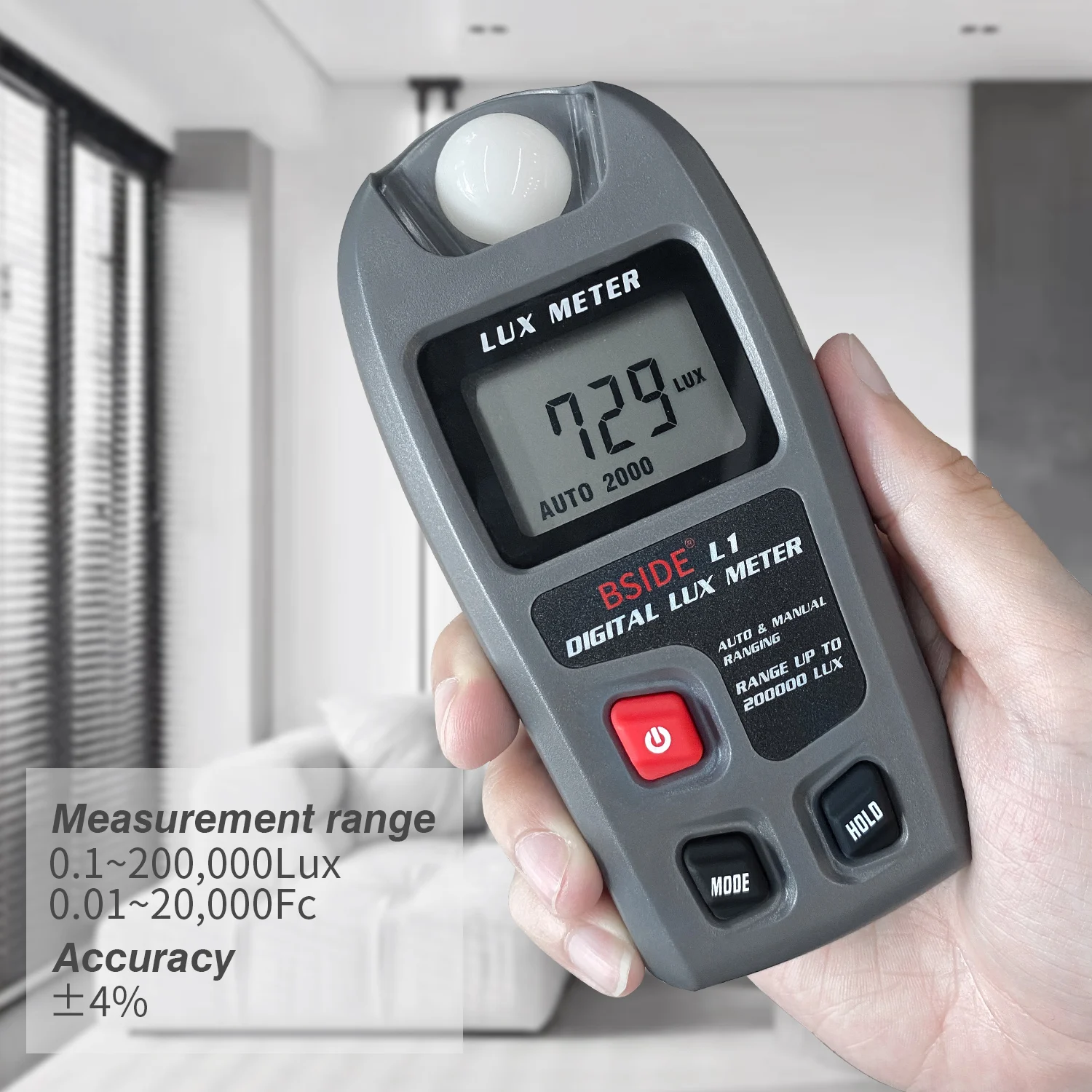
The device features a measurement range of 0.1 to 200,000 Lux and 0.01 to 20,000 Fc, indicating a wide operational scope. This broad range allows for accurate readings in dimly lit basements and brightly lit commercial spaces alike. The stated accuracy of ±4% suggests reliable data collection for most practical applications. Such precision is vital for professional home inspectors who must document light levels for client reports.
Unlike many entry-level light meters that offer limited ranges or lower accuracy, this BSIDE model provides a more robust capability. It handles diverse lighting scenarios. The sensor is protected by a removable lid, a thoughtful design choice. This prevents accidental damage to the sensitive light-detecting component. The measurement sensor is clearly visible at the top, ensuring direct light exposure. This is a critical feature for consistent readings.
For instance, when evaluating a residential property, a home inspector can quickly determine if a room meets recommended lighting levels for specific tasks, such as reading or cooking. Insufficient lighting can pose safety hazards. The meter provides objective data. This allows for informed recommendations to clients regarding lighting upgrades or adjustments. The digital display is easy to read.
Ergonomics and Operational Simplicity
Visually, the BSIDE Lux Meter presents a gray, ergonomic form factor that appears comfortable for single-hand operation. Its dimensions, approximately 14.5cm (5.7in) in length, 6.7cm (2.64in) in width, and 3.2cm (1.26in) in thickness, suggest a pocket-friendly design. This portability is a significant advantage for professionals who require quick, on-the-go measurements across multiple locations within a property.
The control layout is straightforward, featuring a prominent red power on/off button, a mode button for switching between Lux and Foot-candle (Fc) units, and a hold button to freeze readings. This intuitive interface minimizes the learning curve, allowing users to focus on the measurement task rather than device operation. The large LCD display enhances readability. It shows the current measurement clearly.
Many generic light meters often feature complex menu systems or small, hard-to-read displays, which can slow down fieldwork. This design prioritizes efficiency. The hold function is particularly useful when taking readings in awkward positions or when needing to record a measurement before moving to the next location. This saves time during inspections. The device simplifies data acquisition.
Practical Applications in Home Inspection and Beyond
For a home inspector, the ability to quantify light levels is invaluable. It assists in identifying areas with inadequate natural or artificial illumination, which could impact occupant comfort, safety, and even property value. For example, verifying that emergency exit pathways or stairwells meet minimum light requirements is a critical safety check. The meter provides objective evidence.
Beyond traditional home inspections, this lux meter finds utility in diverse fields. In horticulture, it helps optimize light exposure for plant growth in greenhouses or indoor setups, ensuring plants receive the ideal spectrum and intensity. For photography and videography, it aids in setting up appropriate lighting conditions for shoots, ensuring consistent exposure and quality. The device offers broad utility.
Consider a scenario where a client complains about eye strain in their home office. A quick measurement with this device can reveal if the ambient light levels are too low, prompting a recommendation for additional task lighting. Similarly, in commercial settings, ensuring proper lighting can enhance employee productivity and reduce accidents. This tool provides actionable insights. It empowers informed decision-making.
Navigating Data and Display Features
The LCD display is a central feature, providing clear numerical readouts. It includes indicators for MAX/MIN HOLD, suggesting the capability to record peak and lowest light levels during a measurement session. This is particularly useful for monitoring fluctuating light conditions, such as those near windows throughout the day. The display is backlit for low-light conditions. This enhances usability.
The AUTO 2000 x100 notation visible on the display implies an auto-ranging feature, simplifying operation by automatically adjusting the measurement scale. This eliminates the need for manual range selection, a common point of frustration with less sophisticated meters. The device adapts to the environment. It ensures accurate readings without user intervention.
Compared to older analog light meters, which require subjective interpretation of needle positions, this digital display offers unambiguous data. The ability to switch between Lux and Fc units caters to different regional standards and user preferences, making it a globally adaptable tool. This flexibility is a distinct advantage. It broadens the meter's appeal.
Durability and Longevity Considerations
While the specific material composition is not explicitly detailed, the visible casing appears to be a durable plastic or ABS composite. This type of material is common in handheld test equipment, offering a good balance of impact resistance and lightweight design. Such construction is suitable for the rigors of fieldwork, where devices may experience occasional bumps or drops. The build quality seems robust.
The inclusion of a protective lid for the sensor further contributes to the device's longevity. The buttons appear to be rubberized, suggesting resistance to dust and minor splashes, which is beneficial in various working environments. A well-constructed casing protects internal electronics. This ensures consistent performance over time. The design prioritizes practical use.
Unlike cheaper, flimsy plastic devices that can crack or malfunction after minimal use, the apparent build quality of this BSIDE meter suggests it is designed for sustained use. Investing in a tool that can withstand daily professional demands ultimately offers better long-term value. It reduces the need for frequent replacements. This is a cost-effective choice.
The Value Proposition for Professionals
For home inspectors, facility managers, or anyone needing to quantify light levels, this meter represents a significant upgrade from subjective visual assessments. It transforms qualitative observations into quantitative data, lending credibility and professionalism to reports. The ability to provide concrete numbers for light intensity can be a powerful asset when making recommendations or diagnosing issues. It enhances professional standing.
Imagine confidently presenting a client with a report detailing precise light levels in each room, backed by objective measurements. This level of detail not only builds trust but also empowers clients to make informed decisions about their property's lighting. The BSIDE Portable Digital Lux Meter is not just a tool; it is an enabler of professional excellence and informed decision-making in environmental assessment. It elevates the standard of work. This device helps identify hidden issues related to inadequate illumination, ensuring a safer and more comfortable living or working space. It's an investment in thoroughness and client satisfaction.