BIGTREETECH TMC2209 Stepper Motor Driver
Official Store Deal
Expert Analysis Overview
The BIGTREETECH TMC2209 V1.3 Stepper Motor Driver is an advanced, quiet-operation module designed for 3D printer enthusiasts and STEM educators seeking precise and smooth motion control. This component represents a significant upgrade for any 3D printer, particularly those operating in environments where noise reduction and print quality are paramount. It offers a sophisticated solution for common motion control challenges in additive manufacturing.
Traditional stepper motor drivers often produce a noticeable, high-pitched whine during operation. This acoustic byproduct can be particularly disruptive in classroom settings or shared workspaces, hindering concentration and creating an undesirable learning environment. The TMC2209 V1.3 directly addresses this issue. Its core design incorporates stealthChop technology, a voltage mode chopper that ensures virtually silent motor operation. This quiet performance is not merely a comfort feature; it transforms the operational dynamics of a 3D printer.
The visual evidence of the compact module suggests a direct drop-in replacement for many existing drivers. This ease of physical integration simplifies the upgrade path for educators and students. Unlike older drivers that rely on less refined current control, the TMC2209's advanced algorithms actively manage motor coil currents to minimize audible noise. This capability allows for 3D printers to run in the background without becoming a focal point of distraction.
Compared to standard A4988 or DRV8825 drivers, the TMC2209 offers a dramatic reduction in operational noise. This difference is immediately apparent. Where older drivers might generate noise levels that impede conversation, the TMC2209 allows for near-silent printing, making it ideal for libraries, classrooms, or home offices. The quiet operation supports a more focused and productive atmosphere for learning and experimentation.
Precision in 3D printing is critical for producing high-quality models and functional prototypes. The TMC2209 V1.3 driver excels in this area through its microstepping capabilities. It can achieve up to 256 microsteps per full step, interpolating 1/16 microsteps to 1/256. This high resolution translates directly into smoother motion for the stepper motors, resulting in significantly finer surface finishes on printed objects. The visual details of the driver board, with its clearly marked pins and compact layout, indicate a robust engineering approach.
The implication of such high microstepping is a substantial improvement in print quality. Jagged lines and visible layer artifacts, often a byproduct of lower-resolution drivers, are greatly minimized. For STEM education, this means students can produce more accurate and aesthetically pleasing designs, fostering a deeper understanding of precision engineering. The ability to render intricate details with greater fidelity enhances the educational value of every print.
Standard drivers often cap out at 1/16 or 1/32 microstepping, which, while functional, can leave noticeable imperfections on printed surfaces. The TMC2209's superior microstepping, combined with its silent operation, provides a professional-grade motion control experience. This allows students to focus on design optimization rather than troubleshooting print quality issues stemming from basic hardware limitations. It’s an upgrade that pays dividends in both output quality and user satisfaction.
The BIGTREETECH TMC2209 V1.3 is designed for straightforward integration into popular 3D printer mainboards, including the BTT Octopus, SKR V1.4, SKR Mini E3, and boards found in Ender 3 V2 and Voron 2.4 printers. The standard pinout, visible in the images, ensures broad compatibility. This ease of integration is crucial for educational environments, as it minimizes the time spent on complex hardware modifications. The driver's compact size, consistent with the A4988 footprint, ensures it fits into existing sockets without issue.
For students and educators, this means less time wrestling with hardware compatibility and more time dedicated to the principles of 3D design and additive manufacturing. The availability of jumper wires in multi-packs further streamlines the setup process, offering flexibility for various configurations. The focus shifts from installation hurdles to practical application.
Unlike proprietary or less common driver modules, the TMC2209 benefits from extensive community support and documentation. This wealth of information simplifies the learning curve for configuration, particularly for advanced features like UART communication. Educators can leverage this resource to guide students through more complex topics in motor control and firmware customization. This open-source friendly approach fosters a collaborative learning environment.
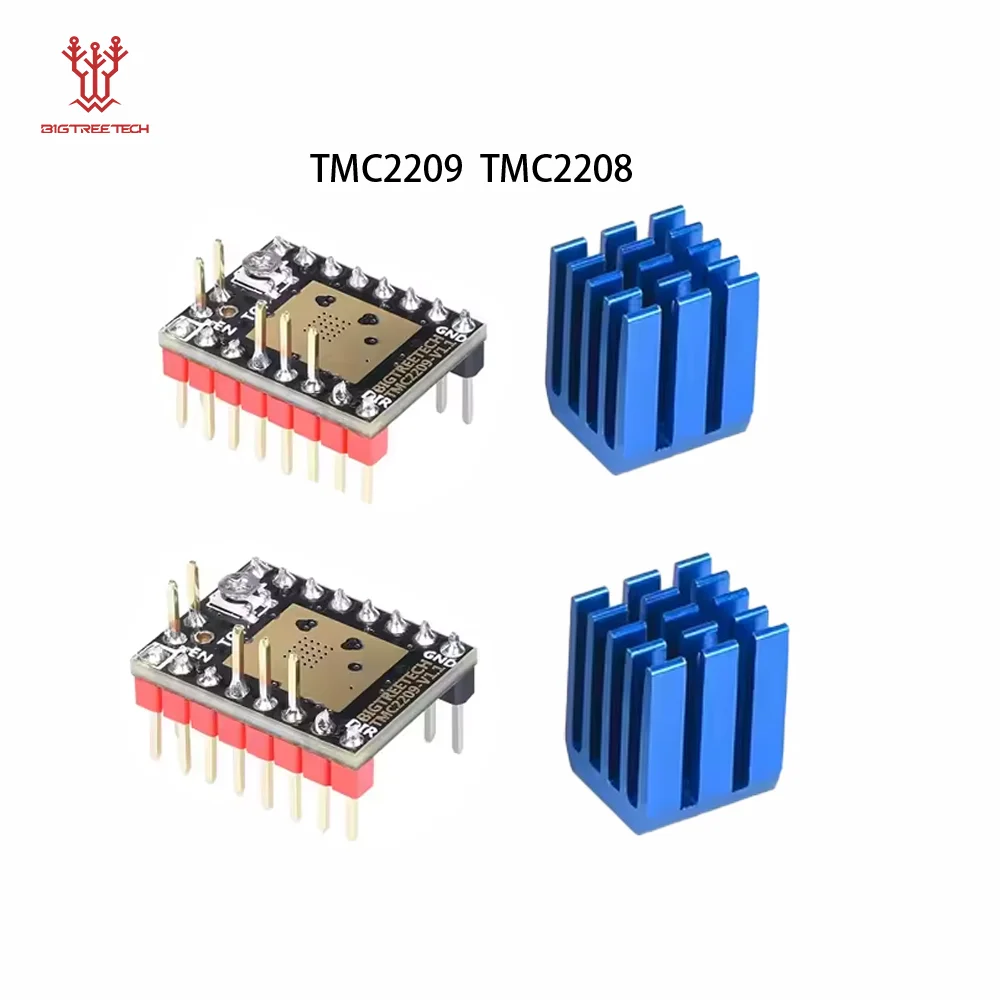
Stepper motor drivers generate heat during operation, especially under high current loads. Effective thermal management is essential for maintaining performance and extending the lifespan of the component. The BIGTREETECH TMC2209 V1.3 drivers are consistently pictured with dedicated aluminum heatsinks. These heatsinks are designed to be affixed directly to the driver chip, dissipating heat efficiently. The blue color of the heatsinks is a common indicator of aluminum, a material known for its good thermal conductivity.
The inclusion of these heatsinks implies a proactive approach to reliability. Without proper cooling, drivers can overheat, leading to skipped steps, reduced current output, and eventual failure. For a classroom setting, where equipment might see extended periods of use, robust thermal management is non-negotiable. The heatsink ensures consistent performance even during long print jobs.
Many basic drivers either omit heatsinks or provide inadequate ones, forcing users to source their own. The bundled heatsinks with the TMC2209 offer a complete thermal solution, reducing the risk of premature component failure. This attention to detail contributes to the overall longevity of the driver, making it a more dependable choice for sustained educational use. Proper application of these heatsinks with thermal adhesive is a small but critical step in ensuring optimal performance.
The capabilities of the TMC2209 V1.3 driver significantly enhance the educational experience in 3D printing. Its quiet operation creates a conducive learning atmosphere, allowing students to focus on the intricacies of design and engineering without auditory distractions. The improved print quality, a direct result of higher microstepping, provides tangible feedback on design choices. Students can observe the precise execution of their digital models in physical form.
This driver simplifies the teaching of advanced motion control concepts. With UART mode, educators can demonstrate how motor current, microstepping, and other parameters can be dynamically adjusted via firmware. This hands-on experience demystifies complex electronics and software interactions. It provides a practical foundation for understanding embedded systems and control theory.
Compared to older driver technologies, which often require manual potentiometer adjustments, the TMC2209's digital control via UART offers a safer and more precise method for tuning. This reduces the risk of accidental damage from incorrect adjustments. It also allows for more consistent and repeatable experiments in a learning environment, which is vital for scientific inquiry. The driver becomes a tool for teaching, not just a component.
While the initial cost of TMC2209 drivers might be slightly higher than older, more basic alternatives, the long-term value proposition is compelling. Reduced noise, enhanced print quality, and improved reliability translate into fewer failed prints, less material waste, and a more efficient learning or production workflow. The investment quickly recoups itself through these efficiencies.
For institutions or individuals involved in advanced fabrication, the precision offered by the TMC2209 is invaluable. It enables the creation of prototypes and functional parts with tighter tolerances and smoother surfaces. This capability expands the scope of projects that can be undertaken, from intricate mechanical components to detailed artistic models. The driver supports higher-fidelity output.
Consider the cost-per-use over the lifespan of a 3D printer. A driver that consistently delivers high-quality results and operates reliably minimizes downtime and maintenance. This contributes to a lower total cost of ownership compared to constantly replacing or troubleshooting less capable drivers. The TMC2209 is an investment in consistent performance.
The TMC2209 V1.3 is not merely a silent driver; it offers advanced features that elevate its utility. One of the most significant is its support for UART (Universal Asynchronous Receiver-Transmitter) communication. This interface allows the mainboard to digitally communicate with the driver, enabling real-time adjustment of parameters such as motor current, microstepping, and stealthChop/spreadCycle modes. This level of control is a major advantage.
The implication for users is unprecedented flexibility. Instead of manually adjusting tiny potentiometers, users can configure and fine-tune their stepper motors directly through the printer's firmware. This digital control offers greater precision and repeatability. It also opens up possibilities for advanced features like sensorless homing, which simplifies printer calibration by using the motor's back EMF to detect endstops. This step simplifies printer calibration.
Unlike drivers limited to basic STEP/DIR control, the TMC2209's UART capability provides a deeper level of interaction. This makes it a powerful tool for experimentation and optimization, particularly for advanced users or those developing custom firmware. It transforms the driver from a passive component into an active participant in the printer's control system, offering a more integrated and intelligent solution.
While the physical installation of the TMC2209 V1.3 is generally straightforward due to its standard footprint, proper configuration is essential to unlock its full potential. The images show a compact board with clearly labeled pins, guiding the user during setup. The included jumper wires, especially in multi-packs, facilitate the necessary connections for UART mode.
The primary consideration after physical installation is firmware adjustment. To utilize features like stealthChop for silent operation or UART communication, the 3D printer's firmware (e.g., Marlin, Klipper) must be configured correctly. This process involves enabling the specific TMC2209 driver type and setting desired parameters. This step is crucial.
Compared to simpler drivers that are plug-and-play with minimal firmware changes, the TMC2209 requires a bit more initial setup for advanced functionality. However, this investment in configuration yields significant benefits in performance and control. The extensive online community and documentation for BIGTREETECH products provide ample resources for navigating these initial setup steps, making the process manageable for even intermediate users.
The adoption of advanced stepper motor drivers like the TMC2209 V1.3 lays a strong foundation for future innovations in 3D printing. As additive manufacturing continues to evolve, the demand for higher precision, faster speeds, and quieter operation will only increase. Components that can meet these evolving requirements are vital. This driver is future-ready.
For STEM educators, providing students with experience using such advanced components prepares them for careers in engineering, robotics, and advanced manufacturing. Understanding the principles behind silent, precise motion control is a valuable skill. It moves beyond basic operation to a deeper appreciation of electromechanical systems.
Imagine a classroom where 3D printers hum almost silently, allowing students to focus on design and engineering principles without distraction. Picture prints with exceptionally smooth surfaces, showcasing intricate details. Envision students confidently configuring advanced driver settings, gaining practical experience in firmware customization and motor control. This driver facilitates a learning environment where innovation thrives, empowering the next generation of engineers and designers to bring their most ambitious ideas to life with unparalleled precision and quiet efficiency.
The Silent Revolution in Motion Control
Traditional stepper motor drivers often produce a noticeable, high-pitched whine during operation. This acoustic byproduct can be particularly disruptive in classroom settings or shared workspaces, hindering concentration and creating an undesirable learning environment. The TMC2209 V1.3 directly addresses this issue. Its core design incorporates stealthChop technology, a voltage mode chopper that ensures virtually silent motor operation. This quiet performance is not merely a comfort feature; it transforms the operational dynamics of a 3D printer.
The visual evidence of the compact module suggests a direct drop-in replacement for many existing drivers. This ease of physical integration simplifies the upgrade path for educators and students. Unlike older drivers that rely on less refined current control, the TMC2209's advanced algorithms actively manage motor coil currents to minimize audible noise. This capability allows for 3D printers to run in the background without becoming a focal point of distraction.
Compared to standard A4988 or DRV8825 drivers, the TMC2209 offers a dramatic reduction in operational noise. This difference is immediately apparent. Where older drivers might generate noise levels that impede conversation, the TMC2209 allows for near-silent printing, making it ideal for libraries, classrooms, or home offices. The quiet operation supports a more focused and productive atmosphere for learning and experimentation.
Engineering for Precision and Serenity
Precision in 3D printing is critical for producing high-quality models and functional prototypes. The TMC2209 V1.3 driver excels in this area through its microstepping capabilities. It can achieve up to 256 microsteps per full step, interpolating 1/16 microsteps to 1/256. This high resolution translates directly into smoother motion for the stepper motors, resulting in significantly finer surface finishes on printed objects. The visual details of the driver board, with its clearly marked pins and compact layout, indicate a robust engineering approach.
The implication of such high microstepping is a substantial improvement in print quality. Jagged lines and visible layer artifacts, often a byproduct of lower-resolution drivers, are greatly minimized. For STEM education, this means students can produce more accurate and aesthetically pleasing designs, fostering a deeper understanding of precision engineering. The ability to render intricate details with greater fidelity enhances the educational value of every print.
Standard drivers often cap out at 1/16 or 1/32 microstepping, which, while functional, can leave noticeable imperfections on printed surfaces. The TMC2209's superior microstepping, combined with its silent operation, provides a professional-grade motion control experience. This allows students to focus on design optimization rather than troubleshooting print quality issues stemming from basic hardware limitations. It’s an upgrade that pays dividends in both output quality and user satisfaction.
Seamless Integration and Enhanced Learning
The BIGTREETECH TMC2209 V1.3 is designed for straightforward integration into popular 3D printer mainboards, including the BTT Octopus, SKR V1.4, SKR Mini E3, and boards found in Ender 3 V2 and Voron 2.4 printers. The standard pinout, visible in the images, ensures broad compatibility. This ease of integration is crucial for educational environments, as it minimizes the time spent on complex hardware modifications. The driver's compact size, consistent with the A4988 footprint, ensures it fits into existing sockets without issue.
For students and educators, this means less time wrestling with hardware compatibility and more time dedicated to the principles of 3D design and additive manufacturing. The availability of jumper wires in multi-packs further streamlines the setup process, offering flexibility for various configurations. The focus shifts from installation hurdles to practical application.
Unlike proprietary or less common driver modules, the TMC2209 benefits from extensive community support and documentation. This wealth of information simplifies the learning curve for configuration, particularly for advanced features like UART communication. Educators can leverage this resource to guide students through more complex topics in motor control and firmware customization. This open-source friendly approach fosters a collaborative learning environment.
Thermal Management and Longevity
Stepper motor drivers generate heat during operation, especially under high current loads. Effective thermal management is essential for maintaining performance and extending the lifespan of the component. The BIGTREETECH TMC2209 V1.3 drivers are consistently pictured with dedicated aluminum heatsinks. These heatsinks are designed to be affixed directly to the driver chip, dissipating heat efficiently. The blue color of the heatsinks is a common indicator of aluminum, a material known for its good thermal conductivity.
The inclusion of these heatsinks implies a proactive approach to reliability. Without proper cooling, drivers can overheat, leading to skipped steps, reduced current output, and eventual failure. For a classroom setting, where equipment might see extended periods of use, robust thermal management is non-negotiable. The heatsink ensures consistent performance even during long print jobs.
Many basic drivers either omit heatsinks or provide inadequate ones, forcing users to source their own. The bundled heatsinks with the TMC2209 offer a complete thermal solution, reducing the risk of premature component failure. This attention to detail contributes to the overall longevity of the driver, making it a more dependable choice for sustained educational use. Proper application of these heatsinks with thermal adhesive is a small but critical step in ensuring optimal performance.
Educational Impact and Classroom Readiness
The capabilities of the TMC2209 V1.3 driver significantly enhance the educational experience in 3D printing. Its quiet operation creates a conducive learning atmosphere, allowing students to focus on the intricacies of design and engineering without auditory distractions. The improved print quality, a direct result of higher microstepping, provides tangible feedback on design choices. Students can observe the precise execution of their digital models in physical form.
This driver simplifies the teaching of advanced motion control concepts. With UART mode, educators can demonstrate how motor current, microstepping, and other parameters can be dynamically adjusted via firmware. This hands-on experience demystifies complex electronics and software interactions. It provides a practical foundation for understanding embedded systems and control theory.
Compared to older driver technologies, which often require manual potentiometer adjustments, the TMC2209's digital control via UART offers a safer and more precise method for tuning. This reduces the risk of accidental damage from incorrect adjustments. It also allows for more consistent and repeatable experiments in a learning environment, which is vital for scientific inquiry. The driver becomes a tool for teaching, not just a component.
The Value Proposition for Advanced Fabrication
While the initial cost of TMC2209 drivers might be slightly higher than older, more basic alternatives, the long-term value proposition is compelling. Reduced noise, enhanced print quality, and improved reliability translate into fewer failed prints, less material waste, and a more efficient learning or production workflow. The investment quickly recoups itself through these efficiencies.
For institutions or individuals involved in advanced fabrication, the precision offered by the TMC2209 is invaluable. It enables the creation of prototypes and functional parts with tighter tolerances and smoother surfaces. This capability expands the scope of projects that can be undertaken, from intricate mechanical components to detailed artistic models. The driver supports higher-fidelity output.
Consider the cost-per-use over the lifespan of a 3D printer. A driver that consistently delivers high-quality results and operates reliably minimizes downtime and maintenance. This contributes to a lower total cost of ownership compared to constantly replacing or troubleshooting less capable drivers. The TMC2209 is an investment in consistent performance.
Beyond Basic Motion: Advanced Capabilities
The TMC2209 V1.3 is not merely a silent driver; it offers advanced features that elevate its utility. One of the most significant is its support for UART (Universal Asynchronous Receiver-Transmitter) communication. This interface allows the mainboard to digitally communicate with the driver, enabling real-time adjustment of parameters such as motor current, microstepping, and stealthChop/spreadCycle modes. This level of control is a major advantage.
The implication for users is unprecedented flexibility. Instead of manually adjusting tiny potentiometers, users can configure and fine-tune their stepper motors directly through the printer's firmware. This digital control offers greater precision and repeatability. It also opens up possibilities for advanced features like sensorless homing, which simplifies printer calibration by using the motor's back EMF to detect endstops. This step simplifies printer calibration.
Unlike drivers limited to basic STEP/DIR control, the TMC2209's UART capability provides a deeper level of interaction. This makes it a powerful tool for experimentation and optimization, particularly for advanced users or those developing custom firmware. It transforms the driver from a passive component into an active participant in the printer's control system, offering a more integrated and intelligent solution.
Installation and Configuration Considerations
While the physical installation of the TMC2209 V1.3 is generally straightforward due to its standard footprint, proper configuration is essential to unlock its full potential. The images show a compact board with clearly labeled pins, guiding the user during setup. The included jumper wires, especially in multi-packs, facilitate the necessary connections for UART mode.
The primary consideration after physical installation is firmware adjustment. To utilize features like stealthChop for silent operation or UART communication, the 3D printer's firmware (e.g., Marlin, Klipper) must be configured correctly. This process involves enabling the specific TMC2209 driver type and setting desired parameters. This step is crucial.
Compared to simpler drivers that are plug-and-play with minimal firmware changes, the TMC2209 requires a bit more initial setup for advanced functionality. However, this investment in configuration yields significant benefits in performance and control. The extensive online community and documentation for BIGTREETECH products provide ample resources for navigating these initial setup steps, making the process manageable for even intermediate users.
A Foundation for Future Innovation
The adoption of advanced stepper motor drivers like the TMC2209 V1.3 lays a strong foundation for future innovations in 3D printing. As additive manufacturing continues to evolve, the demand for higher precision, faster speeds, and quieter operation will only increase. Components that can meet these evolving requirements are vital. This driver is future-ready.
For STEM educators, providing students with experience using such advanced components prepares them for careers in engineering, robotics, and advanced manufacturing. Understanding the principles behind silent, precise motion control is a valuable skill. It moves beyond basic operation to a deeper appreciation of electromechanical systems.
Imagine a classroom where 3D printers hum almost silently, allowing students to focus on design and engineering principles without distraction. Picture prints with exceptionally smooth surfaces, showcasing intricate details. Envision students confidently configuring advanced driver settings, gaining practical experience in firmware customization and motor control. This driver facilitates a learning environment where innovation thrives, empowering the next generation of engineers and designers to bring their most ambitious ideas to life with unparalleled precision and quiet efficiency.