BIGTREETECH EBB36/EBB42 CAN Tool Board
Official Store Deal
Expert Analysis Overview
Redefining Toolhead Connectivity: A Maker's Perspective
The BIGTREETECH EBB36/EBB42 CAN Tool Board is a specialized expansion board engineered for serious 3D printer enthusiasts and tinkerers aiming to optimize their print head's performance and wiring. This board fundamentally shifts how toolhead components communicate and receive power, moving away from cumbersome, multi-wire bundles towards a streamlined, robust CAN bus system. It is a significant upgrade for those seeking cleaner builds, enhanced signal integrity, and greater flexibility in toolhead configurations, especially when running advanced firmware like Klipper.
The Communication Revolution: Embracing CAN Bus
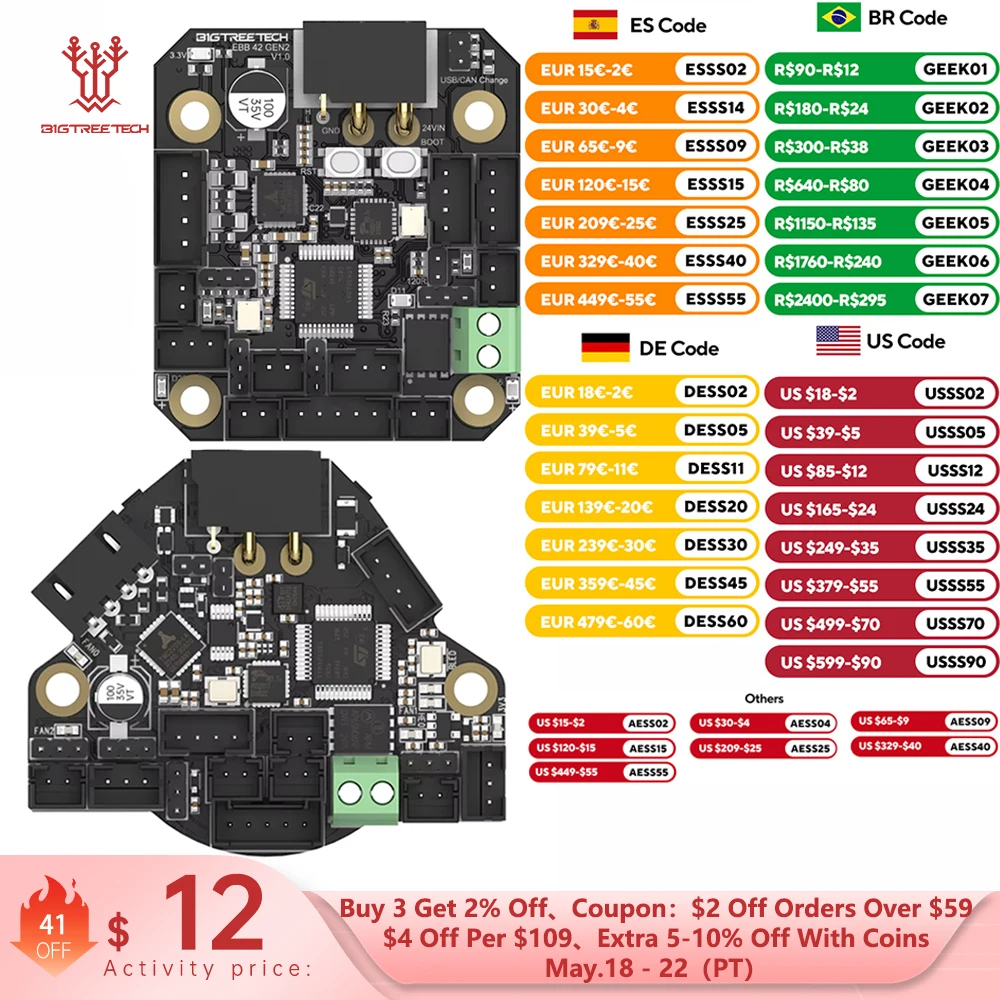
The visual layout of the EBB36 and EBB42 boards clearly indicates their primary function: integrating multiple toolhead peripherals into a single, efficient communication channel. These boards are designed around the CAN bus protocol, a standard known for its reliability in industrial and automotive applications. This choice of communication is not merely an aesthetic preference for fewer wires; it represents a fundamental improvement in data integrity and signal transmission over longer distances, crucial for larger 3D printers.
Traditional 3D printer setups often rely on long runs of individual wires or ribbon cables connecting the mainboard to the print head. This can introduce signal noise, resistance, and complexity, especially with increasing numbers of sensors and actuators. The CAN bus, by contrast, uses a differential signaling method, making it highly resilient to electromagnetic interference. This resilience means more consistent performance and fewer communication errors, which translates directly to more reliable prints.
For makers who frequently experiment with toolhead designs or push their machines to higher speeds, the stability offered by CAN bus is invaluable. It removes one significant variable from the troubleshooting equation. Unlike standard direct-wiring solutions that can become tangled and prone to breakage, a single CAN bus cable provides a sturdy and scalable backbone for the entire print head. This simplifies future modifications considerably.
Precision Temperature Management: PT100 and MAX31865 Integration
A critical feature evident on both versions of the board is the integrated support for PT100 temperature sensors via the MAX31865 amplifier chip. This combination is visible as a dedicated chip and associated circuitry on the PCB. This is not a trivial addition; it signifies a commitment to high-precision thermal control.
Standard 3D printer thermistors, while generally adequate for common filaments like PLA and PETG, can struggle with accuracy and stability at higher temperatures or when printing engineering-grade materials. The PT100 sensor, a type of resistance temperature detector (RTD), offers superior linearity and accuracy across a much broader temperature range. Pairing it with the MAX31865 ensures that these precise resistance changes are accurately converted into digital temperature readings.
For advanced users working with demanding materials such as ABS, Nylon, or PEEK, precise temperature control is paramount. Minor temperature fluctuations can lead to warping, delamination, or inconsistent layer adhesion. The EBB board's native support for PT100 sensors provides the thermal stability and accuracy necessary to reliably print these challenging filaments, opening up new possibilities for material experimentation. This is a clear step up from typical thermistor setups, which are often limited in their thermal fidelity.
On-Board Ecosystem: Powering and Controlling the Toolhead
The boards are packed with connection points, indicating a comprehensive suite of on-toolhead controls. Visible connectors include multiple fan ports, a heater output, dedicated endstop/probe inputs, and general-purpose GPIO pins. These are all strategically placed for direct connection to components on the print head, minimizing external wiring.
Having these essential connections directly on the tool board significantly reduces the wire clutter running from the mainboard. Instead of individual wires for each fan, the heater, and various sensors, these signals are managed locally by the EBB board and then transmitted efficiently over the single CAN bus. This integrated approach makes toolhead maintenance and upgrades much more straightforward.
For instance, installing a new part cooling fan or an auto-leveling probe becomes a matter of connecting directly to the EBB board, rather than routing new wires all the way back to the main control board. This simplifies the wiring harness and reduces potential points of failure. Unlike setups that require bulky breakout boards or custom cabling, this integrated solution is clean. It provides a more robust and organized toolhead environment.
Extruder Control: Dedicated Stepper Driver Socket
Both the EBB36 and EBB42 boards feature a socket for a removable stepper motor driver, typically a TMC2209 or similar, dedicated to the extruder motor. The distinction between EBB36 and EBB42 lies in their motor mounting patterns, accommodating 36mm (NEMA14) and 42mm (NEMA17) stepper motors respectively. This modularity is a thoughtful design choice.
Placing the extruder stepper driver directly on the toolhead minimizes the distance between the driver and the extruder motor. This reduces the likelihood of signal degradation and allows for shorter motor wires, which can improve motor performance and reduce electrical noise. It also makes swapping out a driver for troubleshooting or upgrading to a different type of driver incredibly simple.
For direct-drive extruder setups, this close proximity is particularly beneficial. It ensures the extruder motor receives clean, strong signals, contributing to smoother and more consistent filament extrusion. Compared to systems where the extruder driver resides on the mainboard, often located some distance away, this integrated approach offers a more optimized and responsive control path for the most critical motor on the toolhead.
Firmware Synergy: Optimizing with Klipper
While not explicitly visible as a physical component, the product description heavily emphasizes Klipper firmware compatibility. This is a crucial aspect of these boards' value proposition. Klipper offloads kinematics calculations from the main 3D printer board to a more powerful host, such as a Raspberry Pi, enabling faster processing and more precise motion control.
The CAN bus communication of the EBB boards integrates seamlessly with Klipper's distributed architecture. Klipper is designed to manage multiple microcontrollers, and the EBB board acts as an intelligent peripheral microcontroller for the toolhead. This synergy allows for rapid command execution and feedback, essential for achieving the high print speeds and accelerations Klipper is known for.
For users looking to push the boundaries of their 3D printer's speed and accuracy, the EBB boards provide the necessary hardware foundation for a high-performance Klipper setup. It simplifies the complex wiring that Klipper might otherwise entail for a feature-rich toolhead. This combination offers a significant performance advantage over older, single-board firmware solutions, which often struggle to keep up with demanding kinematics.
Installation and Community Engagement
The physical form factor, as seen in the images, suggests these boards are designed for relatively straightforward integration into existing toolhead assemblies. Mounting holes are visible, indicating they are intended to be secured directly onto the print head carriage or extruder assembly. The compact size of both the EBB36 and EBB42 is a clear advantage for maintaining a low-profile toolhead.
BIGTREETECH products typically benefit from strong community support, and Klipper itself has an extensive, active user base. This means resources for installation guides, configuration examples, and troubleshooting advice are readily available. New users entering the CAN bus ecosystem will find ample assistance from fellow makers.
This robust community infrastructure lowers the barrier to entry for what might otherwise seem like a complex upgrade. Unlike proprietary systems with limited documentation, the open-source nature of Klipper and the widespread adoption of BIGTREETECH hardware ensures that users can find solutions and share their own innovations. This collaborative environment encourages experimentation and continuous improvement.
Modding Potential and Future-Proofing for the Tinkerer
The array of available ports and the CAN bus architecture make these boards highly adaptable for future modifications. The GPIO pins, for example, can be repurposed for custom sensors, LED lighting, or other experimental peripherals. This extensibility is a core appeal for the true tinkerer.
The ability to easily add or swap components without a complete rewire is a major benefit. As new sensors, hotends, or fan designs emerge, the EBB board provides a stable and flexible platform to integrate them. This ensures the 3D printer remains relevant and capable of adopting new technologies without requiring a complete overhaul of the electronics.
For those who view their 3D printer as an evolving project rather than a static appliance, the EBB boards are an excellent investment. They empower users to continually refine their machine's capabilities and experiment with custom parts, which is a significant advantage over less modular electronics. Imagine the satisfaction of a perfectly optimized print head, finely tuned for every filament and every project. This board helps achieve that level of control and precision.
Refined Toolhead Control: Unpacking the Features
Streamlined Wiring with CAN Bus
The primary benefit of the EBB boards is the dramatic reduction in toolhead wiring. Instead of a thick bundle of individual wires, a single, robust CAN bus cable handles all communication and power transmission (with additional power lines for high-current components). This significantly cleans up the aesthetic and reduces potential failure points from snagging or fatigue. A cleaner setup means less troubleshooting.
Enhanced Thermal Accuracy
The integrated MAX31865 chip for PT100 sensors provides significantly improved temperature accuracy and stability compared to standard thermistors. This is especially important for printing engineering filaments that require precise thermal control to prevent warping or poor layer adhesion. Consistent readings ensure consistent extrusion.
On-Board Peripheral Control
These boards consolidate control for critical toolhead components, including multiple fan ports, a heater output, and inputs for endstops and probes. This localization of control minimizes signal loss and simplifies wiring directly at the print head. Everything is within reach.
Modular Extruder Driver
The dedicated socket for a removable stepper motor driver (e.g., TMC2209) allows for optimal placement of the extruder motor driver. This proximity to the motor reduces wire length, improves signal integrity, and simplifies driver replacement or upgrades. Better control over extrusion.
Klipper Firmware Optimization
Designed with Klipper in mind, these boards seamlessly integrate into a Klipperized system, acting as a smart toolhead microcontroller. This enables the high-speed processing and precise motion control that Klipper is known for, pushing the limits of print speed and quality. Unlock new performance levels.
Robust Build Quality
BIGTREETECH is known for producing reliable PCB designs, and the visible components suggest a well-engineered board. The use of robust connectors and quality surface-mount components points to a durable product capable of withstanding the vibrations and thermal cycles of a 3D printer environment. It handles the rigors of printing.
Navigating the Setup: Considerations for the Advanced User
Initial Configuration Complexity
Migrating to a CAN bus system and Klipper firmware, while offering immense benefits, does involve a steeper learning curve than traditional setups. The initial configuration of the CAN bus network and Klipper's `printer.cfg` file requires a solid understanding of 3D printer electronics and software. This is not a plug-and-play solution.
Cable Requirements
While CAN bus reduces the *number* of cables, it necessitates a specific type of cable – shielded twisted pair – for optimal performance over longer runs. This might mean purchasing or crimping new cables, which can be an additional step in the setup process. Proper cabling is crucial.
Ecosystem Integration
These boards are best utilized within an existing Klipper ecosystem, typically involving a Raspberry Pi or similar single-board computer as the host. Users without such a setup will need to factor in the cost and complexity of acquiring and configuring these additional components. A complete system is needed.
Physical Mounting
Integrating the board physically onto the toolhead requires careful planning and potentially designing custom mounts. While compact, ensuring proper clearance and secure attachment for the EBB36 or EBB42 will be necessary to prevent vibrations or interference. Every detail matters.
Community Insights and Practical Use
Troubleshooting Pathways
One of the strengths of adopting a widely used solution like the BIGTREETECH EBB boards with Klipper is the extensive community support. Online forums, Discord servers, and manufacturer documentation provide a wealth of information for troubleshooting common issues. Problems are rarely unique.
When a problem arises, the modular nature of the system aids in diagnosis. Issues can often be isolated to specific components or configuration sections more easily than with monolithic systems. This systematic approach saves time and frustration. It simplifies diagnosis.
Community members often share their Klipper configurations and wiring diagrams, offering practical examples that can be adapted to individual setups. This collaborative spirit is invaluable for both novice and experienced users. Shared knowledge makes a difference.
Customization and Hardware Integration
The EBB boards act as a hub for toolhead customization. With a CAN bus, adding new components like additional fans, LED strips, or specialized sensors becomes simpler, as they can often be wired directly to the tool board without running new long cables. This encourages experimentation. Many possibilities exist.
For example, integrating a custom fan duct with multiple smaller fans is easier when the power and control signals are readily available on the toolhead itself. The board provides the necessary connections. It facilitates advanced cooling solutions.
The flexible input/output pins on the board also allow for experimentation with different types of probes or endstops, enabling users to tailor their toolhead to specific needs or new technologies. This adaptability ensures the system remains relevant. It supports future innovation.
Firmware Modification and Optimization
Klipper's open-source nature means that users can delve into the firmware configuration (`printer.cfg`) to finely tune every aspect of their printer's operation. The EBB boards, as Klipper-compatible microcontrollers, are fully exposed to this level of customization. Deep control is possible.
Users can adjust stepper motor currents, fan speeds, heater PID tuning, and probe offsets with granular control, all through simple text file modifications. This level of access allows for optimal performance extraction from every component. Fine-tuning becomes accessible.
Furthermore, the community regularly develops and shares new Klipper macros and features, which can be easily integrated into a system using EBB boards. This continuous development cycle ensures that the printer's capabilities can evolve over time. It's an ever-improving platform.
Final Thoughts: The Upgrade Path to Precision and Control
For the serious 3D printing enthusiast, the BIGTREETECH EBB36/EBB42 CAN Tool Board represents a significant leap forward in toolhead management and performance. It addresses the common frustrations of tangled wiring and limited expandability by centralizing control and leveraging the robust CAN bus protocol. This board isn't just an accessory; it's a foundational component for building a high-performance, highly customizable 3D printer that is both reliable and a joy to modify. Imagine your printer running with unparalleled precision, its toolhead a streamlined hub of efficiency, responding instantly to every command. This board makes that vision a tangible reality, freeing you to focus on the creative aspects of 3D printing rather than the complexities of its underlying electronics. It is a solid investment for anyone ready to elevate their printing experience and embrace the future of 3D printer control.