BIGTREETECH BTT PI V1.2 Single Board Computer for Klipper
Official Store Deal
Expert Analysis Overview
The BIGTREETECH BTT PI V1.2 is a purpose-built single-board computer, meticulously engineered as a cost-effective, high-performance alternative for advanced 3D printer control systems like Klipper. This board directly addresses the escalating demand for dedicated processing power in the 3D printing community, particularly for users seeking to implement sophisticated firmware and real-time kinematic calculations without the premium cost or availability issues associated with other popular SBCs. Its design prioritizes integration and capability, offering a compelling platform for enthusiasts and professionals alike.
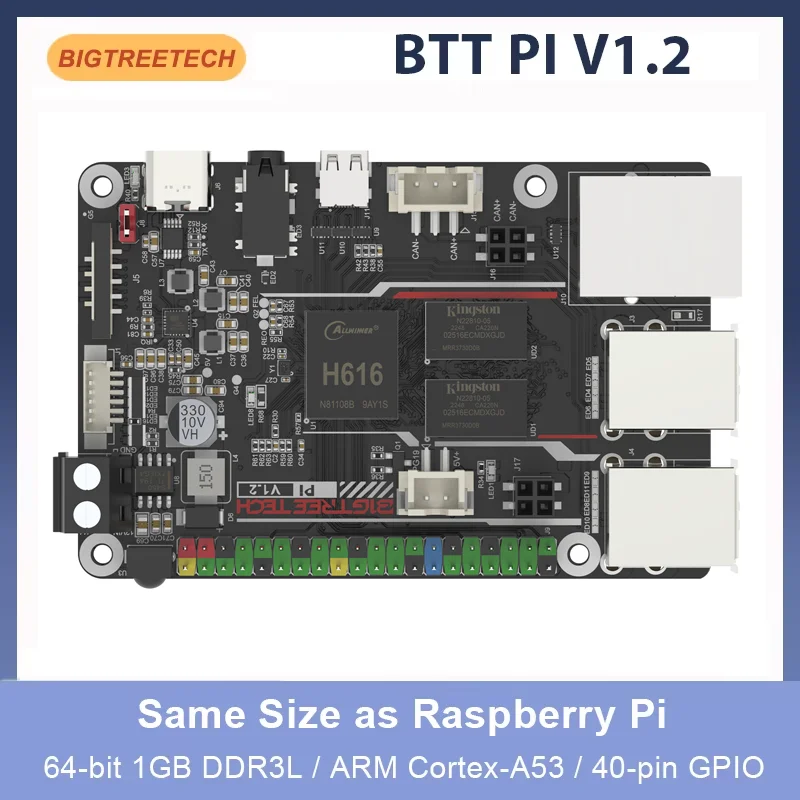
At the heart of the BTT PI V1.2 lies a 64-bit Quad-Core ARM Cortex-A53 processor, complemented by 1GB of DDR3L RAM. This hardware configuration provides a significant leap in processing capability compared to traditional 8-bit or even 32-bit microcontroller-based printer boards. The architecture supports complex computational tasks.
For 3D printing applications, this translates directly into enhanced performance for firmware like Klipper. Klipper offloads the intensive motion planning and kinematics calculations from the printer's mainboard to a more powerful external processor. The Cortex-A53 handles these operations with greater efficiency, allowing for higher step rates and more precise control over stepper motors. This directly impacts the ability to achieve smoother motion, reduce artifacts, and ultimately produce dimensionally accurate engineering parts.
Compared to basic printer control boards that struggle with high-speed movements or intricate G-code, the BTT PI V1.2 provides the computational headroom necessary for advanced features. It minimizes print failures stemming from processor bottlenecks. This board ensures that the printer's movements are executed with optimal timing and accuracy, a critical factor when printing difficult materials that demand consistent extrusion and precise thermal management.
The BTT PI V1.2 offers a comprehensive suite of connectivity options, crucial for modern 3D printer ecosystems. It includes a 40-pin GPIO header, maintaining compatibility with a vast array of existing Raspberry Pi peripherals and expansion boards. This broad compatibility simplifies integration into established projects.
Wireless connectivity is provided by 2.4G WiFi, enabling remote control and monitoring of 3D print jobs. This feature allows users to manage their printers from anywhere on their local network, upload G-code, and monitor progress without direct physical interaction. The convenience of wireless operation streamlines workflow.
A dedicated PWM Fan Port is integrated, allowing for precise control over cooling fans. Effective thermal management is paramount for maintaining stable operating temperatures for stepper drivers and the SBC itself, especially during long print runs or within enclosed printer environments. Proper cooling extends component lifespan.
Crucially for advanced users, the board features a dedicated SPI Port for ADXL345 accelerometers. This port is specifically designed to facilitate input shaper calibration, a key component of Klipper firmware. Input shaping actively mitigates printer resonances, which manifest as ghosting or ringing artifacts on printed parts. By accurately measuring and compensating for these vibrations, the BTT PI V1.2 enables users to achieve significantly higher print speeds without sacrificing surface quality or dimensional accuracy. This capability is vital for producing high-quality prints.
Furthermore, a Dedicated CAN bus Port is present, though it requires a separate CAN Adapter V1.0 for activation. The Controller Area Network (CAN) bus offers a robust, high-speed, and noise-resistant communication protocol for connecting multiple devices within a printer's architecture. This reduces wiring complexity, improves signal integrity over longer distances, and facilitates a modular approach to printer design, allowing for distributed control of toolheads, extruders, and other peripherals. The CAN bus enhances system reliability.
Multiple display options are supported, including 4K UHD HDMI displays at 60fps and low-power OLED/TFT displays via SPI. This flexibility allows users to choose the most appropriate interface for their specific setup, from high-resolution monitoring screens to compact, integrated control panels. Visual feedback is immediate.
The physical dimensions of the BTT PI V1.2 are 85mm x 56mm, mirroring the form factor of a Raspberry Pi 3B. This identical footprint ensures compatibility with a wide range of existing enclosures, mounting solutions, and accessories designed for Raspberry Pi boards. Integration into existing setups becomes straightforward.
The board's Debian Linux compatibility further enhances its versatility. Debian is a stable and widely supported Linux distribution, providing a robust operating system environment for running Klipper, OctoPrint, or other 3D printer management software. The familiarity of a Linux environment simplifies software installation and configuration for many users. This open-source foundation fosters customization.
This compatibility means that users accustomed to Raspberry Pi environments will find the transition to the BTT PI V1.2 seamless. The learning curve for setting up the operating system and necessary software is significantly reduced, allowing users to focus more on optimizing their printer's performance. It leverages existing knowledge bases.
Positioned as a direct competitor and alternative to the Raspberry Pi 3B, the BTT PI V1.2 offers a compelling value proposition, especially given the fluctuating availability and pricing of Raspberry Pi boards. It provides comparable, and in some aspects, superior performance for Klipper applications at a more accessible price point. This makes advanced 3D printer control more attainable.
While the board offers extensive features, it's important to acknowledge certain design choices. The reliance on 2.4G WiFi only, without 5G support, might present limitations in congested wireless environments. However, for most 3D printing applications where the board is typically within reasonable range of an access point, 2.4G provides sufficient bandwidth and range. The dedicated CAN bus port requires an additional CAN Adapter V1.0, which is a separate purchase. This modular approach allows users to only invest in the CAN functionality if their specific setup requires it, preventing unnecessary cost for simpler configurations. These are logical trade-offs for a cost-optimized solution.
The BTT PI V1.2 represents an upgrade from generic SBCs that might lack specific 3D printing-centric features. Unlike general-purpose mini-computers that require workarounds for input shaping or CAN bus integration, this board provides dedicated ports and optimized hardware. This ensures a more streamlined and reliable experience for advanced 3D printer control. It simplifies complex setups.
Imagine a scenario where your 3D printer consistently produces parts with exceptional surface finish, free from ringing artifacts, and with precise dimensional accuracy, even at high speeds. Picture yourself effortlessly managing print jobs remotely, confident in the stability and responsiveness of your printer's control system. The BIGTREETECH BTT PI V1.2 empowers this level of control and reliability, transforming your 3D printing experience into one of consistent success and innovation. This board is a foundational component for achieving professional-grade results in your workshop, enabling you to print difficult materials reliably and minimize print failures with advanced control. It's an investment in the future capability of your additive manufacturing projects.
Computational Core for Precision
At the heart of the BTT PI V1.2 lies a 64-bit Quad-Core ARM Cortex-A53 processor, complemented by 1GB of DDR3L RAM. This hardware configuration provides a significant leap in processing capability compared to traditional 8-bit or even 32-bit microcontroller-based printer boards. The architecture supports complex computational tasks.
For 3D printing applications, this translates directly into enhanced performance for firmware like Klipper. Klipper offloads the intensive motion planning and kinematics calculations from the printer's mainboard to a more powerful external processor. The Cortex-A53 handles these operations with greater efficiency, allowing for higher step rates and more precise control over stepper motors. This directly impacts the ability to achieve smoother motion, reduce artifacts, and ultimately produce dimensionally accurate engineering parts.
Compared to basic printer control boards that struggle with high-speed movements or intricate G-code, the BTT PI V1.2 provides the computational headroom necessary for advanced features. It minimizes print failures stemming from processor bottlenecks. This board ensures that the printer's movements are executed with optimal timing and accuracy, a critical factor when printing difficult materials that demand consistent extrusion and precise thermal management.
Interfacing the Digital Workshop
The BTT PI V1.2 offers a comprehensive suite of connectivity options, crucial for modern 3D printer ecosystems. It includes a 40-pin GPIO header, maintaining compatibility with a vast array of existing Raspberry Pi peripherals and expansion boards. This broad compatibility simplifies integration into established projects.
Wireless connectivity is provided by 2.4G WiFi, enabling remote control and monitoring of 3D print jobs. This feature allows users to manage their printers from anywhere on their local network, upload G-code, and monitor progress without direct physical interaction. The convenience of wireless operation streamlines workflow.
A dedicated PWM Fan Port is integrated, allowing for precise control over cooling fans. Effective thermal management is paramount for maintaining stable operating temperatures for stepper drivers and the SBC itself, especially during long print runs or within enclosed printer environments. Proper cooling extends component lifespan.
Crucially for advanced users, the board features a dedicated SPI Port for ADXL345 accelerometers. This port is specifically designed to facilitate input shaper calibration, a key component of Klipper firmware. Input shaping actively mitigates printer resonances, which manifest as ghosting or ringing artifacts on printed parts. By accurately measuring and compensating for these vibrations, the BTT PI V1.2 enables users to achieve significantly higher print speeds without sacrificing surface quality or dimensional accuracy. This capability is vital for producing high-quality prints.
Furthermore, a Dedicated CAN bus Port is present, though it requires a separate CAN Adapter V1.0 for activation. The Controller Area Network (CAN) bus offers a robust, high-speed, and noise-resistant communication protocol for connecting multiple devices within a printer's architecture. This reduces wiring complexity, improves signal integrity over longer distances, and facilitates a modular approach to printer design, allowing for distributed control of toolheads, extruders, and other peripherals. The CAN bus enhances system reliability.
Multiple display options are supported, including 4K UHD HDMI displays at 60fps and low-power OLED/TFT displays via SPI. This flexibility allows users to choose the most appropriate interface for their specific setup, from high-resolution monitoring screens to compact, integrated control panels. Visual feedback is immediate.
Form Factor and System Integration
The physical dimensions of the BTT PI V1.2 are 85mm x 56mm, mirroring the form factor of a Raspberry Pi 3B. This identical footprint ensures compatibility with a wide range of existing enclosures, mounting solutions, and accessories designed for Raspberry Pi boards. Integration into existing setups becomes straightforward.
The board's Debian Linux compatibility further enhances its versatility. Debian is a stable and widely supported Linux distribution, providing a robust operating system environment for running Klipper, OctoPrint, or other 3D printer management software. The familiarity of a Linux environment simplifies software installation and configuration for many users. This open-source foundation fosters customization.
This compatibility means that users accustomed to Raspberry Pi environments will find the transition to the BTT PI V1.2 seamless. The learning curve for setting up the operating system and necessary software is significantly reduced, allowing users to focus more on optimizing their printer's performance. It leverages existing knowledge bases.
Value Proposition and Strategic Trade-offs
Positioned as a direct competitor and alternative to the Raspberry Pi 3B, the BTT PI V1.2 offers a compelling value proposition, especially given the fluctuating availability and pricing of Raspberry Pi boards. It provides comparable, and in some aspects, superior performance for Klipper applications at a more accessible price point. This makes advanced 3D printer control more attainable.
While the board offers extensive features, it's important to acknowledge certain design choices. The reliance on 2.4G WiFi only, without 5G support, might present limitations in congested wireless environments. However, for most 3D printing applications where the board is typically within reasonable range of an access point, 2.4G provides sufficient bandwidth and range. The dedicated CAN bus port requires an additional CAN Adapter V1.0, which is a separate purchase. This modular approach allows users to only invest in the CAN functionality if their specific setup requires it, preventing unnecessary cost for simpler configurations. These are logical trade-offs for a cost-optimized solution.
The BTT PI V1.2 represents an upgrade from generic SBCs that might lack specific 3D printing-centric features. Unlike general-purpose mini-computers that require workarounds for input shaping or CAN bus integration, this board provides dedicated ports and optimized hardware. This ensures a more streamlined and reliable experience for advanced 3D printer control. It simplifies complex setups.
Imagine a scenario where your 3D printer consistently produces parts with exceptional surface finish, free from ringing artifacts, and with precise dimensional accuracy, even at high speeds. Picture yourself effortlessly managing print jobs remotely, confident in the stability and responsiveness of your printer's control system. The BIGTREETECH BTT PI V1.2 empowers this level of control and reliability, transforming your 3D printing experience into one of consistent success and innovation. This board is a foundational component for achieving professional-grade results in your workshop, enabling you to print difficult materials reliably and minimize print failures with advanced control. It's an investment in the future capability of your additive manufacturing projects.