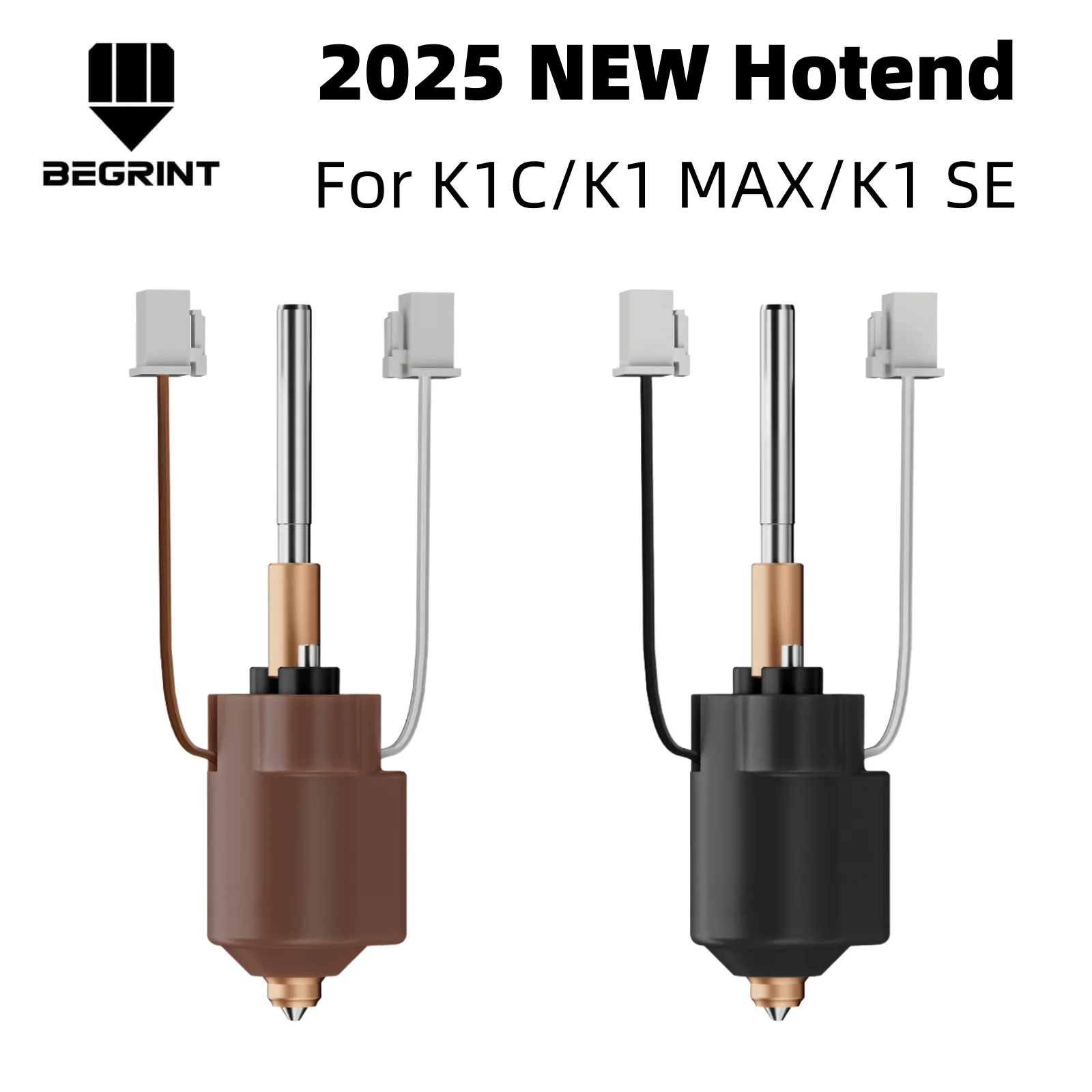
BEGRINT 2025 Hotend for Creality K1C, K1 Max, K1 SE
Official Store Deal
Expert Analysis Overview
Precision Extrusion: The 2025 Hotend for Creality K1 Series
The BEGRINT 2025 Hotend is a high-performance extrusion component engineered for Creality K1C, K1 Max, and K1 SE 3D printers. This unit is designed to address common limitations in filament delivery and thermal management, aiming to enhance print quality and speed for demanding applications. Its integrated nozzle and ceramic heating block represent a significant upgrade over conventional hotend designs, targeting users who require consistent, high-speed, and reliable 3D printing capabilities.
Core Design and Material Science
The hotend's construction emphasizes precision craftsmanship and material selection. Visible components include a robust metallic heat break, a ceramic heating block, and an integrated nozzle. These elements are critical for maintaining thermal stability and ensuring smooth filament flow.
Standard hotends often feature multiple threaded components, which can introduce thermal inconsistencies and potential leakage points. This integrated design minimizes such interfaces. The unit's construction implies a focus on reducing potential failure points inherent in multi-part assemblies.
Compared to generic hotends that rely on simpler heating elements and less integrated designs, this unit's approach to material science and structural integrity offers a more unified thermal path. This is a direct benefit for print reliability.
Advanced Thermal Management
Central to the hotend's performance is its high thermal conductivity and uniform heating. The 360° surround ceramic heater significantly improves heating efficiency. It ensures more uniform heat transfer to the filament.
This uniform heating is crucial for melting filament consistently, preventing localized overheating or underheating that can lead to print defects. The ability to heat to 200°C in approximately 40 seconds demonstrates rapid thermal response. Fast heat-up times reduce idle periods.
Many entry-level hotends utilize resistive cartridge heaters that provide less uniform heat distribution, often leading to inconsistent melt zones. The ceramic heater's design directly addresses this, offering a more stable and predictable thermal environment for the filament. This translates to better layer adhesion.
Optimized Flow Dynamics
The hotend is engineered for high flow, supporting high-speed printing. An enlarged nozzle chamber is a key feature, achieving a maximum flow rate of up to 32 mm³/s. This supports high-speed printing at 600 mm/s.
Such high flow rates are essential for rapid prototyping and production, where print time is a critical factor. The increased volume within the melt zone allows for faster extrusion without compromising filament melting. This is a significant advantage for large prints.
Traditional hotends often struggle to maintain consistent extrusion at high speeds dueading to pressure fluctuations and under-extrusion. The enlarged nozzle chamber mitigates these issues by providing a larger reservoir of molten filament, ensuring a steady supply even during rapid movements. This capability directly impacts throughput.
Precision Filament Path
The internal geometry of the hotend is meticulously designed for smooth filament feeding. The inner walls boast a roughness Ra
This low roughness minimizes friction as the filament passes through the hotend, reducing the likelihood of clogs and improving extrusion consistency. A smooth path is vital for maintaining dimensional accuracy. Filament flow is unimpeded.
In contrast, hotends with rougher internal surfaces can cause increased drag, leading to inconsistent extrusion, especially with abrasive or flexible filaments. The precision-machined inner walls of this hotend provide a superior pathway, ensuring reliable material delivery. This reduces print failures.
Impeccable Craftsmanship and Fitment
Precision machining is evident in the hotend's construction, with no burrs at the opening. This ensures stable printing and reduced clogging. A tight fit prevents filament leakage during printing.
Burrs or imperfections can snag filament, causing blockages or inconsistent extrusion. The absence of these defects indicates a high standard of manufacturing quality. A secure fit is paramount.
Many aftermarket hotends can suffer from manufacturing inconsistencies, leading to poor fitment or internal defects that hinder performance. This hotend's focus on precision machining and tight tolerances ensures a reliable and leak-free operation, which is critical for long print jobs. This attention to detail prevents costly reprints.
Enhanced Material Compatibility
The robust design and efficient heating of this hotend enable it to handle a wider range of filament types. The integrated nozzle, often made from hardened materials, is suitable for abrasive filaments like carbon fiber-filled or glass fiber-filled composites. This expands printing possibilities.
Printing with advanced materials often requires higher temperatures and wear-resistant components. The ceramic heating block ensures the necessary thermal performance, while the durable nozzle withstands the abrasive nature of these filaments. This allows for functional prototypes.
Unlike standard brass nozzles that quickly wear down with abrasive materials, this hotend's design is built to endure, offering longevity and consistent performance across a diverse material palette. This capability saves on replacement costs.
Simplified Maintenance and Installation
The quick-swap integrated nozzle design simplifies both installation and maintenance. This feature allows for rapid nozzle changes without extensive disassembly. Downtime is significantly reduced.
Ease of maintenance is a critical factor for users who frequently swap nozzles for different materials or print resolutions. The integrated design streamlines this process, making it more accessible even for less experienced users. This improves workflow efficiency.
Compared to hotends requiring multiple tools and careful reassembly, the quick-swap mechanism offers a user-friendly experience, minimizing the risk of improper installation or damage during maintenance. This design choice prioritizes user convenience.
Long-Term Value and Operational Efficiency
Investing in a hotend with superior thermal management, high flow capabilities, and precision manufacturing translates into significant long-term value. Reduced print failures, faster print times, and compatibility with advanced materials contribute to a lower cost per print. This is a smart investment.
The initial cost of a premium hotend is offset by the savings in failed prints, wasted filament, and increased productivity. Its durability ensures a longer operational lifespan, further enhancing its return on investment. This improves overall efficiency.
Generic hotends, while cheaper upfront, often lead to higher operational costs due to frequent clogs, inconsistent prints, and the inability to handle specialized filaments. This hotend provides a reliable foundation for consistent, high-quality 3D printing, making it a cost-effective choice over time. This ensures project success.
Imagine the satisfaction of initiating complex prints with confidence, knowing that consistent extrusion and optimal thermal conditions are maintained throughout the entire process. Visualize prototypes emerging with exceptional surface finish and dimensional accuracy, free from the common defects that plague less capable systems. This hotend empowers users to push the boundaries of their 3D printing projects, transforming ambitious designs into tangible realities with unparalleled reliability and speed. The ability to switch between materials and nozzle sizes effortlessly means more time creating and less time troubleshooting, ultimately accelerating innovation and project completion. This is the future of reliable additive manufacturing, delivered directly to the print bed.