Bambu Lab A1/A1 Mini Hardened Steel Hotend Kit
Official Store Deal
Expert Analysis Overview
Initial Assessment: Precision Engineering for Additive Manufacturing
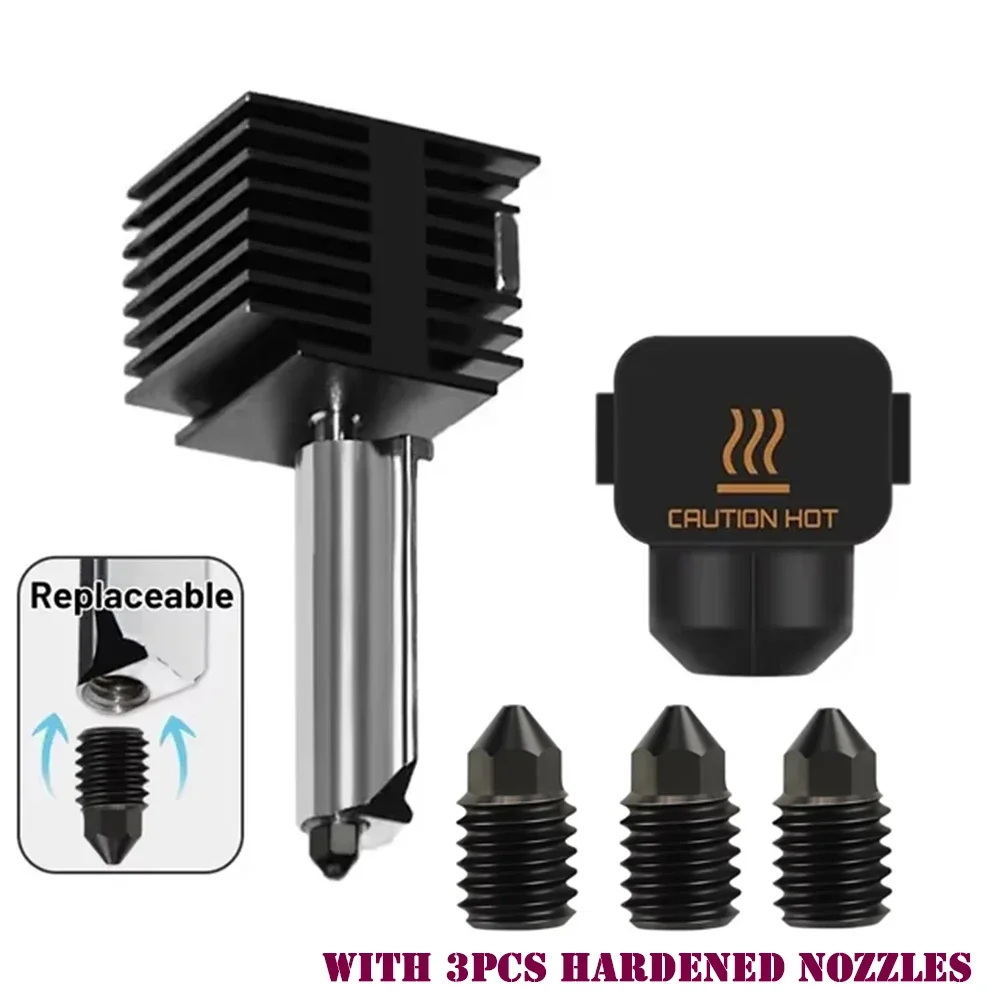
The Bambu Lab A1/A1 Mini Hardened Steel Hotend Kit is a critical upgrade component engineered for serious 3D printing enthusiasts and professionals who demand enhanced material compatibility, increased print speeds, and superior durability from their Bambu Lab A1 or A1 Mini printers. This assembly directly addresses the limitations of standard hotends, particularly when processing abrasive or high-temperature filaments. Its design emphasizes both robust construction and user-friendly maintenance, positioning it as an essential tool for expanding printing capabilities.
Standard hotends, often equipped with brass nozzles, are prone to rapid wear when exposed to materials like carbon fiber-filled PLA, glow-in-the-dark filaments, or glass fiber composites. This wear leads to inconsistent extrusion, reduced print quality, and frequent nozzle replacements, creating significant downtime and material waste. The hardened steel construction of this kit directly counters these issues, offering a resilient solution for continuous, high-quality output. It is a direct response to the evolving demands of advanced additive manufacturing.
Compared to the stock hotend, this kit introduces a significant leap in material handling. The ability to reliably print with abrasive filaments without immediate degradation of the nozzle opens up a new spectrum of functional and aesthetic possibilities for printed parts. This translates into greater design freedom and the production of more robust, application-specific components. The investment in such an upgrade quickly pays dividends through reduced maintenance and expanded project scope.
The Core: Hardened Steel for Unyielding Performance
At the heart of this hotend kit lies its detachable hardened steel nozzle, available in multiple diameters: 0.2mm, 0.4mm, 0.6mm, and 0.8mm. This material choice is not merely an enhancement; it is a fundamental shift in durability. Hardened steel possesses significantly greater wear resistance than traditional brass, making it indispensable for printing with abrasive composite filaments.
Consider a scenario where a user frequently prints prototypes for industrial applications using carbon fiber-reinforced nylon. A standard brass nozzle might show noticeable wear after just a few hours of printing, leading to dimensional inaccuracies and eventual failure. The hardened steel nozzle, however, maintains its precise orifice geometry over hundreds of hours of printing, ensuring consistent line width and layer adhesion. This resilience minimizes print failures and maximizes throughput, a crucial factor in professional environments.
Unlike the softer brass nozzles that come standard with many 3D printers, including some entry-level Bambu Lab configurations, the hardened steel variant offers a substantial upgrade in longevity. This extended lifespan reduces the frequency of nozzle changes, saving both time and the recurring cost of replacements. The material's inherent strength also contributes to maintaining high accuracy even under prolonged stress from high-speed extrusion, a common characteristic of Bambu Lab printers.
Thermal Dynamics: Maintaining Optimal Extrusion
The hotend assembly incorporates a meticulously designed heat sink, a heat break, and a chromium-plated copper heating block. These components work in concert to manage thermal gradients effectively, ensuring stable and consistent extrusion temperatures. The heat sink, with its finned structure, efficiently dissipates heat from the cold end, preventing heat creep into the filament path.
Heat creep, a common issue in 3D printing, occurs when heat travels too far up the hotend, causing the filament to soften prematurely before it reaches the melt zone. This leads to clogs, inconsistent extrusion, and ultimately, print failures. The robust heat sink and precisely engineered heat break in this kit actively combat this phenomenon, maintaining a sharp thermal transition zone. This ensures that filament melts only where and when it is intended to, promoting smooth and reliable material flow.
Compared to less optimized hotend designs, where heat management can be a compromise, this kit's integrated thermal solution provides superior control. The chromium-plated copper heating block offers excellent thermal conductivity, ensuring rapid and uniform heating of the filament. This allows for quicker heat-up times and more stable temperatures during high-speed printing, which is particularly beneficial for the fast-paced operation of Bambu Lab machines. Stable temperatures are paramount.
Ergonomics of Maintenance: The Quick-Change Advantage
A standout feature of this hotend kit is its quick nozzle replacement design, allowing for changes in approximately 30 seconds. This is facilitated by a magnetic attachment system that securely holds the hotend assembly in place while enabling rapid detachment. The process involves a simple twist and pull, eliminating the need for complex disassembly or specialized Tools for routine maintenance.
Imagine needing to switch from a 0.4mm nozzle for detailed prototyping to a 0.8mm nozzle for a large, fast draft print. With traditional hotends, this often involves heating the hotend, carefully unscrewing a hot nozzle, and then screwing in a new one, a process that can be messy, time-consuming, and carries a risk of burns or damage to delicate components. This quick-change system streamlines the entire operation, minimizing downtime between projects.
This rapid interchangeability represents a significant improvement over many conventional hotend designs that require extensive tool use and careful handling of small, hot parts. The magnetic connection ensures precise seating every time, reducing the risk of leaks or misalignment that can plague less refined systems. This design choice directly enhances the user experience, making filament and nozzle experimentation far more accessible and less intimidating for users of all skill levels.
Flow and Fidelity: Balancing Speed with Accuracy
This hotend kit is designed for high flow and high accuracy, critical attributes for modern 3D printing. The internal geometry of the hotend and nozzles is optimized to allow for a greater volume of molten filament to pass through per second without compromising the precision of the extrusion. This capability directly translates into faster print speeds for larger objects or quicker completion of print farms.
Consider a production environment where print time directly impacts output and profitability. A hotend capable of high flow rates can significantly reduce the time required to complete large parts, effectively increasing the printer's overall efficiency. Simultaneously, the hardened steel nozzles maintain their precise orifice, ensuring that even at elevated speeds, the printed layers exhibit consistent dimensions and excellent surface finish. This balance between speed and precision is a hallmark of well-engineered 3D printing components.
Unlike hotends that prioritize either speed or accuracy at the expense of the other, this assembly aims for a synergistic performance. The multiple nozzle sizes (0.2mm for fine detail, 0.4mm for general purpose, 0.6mm and 0.8mm for speed and strength) further enhance this versatility. Users can select the optimal nozzle for their specific application, whether it's intricate miniatures or robust functional parts, without sacrificing the core performance characteristics of the hotend.
Seamless Integration: Designed for Bambu Lab A1/A1 Mini
The hotend kit boasts specific compatibility with Bambu Lab A1 and A1 Mini 3D printers. This dedicated design ensures a perfect fit and seamless integration with the printer's existing toolhead, electronics, and firmware. The magnetic attachment system is engineered to match the Bambu Lab's quick-change mechanism, preserving the printer's native ease of use.
Attempting to integrate generic hotends or third-party modifications often involves complex wiring, custom mounting brackets, and potential firmware adjustments, which can be daunting and lead to compatibility issues. This kit, however, is a plug-and-play solution, designed to work flawlessly with the Bambu Lab ecosystem. This reduces the barrier to entry for users looking to upgrade their machines without extensive technical knowledge or modification skills.
This level of direct compatibility is a significant advantage over universal hotend solutions that require adapters or custom fabrication. It means users can install the upgrade with confidence, knowing that the hotend will communicate correctly with the printer's sensors and control board. The result is a reliable and predictable printing experience, maintaining the high standards expected from Bambu Lab hardware.
The Long-Term Investment: Durability and Efficiency
The initial cost of a specialized hardened steel hotend might appear higher than a basic brass nozzle. However, framing this purchase as a long-term investment reveals its true value. The enhanced durability of the hardened steel nozzle drastically extends its operational lifespan, particularly when printing abrasive materials. This reduces the frequency and cost of replacements over time.
Consider the operational expenses of a busy print farm. Frequent nozzle changes not only incur the cost of new nozzles but also significant labor time for replacement and recalibration. By minimizing these interventions, the hardened steel hotend contributes to a lower total cost of ownership and increased operational uptime. It is a smart financial decision for any high-volume or specialized printing operation.
Furthermore, the high-flow capabilities translate directly into faster print times. This efficiency gain means more parts can be produced in the same amount of time, effectively increasing the printer's output capacity. For businesses or individuals relying on 3D printing for revenue, this direct correlation between speed and productivity makes the hotend a valuable asset. It prints faster.
Operational Nuances: Fine-Tuning for Peak Output
While the hardened steel hotend offers significant advantages, users should be aware of minor operational nuances. Hardened steel has different thermal conductivity properties compared to brass. This may necessitate slight adjustments to printing temperatures, typically a few degrees higher, to achieve optimal melt flow characteristics for certain filaments. Such calibration is a standard practice.
This minor adjustment is a logical trade-off for the vastly improved wear resistance and material compatibility. It is not a flaw but a characteristic that requires a brief period of fine-tuning to maximize performance. Most modern slicer software allows for easy temperature profile adjustments, making this a straightforward process for experienced users.
Compared to the immediate degradation of brass nozzles when printing abrasive materials, the need for a minor temperature tweak is a negligible inconvenience. The long-term benefits of consistent extrusion and extended nozzle life far outweigh this initial calibration step. Users will quickly adapt to these settings, integrating them into their standard printing workflows.
The Future of Fabrication: Empowering Advanced Projects
Imagine a workshop where the limitations of filament choice are virtually eliminated. Picture intricate, functional prototypes emerging from your Bambu Lab A1 or A1 Mini, crafted from materials previously deemed too abrasive or challenging for your stock setup. This hotend kit empowers users to explore advanced composites, creating parts with superior strength, heat resistance, or unique aesthetic properties. It is an enabler for innovation, allowing designers and engineers to push the boundaries of what is possible with desktop additive manufacturing. The consistent output and reduced maintenance free up valuable time, shifting focus from troubleshooting to creation. This is not just an upgrade; it is an expansion of your creative and productive potential, ensuring your printer remains at the forefront of personal fabrication capabilities for years to come.