AWithZ UF20B Capacitor Spot Welder
Official Store Deal
Expert Analysis Overview
The Capacitor Discharge Advantage: Precision Welding for Battery Builders
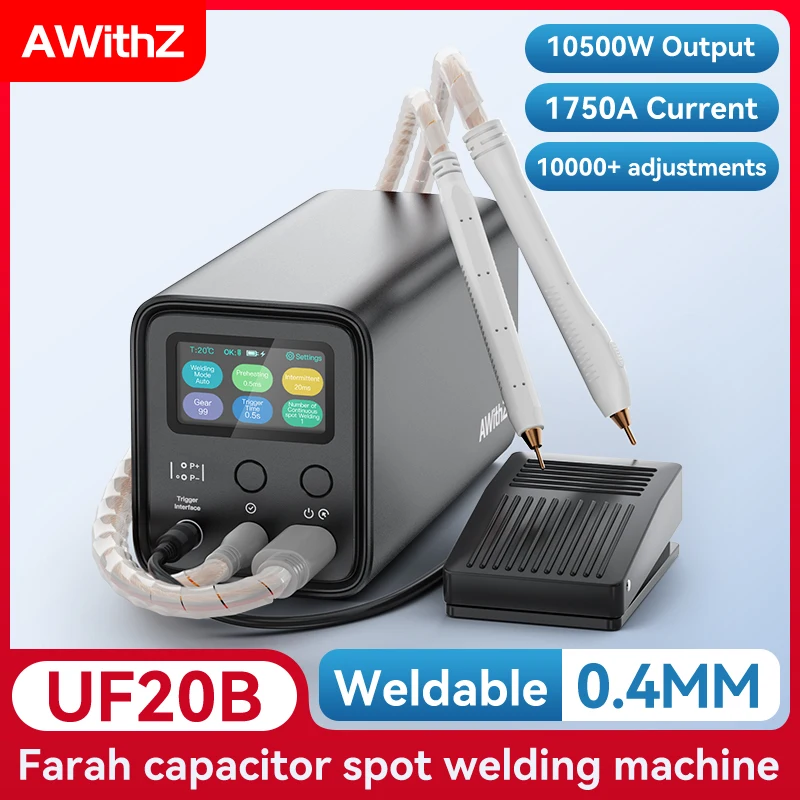
The AWithZ UF20B Spot Welder is a high-output capacitor discharge machine engineered for precision battery pack assembly and thin metal fabrication. This unit targets professionals and serious DIY enthusiasts requiring consistent, powerful welds for applications like 18650 lithium battery packs and nickel strip joining. Its design prioritizes rapid energy delivery and fine-tuned control, critical for delicate yet robust connections.Unpacking the Power Core: Farad Capacitor Technology
The UF20B boasts a 10.5kW maximum output and a 1750A maximum current, driven by its Super Farad Capacitors. These components are the heart of its performance.This configuration ensures an instantaneous burst of high current. Such rapid energy discharge minimizes heat input to the workpiece, crucial for welding near sensitive battery cells. It prevents thermal damage.
Unlike traditional transformer-based resistance welders that rely on sustained AC power, capacitor discharge welders store energy and release it in a controlled pulse. This method offers superior consistency and power for demanding spot welding tasks, especially on materials like nickel and copper, where precise heat management is paramount.
Command and Control: Navigating the 10,000+ Adjustments
Control over the welding process is extensive, featuring 10,000+ precision adjustments. The unit's interface allows for granular control over parameters such as welding mode (Auto/Manual), gear settings (01-99), and trigger times (1-10ms, 1-20ms, 0.5-5.0s).This level of adjustability empowers the operator to fine-tune the weld for various nickel strip thicknesses, battery chemistries, and desired weld penetration. Achieving the perfect weld is within reach. It prevents common issues like cold welds or excessive penetration that can damage battery cells.
Compared to entry-level spot welders with limited or fixed power settings, the UF20B's comprehensive control suite provides the flexibility needed for professional-grade work. This precision is indispensable for repeatable, high-quality battery pack construction, where consistency directly impacts safety and performance.
Field-Ready Design: Portability and Ergonomics
The physical design of the UF20B emphasizes both portability and user comfort. It features a compact main unit, a detachable welding pen with a 15.74-inch (40cm) total length, and a separate foot pedal for hands-free operation.This compact form factor makes the unit highly portable, suitable for movement around a busy workshop or for mobile repair services. Minimal bench space is required. The detachable pen and foot pedal enhance workflow efficiency, allowing the operator to focus on precise electrode placement without simultaneously manipulating a trigger button.
While not designed for the ruggedness of a pipeline welding rig, its portability is a significant upgrade over bulkier, fixed-station spot welders. This allows for greater flexibility in setup and operation, adapting to various work environments where space or mobility is a concern.
Material Mastery: Welding Performance on Thin Metals
The UF20B is specified to weld 0.4mm (0.015inch/0.04cm) weldable copper. This capability extends to common nickel strip thicknesses used in battery pack assembly.This welding capacity ensures strong, reliable bonds on battery tabs and nickel strips without compromising the integrity of the underlying battery cells. Consistent penetration is key. The high current output ensures rapid melting and fusion, creating a robust metallurgical bond.
For battery builders, the ability to consistently weld up to 0.4mm copper or nickel is a benchmark for professional-grade equipment. Many cheaper units struggle with thicker nickel or copper, leading to unreliable connections and potential pack failures. The UF20B handles these materials with confidence.
Ergonomics in Action: The Welding Pen and Foot Pedal
The welding pen features detachable aluminum oxide copper welding needles and uses thick copper pen wire. The inclusion of a foot pedal further refines the user experience.These design choices contribute to a comfortable and efficient welding process. The detachable needles allow for easy replacement and maintenance, ensuring optimal conductivity and weld quality. The thick copper wire minimizes resistance and heat loss, delivering maximum current to the weld point. The foot pedal enables precise, hands-free triggering, freeing up both hands for accurate workpiece positioning.
This ergonomic setup significantly reduces operator fatigue during repetitive tasks, a common issue with hand-triggered pens. It elevates the user experience beyond basic, integrated pen designs, promoting greater control and consistency in every weld.
Powering Up in the Field: Generator Compatibility
While primarily a workshop tool, the question of field deployment and generator compatibility is relevant for any high-power device. Capacitor discharge welders draw a significant, albeit brief, peak current.For field operations, a stable power source is paramount. An inverter generator with sufficient surge capacity is highly recommended to handle the instantaneous current draw without voltage sags or power fluctuations. Clean power is essential. Standard open-frame generators may struggle to provide the consistent, clean power required, potentially affecting weld quality or even damaging the unit.
Unlike continuous-arc welders that draw sustained power, the pulsed nature of a capacitor discharge welder presents a different challenge to generators. Ensuring the generator can manage the brief, high-current spikes is more critical than its continuous running wattage alone. Proper generator selection is a must.
Durability for the Demanding Workshop
The unit's enclosure appears to be constructed from a robust material, likely a heavy-duty plastic or aluminum alloy, designed for a workshop environment. This implies a degree of protection against typical workshop hazards.This construction suggests resilience against minor impacts, dust, and general wear and tear encountered in a busy workspace. It is built for daily use. While not explicitly rated for outdoor elements like heavy rain or mud, its solid casing provides adequate protection for its intended indoor or covered outdoor use.
Compared to more fragile, open-circuit designs, the UF20B's enclosed structure offers better protection for its internal components. This contributes to a longer service life and reliable operation within a controlled, yet active, environment.
The Investment: Long-Term Value and Efficiency
The AWithZ UF20B represents a significant investment compared to basic spot welders, but its capabilities justify the cost. The precision and power it offers translate directly into efficiency and quality.This machine reduces material waste by consistently producing strong, clean welds, minimizing rework and damaged battery cells. It saves time and money. The longevity of battery packs built with this level of precision also adds to its long-term value, preventing premature failures and customer dissatisfaction.
Considering the cost of damaged battery cells or failed battery packs due to inferior welding, the UF20B's upfront cost is offset by its ability to deliver consistent, high-quality results. It is an investment in reliability and professional output.
Imagine the confidence of assembling custom battery packs with consistent, professional-grade welds, knowing each connection is solid. This machine delivers that assurance, transforming complex battery builds into a streamlined, reliable process, allowing for rapid project completion and superior end products.