ATORCH 20A 4-Wire Battery Test Stand
Official Store Deal
Expert Analysis Overview
Precision Battery Characterization: The ATORCH 20A 4-Wire Test Stand
The ATORCH 20A 4-Wire Battery Test Stand is a specialized measurement fixture engineered for precise and high-current battery characterization, targeting professionals and enthusiasts who demand accurate data for cell performance and aging analysis. This device addresses the critical need for minimizing measurement errors inherent in high-current battery testing, providing a robust platform for evaluating a wide range of cylindrical cells. Its design prioritizes signal integrity and power delivery, essential for reliable metrological outcomes.
The Imperative of 4-Wire Measurement
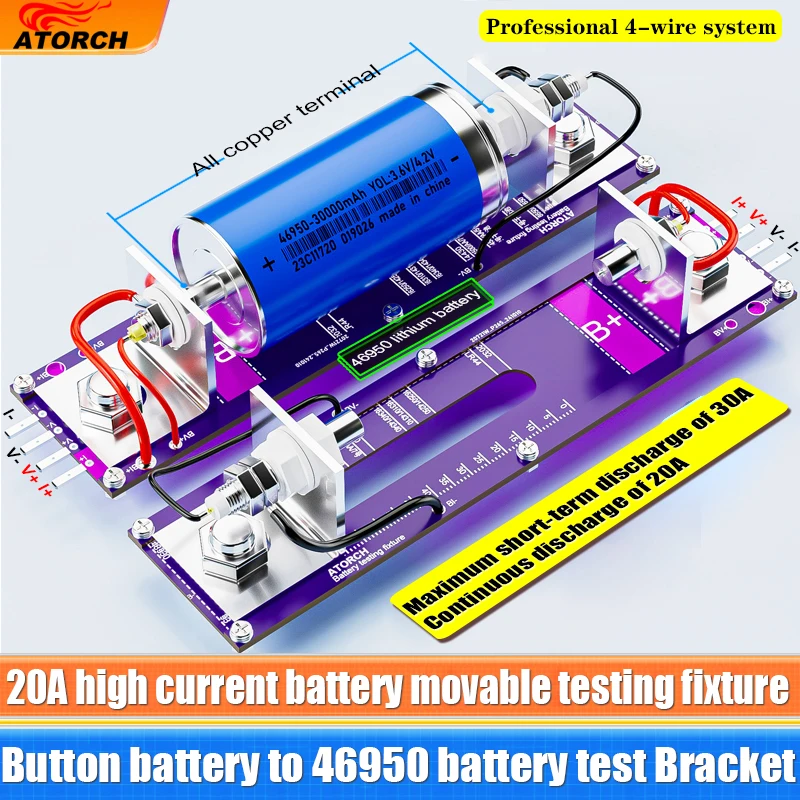
Standard 2-wire test setups often introduce significant voltage drop errors, particularly under high current loads. This unit employs a professional 4-wire wiring system. This architecture separates the current carrying paths from the voltage sensing paths. The dedicated voltage sense lines draw negligible current, effectively eliminating the voltage drop across the test leads and contact resistances from the measurement. This is a fundamental principle for accurate electrical characterization.
For battery testing, this means the voltage measured is the true voltage across the battery terminals, not a voltage diminished by lead resistance. This distinction is paramount for calculating internal resistance, capacity, and discharge curves with high fidelity. Without this separation, internal resistance measurements would be artificially inflated, and capacity readings could be skewed, leading to misinformed decisions about cell health or suitability.
Compared to simpler, less expensive 2-wire fixtures, the 4-wire system represents a significant upgrade in measurement accuracy. It transforms the fixture from a basic connectivity tool into a precision instrument, aligning with the demands of serious battery research, quality control, and performance validation. This design choice directly impacts the repeatability and reliability of all collected data, making it an indispensable feature for critical applications.
High Current Handling and Thermal Management
The fixture is rated for a maximum short-term discharge of 20A and a continuous discharge of 20A. This high current capability is crucial for testing modern high-drain battery cells, such as those used in power tools, electric vehicles, and high-performance portable electronics. Many contemporary lithium-ion cells are designed to deliver substantial current, and a test fixture must be able to replicate these operational conditions accurately.
Sustaining 20A continuous discharge generates considerable heat, both within the battery under test and the fixture's contact points. The visible use of all copper terminals is a critical design choice. Copper offers superior electrical conductivity and thermal dissipation compared to other common metals, minimizing resistive heating at the contact points and ensuring stable current flow. This material selection directly contributes to the fixture's ability to maintain its rated current capacity without excessive temperature rise, which could otherwise affect measurement stability or damage the battery.
In contrast to fixtures with lower current ratings or less robust contact materials, this ATORCH stand is built to handle the rigors of demanding discharge cycles. It allows for comprehensive stress testing and aging simulations that accurately reflect real-world application scenarios. This capability is vital for identifying cells that might prematurely degrade under load or fail to meet specified performance metrics, providing a more complete picture of battery longevity and reliability.
Versatile Battery Compatibility and Modular Design
The fixture is designed to accommodate a wide range of cylindrical battery formats, from button batteries up to 46950 cells. This broad compatibility is achieved through a movable testing bracket, allowing for flexible adjustment to different cell lengths. The ability to test various form factors makes this fixture a highly adaptable tool for laboratories and workshops dealing with diverse battery types.
This adaptability means a single fixture can serve multiple testing needs, reducing the requirement for specialized jigs for each battery size. The movable bracket ensures secure contact across different lengths, which is essential for consistent and repeatable measurements. A stable physical connection is fundamental to the integrity of the electrical circuit, preventing intermittent contact or increased resistance that could corrupt data.
Many generic test fixtures are limited to a single or narrow range of battery sizes, necessitating multiple purchases or improvised solutions. This ATORCH fixture's design philosophy embraces versatility, offering a unified platform for comprehensive battery analysis. It simplifies the testing workflow for users who work with a variety of cell dimensions, from common 18650s to larger, emerging formats like the 46950.
Operational Integrity and Data Acquisition
The fixture is presented as a battery discharge aging fixture, implying its primary role in long-duration testing and performance degradation studies. The professional 4-wire wiring system directly supports this application by ensuring that voltage measurements remain accurate throughout extended test cycles, even as the battery's internal resistance changes. This allows for precise tracking of capacity fade and impedance growth over time.
Integration with external battery testers and electronic loads is a key aspect of its functionality. The images show compatibility with various ATORCH DL series products, which are typically electronic loads with data logging capabilities. This modular approach means the fixture provides the physical interface, while the external equipment handles the complex algorithms for capacity calculation, internal resistance measurement, and data recording. This separation of concerns allows users to pair the fixture with the most appropriate data acquisition system for their specific needs.
Unlike all-in-one testers that might compromise on either the fixture's robustness or the tester's analytical power, this modular system allows for specialized components to excel in their respective roles. The fixture provides the stable, accurate electrical connection, while the external tester provides the sophisticated control and data analysis. This synergy results in a powerful and flexible testing solution, enabling detailed performance analysis and long-term aging studies with high confidence in the collected data.
The Metrological Advantage
For any metrologist, the primary concern is the integrity of the measurement. This fixture's all copper terminals and 4-wire system are direct answers to common sources of measurement error in high-current applications. The reduction of voltage drop ensures that the measured parameters truly reflect the battery's characteristics, not the artifacts of the test setup. This is critical for achieving repeatable results, a cornerstone of scientific and engineering validation.
Repeatable results are not merely a convenience; they are a necessity for comparative analysis, quality control, and product development. When a test yields consistent data under identical conditions, it builds confidence in the conclusions drawn from that data. This fixture's design elements are specifically chosen to minimize variability introduced by the test environment, allowing the focus to remain on the battery itself.
This level of precision and repeatability sets the ATORCH fixture apart from less sophisticated alternatives. It provides the foundational accuracy required for serious battery research and development, where even small deviations in measurement can lead to significant misinterpretations of cell performance or longevity. Users can confidently conduct experiments, compare different cell chemistries, or validate manufacturer specifications, knowing their measurements are grounded in sound metrological principles.
Imagine confidently conducting long-term aging tests, knowing that every data point collected is a true reflection of your battery's performance, uncorrupted by lead resistance or contact issues. Visualize the ease of switching between different battery sizes, maintaining consistent contact quality across all tests. Envision a streamlined workflow where precise measurements inform critical decisions about cell selection, product design, and quality assurance, ultimately leading to more reliable and efficient energy storage solutions.