ATORCH 150W 4-Wire Battery Capacity Tester
Official Store Deal
Expert Analysis Overview
The ATORCH 150W 4-Wire Battery Capacity Tester is a precise diagnostic instrument engineered for professionals and serious enthusiasts requiring detailed battery performance analysis. This electronic load tester moves beyond simple voltage checks, offering a comprehensive suite of Tools to accurately assess battery capacity, internal resistance, and overall health under various discharge conditions. Its robust design and advanced measurement capabilities make it an indispensable asset for anyone working with rechargeable power sources, from hobbyists to industrial technicians.
This tester provides four distinct operating modes: Constant Current (CC), Constant Voltage (CV), Constant Resistance (CR), and Constant Power (CP). Each mode serves a specific purpose in characterizing battery behavior. For instance, CC mode is ideal for determining the actual capacity of a battery by discharging it at a steady rate until a set voltage is reached. This is crucial for verifying manufacturer specifications or identifying degradation over time.
Understanding these modes allows for a nuanced approach to battery testing. CV mode, for example, can simulate specific load conditions where a device demands a stable voltage, revealing how well a battery maintains output under varying current draw. The ability to switch between these modes ensures that a wide array of testing scenarios can be accurately replicated, providing insights into battery performance under real-world stresses. A comprehensive understanding of battery characteristics becomes possible.
Compared to basic electronic loads that often provide only CC mode, the inclusion of CV, CR, and CP modes significantly expands the diagnostic utility of this ATORCH unit. This versatility allows users to simulate diverse application environments, such as LED lighting (constant current), voltage-sensitive electronics (constant voltage), or resistive heating elements (constant resistance), offering a far more complete picture of a battery's suitability for a given task. It's a substantial upgrade for detailed analysis.
The most significant feature for accurate battery testing is the 4-wire measurement method. This technique separates the current-carrying wires from the voltage-sensing wires. The current flows through two heavy-gauge wires, while two separate, thinner wires measure the voltage directly at the battery terminals. This eliminates the voltage drop caused by the resistance of the current-carrying wires, which can be substantial at higher currents.
Eliminating lead resistance errors is paramount for obtaining true battery performance data. Without a 4-wire connection, the voltage measured by the tester would be artificially lower than the actual voltage at the battery terminals, leading to an underestimation of capacity or an inaccurate assessment of internal resistance. This precision is critical for applications where even small discrepancies can impact performance or safety, such as in electric vehicle battery packs or critical backup power systems. Accurate data is essential.
Many entry-level electronic loads rely solely on 2-wire connections, which are simpler to implement but inherently less accurate, especially when dealing with high currents or long test leads. The ATORCH tester's commitment to the 4-wire method positions it as a professional-grade instrument, offering data integrity that simpler devices cannot match. This design choice directly translates into more reliable and actionable test results, saving time and preventing costly misdiagnoses in the long run. It ensures measurement fidelity.
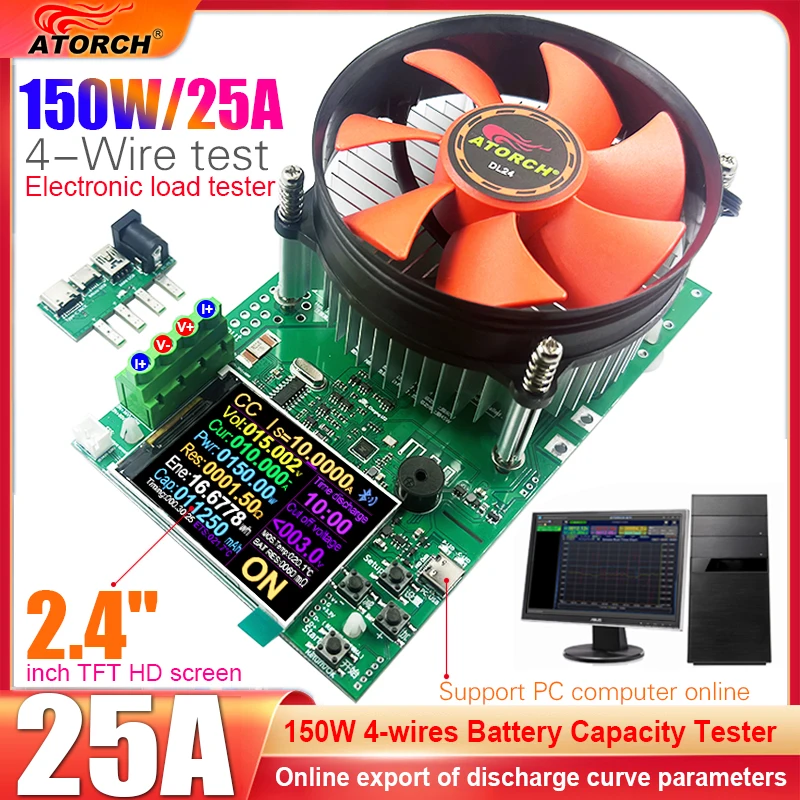
Operating at up to 150W and 25A, efficient thermal management is not merely a feature; it is a necessity. The device incorporates a prominent cooling fan and a substantial heatsink, clearly visible on the main board. This active cooling system is designed to dissipate the significant heat generated during high-power discharge tests, ensuring stable operation and preventing thermal throttling or damage to the internal components. The fan engages as needed.
During a prolonged 150W discharge test, the cooling system works tirelessly to maintain optimal operating temperatures. This allows the tester to run continuously at its maximum rated power without performance degradation, a critical factor for testing large capacity batteries that require many hours to fully discharge. Imagine running a 100Ah battery test at 10A; this could take 10 hours. A robust cooling system ensures the test completes accurately and without interruption. The fan noise is noticeable but expected for this power level.
Unlike many compact or budget electronic loads that might rely on passive cooling or undersized fans, this ATORCH unit's thermal design is clearly engineered for sustained, high-power operation. This robust cooling capability is a significant advantage, particularly for users who frequently conduct demanding tests or work with higher voltage/current battery configurations. It prevents premature component failure and ensures consistent measurement accuracy throughout extended test cycles. Reliability is built-in.
The 2.4-inch high-definition TFT color screen provides a clear and comprehensive display of all critical testing parameters in real-time. Voltage, current, power, resistance, energy, and capacity are all presented simultaneously, along with discharge time. This immediate visual feedback is invaluable for monitoring test progress and quickly identifying any anomalies. The screen's clarity is excellent.
Monitoring a discharge test becomes intuitive with such a detailed display. Users can observe the discharge curve unfolding, track capacity accumulation, and note any unexpected drops in voltage or current. The ability to see multiple parameters at once eliminates the need to cycle through different screens, streamlining the testing process. For professionals, this means quicker diagnostics and more efficient workflow. Data is always at hand.
Beyond real-time monitoring, the tester supports online export of discharge curve parameters to a PC. This capability transforms raw test data into actionable insights, allowing for detailed analysis, comparison between batteries, and the generation of professional client reports. Compared to testers that only offer on-screen readings, the data export function elevates this device to a serious analytical tool, enabling long-term performance tracking and predictive maintenance strategies. Data analysis is simplified.
To operate, the ATORCH tester requires a separate DC12V power supply. However, it offers three flexible methods for this: a standard DC5.5-12V power supply, a USB-5V/2A charger, or a PD protocol 12V charger. This adaptability ensures the device can be powered in various environments, from a workbench with a dedicated power brick to field use with a portable power bank or a modern USB-C PD charger. Powering up is easy.
This flexibility is a significant convenience for users who might not always have access to a specific type of power source. Imagine needing to test a battery on-site where only USB power is readily available; the option to use a standard USB-5V/2A charger makes this possible. The device intelligently handles the input, ensuring stable operation regardless of the chosen method, provided the voltage and current requirements are met. Versatility is key.
Unlike many specialized test instruments that demand a very specific and often proprietary power adapter, this tester's multi-source compatibility is a thoughtful design choice. It reduces reliance on a single power solution, making the unit more adaptable and user-friendly in diverse settings. This broad compatibility minimizes potential downtime due to power supply issues and enhances the overall utility of the device. It simplifies setup.
The physical construction of the ATORCH tester suggests a focus on durability and functionality. The main PCB appears well-laid out, with clearly labeled components and robust terminal blocks. The orange fan, a prominent feature, is securely mounted, indicating a design intended for longevity under operational stress. The overall assembly feels solid, not flimsy, suggesting it can withstand regular use in a workshop environment. Components are well-integrated.
The green terminal blocks for both power input and battery connection are substantial, designed to handle the specified currents without overheating or degradation. The tactile feel of these terminals suggests a secure connection once wires are properly inserted, minimizing the risk of intermittent contacts during testing. The 2.4-inch TFT screen is integrated cleanly into the board, protected by its mounting. Precision molding is evident.
Compared to some lower-cost electronic loads that might use less robust connectors or simpler PCBs, the visible quality of the ATORCH unit's components, from the fan to the terminal blocks, indicates a higher standard of manufacturing. This attention to detail in the physical build contributes to the device's overall reliability and accuracy, ensuring it remains a dependable tool for consistent battery analysis over time. It is built to last.
Investing in a dedicated battery capacity tester like the ATORCH 150W unit offers significant long-term value. For professionals, it translates into accurate diagnostics, preventing costly replacements of good batteries or the deployment of faulty ones. For enthusiasts, it means maximizing the lifespan and performance of expensive battery packs, ensuring projects run reliably. The initial cost is quickly recouped through informed decisions and extended battery life. It's a smart investment.
This tester allows for proactive maintenance and quality control. By regularly testing batteries, users can identify declining performance before it leads to critical failures, enabling timely intervention or replacement. This capability is invaluable in applications ranging from drone batteries to power tool packs, where unexpected power loss can have significant consequences. It provides peace of mind.
Imagine confidently assessing the true health of every battery in your inventory, knowing exactly which ones are still performing optimally and which require attention. This tester provides that capability, empowering users to make data-driven decisions about battery management. It's not just a tool; it's an intelligent system for optimizing power storage and delivery, ensuring your devices and projects always have the reliable energy they need.
Unveiling Battery Performance: The Four Operating Modes
This tester provides four distinct operating modes: Constant Current (CC), Constant Voltage (CV), Constant Resistance (CR), and Constant Power (CP). Each mode serves a specific purpose in characterizing battery behavior. For instance, CC mode is ideal for determining the actual capacity of a battery by discharging it at a steady rate until a set voltage is reached. This is crucial for verifying manufacturer specifications or identifying degradation over time.
Understanding these modes allows for a nuanced approach to battery testing. CV mode, for example, can simulate specific load conditions where a device demands a stable voltage, revealing how well a battery maintains output under varying current draw. The ability to switch between these modes ensures that a wide array of testing scenarios can be accurately replicated, providing insights into battery performance under real-world stresses. A comprehensive understanding of battery characteristics becomes possible.
Compared to basic electronic loads that often provide only CC mode, the inclusion of CV, CR, and CP modes significantly expands the diagnostic utility of this ATORCH unit. This versatility allows users to simulate diverse application environments, such as LED lighting (constant current), voltage-sensitive electronics (constant voltage), or resistive heating elements (constant resistance), offering a far more complete picture of a battery's suitability for a given task. It's a substantial upgrade for detailed analysis.
Precision Measurement: The 4-Wire Advantage
The most significant feature for accurate battery testing is the 4-wire measurement method. This technique separates the current-carrying wires from the voltage-sensing wires. The current flows through two heavy-gauge wires, while two separate, thinner wires measure the voltage directly at the battery terminals. This eliminates the voltage drop caused by the resistance of the current-carrying wires, which can be substantial at higher currents.
Eliminating lead resistance errors is paramount for obtaining true battery performance data. Without a 4-wire connection, the voltage measured by the tester would be artificially lower than the actual voltage at the battery terminals, leading to an underestimation of capacity or an inaccurate assessment of internal resistance. This precision is critical for applications where even small discrepancies can impact performance or safety, such as in electric vehicle battery packs or critical backup power systems. Accurate data is essential.
Many entry-level electronic loads rely solely on 2-wire connections, which are simpler to implement but inherently less accurate, especially when dealing with high currents or long test leads. The ATORCH tester's commitment to the 4-wire method positions it as a professional-grade instrument, offering data integrity that simpler devices cannot match. This design choice directly translates into more reliable and actionable test results, saving time and preventing costly misdiagnoses in the long run. It ensures measurement fidelity.
Sustained Performance: Thermal Management
Operating at up to 150W and 25A, efficient thermal management is not merely a feature; it is a necessity. The device incorporates a prominent cooling fan and a substantial heatsink, clearly visible on the main board. This active cooling system is designed to dissipate the significant heat generated during high-power discharge tests, ensuring stable operation and preventing thermal throttling or damage to the internal components. The fan engages as needed.
During a prolonged 150W discharge test, the cooling system works tirelessly to maintain optimal operating temperatures. This allows the tester to run continuously at its maximum rated power without performance degradation, a critical factor for testing large capacity batteries that require many hours to fully discharge. Imagine running a 100Ah battery test at 10A; this could take 10 hours. A robust cooling system ensures the test completes accurately and without interruption. The fan noise is noticeable but expected for this power level.
Unlike many compact or budget electronic loads that might rely on passive cooling or undersized fans, this ATORCH unit's thermal design is clearly engineered for sustained, high-power operation. This robust cooling capability is a significant advantage, particularly for users who frequently conduct demanding tests or work with higher voltage/current battery configurations. It prevents premature component failure and ensures consistent measurement accuracy throughout extended test cycles. Reliability is built-in.
Visualizing Data: The 2.4-inch TFT Display and Export Capabilities
The 2.4-inch high-definition TFT color screen provides a clear and comprehensive display of all critical testing parameters in real-time. Voltage, current, power, resistance, energy, and capacity are all presented simultaneously, along with discharge time. This immediate visual feedback is invaluable for monitoring test progress and quickly identifying any anomalies. The screen's clarity is excellent.
Monitoring a discharge test becomes intuitive with such a detailed display. Users can observe the discharge curve unfolding, track capacity accumulation, and note any unexpected drops in voltage or current. The ability to see multiple parameters at once eliminates the need to cycle through different screens, streamlining the testing process. For professionals, this means quicker diagnostics and more efficient workflow. Data is always at hand.
Beyond real-time monitoring, the tester supports online export of discharge curve parameters to a PC. This capability transforms raw test data into actionable insights, allowing for detailed analysis, comparison between batteries, and the generation of professional client reports. Compared to testers that only offer on-screen readings, the data export function elevates this device to a serious analytical tool, enabling long-term performance tracking and predictive maintenance strategies. Data analysis is simplified.
Powering the Analysis: Flexible Supply Options
To operate, the ATORCH tester requires a separate DC12V power supply. However, it offers three flexible methods for this: a standard DC5.5-12V power supply, a USB-5V/2A charger, or a PD protocol 12V charger. This adaptability ensures the device can be powered in various environments, from a workbench with a dedicated power brick to field use with a portable power bank or a modern USB-C PD charger. Powering up is easy.
This flexibility is a significant convenience for users who might not always have access to a specific type of power source. Imagine needing to test a battery on-site where only USB power is readily available; the option to use a standard USB-5V/2A charger makes this possible. The device intelligently handles the input, ensuring stable operation regardless of the chosen method, provided the voltage and current requirements are met. Versatility is key.
Unlike many specialized test instruments that demand a very specific and often proprietary power adapter, this tester's multi-source compatibility is a thoughtful design choice. It reduces reliance on a single power solution, making the unit more adaptable and user-friendly in diverse settings. This broad compatibility minimizes potential downtime due to power supply issues and enhances the overall utility of the device. It simplifies setup.
Robust Construction and Component Quality
The physical construction of the ATORCH tester suggests a focus on durability and functionality. The main PCB appears well-laid out, with clearly labeled components and robust terminal blocks. The orange fan, a prominent feature, is securely mounted, indicating a design intended for longevity under operational stress. The overall assembly feels solid, not flimsy, suggesting it can withstand regular use in a workshop environment. Components are well-integrated.
The green terminal blocks for both power input and battery connection are substantial, designed to handle the specified currents without overheating or degradation. The tactile feel of these terminals suggests a secure connection once wires are properly inserted, minimizing the risk of intermittent contacts during testing. The 2.4-inch TFT screen is integrated cleanly into the board, protected by its mounting. Precision molding is evident.
Compared to some lower-cost electronic loads that might use less robust connectors or simpler PCBs, the visible quality of the ATORCH unit's components, from the fan to the terminal blocks, indicates a higher standard of manufacturing. This attention to detail in the physical build contributes to the device's overall reliability and accuracy, ensuring it remains a dependable tool for consistent battery analysis over time. It is built to last.
The Value Proposition for Battery Health
Investing in a dedicated battery capacity tester like the ATORCH 150W unit offers significant long-term value. For professionals, it translates into accurate diagnostics, preventing costly replacements of good batteries or the deployment of faulty ones. For enthusiasts, it means maximizing the lifespan and performance of expensive battery packs, ensuring projects run reliably. The initial cost is quickly recouped through informed decisions and extended battery life. It's a smart investment.
This tester allows for proactive maintenance and quality control. By regularly testing batteries, users can identify declining performance before it leads to critical failures, enabling timely intervention or replacement. This capability is invaluable in applications ranging from drone batteries to power tool packs, where unexpected power loss can have significant consequences. It provides peace of mind.
Imagine confidently assessing the true health of every battery in your inventory, knowing exactly which ones are still performing optimally and which require attention. This tester provides that capability, empowering users to make data-driven decisions about battery management. It's not just a tool; it's an intelligent system for optimizing power storage and delivery, ensuring your devices and projects always have the reliable energy they need.