Anycubic Standard 405nm UV Resin (1kg)
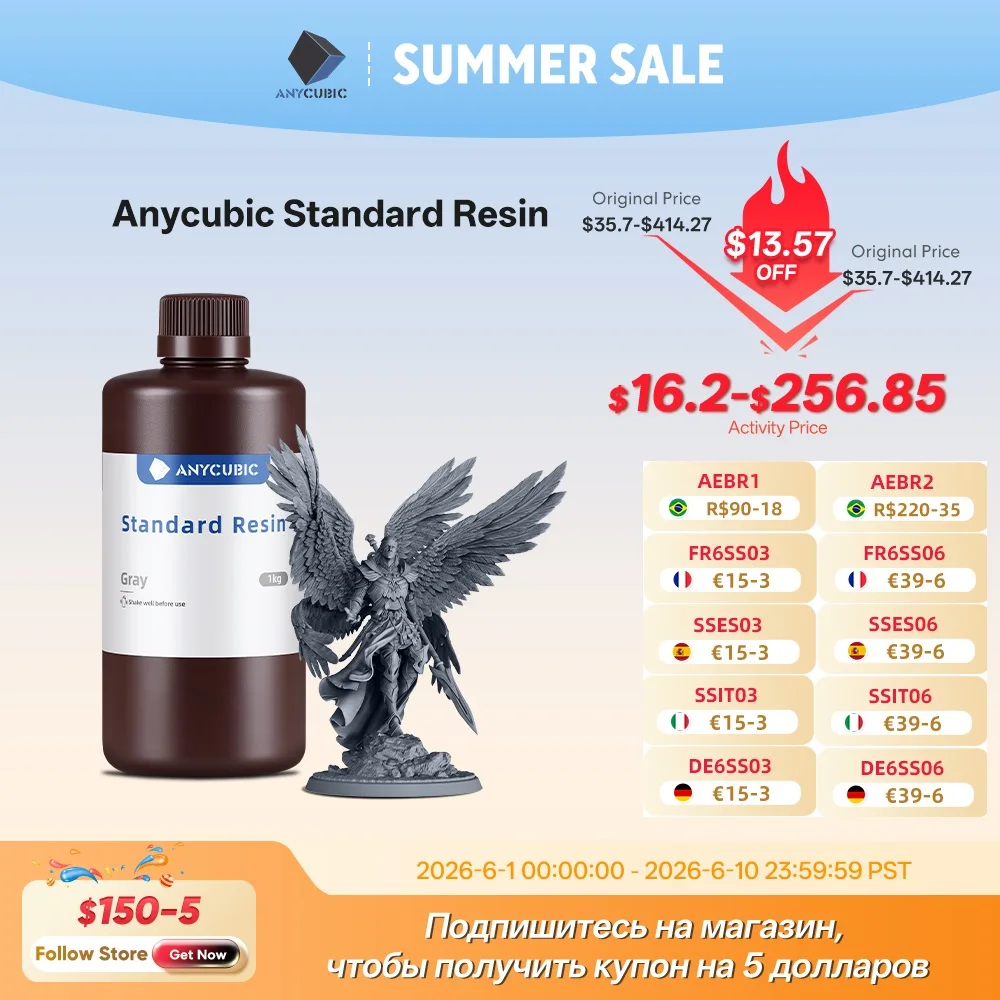
Official Store Deal
Expert Analysis Overview
The Anycubic Standard 405nm UV Resin is a foundational consumable for resin 3D printing, specifically tailored for makers prioritizing a balance of detail, ease of use, and overall print reliability. This particular formulation is engineered to interface seamlessly with 405nm UV light sources, which are the standard for most consumer-grade LCD and DLP resin printers. Its consistent properties aim to minimize variability in print outcomes, a critical factor for successful project completion. This resin is a solid choice.
The visible performance chart provides a clear overview of this resin's intended strengths. Key metrics like hardness, bending resistance, accuracy, and speed are highlighted, suggesting a well-rounded profile. Low odor and high temperature resistance are also noted, contributing to a more comfortable and stable printing environment. These are not merely abstract figures; they translate directly into the tangible quality of printed objects. The blue shaded area on the radar graph visually confirms a balanced distribution of these attributes, indicating a resin that doesn't significantly compromise one property for another. These are not just numbers.
For the maker, these balanced characteristics mean less time spent troubleshooting and more time creating. A resin with good hardness provides structural integrity for models, making them less prone to accidental damage during handling or post-processing. Adequate bending resistance indicates that thin features might flex rather than snap, a common failure point for brittle resins. Accuracy and speed combine to ensure that intricate designs are reproduced faithfully and efficiently, allowing for quicker iteration on custom parts or faster batch production of components. The ease of cleaning and curing further streamlines the post-processing workflow. Less time troubleshooting, more creating.
Compared to generic, unbranded resins, Anycubic's standard offering typically presents a more predictable performance curve. Unbranded alternatives often suffer from inconsistent viscosity, leading to print failures or poor detail resolution. The consistency of a known brand like Anycubic reduces the variables a maker needs to manage, streamlining the path from digital model to physical object. This predictability is invaluable when working on complex projects or developing custom modifications for existing hardware, where reliable material performance is paramount. It allows for more consistent results across different batches. Reliability is key here.
The radar graph explicitly details the resin's hardness and resilience, two interconnected material properties crucial for 3D printed objects. Hardness refers to a material's resistance to localized plastic deformation, such as indentation or scratching. Resilience, in this context, often implies the ability to absorb energy when deformed elastically and then release that energy upon unloading, essentially its springiness or toughness. A good balance here prevents prints from being overly brittle or too soft.
In practical terms, a well-balanced resin like this allows for the creation of parts that can withstand everyday handling without immediately showing signs of wear. Imagine printing a custom enclosure for a small electronic circuit; if the resin is too soft, the enclosure might deform under slight pressure, compromising the electronics within. Conversely, if it's too hard and lacks resilience, a minor drop could shatter it. This Anycubic resin aims for the sweet spot, providing enough rigidity for structural integrity while offering a degree of give to resist sudden impacts. It truly hits the mark.
Many entry-level resins often lean too heavily on one property, either being excessively brittle or surprisingly soft. This can be frustrating for makers who need parts with diverse mechanical requirements. The "better balance between sturdiness and resilience" advertised by Anycubic suggests a material that won't force a user to compromise significantly. This makes it a more forgiving material for a wider range of projects, from highly detailed miniatures to more robust functional prototypes, which is essential for a maker who experiments with various applications. Versatility is its strength.
The inclusion of low odor and high temperature resistance on the performance chart indicates an understanding of the user's working environment and the potential end-use of printed parts. A low odor profile is a significant comfort factor, particularly for hobbyists printing in home workshops or shared spaces where strong chemical smells can be a deterrent. High temperature resistance is crucial for parts that might be exposed to elevated temperatures, such as components near heat-generating electronics or models left in direct sunlight. It's a subtle but important indicator of the resin's stability.
For the maker, reduced odor means a more pleasant and potentially safer working environment, minimizing the need for extensive, active ventilation systems. This can make resin printing more accessible to those without dedicated workshops. High temperature resistance broadens the application possibilities; a custom jig used in a slightly warm environment, or a decorative piece displayed near a window, would benefit from this property, preventing warping or degradation over time. It extends the utility of the printed parts.
Many budget resins neglect these environmental considerations, often emitting strong, unpleasant fumes and exhibiting poor thermal stability. Such resins can limit where and how a maker can print, and where the final objects can be used. The explicit mention of these characteristics positions the Anycubic Standard Resin as a more refined option, offering an improved user experience and greater versatility for finished products. This attention to detail extends the utility of the printed parts beyond mere display.
The product highlights high precision with low shrinkage and dimensional stability during printing. This means the final model closely matches the digital design, with clear and accurate details. The orange flexible ring structure in the image visually confirms this claim, showing intricate geometries maintained even when the material is slightly manipulated. This level of fidelity is what separates a usable custom part from a mere approximation. The image clearly demonstrates that the resin retains its shape and fine features even under slight stress.
For makers engaged in functional prototyping or creating custom enclosures, dimensional accuracy is non-negotiable. If a printed part is meant to fit precisely with another component, even a slight deviation due to shrinkage can render it useless. Low shrinkage ensures that bolt holes align, interlocking parts mate correctly, and surface features remain true to scale. This precision directly impacts the success of complex assemblies and the reliability of custom-designed tools or modifications. It minimizes the need for post-print sanding or filing to achieve desired fits.
Unlike many general-purpose resins that might prioritize speed or cost over precision, Anycubic's focus on low shrinkage and dimensional stability caters directly to the needs of engineering and design-oriented makers. Inferior resins can exhibit significant volumetric shrinkage during curing, leading to warped prints, lost detail, or parts that simply do not fit their intended application. This resin provides a more reliable foundation for projects where exact measurements and intricate features are paramount, reducing the frustration of failed prints due to material instability. It allows for more confident design work.
The ability to produce "clear details" is a direct consequence of the resin's high precision and low shrinkage. The example of the intricate spherical object, alongside the winged angel statue, showcases the resin's capability to resolve fine features. Every groove, texture, and delicate wing structure is reproduced faithfully, which is a hallmark of good quality resin. Such detail retention is crucial for aesthetic and functional prints alike.
For a maker creating highly detailed miniatures, scale models, or even custom jewelry molds, the resin's ability to hold fine detail is paramount. Subtleties in sculpting, sharp edges, and delicate textures are preserved, bringing the digital design to life without compromise. This allows for complex designs that might otherwise be impossible to achieve with less precise materials, opening up new avenues for creative expression and functional innovation. The visual evidence strongly supports this claim.
Many hobby-grade resins struggle with reproducing minute details, often blurring fine lines or losing small features entirely due to light bleed or poor resolution. This forces makers to simplify their designs or accept lower quality outputs. The Anycubic Standard Resin, by contrast, appears to provide the necessary clarity and resolution to support highly intricate designs, making it a reliable choice for projects where visual fidelity is a key requirement. This capability truly differentiates it in a crowded market.
The collage of diverse 3D printed objects demonstrates the resin's versatility across various applications. From architectural models like the blue castle to functional items like eyeglasses, and decorative pieces such as the angel figurine or custom jewelry, the resin appears capable of handling a broad spectrum of printing needs. This wide applicability makes it a valuable staple in any maker's workshop. The range of complexity and size in the example prints is notable.
For the experimental maker, this versatility means fewer specialized resins are needed for different projects. One can move from printing a detailed miniature for a tabletop game to prototyping a custom bracket for a drone, all with the same material. This simplifies inventory management and allows for more fluid transitions between different types of creative and engineering tasks. The ability to trust one resin for multiple purposes fosters broader experimentation. This resin truly supports a multi-disciplinary approach.
In contrast, some resins are highly specialized, excelling in one specific area (e.g., extreme flexibility, dental applications) but performing poorly in others. This often necessitates stocking multiple types of resin, increasing cost and complexity. The Anycubic Standard Resin positions itself as a robust, general-purpose solution, providing a solid performance baseline across many common applications. This allows makers to explore new ideas without the immediate need for a new material. It eliminates the need for a specialized resin for every new project.
The ability to reliably print diverse objects directly supports the maker's drive for customization and iteration. Whether it's creating custom parts for a machine, unique architectural elements, or personalized wearable items, the resin's consistent performance ensures that design changes can be tested and refined quickly. This iterative process is fundamental to effective problem-solving and innovation in the maker community.
Imagine a scenario where a maker is designing a custom mounting solution for a camera rig. The ability to print multiple iterations, testing different angles, thicknesses, and attachment mechanisms with a reliable material, significantly accelerates the design cycle. Each print serves as a tangible prototype, providing immediate feedback that refines the next version. This rapid prototyping capability is a core strength of resin 3D printing, and a stable resin is its backbone.
Without a consistent and versatile resin, makers would face delays and increased material waste due to unpredictable print outcomes. Each design iteration might be compromised by material inconsistencies, making it difficult to discern whether a failure is due to design flaws or resin performance. This Anycubic resin minimizes that uncertainty, allowing makers to focus on their designs and modifications with confidence. Focus on design, not material.
While the resin itself is a consumable, its properties have a direct impact on the hackability and community support surrounding 3D printers. A reliable, well-documented standard resin like this often becomes a benchmark for printer calibration and troubleshooting discussions within online communities. Its predictable behavior allows users to isolate issues to either their printer settings or their specific model, rather than questioning the material itself. The consistency of a known brand helps in shared knowledge.
For a maker, this means faster resolution of printing problems. When a new custom profile is being developed for a printer, or a modification is being tested, using a known-good resin significantly reduces the variables. Community forums are rich with shared settings and experiences for popular resins, providing a valuable knowledge base for optimizing print quality or tackling specific challenges. This collective wisdom is a powerful resource for any tinkerer. It truly fosters collaborative problem-solving.
Inferior or less common resins often lack this community backing, leaving makers to troubleshoot in isolation. When a print fails, without established parameters or shared experiences, it becomes a frustrating process of trial and error. The widespread use and predictable nature of Anycubic's standard resins contribute to a robust ecosystem of shared knowledge, which is an indirect but significant benefit for makers looking to push the boundaries of their 3D printing capabilities and experiment with custom parts. This enables users to focus on optimizing their machines.
The overall ease of use, including easy to clean and easy to cure properties, is a practical advantage for any maker's workflow. Post-processing is an unavoidable part of resin 3D printing, and any features that streamline this stage save valuable time and effort. A resin that cleans up readily with common solvents and cures efficiently under UV light contributes to a smoother, more enjoyable printing experience. The optimized properties of this resin help accelerate the entire print-to-finish cycle.
For the maker, this translates to less mess and quicker turnaround times between prints. If a resin is difficult to clean, it can lead to sticky residues on prints and tools, requiring more aggressive solvents or prolonged washing. If it's slow to cure, it ties up post-processing equipment or requires longer exposure to UV light, delaying the final steps of a project. This efficiency is a core benefit.
Some resins, particularly those with highly specialized properties, can be notoriously difficult to clean or require specific, often expensive, curing parameters. This adds complexity and cost to the post-processing stage. Anycubic's standard resin aims for a straightforward workflow, making it accessible even for those new to resin printing, while still offering consistent results for experienced users. This balance is key for maintaining efficiency in a busy workshop.
The price point of Anycubic Standard 405nm UV Resin, around 18.05 USD for a 1kg bottle, positions it as a highly competitive option. When considering consumables, the long-term value is not just about the upfront cost but also about the reliability and consistency it provides. Reduced print failures, less material waste, and quicker project completion all contribute to a better return on investment over time. The "328 Anniversary Sale" highlights opportunities for even greater savings.
For a maker, choosing a reliable resin means fewer failed prints that waste both material and time. A cheaper, inconsistent resin might seem appealing initially, but if it leads to frequent print failures, the actual cost per successful print can skyrocket. The predictability of a reputable standard resin minimizes these hidden costs, allowing a maker to allocate resources more effectively to new projects or design iterations rather than reprinting failed attempts. This ensures that every drop of resin contributes to a successful project.
Compared to ultra-premium or highly specialized resins, the Anycubic Standard offers a compelling balance of performance and affordability. While those niche resins might offer superior properties for very specific applications, their higher cost often makes them impractical for general-purpose use or extensive prototyping. This standard resin provides a robust foundation for the majority of maker projects, ensuring that high-quality prints are achievable without "breaking the bank." It is an investment in consistent output, reducing overall project costs.
Proper handling and storage are critical for maximizing the performance and safety of any UV resin. The bottle itself is opaque, designed to protect the resin from ambient UV light exposure, which can prematurely cure the material. This attention to packaging detail is a small but important aspect of quality control, ensuring the resin reaches the user in optimal condition. Packaging matters for resin.
For the maker, understanding the environmental needs of the resin is part of the craft. Storing the resin correctly, away from direct sunlight and at a stable temperature, prevents degradation and extends its shelf life. This ensures that when a new project begins, the material is ready to perform as expected, avoiding frustrating print failures due to improperly stored resin. It is a simple step that significantly impacts print reliability.
Unlike some more forgiving filament materials, UV resin is reactive to its environment. Ignoring storage recommendations can lead to increased viscosity, reduced print quality, or even premature curing within the bottle. Anycubic's standard resin, like all UV resins, requires mindful storage, but its stable formulation helps maintain consistency over time when properly cared for. This proactive approach to material management is a hallmark of an experienced maker.
Imagine the satisfaction of consistently bringing your intricate designs to life, knowing that each custom part, miniature, or functional prototype emerges from your 3D printer with exceptional detail and reliable strength. This resin becomes an extension of your creative vision, enabling you to experiment with complex geometries and functional mechanisms without the frustration of material inconsistencies. Your workshop transforms into a hub of innovation, where ideas quickly transition from digital models to tangible realities, ready for assembly, modification, or display. Your creations come to life.
Crafting with Light: Resin's Core Performance
The visible performance chart provides a clear overview of this resin's intended strengths. Key metrics like hardness, bending resistance, accuracy, and speed are highlighted, suggesting a well-rounded profile. Low odor and high temperature resistance are also noted, contributing to a more comfortable and stable printing environment. These are not merely abstract figures; they translate directly into the tangible quality of printed objects. The blue shaded area on the radar graph visually confirms a balanced distribution of these attributes, indicating a resin that doesn't significantly compromise one property for another. These are not just numbers.
For the maker, these balanced characteristics mean less time spent troubleshooting and more time creating. A resin with good hardness provides structural integrity for models, making them less prone to accidental damage during handling or post-processing. Adequate bending resistance indicates that thin features might flex rather than snap, a common failure point for brittle resins. Accuracy and speed combine to ensure that intricate designs are reproduced faithfully and efficiently, allowing for quicker iteration on custom parts or faster batch production of components. The ease of cleaning and curing further streamlines the post-processing workflow. Less time troubleshooting, more creating.
Compared to generic, unbranded resins, Anycubic's standard offering typically presents a more predictable performance curve. Unbranded alternatives often suffer from inconsistent viscosity, leading to print failures or poor detail resolution. The consistency of a known brand like Anycubic reduces the variables a maker needs to manage, streamlining the path from digital model to physical object. This predictability is invaluable when working on complex projects or developing custom modifications for existing hardware, where reliable material performance is paramount. It allows for more consistent results across different batches. Reliability is key here.
The Material Science of Detail: Hardness and Resilience
The radar graph explicitly details the resin's hardness and resilience, two interconnected material properties crucial for 3D printed objects. Hardness refers to a material's resistance to localized plastic deformation, such as indentation or scratching. Resilience, in this context, often implies the ability to absorb energy when deformed elastically and then release that energy upon unloading, essentially its springiness or toughness. A good balance here prevents prints from being overly brittle or too soft.
In practical terms, a well-balanced resin like this allows for the creation of parts that can withstand everyday handling without immediately showing signs of wear. Imagine printing a custom enclosure for a small electronic circuit; if the resin is too soft, the enclosure might deform under slight pressure, compromising the electronics within. Conversely, if it's too hard and lacks resilience, a minor drop could shatter it. This Anycubic resin aims for the sweet spot, providing enough rigidity for structural integrity while offering a degree of give to resist sudden impacts. It truly hits the mark.
Many entry-level resins often lean too heavily on one property, either being excessively brittle or surprisingly soft. This can be frustrating for makers who need parts with diverse mechanical requirements. The "better balance between sturdiness and resilience" advertised by Anycubic suggests a material that won't force a user to compromise significantly. This makes it a more forgiving material for a wider range of projects, from highly detailed miniatures to more robust functional prototypes, which is essential for a maker who experiments with various applications. Versatility is its strength.
Environmental Factors: Low Odor and Temperature Resistance
The inclusion of low odor and high temperature resistance on the performance chart indicates an understanding of the user's working environment and the potential end-use of printed parts. A low odor profile is a significant comfort factor, particularly for hobbyists printing in home workshops or shared spaces where strong chemical smells can be a deterrent. High temperature resistance is crucial for parts that might be exposed to elevated temperatures, such as components near heat-generating electronics or models left in direct sunlight. It's a subtle but important indicator of the resin's stability.
For the maker, reduced odor means a more pleasant and potentially safer working environment, minimizing the need for extensive, active ventilation systems. This can make resin printing more accessible to those without dedicated workshops. High temperature resistance broadens the application possibilities; a custom jig used in a slightly warm environment, or a decorative piece displayed near a window, would benefit from this property, preventing warping or degradation over time. It extends the utility of the printed parts.
Many budget resins neglect these environmental considerations, often emitting strong, unpleasant fumes and exhibiting poor thermal stability. Such resins can limit where and how a maker can print, and where the final objects can be used. The explicit mention of these characteristics positions the Anycubic Standard Resin as a more refined option, offering an improved user experience and greater versatility for finished products. This attention to detail extends the utility of the printed parts beyond mere display.
Precision in Every Layer: Dimensional Stability
The product highlights high precision with low shrinkage and dimensional stability during printing. This means the final model closely matches the digital design, with clear and accurate details. The orange flexible ring structure in the image visually confirms this claim, showing intricate geometries maintained even when the material is slightly manipulated. This level of fidelity is what separates a usable custom part from a mere approximation. The image clearly demonstrates that the resin retains its shape and fine features even under slight stress.
For makers engaged in functional prototyping or creating custom enclosures, dimensional accuracy is non-negotiable. If a printed part is meant to fit precisely with another component, even a slight deviation due to shrinkage can render it useless. Low shrinkage ensures that bolt holes align, interlocking parts mate correctly, and surface features remain true to scale. This precision directly impacts the success of complex assemblies and the reliability of custom-designed tools or modifications. It minimizes the need for post-print sanding or filing to achieve desired fits.
Unlike many general-purpose resins that might prioritize speed or cost over precision, Anycubic's focus on low shrinkage and dimensional stability caters directly to the needs of engineering and design-oriented makers. Inferior resins can exhibit significant volumetric shrinkage during curing, leading to warped prints, lost detail, or parts that simply do not fit their intended application. This resin provides a more reliable foundation for projects where exact measurements and intricate features are paramount, reducing the frustration of failed prints due to material instability. It allows for more confident design work.
Reproducing Intricate Geometries: Detail Retention
The ability to produce "clear details" is a direct consequence of the resin's high precision and low shrinkage. The example of the intricate spherical object, alongside the winged angel statue, showcases the resin's capability to resolve fine features. Every groove, texture, and delicate wing structure is reproduced faithfully, which is a hallmark of good quality resin. Such detail retention is crucial for aesthetic and functional prints alike.
For a maker creating highly detailed miniatures, scale models, or even custom jewelry molds, the resin's ability to hold fine detail is paramount. Subtleties in sculpting, sharp edges, and delicate textures are preserved, bringing the digital design to life without compromise. This allows for complex designs that might otherwise be impossible to achieve with less precise materials, opening up new avenues for creative expression and functional innovation. The visual evidence strongly supports this claim.
Many hobby-grade resins struggle with reproducing minute details, often blurring fine lines or losing small features entirely due to light bleed or poor resolution. This forces makers to simplify their designs or accept lower quality outputs. The Anycubic Standard Resin, by contrast, appears to provide the necessary clarity and resolution to support highly intricate designs, making it a reliable choice for projects where visual fidelity is a key requirement. This capability truly differentiates it in a crowded market.
The Maker's Palette: Versatility in Application
The collage of diverse 3D printed objects demonstrates the resin's versatility across various applications. From architectural models like the blue castle to functional items like eyeglasses, and decorative pieces such as the angel figurine or custom jewelry, the resin appears capable of handling a broad spectrum of printing needs. This wide applicability makes it a valuable staple in any maker's workshop. The range of complexity and size in the example prints is notable.
For the experimental maker, this versatility means fewer specialized resins are needed for different projects. One can move from printing a detailed miniature for a tabletop game to prototyping a custom bracket for a drone, all with the same material. This simplifies inventory management and allows for more fluid transitions between different types of creative and engineering tasks. The ability to trust one resin for multiple purposes fosters broader experimentation. This resin truly supports a multi-disciplinary approach.
In contrast, some resins are highly specialized, excelling in one specific area (e.g., extreme flexibility, dental applications) but performing poorly in others. This often necessitates stocking multiple types of resin, increasing cost and complexity. The Anycubic Standard Resin positions itself as a robust, general-purpose solution, providing a solid performance baseline across many common applications. This allows makers to explore new ideas without the immediate need for a new material. It eliminates the need for a specialized resin for every new project.
Enabling Customization and Iteration
The ability to reliably print diverse objects directly supports the maker's drive for customization and iteration. Whether it's creating custom parts for a machine, unique architectural elements, or personalized wearable items, the resin's consistent performance ensures that design changes can be tested and refined quickly. This iterative process is fundamental to effective problem-solving and innovation in the maker community.
Imagine a scenario where a maker is designing a custom mounting solution for a camera rig. The ability to print multiple iterations, testing different angles, thicknesses, and attachment mechanisms with a reliable material, significantly accelerates the design cycle. Each print serves as a tangible prototype, providing immediate feedback that refines the next version. This rapid prototyping capability is a core strength of resin 3D printing, and a stable resin is its backbone.
Without a consistent and versatile resin, makers would face delays and increased material waste due to unpredictable print outcomes. Each design iteration might be compromised by material inconsistencies, making it difficult to discern whether a failure is due to design flaws or resin performance. This Anycubic resin minimizes that uncertainty, allowing makers to focus on their designs and modifications with confidence. Focus on design, not material.
Beyond the Bottle: Community and Customization
While the resin itself is a consumable, its properties have a direct impact on the hackability and community support surrounding 3D printers. A reliable, well-documented standard resin like this often becomes a benchmark for printer calibration and troubleshooting discussions within online communities. Its predictable behavior allows users to isolate issues to either their printer settings or their specific model, rather than questioning the material itself. The consistency of a known brand helps in shared knowledge.
For a maker, this means faster resolution of printing problems. When a new custom profile is being developed for a printer, or a modification is being tested, using a known-good resin significantly reduces the variables. Community forums are rich with shared settings and experiences for popular resins, providing a valuable knowledge base for optimizing print quality or tackling specific challenges. This collective wisdom is a powerful resource for any tinkerer. It truly fosters collaborative problem-solving.
Inferior or less common resins often lack this community backing, leaving makers to troubleshoot in isolation. When a print fails, without established parameters or shared experiences, it becomes a frustrating process of trial and error. The widespread use and predictable nature of Anycubic's standard resins contribute to a robust ecosystem of shared knowledge, which is an indirect but significant benefit for makers looking to push the boundaries of their 3D printing capabilities and experiment with custom parts. This enables users to focus on optimizing their machines.
Optimizing Your Workflow: Handling and Curing
The overall ease of use, including easy to clean and easy to cure properties, is a practical advantage for any maker's workflow. Post-processing is an unavoidable part of resin 3D printing, and any features that streamline this stage save valuable time and effort. A resin that cleans up readily with common solvents and cures efficiently under UV light contributes to a smoother, more enjoyable printing experience. The optimized properties of this resin help accelerate the entire print-to-finish cycle.
For the maker, this translates to less mess and quicker turnaround times between prints. If a resin is difficult to clean, it can lead to sticky residues on prints and tools, requiring more aggressive solvents or prolonged washing. If it's slow to cure, it ties up post-processing equipment or requires longer exposure to UV light, delaying the final steps of a project. This efficiency is a core benefit.
Some resins, particularly those with highly specialized properties, can be notoriously difficult to clean or require specific, often expensive, curing parameters. This adds complexity and cost to the post-processing stage. Anycubic's standard resin aims for a straightforward workflow, making it accessible even for those new to resin printing, while still offering consistent results for experienced users. This balance is key for maintaining efficiency in a busy workshop.
Long-Term Value: A Consumable's ROI
The price point of Anycubic Standard 405nm UV Resin, around 18.05 USD for a 1kg bottle, positions it as a highly competitive option. When considering consumables, the long-term value is not just about the upfront cost but also about the reliability and consistency it provides. Reduced print failures, less material waste, and quicker project completion all contribute to a better return on investment over time. The "328 Anniversary Sale" highlights opportunities for even greater savings.
For a maker, choosing a reliable resin means fewer failed prints that waste both material and time. A cheaper, inconsistent resin might seem appealing initially, but if it leads to frequent print failures, the actual cost per successful print can skyrocket. The predictability of a reputable standard resin minimizes these hidden costs, allowing a maker to allocate resources more effectively to new projects or design iterations rather than reprinting failed attempts. This ensures that every drop of resin contributes to a successful project.
Compared to ultra-premium or highly specialized resins, the Anycubic Standard offers a compelling balance of performance and affordability. While those niche resins might offer superior properties for very specific applications, their higher cost often makes them impractical for general-purpose use or extensive prototyping. This standard resin provides a robust foundation for the majority of maker projects, ensuring that high-quality prints are achievable without "breaking the bank." It is an investment in consistent output, reducing overall project costs.
Essential Safeguards: Handling and Storage
Proper handling and storage are critical for maximizing the performance and safety of any UV resin. The bottle itself is opaque, designed to protect the resin from ambient UV light exposure, which can prematurely cure the material. This attention to packaging detail is a small but important aspect of quality control, ensuring the resin reaches the user in optimal condition. Packaging matters for resin.
For the maker, understanding the environmental needs of the resin is part of the craft. Storing the resin correctly, away from direct sunlight and at a stable temperature, prevents degradation and extends its shelf life. This ensures that when a new project begins, the material is ready to perform as expected, avoiding frustrating print failures due to improperly stored resin. It is a simple step that significantly impacts print reliability.
Unlike some more forgiving filament materials, UV resin is reactive to its environment. Ignoring storage recommendations can lead to increased viscosity, reduced print quality, or even premature curing within the bottle. Anycubic's standard resin, like all UV resins, requires mindful storage, but its stable formulation helps maintain consistency over time when properly cared for. This proactive approach to material management is a hallmark of an experienced maker.
The Future of Your Creations
Imagine the satisfaction of consistently bringing your intricate designs to life, knowing that each custom part, miniature, or functional prototype emerges from your 3D printer with exceptional detail and reliable strength. This resin becomes an extension of your creative vision, enabling you to experiment with complex geometries and functional mechanisms without the frustration of material inconsistencies. Your workshop transforms into a hub of innovation, where ideas quickly transition from digital models to tangible realities, ready for assembly, modification, or display. Your creations come to life.