Anycubic Kobra S1 Ceramic Hotend Upgrade
Official Store Deal
Expert Analysis Overview
Elevating Kobra S1 Performance: A Deep Dive into the Ceramic Hotend Upgrade
The Anycubic Kobra S1/S1 Combo ceramic hotend upgrade is a performance-focused modification designed for 3D printer enthusiasts seeking significant speed and temperature capabilities. This component aims to resolve common bottlenecks in print speed and material versatility often encountered with stock hotends. It targets users keen on pushing their Anycubic Kobra S1 or S1 Combo machines beyond their original specifications, enabling faster print times and the use of more demanding filaments. The upgrade represents a clear path for makers to enhance their printing experience without investing in an entirely new machine.The Core of Speed: Ceramic Heating Technology
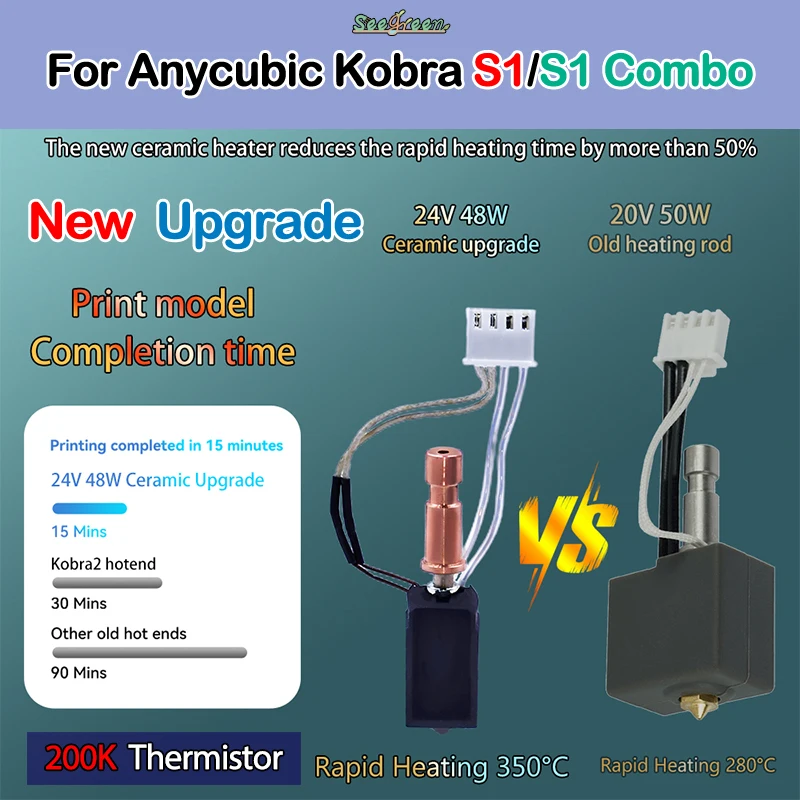
Visible data highlights a 24V 48W ceramic upgrade in contrast to an older 20V 50W heating rod. This ceramic heater significantly impacts the thermal efficiency of the hotend. It's a fundamental shift in how heat is delivered to the nozzle.The real-world implication for this ceramic heating element is a substantial reduction in heat-up times. The image suggests a more than 50% decrease in rapid heating time, which directly translates to less waiting and more printing. For iterative design processes or batch production, these saved minutes accumulate quickly. Print initiation becomes notably faster.
Compared to traditional cartridge heaters, ceramic elements often provide more uniform heat distribution and quicker thermal response. This consistency is crucial for maintaining stable print temperatures, particularly during high-speed printing or when transitioning between different filament types. Many standard hotends struggle with rapid temperature changes, leading to inconsistencies; this upgrade mitigates that.
Structural Integrity and Material Flow
An upgraded 350°C Full-Metal Hotend is a central feature of this component. The internal structure dictates both temperature capacity and material compatibility. This design choice is not merely about reaching higher temperatures.The full-metal construction allows for the safe and effective printing of high-temperature filaments like ABS, Nylon, PC, and even some carbon fiber composites that would quickly degrade or clog a PTFE-lined hotend. The material path remains clear and consistent, even at elevated temperatures. This expands the creative possibilities for any maker.
Many entry-level 3D printers come with PTFE-lined hotends that are limited to lower temperatures (typically around 240-260°C) due to the degradation of the PTFE tube. This full-metal upgrade removes that constraint, offering a significant leap in material versatility. It broadens the scope of projects a Kobra S1 can undertake.
Precision Extrusion: The 350°C Metal Nozzle
The hotend is equipped with a 350°C metal nozzle, implying robust material handling. The nozzle is the final point of extrusion, directly influencing print quality.This metal nozzle, combined with an aerospace-grade ceramic-based composite throat, is designed to be resistant to high temperatures and minimize clogging. This translates to smoother extrusion, fewer print failures due to blockages, and cleaner prints. Consistent flow is key to quality.
Unlike brass nozzles often found on stock printers, which can wear down quickly with abrasive filaments, a metal nozzle, especially if hardened, offers superior durability. This means fewer nozzle replacements and consistent performance over a longer lifespan, particularly when working with specialized engineering filaments.
Streamlined Maintenance: Quick Replacement Design
One highlighted feature is the quick replacement of hotend design, described as tool-free disassembly. This addresses a common pain point for 3D printer users.This design allows for the hotend to be replaced in just a few seconds, according to the product information. For makers who frequently swap nozzles for different filament types or sizes, or who occasionally experience clogs requiring hotend removal, this is a major time-saver. Downtime is minimized.
Many standard hotends require multiple tools and a more involved disassembly process, often leading to frustration and potential damage to other components. This quick-change mechanism significantly simplifies maintenance, making the printer more user-friendly and reducing the barrier to experimentation. It encourages more tinkering.
Enhanced Flow Path: Structural Upgrading
The product details mention structural upgrading with an integrated heating block and a throat with an inner wall surface finish level of Ra=0.4μm. This speaks to the internal fluid dynamics of the filament.An integrated heating block design aims to reduce leakage, a common issue with older split heating block designs where the pipe could easily fall off. The smooth inner wall finish of the throat further reduces friction, allowing for smoother filament passage and minimizing the chances of heat creep or clogs. This directly improves print reliability.
Older hotend designs often feature separate components that can introduce micro-gaps or inconsistencies in the filament path, leading to increased friction and potential blockages. This integrated and polished design offers a more optimized and reliable path for molten filament, ensuring consistent extrusion and better print quality, particularly for long prints. It's a subtle yet impactful improvement.
Thermal Monitoring: The 200K Thermistor
The inclusion of a 200K Thermistor is specified for accurate temperature readings. This component is vital for thermal regulation.A thermistor is a temperature-sensing resistor, and a 200K thermistor typically indicates a specific resistance curve suitable for higher temperature ranges. This ensures the printer's firmware receives precise temperature data, allowing the ceramic heater to maintain the exact desired temperature for the filament. Accurate temperature control prevents under-extrusion or material degradation.
Standard thermistors might have a more limited temperature range or less accuracy at the higher temperatures this hotend is capable of. Using a thermistor specifically designed for 350°C operation ensures the thermal runaway protection systems function correctly and that material properties are optimized during printing. It's a critical safety and performance component.
Performance Metrics: Speed and Acceleration
The upgrade promises impressive performance metrics: a recommended printing speed of 300mm/s, a maximum printing speed of 600mm/s, and a maximum printing acceleration of 20000mm/s². These figures point to a hotend designed for speed.These specifications imply that the hotend can melt and extrude filament at an extremely high rate, keeping up with the rapid movements of a modern 3D printer. For users looking to reduce print times significantly, this hotend provides the necessary melt flow rate. It directly impacts project completion times.
Compared to many stock hotends that struggle to maintain consistent extrusion at speeds much above 100-150mm/s, this ceramic hotend is engineered for high-flow applications. This allows users to leverage the full mechanical capabilities of their Kobra S1 printer, pushing print speeds to levels previously unattainable without such an upgrade. It truly unlocks the printer's potential.