Anycubic Kobra S1 3D Printer
Official Store Deal
Expert Analysis Overview
The Anycubic Kobra S1 is a high-speed, enclosed CoreXY 3D printer engineered for rapid prototyping and reliable production of complex parts. This machine targets professionals and hobbyists requiring both speed and precision for a diverse range of materials. Its fully enclosed design is a significant differentiator.
The Anycubic Kobra S1 boasts a formidable maximum printing speed of 600mm/s, with a recommended operational speed of 300mm/s for optimal print quality. This capability allows for significantly reduced print times across various projects. A common benchmark model, the 3D Benchy, can be completed in approximately 15 minutes, a testament to its rapid throughput.
Such high velocities are achieved through a combination of robust mechanical design and optimized motion control algorithms. The CoreXY kinematics inherently provide a stable and rigid platform for rapid toolhead movement, minimizing inertia. This translates directly to faster iteration cycles for designers and engineers, accelerating product development timelines. Time is money.
Compared to traditional Cartesian or Delta style printers, which often struggle to maintain accuracy at speeds exceeding 100-150mm/s, the Kobra S1's architecture is purpose-built for sustained high-speed operation. Standard entry-level FDM printers typically operate at speeds between 50-150mm/s, making the Kobra S1 a substantial upgrade in terms of production efficiency and project completion speed. It prints fast.
The maximum acceleration is rated at an impressive 20000mm/s². This high acceleration capability is crucial for maintaining print quality at high speeds, especially when printing models with intricate details or frequent changes in direction. Rapid acceleration minimizes common artifacts such as "ringing" or "ghosting," which are visual echoes of sharp corners.
This level of acceleration ensures that the print head can quickly reach its target velocity and decelerate efficiently, reducing dwell time at corners. It is a key factor in achieving both speed and precision simultaneously, as the printer can rapidly change direction without losing positional accuracy. Precision matters.
Many consumer-grade 3D printers offer accelerations in the range of 2000-5000mm/s². The Kobra S1's specification places it firmly in the performance category, enabling quicker transitions and sharper corners on printed objects, which is vital for dimensionally accurate parts. This is a significant leap.
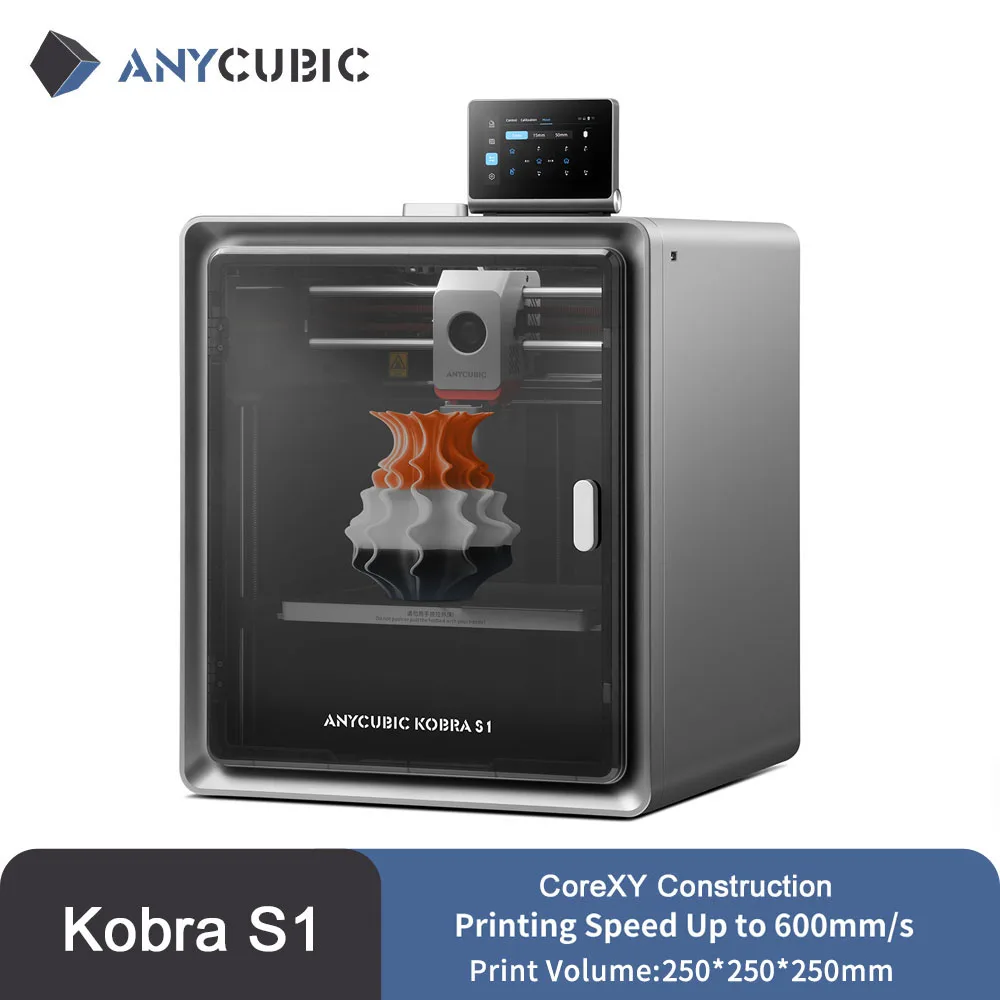
The printer features a fully enclosed CoreXY construction. This design provides a stable and thermally controlled printing environment, crucial for consistent results. The generous print volume is specified as 250x250x250mm, offering ample space for medium-sized models.
An enclosed build chamber is critical for printing advanced engineering filaments. It maintains a consistent internal temperature, preventing common issues like warping, cracking, and poor layer adhesion in materials such as ABS and ASA. This controlled environment is a major advantage for reliability.
Unlike open-frame 3D printers, which are primarily suited for PLA due to its lower temperature sensitivity, the Kobra S1's enclosure expands its material compatibility significantly. It offers a more predictable and successful printing experience for temperature-sensitive filaments, reducing failed prints. This is a game changer.
The CoreXY motion system itself contributes significantly to stability. In this configuration, the print head moves in the X and Y axes via a belt system where both stepper motors are stationary on the printer's frame. This design inherently reduces the moving mass of the print head assembly. Less inertia means less vibration.
This mechanical arrangement minimizes the impact of rapid movements on the printer's overall structure, leading to less ringing and ghosting. The result is improved print quality, particularly at higher speeds, as the frame remains more rigid and less prone to oscillations. Stability is key.
Many budget 3D printers utilize a Cartesian system where the print bed moves along the Y-axis, adding significant moving mass and inertia to the system. The CoreXY system, as implemented in the Kobra S1, offers a superior foundation for high-speed, high-quality output, especially for larger prints. It moves smoothly.
The Kobra S1 offers perfect support for ASA/ABS, PLA, and PETG. This broad compatibility covers a wide spectrum of 3D printing applications, from general prototyping to functional end-use parts. The ability to handle high-temperature engineering filaments is a direct benefit of the enclosed design and robust hotend.
For engineers, product designers, and advanced hobbyists, printing with ASA or ABS is often a necessity due to their superior mechanical properties, heat resistance, and durability compared to PLA. The Kobra S1 facilitates the reliable production of functional prototypes, jigs, fixtures, and even end-use parts that require specific environmental resistances. This capability is crucial for professional workflows.
Many consumer-grade printers struggle with ABS due to its tendency to warp and delaminate, caused by uncontrolled ambient temperatures and rapid cooling. The Kobra S1's enclosed design directly addresses these challenges, making these high-performance materials accessible and reliable for consistent, high-quality prints. No more warping.
PLA and PLA+ are standard, easy-to-print filaments, ideal for general prototyping, aesthetic models, and educational projects. The Kobra S1 handles these with ease, offering fast print times for common projects where mechanical strength is less critical. PETG, on the other hand, provides a good balance of strength, flexibility, and temperature resistance, making it suitable for functional parts that require more durability and impact resistance than PLA.
The printer's support for these diverse materials means users are not limited in their creative or functional applications. If you are designing a strong enclosure, ABS is ideal. If you need a flexible, chemical-resistant part, PETG excels. From rigid prototypes to flexible components, the Kobra S1 can accommodate various project requirements without compromise.
This versatility contrasts sharply with printers limited primarily to PLA, which restricts the types of parts that can be reliably produced for real-world applications. The Kobra S1's comprehensive material handling capabilities make it a more valuable and adaptable tool for a broader range of users and projects. It is very adaptable.
A key component enabling the Kobra S1's advanced material compatibility is its 320°C full-metal hotend. This high-temperature capability is absolutely essential for melting and extruding demanding engineering-grade filaments effectively and consistently. The design also emphasizes user-friendliness, stating that swapping out the hotend takes only a few seconds.
The full-metal design ensures that the filament path, from the extruder gear to the nozzle tip, remains hot enough to melt even the most demanding materials like Nylon, Polycarbonate, or carbon fiber-filled composites, should the user choose to experiment beyond the explicitly listed supported materials. This significant thermal headroom is a critical performance indicator for advanced users. Heat is controlled.
Many stock hotends on budget printers are PTFE-lined, meaning a Teflon tube extends into the hot zone, limiting their safe operating temperature to around 240-260°C before the PTFE begins to degrade and release toxic fumes. The Kobra S1's full-metal hotend removes this thermal bottleneck, allowing for a wider range of high-performance filaments to be printed safely and effectively.
The hotend supports multiple nozzle sizes, providing significant flexibility for various printing needs: 0.2mm, 0.4mm, 0.6mm, and 0.8mm. This modularity allows users to optimize prints for either extremely fine detail or rapid production of larger objects. A 0.2mm nozzle can achieve intricate features and smooth surfaces, ideal for miniatures or highly detailed prototypes.
Conversely, a 0.8mm nozzle dramatically reduces print time for large, less detailed objects, such as architectural models or robust functional parts where speed is prioritized over microscopic detail. This flexibility empowers users to tailor the printer's output precisely to specific project needs. Choose your detail.
Standard printers often come equipped with only a 0.4mm nozzle, requiring aftermarket purchases and potentially complex installation for different sizes. The Kobra S1's integrated support for various nozzle diameters enhances its utility and value out of the box, providing immediate adaptability for diverse projects.
The Anycubic Kobra S1 is capable of producing stunning colors printing, though it is explicitly stated that multicolor printing requires an additional Anycubic ACE PRO module. This indicates a clear upgrade path for users interested in advanced aesthetic outputs. The visual input shows a vibrant, multi-colored disc, demonstrating the potential.
While the base printer is likely a single-extruder system, the mention of an optional module suggests an ecosystem designed for expansion into multi-material or multi-color capabilities. This expands the printer's artistic and functional potential, allowing for more complex visual designs. Color adds impact.
For those creating visually appealing prototypes, artistic pieces, educational models, or parts with color-coded functionality, the ability to integrate multiple colors is a significant advantage. It allows for more realistic, engaging, and informative representations of designs. This enhances communication.
Many single-extruder printers are limited to one color per print, or require tedious manual filament changes mid-print to achieve multiple colors. The Kobra S1's ecosystem, with its potential for an external color module, offers a more streamlined and automated approach to multi-color printing, saving time and effort.
The printer features a top-mounted control screen. This strategic placement ensures easy access and clear visibility during operation, allowing users to monitor print progress and adjust settings without awkward bending or reaching. A clear interface is crucial for efficient workflow.
An intuitive user interface reduces the learning curve for new users and streamlines operations for experienced ones, making the printing process more efficient. The screen likely provides real-time feedback on critical parameters such as hotend and bed temperatures, print progress percentage, and estimated completion time. Information is readily available.
Some printers place their screens in less accessible locations, or rely solely on computer control, which can tether the user to a workstation. The Kobra S1's dedicated, well-positioned screen enhances standalone usability, allowing for quick adjustments and monitoring directly at the machine. It is very convenient.
The Anycubic Kobra S1 is designed for high precision. This inherent capability stems directly from its rigid CoreXY structure, the controlled thermal environment of its enclosure, and its advanced motion system. Precision is paramount for functional parts that require exact dimensions.
Achieving tight tolerances and smooth surface finishes is a primary goal for any prototyping machine, especially when parts need to fit together or interact with other components. The combination of stable mechanics, precise stepper motor control, and consistent extrusion contributes to uniform layer deposition and accurate feature reproduction. Accuracy is vital.
Many budget printers struggle with dimensional accuracy over larger prints or with fine details, leading to parts that do not fit together correctly or exhibit visible imperfections. The Kobra S1 aims to mitigate these common issues, providing reliable and repeatable precision for critical applications. It builds trust.
The product description highlights ultra-quiet operation. This is a significant consideration for users who plan to operate the printer in home offices, shared workspaces, or even living areas. Excessive noise from cooling fans and stepper motors can be a major distraction and source of fatigue during long print jobs.
Quiet operation allows the printer to run in sensitive environments without causing disturbance to others or interrupting concentration. This improves the overall user experience, making it possible to run prints overnight or during work hours without intrusive background noise. Peace and quiet.
Many 3D printers, particularly older models or those with less refined stepper motor drivers and fan designs, can be quite loud, often exceeding 60-70 decibels. The Kobra S1's focus on quietness makes it a more suitable and considerate choice for a wider range of installation locations. It's less disruptive.
The Anycubic Kobra S1 positions itself as a robust and high-performance solution for users demanding speed, precision, and material versatility in their 3D printing endeavors. Its fully enclosed CoreXY construction directly addresses common pain points in 3D printing, such as warping with advanced filaments and slow print times that hinder rapid iteration. The high-temperature full-metal hotend and broad material support ensure that engineers, product developers, and advanced hobbyists can create dimensionally accurate parts from a variety of plastics, minimizing print failures and expanding creative and functional possibilities. This printer represents a significant upgrade from standard open-frame models, offering a controlled environment and faster throughput that translates into quicker design iterations and more reliable functional prototypes. Imagine effortlessly producing strong, heat-resistant components for your next engineering project, or rapidly iterating through multiple design concepts in a single day without waiting hours for each print to complete. The Kobra S1 is built to deliver consistent, high-quality results, enabling users to focus on innovation and creation rather than troubleshooting and print failures.
The Velocity of Creation: Print Speed and Acceleration
The Anycubic Kobra S1 boasts a formidable maximum printing speed of 600mm/s, with a recommended operational speed of 300mm/s for optimal print quality. This capability allows for significantly reduced print times across various projects. A common benchmark model, the 3D Benchy, can be completed in approximately 15 minutes, a testament to its rapid throughput.
Such high velocities are achieved through a combination of robust mechanical design and optimized motion control algorithms. The CoreXY kinematics inherently provide a stable and rigid platform for rapid toolhead movement, minimizing inertia. This translates directly to faster iteration cycles for designers and engineers, accelerating product development timelines. Time is money.
Compared to traditional Cartesian or Delta style printers, which often struggle to maintain accuracy at speeds exceeding 100-150mm/s, the Kobra S1's architecture is purpose-built for sustained high-speed operation. Standard entry-level FDM printers typically operate at speeds between 50-150mm/s, making the Kobra S1 a substantial upgrade in terms of production efficiency and project completion speed. It prints fast.
The maximum acceleration is rated at an impressive 20000mm/s². This high acceleration capability is crucial for maintaining print quality at high speeds, especially when printing models with intricate details or frequent changes in direction. Rapid acceleration minimizes common artifacts such as "ringing" or "ghosting," which are visual echoes of sharp corners.
This level of acceleration ensures that the print head can quickly reach its target velocity and decelerate efficiently, reducing dwell time at corners. It is a key factor in achieving both speed and precision simultaneously, as the printer can rapidly change direction without losing positional accuracy. Precision matters.
Many consumer-grade 3D printers offer accelerations in the range of 2000-5000mm/s². The Kobra S1's specification places it firmly in the performance category, enabling quicker transitions and sharper corners on printed objects, which is vital for dimensionally accurate parts. This is a significant leap.
Structural Integrity: The CoreXY Enclosure Advantage
The printer features a fully enclosed CoreXY construction. This design provides a stable and thermally controlled printing environment, crucial for consistent results. The generous print volume is specified as 250x250x250mm, offering ample space for medium-sized models.
An enclosed build chamber is critical for printing advanced engineering filaments. It maintains a consistent internal temperature, preventing common issues like warping, cracking, and poor layer adhesion in materials such as ABS and ASA. This controlled environment is a major advantage for reliability.
Unlike open-frame 3D printers, which are primarily suited for PLA due to its lower temperature sensitivity, the Kobra S1's enclosure expands its material compatibility significantly. It offers a more predictable and successful printing experience for temperature-sensitive filaments, reducing failed prints. This is a game changer.
The CoreXY motion system itself contributes significantly to stability. In this configuration, the print head moves in the X and Y axes via a belt system where both stepper motors are stationary on the printer's frame. This design inherently reduces the moving mass of the print head assembly. Less inertia means less vibration.
This mechanical arrangement minimizes the impact of rapid movements on the printer's overall structure, leading to less ringing and ghosting. The result is improved print quality, particularly at higher speeds, as the frame remains more rigid and less prone to oscillations. Stability is key.
Many budget 3D printers utilize a Cartesian system where the print bed moves along the Y-axis, adding significant moving mass and inertia to the system. The CoreXY system, as implemented in the Kobra S1, offers a superior foundation for high-speed, high-quality output, especially for larger prints. It moves smoothly.
Material Mastery: Filament Versatility for Functional Parts
The Kobra S1 offers perfect support for ASA/ABS, PLA, and PETG. This broad compatibility covers a wide spectrum of 3D printing applications, from general prototyping to functional end-use parts. The ability to handle high-temperature engineering filaments is a direct benefit of the enclosed design and robust hotend.
For engineers, product designers, and advanced hobbyists, printing with ASA or ABS is often a necessity due to their superior mechanical properties, heat resistance, and durability compared to PLA. The Kobra S1 facilitates the reliable production of functional prototypes, jigs, fixtures, and even end-use parts that require specific environmental resistances. This capability is crucial for professional workflows.
Many consumer-grade printers struggle with ABS due to its tendency to warp and delaminate, caused by uncontrolled ambient temperatures and rapid cooling. The Kobra S1's enclosed design directly addresses these challenges, making these high-performance materials accessible and reliable for consistent, high-quality prints. No more warping.
PLA and PLA+ are standard, easy-to-print filaments, ideal for general prototyping, aesthetic models, and educational projects. The Kobra S1 handles these with ease, offering fast print times for common projects where mechanical strength is less critical. PETG, on the other hand, provides a good balance of strength, flexibility, and temperature resistance, making it suitable for functional parts that require more durability and impact resistance than PLA.
The printer's support for these diverse materials means users are not limited in their creative or functional applications. If you are designing a strong enclosure, ABS is ideal. If you need a flexible, chemical-resistant part, PETG excels. From rigid prototypes to flexible components, the Kobra S1 can accommodate various project requirements without compromise.
This versatility contrasts sharply with printers limited primarily to PLA, which restricts the types of parts that can be reliably produced for real-world applications. The Kobra S1's comprehensive material handling capabilities make it a more valuable and adaptable tool for a broader range of users and projects. It is very adaptable.
Thermal Engineering: The 320°C Full-Metal Hotend
A key component enabling the Kobra S1's advanced material compatibility is its 320°C full-metal hotend. This high-temperature capability is absolutely essential for melting and extruding demanding engineering-grade filaments effectively and consistently. The design also emphasizes user-friendliness, stating that swapping out the hotend takes only a few seconds.
The full-metal design ensures that the filament path, from the extruder gear to the nozzle tip, remains hot enough to melt even the most demanding materials like Nylon, Polycarbonate, or carbon fiber-filled composites, should the user choose to experiment beyond the explicitly listed supported materials. This significant thermal headroom is a critical performance indicator for advanced users. Heat is controlled.
Many stock hotends on budget printers are PTFE-lined, meaning a Teflon tube extends into the hot zone, limiting their safe operating temperature to around 240-260°C before the PTFE begins to degrade and release toxic fumes. The Kobra S1's full-metal hotend removes this thermal bottleneck, allowing for a wider range of high-performance filaments to be printed safely and effectively.
The hotend supports multiple nozzle sizes, providing significant flexibility for various printing needs: 0.2mm, 0.4mm, 0.6mm, and 0.8mm. This modularity allows users to optimize prints for either extremely fine detail or rapid production of larger objects. A 0.2mm nozzle can achieve intricate features and smooth surfaces, ideal for miniatures or highly detailed prototypes.
Conversely, a 0.8mm nozzle dramatically reduces print time for large, less detailed objects, such as architectural models or robust functional parts where speed is prioritized over microscopic detail. This flexibility empowers users to tailor the printer's output precisely to specific project needs. Choose your detail.
Standard printers often come equipped with only a 0.4mm nozzle, requiring aftermarket purchases and potentially complex installation for different sizes. The Kobra S1's integrated support for various nozzle diameters enhances its utility and value out of the box, providing immediate adaptability for diverse projects.
Aesthetic Output: The Potential for Stunning Colors
The Anycubic Kobra S1 is capable of producing stunning colors printing, though it is explicitly stated that multicolor printing requires an additional Anycubic ACE PRO module. This indicates a clear upgrade path for users interested in advanced aesthetic outputs. The visual input shows a vibrant, multi-colored disc, demonstrating the potential.
While the base printer is likely a single-extruder system, the mention of an optional module suggests an ecosystem designed for expansion into multi-material or multi-color capabilities. This expands the printer's artistic and functional potential, allowing for more complex visual designs. Color adds impact.
For those creating visually appealing prototypes, artistic pieces, educational models, or parts with color-coded functionality, the ability to integrate multiple colors is a significant advantage. It allows for more realistic, engaging, and informative representations of designs. This enhances communication.
Many single-extruder printers are limited to one color per print, or require tedious manual filament changes mid-print to achieve multiple colors. The Kobra S1's ecosystem, with its potential for an external color module, offers a more streamlined and automated approach to multi-color printing, saving time and effort.
User Experience and Control: Intuitive Interaction
The printer features a top-mounted control screen. This strategic placement ensures easy access and clear visibility during operation, allowing users to monitor print progress and adjust settings without awkward bending or reaching. A clear interface is crucial for efficient workflow.
An intuitive user interface reduces the learning curve for new users and streamlines operations for experienced ones, making the printing process more efficient. The screen likely provides real-time feedback on critical parameters such as hotend and bed temperatures, print progress percentage, and estimated completion time. Information is readily available.
Some printers place their screens in less accessible locations, or rely solely on computer control, which can tether the user to a workstation. The Kobra S1's dedicated, well-positioned screen enhances standalone usability, allowing for quick adjustments and monitoring directly at the machine. It is very convenient.
Precision Prototyping: The Core Advantage
The Anycubic Kobra S1 is designed for high precision. This inherent capability stems directly from its rigid CoreXY structure, the controlled thermal environment of its enclosure, and its advanced motion system. Precision is paramount for functional parts that require exact dimensions.
Achieving tight tolerances and smooth surface finishes is a primary goal for any prototyping machine, especially when parts need to fit together or interact with other components. The combination of stable mechanics, precise stepper motor control, and consistent extrusion contributes to uniform layer deposition and accurate feature reproduction. Accuracy is vital.
Many budget printers struggle with dimensional accuracy over larger prints or with fine details, leading to parts that do not fit together correctly or exhibit visible imperfections. The Kobra S1 aims to mitigate these common issues, providing reliable and repeatable precision for critical applications. It builds trust.
Acoustic Management: Ultra-Quiet Operation
The product description highlights ultra-quiet operation. This is a significant consideration for users who plan to operate the printer in home offices, shared workspaces, or even living areas. Excessive noise from cooling fans and stepper motors can be a major distraction and source of fatigue during long print jobs.
Quiet operation allows the printer to run in sensitive environments without causing disturbance to others or interrupting concentration. This improves the overall user experience, making it possible to run prints overnight or during work hours without intrusive background noise. Peace and quiet.
Many 3D printers, particularly older models or those with less refined stepper motor drivers and fan designs, can be quite loud, often exceeding 60-70 decibels. The Kobra S1's focus on quietness makes it a more suitable and considerate choice for a wider range of installation locations. It's less disruptive.
The Value Proposition for the Precision Prototyper
The Anycubic Kobra S1 positions itself as a robust and high-performance solution for users demanding speed, precision, and material versatility in their 3D printing endeavors. Its fully enclosed CoreXY construction directly addresses common pain points in 3D printing, such as warping with advanced filaments and slow print times that hinder rapid iteration. The high-temperature full-metal hotend and broad material support ensure that engineers, product developers, and advanced hobbyists can create dimensionally accurate parts from a variety of plastics, minimizing print failures and expanding creative and functional possibilities. This printer represents a significant upgrade from standard open-frame models, offering a controlled environment and faster throughput that translates into quicker design iterations and more reliable functional prototypes. Imagine effortlessly producing strong, heat-resistant components for your next engineering project, or rapidly iterating through multiple design concepts in a single day without waiting hours for each print to complete. The Kobra S1 is built to deliver consistent, high-quality results, enabling users to focus on innovation and creation rather than troubleshooting and print failures.