Anycubic ABS-Like Resin 3.0 for LCD 3D Printers
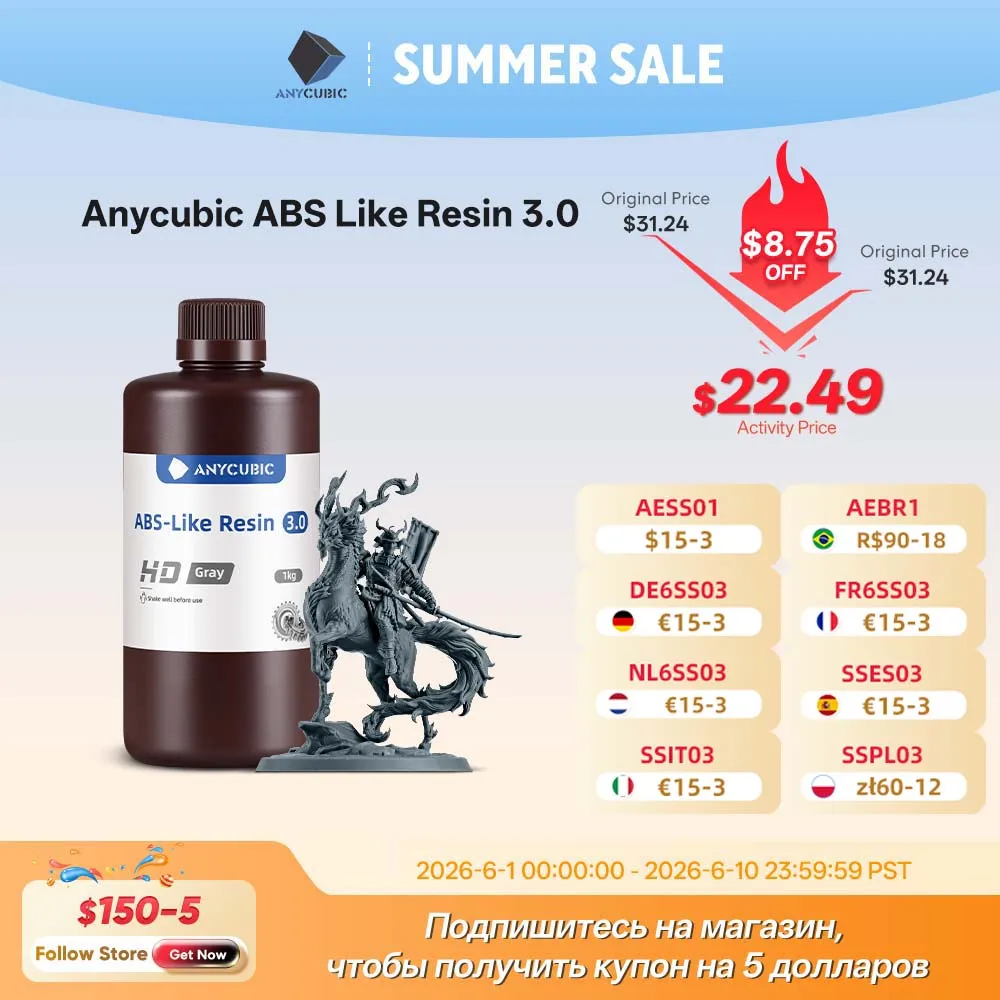
Official Store Deal
Expert Analysis Overview
Engineering Resilience and Fracture Resistance
The Anycubic ABS-Like Resin 3.0 is a formidable engineering-grade photopolymer designed for discerning LCD 3D printer users who prioritize mechanical integrity and dimensional accuracy. This resin distinguishes itself with a remarkable 30% elongation at break, a critical metric for parts that must withstand bending and stress without immediate fracture. Its Shore Hardness registers at an impressive 86D, indicating a high degree of rigidity and surface resistance to indentation. Furthermore, the material boasts an impact strength of 130 J/m, a figure that underscores its capacity to absorb sudden forces without catastrophic failure.
These mechanical properties translate directly into the production of highly durable, functional components. Parts printed with this resin can endure significant mechanical loads, making them suitable for applications beyond mere aesthetic models. The enhanced flexibility, evidenced by the 30% elongation, allows for a degree of give under pressure, which is invaluable for snap-fit enclosures, living hinges, or components subjected to repeated handling. This resin resists cracking. The high Shore Hardness ensures that printed surfaces maintain their form and resist scratches or deformation during use, crucial for prototypes that undergo rigorous testing or end-use parts requiring a robust exterior.
Unlike many standard photopolymer resins, which often exhibit brittle failure characteristics, the ABS-Like Resin 3.0 offers a significant upgrade in material performance. Generic resins frequently shatter or crack under minimal stress, rendering them unsuitable for functional prototypes or parts that require any degree of flexibility or impact absorption. This Anycubic formulation bridges that gap, providing a material that combines the high detail of resin printing with the mechanical robustness typically associated with injection-molded ABS plastics. It is a substantial improvement.
Precision Prototyping and Dimensional Stability
Dimensional accuracy is paramount in precision prototyping, and the Anycubic ABS-Like Resin 3.0 addresses this with a lower shrinkage rate. This characteristic is fundamental to ensuring that printed parts precisely match their digital CAD designs. The resin also facilitates the reproduction of high-level details and yields a smooth texture finish, directly contributing to the aesthetic and functional quality of the final print. These attributes are visible in intricate models, where fine features are retained without distortion.
Reduced shrinkage ensures that components intended for assembly fit together without modification, minimizing post-processing and rework. This is particularly vital for engineers and product designers creating complex mechanisms or multi-part enclosures where tight tolerances are non-negotiable. The ability to capture minute details means that even the most intricate textures, engravings, or small functional elements are accurately rendered. A smooth surface finish not only enhances the visual appeal of a print but also reduces friction in moving parts and simplifies any subsequent painting or finishing processes. It saves time.
Compared to generic resins, which can suffer from higher volumetric shrinkage, the Anycubic ABS-Like Resin 3.0 provides a distinct advantage. Higher shrinkage rates in other resins often lead to warping, curling, or inaccurate dimensions, especially in larger prints or those with thin walls. Such inconsistencies can render parts unusable for their intended purpose, leading to wasted material and printing time. This resin mitigates these common pitfalls, offering a more reliable and predictable printing experience for critical applications.
Optimized Workflow and User Experience
Beyond its mechanical properties, the Anycubic ABS-Like Resin 3.0 is engineered for an improved user experience, notably through its minimal odor formulation and lower viscosity. The reduction in volatile organic compounds (VOCs) contributes to a more pleasant working environment, a significant consideration for users operating printers in home studios or less industrial settings. The resin's low viscosity is another key feature, allowing for rapid resin reflow.
The minimal odor characteristic directly addresses one of the most common complaints associated with resin 3D printing: the strong, pervasive chemical smell. While proper ventilation remains essential, a low-odor resin makes the printing process less intrusive and more comfortable, particularly during longer print jobs. The lower viscosity of the resin translates into practical benefits for the printing workflow. It enables faster curing times, as the UV light penetrates the less viscous material more efficiently. Furthermore, the quick reflow ensures that the resin rapidly fills the vat after each layer, reducing delays and contributing to faster overall print cycles. This boosts productivity.
Many older or generic resin formulations are notorious for their pungent odors, often requiring extensive ventilation systems or dedicated print spaces. Their higher viscosity can also lead to slower print speeds, as the resin takes longer to settle and level in the vat between layers. The Anycubic ABS-Like Resin 3.0 represents a clear evolution in resin technology, offering a more user-friendly and efficient material. It streamlines the printing process. This material is designed to minimize common frustrations, allowing users to focus more on creation and less on managing environmental factors or print delays.
Material Compatibility and Application Versatility
This resin is specifically formulated for LCD 3D printers, ensuring optimal performance across a wide range of popular machines. Its robust properties, including high strength and crack resistance, extend its utility beyond mere visual models. The material is described as drillable, indicating that post-processing operations such as drilling, tapping, or sanding can be performed without compromising the structural integrity of the printed part. This expands the functional possibilities for prototypes and end-use components.
For users engaged in precision prototyping, the compatibility with LCD technology means access to high-resolution printing, which is crucial for intricate designs. The ability to drill and machine parts post-cure is a significant advantage for creating functional assemblies. Imagine producing a custom enclosure that requires mounting holes, or a jig that needs precise screw threads; this resin allows for such modifications without fear of the material cracking or chipping. This versatility makes it suitable for engineering prototypes, functional jigs and fixtures, durable miniatures, and even small-batch manufacturing of resilient parts. It is highly adaptable.
Unlike many general-purpose resins that might offer high detail but lack the mechanical strength for post-processing or functional use, the Anycubic ABS-Like Resin 3.0 provides a balanced solution. While some resins are too brittle for drilling, others might be too soft to hold fine details. This formulation strikes an effective balance, offering both high resolution and robust mechanical properties. It stands apart from basic resins. This makes it a superior choice for projects demanding both aesthetic quality and practical durability, providing a comprehensive material solution for diverse 3D printing needs.
Imagine the satisfaction of holding a perfectly replicated, durable prototype in your hand, knowing it will withstand rigorous testing. Picture your workshop, free from the overpowering fumes of traditional resins, allowing for longer, more focused creative sessions. Envision complex assemblies fitting together flawlessly, thanks to the resin's exceptional dimensional accuracy. This resin empowers creators to push the boundaries of what's possible with desktop 3D printing, transforming ideas into tangible, resilient realities with unparalleled precision and efficiency.