Anycubic ABS-Like Resin 2.0
Official Store Deal
Expert Analysis Overview
Anycubic ABS-Like Resin 2.0 is a robust photopolymer resin engineered for educational and prototyping environments demanding both durability and ease of use. This second-generation formulation addresses common frustrations in 3D printing, offering a more resilient and user-friendly material for creators and students alike. It aims to simplify the often-complex resin printing workflow, making advanced fabrication accessible.
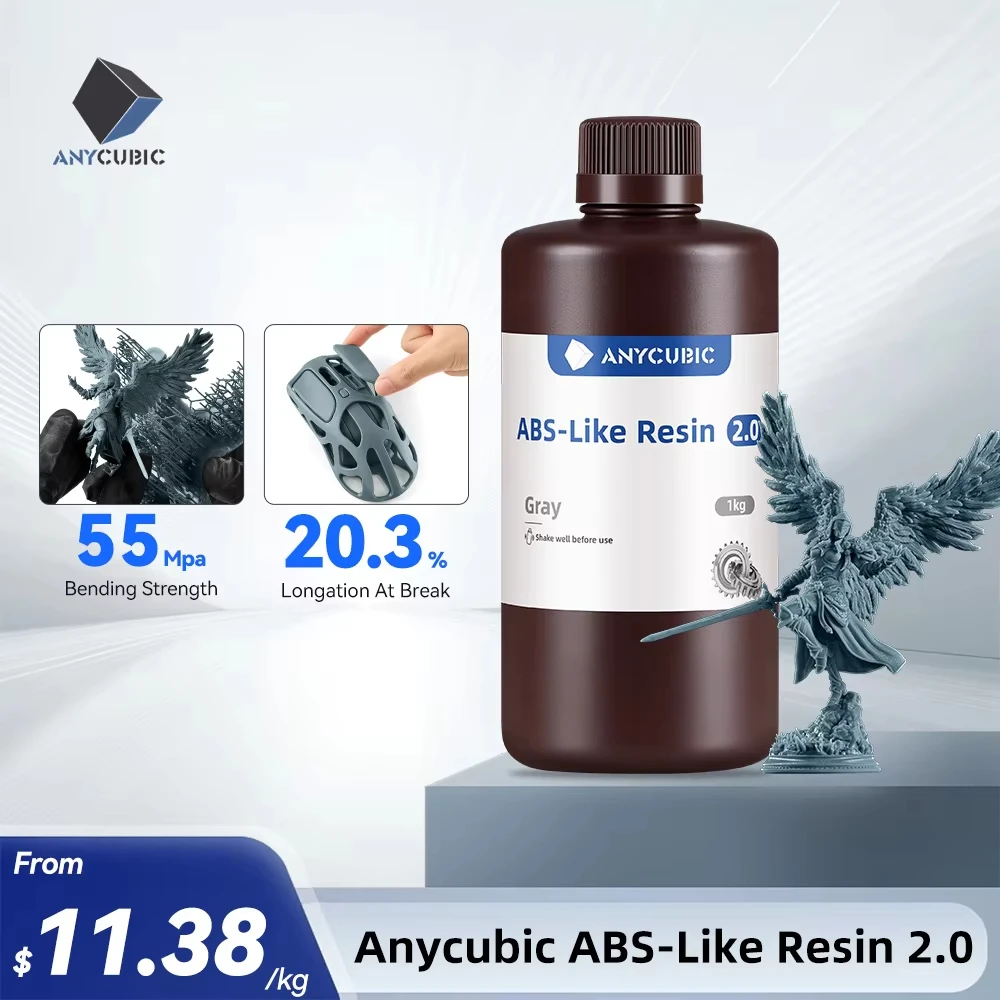
This resin is specifically formulated to be stronger, tougher, and more wear-resistant than previous iterations. The material exhibits a bending strength of 55 Mpa. This metric indicates the material's resistance to deformation under stress, crucial for parts that might experience mechanical loads.
For students learning about material science and engineering, understanding how a print withstands force is vital. A higher bending strength means less likelihood of parts snapping during post-processing or functional use. This is a significant improvement over standard resins, which often produce brittle objects that break easily, leading to frustration and wasted material in a classroom setting.
The resin also boasts a 20.3% elongation at break. This property signifies the material's ability to stretch or deform plastically before fracturing. It bends, not breaks.
Such flexibility is invaluable for functional prototypes or parts requiring some give, like snap-fit enclosures or hinges. Imagine a student designing a drone component; the ability for the material to absorb impact without immediate failure extends the lifespan of their creation. Generic resins often lack this elasticity, resulting in rigid, unforgiving prints that are prone to sudden failure under minimal stress, hindering iterative design processes.
Durability is further underscored by a hardness rating of 83-85HD. This measurement reflects the material's resistance to indentation and scratching. High hardness means prints maintain their surface integrity longer.
In a workshop or classroom, prints are handled frequently. This resin's hardness ensures that models resist wear and tear from repeated interaction, maintaining their aesthetic and functional quality. Many entry-level resins scratch easily, quickly degrading the appearance and precision of printed objects, which can be disheartening for new users.
The formulation is engineered for both speed and detail. It features a low viscosity of 283 mPa.s. This low viscosity allows the resin to flow quickly and smoothly, reducing wait times between layers.
Rapid flow minimizes the chances of air bubbles getting trapped during printing, which can cause imperfections or print failures. This characteristic is particularly beneficial when printing intricate models where consistent resin distribution is critical for fine details. Thicker, higher viscosity resins often struggle with bubble dissipation, leading to pockmarks and voids that compromise print quality and structural integrity.
Superior adhesion is also a key benefit, designed to minimize print failures. The resin's properties ensure that layers bond effectively, creating a cohesive and strong final product. This prevents common issues like layer separation or parts detaching from the build plate prematurely.
Reliable adhesion translates directly to higher print success rates, which is paramount for educational environments where consistent results encourage learning and experimentation. Unlike resins with poor adhesion, which can lead to frequent failed prints and wasted time, this formulation promotes a more dependable printing experience.
Prints exhibit a fine tolerance of ±0.15mm, with digital caliper measurements confirming precision down to 0.05mm. This level of accuracy is crucial for creating parts that require exact dimensions or need to fit together perfectly in multi-component assemblies. Complex mechanical parts can be produced with confidence.
For engineering students, learning to design and print parts with tight tolerances is a fundamental skill. This resin supports that learning by allowing for highly precise outputs, enabling the creation of functional prototypes with accurate fitment. Less precise resins often result in parts that require significant post-processing to fit, adding unnecessary complexity and time to projects.
The Anycubic ABS-Like Resin 2.0 integrates seamlessly with Photon Workshop, Anycubic's official slicing software. This software comes pre-configured with optimal settings specifically for Anycubic resins. This eliminates the tedious manual tuning often required with generic slicing programs.
An intuitive slicing process is critical for reducing the learning curve for beginners and ensuring consistent success rates. Students can focus on design and conceptualization rather than wrestling with complex software parameters. Standard slicers can be overwhelming for new users, demanding extensive trial-and-error to find suitable settings, which often leads to failed prints and frustration.
The pre-configured settings ensure high print success rates and exceptional model quality right out of the box. This means less time troubleshooting and more time creating. The software simplifies the entire process.
This streamlined approach empowers educators to introduce 3D printing without the common pitfalls associated with complex setup procedures. It allows for a more direct and rewarding learning experience. Many resins require specific, often undocumented, settings for optimal performance, turning the printing process into a guessing game for users. This resin and software combination removes that barrier.
While resin 3D printing offers incredible detail, safe handling is always a priority, especially in classrooms. The resin comes in a secure, opaque bottle designed to protect it from UV light exposure, which can prematurely cure the material. Proper storage is simple.
Educators can easily store the resin in a cool, dark place, minimizing risks associated with accidental exposure. This prevents material degradation and maintains resin quality over time. Generic containers might not offer the same level of UV protection, leading to reduced shelf life and inconsistent print results.
When handling the resin, standard personal protective equipment (PPE) is recommended. This includes gloves and eye protection. Ensuring a well-ventilated area for printing and post-processing is also crucial. These are basic safety practices.
Implementing these simple safety measures creates a secure learning environment for students exploring additive manufacturing. It teaches responsible handling of chemicals from the outset. Unlike casual crafting materials, resins require a disciplined approach to safety, which this product implicitly supports through its usage context.
Investing in a high-quality resin like the Anycubic ABS-Like Resin 2.0 offers significant long-term value, particularly in educational or prototyping contexts. The enhanced durability and reduced print failure rates mean less wasted material and fewer re-prints. This saves both time and resources.
Consider the cost per successful print rather than just the initial bottle price. A resin that consistently produces high-quality, durable parts without repeated failures is ultimately more economical. Cheaper, less reliable resins often lead to a higher overall cost due to frequent failed prints and the need for replacements.
Imagine a classroom where students are confidently printing complex architectural models or functional robot parts, knowing their creations will withstand handling and use. The ease of use, combined with the material's strength, allows for a focus on design innovation rather than troubleshooting. This resin fosters a creative and productive learning environment.
Students can iterate on designs quickly, testing physical prototypes that accurately reflect their digital models. The ability to produce robust, precise components with minimal hassle accelerates the learning process and builds confidence in their engineering skills. This resin enables practical, hands-on learning that prepares students for real-world design challenges.
Even with advanced resins, occasional issues can arise. Understanding basic troubleshooting steps helps maintain print success. If prints are failing to adhere to the build plate, ensure the plate is clean and properly leveled. A clean surface provides better grip.
If parts are exhibiting layer separation, verify that the resin is thoroughly mixed and that the ambient temperature is within the recommended range for optimal curing. Temperature consistency matters. Small variations can impact layer bonding.
Should prints appear brittle or soft after curing, confirm that the post-curing process is adequate. Proper UV exposure is essential for maximizing the resin's mechanical properties. Undercuring or overcuring can both lead to suboptimal results.
If fine details are lost or surfaces are rough, check the slicer settings to ensure correct exposure times and lift speeds. These parameters directly influence print resolution. Adjusting these can significantly improve surface finish.
Finally, if bubbles are consistently appearing in prints, gently stir the resin in the vat before printing to release any trapped air. Allow it to settle for a few minutes. This simple step often resolves bubble-related defects.
Imagine a workshop where every student's design comes to life with remarkable fidelity and strength. Picture functional prototypes that withstand rigorous testing, inspiring further innovation. Envision intricate models that capture every nuance of artistic vision, free from the common frustrations of brittle materials or failed prints. This resin empowers educators to teach advanced manufacturing techniques with confidence, knowing that the tools support the learning process, not hinder it. It's about enabling a future generation of creators to build, test, and innovate without limits, transforming digital designs into tangible realities with ease and reliability.
Engineering for Enhanced Resilience
This resin is specifically formulated to be stronger, tougher, and more wear-resistant than previous iterations. The material exhibits a bending strength of 55 Mpa. This metric indicates the material's resistance to deformation under stress, crucial for parts that might experience mechanical loads.
For students learning about material science and engineering, understanding how a print withstands force is vital. A higher bending strength means less likelihood of parts snapping during post-processing or functional use. This is a significant improvement over standard resins, which often produce brittle objects that break easily, leading to frustration and wasted material in a classroom setting.
The resin also boasts a 20.3% elongation at break. This property signifies the material's ability to stretch or deform plastically before fracturing. It bends, not breaks.
Such flexibility is invaluable for functional prototypes or parts requiring some give, like snap-fit enclosures or hinges. Imagine a student designing a drone component; the ability for the material to absorb impact without immediate failure extends the lifespan of their creation. Generic resins often lack this elasticity, resulting in rigid, unforgiving prints that are prone to sudden failure under minimal stress, hindering iterative design processes.
Durability is further underscored by a hardness rating of 83-85HD. This measurement reflects the material's resistance to indentation and scratching. High hardness means prints maintain their surface integrity longer.
In a workshop or classroom, prints are handled frequently. This resin's hardness ensures that models resist wear and tear from repeated interaction, maintaining their aesthetic and functional quality. Many entry-level resins scratch easily, quickly degrading the appearance and precision of printed objects, which can be disheartening for new users.
Precision in Every Layer
The formulation is engineered for both speed and detail. It features a low viscosity of 283 mPa.s. This low viscosity allows the resin to flow quickly and smoothly, reducing wait times between layers.
Rapid flow minimizes the chances of air bubbles getting trapped during printing, which can cause imperfections or print failures. This characteristic is particularly beneficial when printing intricate models where consistent resin distribution is critical for fine details. Thicker, higher viscosity resins often struggle with bubble dissipation, leading to pockmarks and voids that compromise print quality and structural integrity.
Superior adhesion is also a key benefit, designed to minimize print failures. The resin's properties ensure that layers bond effectively, creating a cohesive and strong final product. This prevents common issues like layer separation or parts detaching from the build plate prematurely.
Reliable adhesion translates directly to higher print success rates, which is paramount for educational environments where consistent results encourage learning and experimentation. Unlike resins with poor adhesion, which can lead to frequent failed prints and wasted time, this formulation promotes a more dependable printing experience.
Prints exhibit a fine tolerance of ±0.15mm, with digital caliper measurements confirming precision down to 0.05mm. This level of accuracy is crucial for creating parts that require exact dimensions or need to fit together perfectly in multi-component assemblies. Complex mechanical parts can be produced with confidence.
For engineering students, learning to design and print parts with tight tolerances is a fundamental skill. This resin supports that learning by allowing for highly precise outputs, enabling the creation of functional prototypes with accurate fitment. Less precise resins often result in parts that require significant post-processing to fit, adding unnecessary complexity and time to projects.
Streamlined Workflow for Learning
The Anycubic ABS-Like Resin 2.0 integrates seamlessly with Photon Workshop, Anycubic's official slicing software. This software comes pre-configured with optimal settings specifically for Anycubic resins. This eliminates the tedious manual tuning often required with generic slicing programs.
An intuitive slicing process is critical for reducing the learning curve for beginners and ensuring consistent success rates. Students can focus on design and conceptualization rather than wrestling with complex software parameters. Standard slicers can be overwhelming for new users, demanding extensive trial-and-error to find suitable settings, which often leads to failed prints and frustration.
The pre-configured settings ensure high print success rates and exceptional model quality right out of the box. This means less time troubleshooting and more time creating. The software simplifies the entire process.
This streamlined approach empowers educators to introduce 3D printing without the common pitfalls associated with complex setup procedures. It allows for a more direct and rewarding learning experience. Many resins require specific, often undocumented, settings for optimal performance, turning the printing process into a guessing game for users. This resin and software combination removes that barrier.
Safe Operation in Educational Settings
While resin 3D printing offers incredible detail, safe handling is always a priority, especially in classrooms. The resin comes in a secure, opaque bottle designed to protect it from UV light exposure, which can prematurely cure the material. Proper storage is simple.
Educators can easily store the resin in a cool, dark place, minimizing risks associated with accidental exposure. This prevents material degradation and maintains resin quality over time. Generic containers might not offer the same level of UV protection, leading to reduced shelf life and inconsistent print results.
When handling the resin, standard personal protective equipment (PPE) is recommended. This includes gloves and eye protection. Ensuring a well-ventilated area for printing and post-processing is also crucial. These are basic safety practices.
Implementing these simple safety measures creates a secure learning environment for students exploring additive manufacturing. It teaches responsible handling of chemicals from the outset. Unlike casual crafting materials, resins require a disciplined approach to safety, which this product implicitly supports through its usage context.
The Value Proposition in Practice
Investing in a high-quality resin like the Anycubic ABS-Like Resin 2.0 offers significant long-term value, particularly in educational or prototyping contexts. The enhanced durability and reduced print failure rates mean less wasted material and fewer re-prints. This saves both time and resources.
Consider the cost per successful print rather than just the initial bottle price. A resin that consistently produces high-quality, durable parts without repeated failures is ultimately more economical. Cheaper, less reliable resins often lead to a higher overall cost due to frequent failed prints and the need for replacements.
Imagine a classroom where students are confidently printing complex architectural models or functional robot parts, knowing their creations will withstand handling and use. The ease of use, combined with the material's strength, allows for a focus on design innovation rather than troubleshooting. This resin fosters a creative and productive learning environment.
Students can iterate on designs quickly, testing physical prototypes that accurately reflect their digital models. The ability to produce robust, precise components with minimal hassle accelerates the learning process and builds confidence in their engineering skills. This resin enables practical, hands-on learning that prepares students for real-world design challenges.
Troubleshooting Common Printing Issues
Even with advanced resins, occasional issues can arise. Understanding basic troubleshooting steps helps maintain print success. If prints are failing to adhere to the build plate, ensure the plate is clean and properly leveled. A clean surface provides better grip.
If parts are exhibiting layer separation, verify that the resin is thoroughly mixed and that the ambient temperature is within the recommended range for optimal curing. Temperature consistency matters. Small variations can impact layer bonding.
Should prints appear brittle or soft after curing, confirm that the post-curing process is adequate. Proper UV exposure is essential for maximizing the resin's mechanical properties. Undercuring or overcuring can both lead to suboptimal results.
If fine details are lost or surfaces are rough, check the slicer settings to ensure correct exposure times and lift speeds. These parameters directly influence print resolution. Adjusting these can significantly improve surface finish.
Finally, if bubbles are consistently appearing in prints, gently stir the resin in the vat before printing to release any trapped air. Allow it to settle for a few minutes. This simple step often resolves bubble-related defects.
Cultivating Innovation with Reliable Tools
Imagine a workshop where every student's design comes to life with remarkable fidelity and strength. Picture functional prototypes that withstand rigorous testing, inspiring further innovation. Envision intricate models that capture every nuance of artistic vision, free from the common frustrations of brittle materials or failed prints. This resin empowers educators to teach advanced manufacturing techniques with confidence, knowing that the tools support the learning process, not hinder it. It's about enabling a future generation of creators to build, test, and innovate without limits, transforming digital designs into tangible realities with ease and reliability.