ANENG SZ308+B15 Digital Multimeter & Voltage Detector
Official Store Deal
Expert Analysis Overview
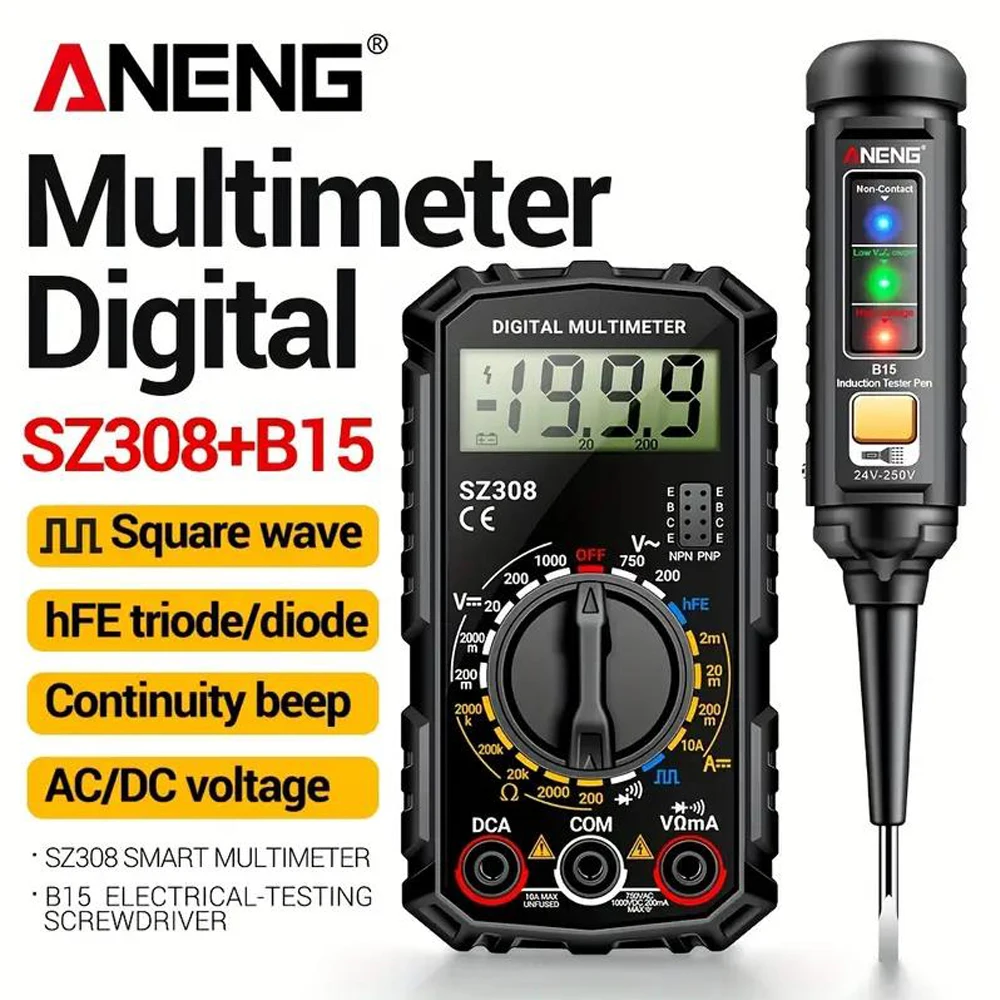
The ANENG SZ308+B15 Digital Multimeter & Voltage Detector is a practical measurement solution designed for electricians, hobbyists, and DIY enthusiasts requiring fundamental electrical diagnostic capabilities. This combination package offers both a versatile digital multimeter and a dedicated non-contact voltage tester, addressing common electrical troubleshooting needs with a focus on accessibility and utility.Precision in Electrical MeasurementThe ANENG SZ308 digital multimeter presents a 1999-count display, a standard resolution for entry-level to mid-range handheld devices. This count dictates the maximum numerical value the meter can display before requiring a range change, directly influencing the precision of readings. For instance, when set to a 20V range, the device can display values up to 19.99V, offering a resolution of 0.01V. Similarly, in a 200V range, it would display up to 199.9V with a 0.1V resolution. This granular display capability ensures that minor fluctuations or specific voltage levels are discernible.This resolution is generally sufficient for most residential, automotive, and basic electronics work, where precise measurements down to millivolts or microvolts are often not the primary concern. Users can confidently assess battery voltages, check continuity in household wiring, or diagnose basic circuit faults with a reasonable degree of accuracy. The clarity of the large, segmented LCD digits ensures readings are easily discernible even in varied lighting conditions, reducing the potential for misinterpretation during critical tasks. The display's refresh rate appears adequate for stable readings.Compared to older analog multimeters, which rely on a moving needle and can be prone to parallax errors, a digital multimeter like the SZ308 provides unambiguous numerical readouts, eliminating subjective interpretation. While it does not offer the ultra-high resolution of a 20,000-count or 60,000-count professional instrument, which might be necessary for sensitive laboratory work or advanced industrial process control, its 1999-count capability significantly surpasses the basic "go/no-go" indication of simpler continuity testers, providing actual quantitative data that is actionable for troubleshooting. This makes it a substantial upgrade from basic test lights.
(DC Voltage), indicating a manual ranging operation. This design choice requires the user to actively select the appropriate voltage scale before measurement, which, while adding a preliminary step, ensures the meter is operating within its optimal accuracy band for the chosen range. This manual selection can also prevent the meter from "auto-ranging" into an incorrect or unstable reading in noisy environments.Measuring AC voltage is crucial for verifying power supply integrity in wall outlets, household appliances, and industrial machinery, ensuring that equipment receives the correct operating voltage. Conversely, DC voltage measurement is essential for battery testing, diagnosing automotive electrical systems, and troubleshooting low-voltage electronic circuits found in consumer devices. The ability to switch between these modes quickly and reliably makes the device adaptable to a diverse array of measurement scenarios, from checking a car battery to verifying a power adapter's output. The input impedance for voltage measurements is typically high, minimizing circuit loading.In contrast to auto-ranging multimeters that automatically select the optimal range, manual ranging units like the SZ308 often offer a slightly lower price point and can sometimes be preferred by experienced technicians who value direct control over the measurement scale. This direct control can prevent the meter from "hunting" for the correct range, potentially speeding up repetitive measurements once the user is familiar with the circuit's approximate values. For educational purposes, manual ranging also helps users understand the concept of measurement scales.The multimeter also includes DCA (DC Amps) measurement capabilities, a critical function for assessing current flow. Current measurement is vital for diagnosing circuit overloads, checking the current draw of individual components, and verifying proper current flow in DC circuits, such as those found in battery-powered devices or vehicle electrical systems. The dedicated DCA input jack, separate from the voltage/resistance input, is a standard safety feature, preventing accidental short circuits when measuring current by ensuring the meter is configured correctly for a low-impedance measurement.Accurate current measurement helps in identifying parasitic draws in vehicle electrical systems that can drain batteries, or ensuring that electronic components are operating within their specified current limits to prevent damage. Without this function, diagnosing issues related to excessive power consumption or component failure due to overcurrent would be significantly more challenging, often leading to guesswork. The inclusion of DCA, rather than just voltage and resistance, positions the SZ308 as a more comprehensive diagnostic tool than many basic continuity or voltage-only testers.Compared to clamp meters, which offer non-contact current measurement by sensing the magnetic field around a conductor, the SZ308 requires the circuit to be broken and the meter inserted in series with the load. This method, while more intrusive and requiring careful circuit interruption, often provides higher accuracy for lower DC current measurements, making it suitable for precise diagnostics where the circuit can be safely interrupted and a direct measurement is preferred over an inductive approximation.### Resistance and Continuity VerificationResistance measurement (Ohm) is another core function of the ANENG SZ308, allowing users to check the integrity of wires, heating elements, and various resistive components. The ability to measure resistance helps in identifying open circuits (infinite resistance), short circuits (near-zero resistance), or components that have drifted out of tolerance due to age or damage. This is a quick and effective way to diagnose issues in passive components before applying power.The continuity beep function is particularly useful for quickly checking if a circuit path is complete or broken. A rapid audible tone indicates a low-resistance path, signifying continuity, which is invaluable for tracing wires or verifying connections. This feature saves considerable time compared to watching the numerical display for a zero-ohm reading, especially when tracing long wires, checking multiple connections in a wiring harness, or verifying solder joints on a PCB. It is an indispensable tool for wiring installations, cable testing, and general circuit troubleshooting.Many basic electrical testers only offer a simple continuity light, providing a binary "yes/no" indication. The SZ308's audible beep, combined with a numerical resistance reading, provides both the speed of an immediate alert and quantitative data for more detailed analysis. This dual feedback mechanism enhances diagnostic efficiency, allowing for both rapid checks of multiple points and more detailed analysis when a specific resistance value is required. This combination offers superior diagnostic depth.### Specialized Diagnostic FunctionsBeyond standard electrical measurements, the ANENG SZ308 integrates several specialized functions that significantly enhance its utility for electronics work. The square wave output capability, as depicted in the visual data, allows the multimeter to generate a basic square wave signal. This feature is invaluable for testing audio circuits, digital logic gates, or as a simple clock source for troubleshooting microcontrollers and other digital systems.Generating a square wave enables the user to inject a known signal into a circuit and observe its response using an oscilloscope or another diagnostic tool. This diagnostic method helps in verifying signal path integrity, testing frequency response of amplifiers, and confirming component functionality in active circuits. It transforms the multimeter from a purely passive measurement device into an active diagnostic instrument, expanding its role in a technician's toolkit.Compared to dedicated function generators, the square wave output from a multimeter is typically fixed in frequency and amplitude, offering basic utility rather than comprehensive signal generation. However, for quick checks, simple signal injection tasks, or verifying basic digital circuit operation, it eliminates the need for additional specialized equipment, making the SZ308 a more versatile and cost-effective tool for electronics enthusiasts and students.The hFE triode/diode test function is another specialized capability, specifically for analyzing semiconductor components like transistors and diodes. The hFE test measures the DC current gain of bipolar junction transistors (BJTs), indicating their amplification capability. This is crucial for verifying transistor health, identifying faulty components, and even matching components in sensitive amplifier circuits where gain consistency is important.The diode test function applies a small current across a diode and measures the forward voltage drop, allowing users to determine if the diode is functioning correctly (exhibiting a typical voltage drop, e.g., 0.6-0.7V for silicon), or if it is open (infinite resistance) or shorted (near-zero resistance). This is a quick and effective way to diagnose semiconductor components without complex setups. The dedicated socket for transistor testing simplifies the process, ensuring proper pin alignment and reliable contact.Many entry-level multimeters omit these component testing functions, limiting their utility for electronics repair or design. The inclusion of hFE and diode testing positions the SZ308 as a more capable tool for those working with discrete electronic components, offering insights beyond simple voltage and resistance checks and enabling more thorough component-level diagnostics.## The ANENG B15 Voltage Detector PenComplementing the multimeter is the ANENG B15 electrical testing screwdriver, a non-contact voltage detector and breakpoint finder. This pen-style device is designed for rapid, preliminary electrical checks without the need for direct circuit contact, significantly enhancing user safety. Its primary function is to identify the presence of AC voltage in wires, outlets, and circuit breakers, providing an immediate indication of live circuits.The B15 utilizes clear LED indicators (green for zero line, red for fire/live wire) to visually communicate the presence and type of voltage detected. This visual feedback is augmented by an audible beep, providing a clear and unmistakable indication of live circuits, even in noisy environments. The "touch pole" on the side of the pen is an integral part of its operation, requiring user contact to complete the detection circuit and ensure accurate readings.This non-contact method significantly enhances safety, allowing users to quickly identify potentially live wires or components before making physical contact with test leads or beginning work. It is an indispensable tool for initial safety checks in electrical installations, when troubleshooting unknown circuits, or before performing maintenance. The pen's compact, pocket-friendly form factor makes it highly portable and always ready for immediate use.### Breakpoint Detection and Line TracingA standout feature of the B15 is its breakpoint finder capability. This function allows users to trace a live wire and identify the exact point where continuity is lost, indicating a break in the cable. As the pen moves along a live wire, its internal sensor detects the electromagnetic field, causing its LED to remain illuminated; when it passes over a break in the conductor, the field dissipates, and the light will extinguish. This provides a precise location for the fault.This diagnostic capability is particularly useful for identifying hidden breaks in insulated wires, such as those embedded in walls, under flooring, or within appliance cords, without needing to strip the insulation or perform destructive testing. It saves considerable time and effort in troubleshooting intermittent faults or complete circuit failures, making it an invaluable tool for electricians and home inspectors. The precision of this detection is critical for efficient repair.Compared to traditional methods of fault finding, which might involve cutting and testing sections of wire or using more complex cable tracers, the B15's breakpoint finder offers a non-destructive, efficient, and straightforward solution. This feature alone adds significant value for electricians and maintenance personnel dealing with complex wiring systems, streamlining the diagnostic process and reducing labor.## Ergonomics and Durability ConsiderationsThe ANENG SZ308 multimeter features a ruggedized design, evident from its visible rubberized casing that encases the main unit. This protective shell is engineered to absorb impacts from accidental drops and provide a secure grip, a common occurrence in demanding field environments. The robust construction suggests a strong focus on durability, ensuring the device can withstand the rigors of daily use in workshops, job sites, or home garages.The large, clear LCD display is another key ergonomic consideration, providing excellent readability of measurement values from various angles. The rotary dial is prominently positioned, appears to have distinct, tactile detents, allowing for precise function selection even when wearing work gloves. The test lead ports are clearly labeled with their respective functions (DCA, COM, VΩmA), minimizing connection errors and enhancing user safety.While the B15 voltage detector is a simpler device, its pen-style form factor is inherently ergonomic, fitting comfortably in the hand for extended use. The placement of the touch pole and LED indicators is intuitive, facilitating quick and accurate operation without requiring complex maneuvers. Both devices prioritize user-friendliness and practical design in their physical construction.## Accuracy, Resolution, and CalibrationAs a metrologist, the primary concern revolves around the accuracy and repeatability of measurements. The 1999-count display of the SZ308 indicates a specific level of resolution, which directly impacts the granularity of readings. For example, when measuring 120V AC, the display would show "120.0V", implying a resolution of 0.1V. When measuring 12V DC, it would show "12.00V", implying 0.01V resolution. This resolution is generally adequate for common electrical work, providing sufficient detail for most diagnostic tasks without being overly sensitive to minor noise.Repeatable results are crucial for reliable diagnostics and building confidence in the instrument. The design of the rotary switch, the quality of the internal components, and the stability of the measurement circuitry directly influence measurement consistency. While specific accuracy specifications (e.g., ±% of reading + counts) are not explicitly visible in the provided images, the device's category suggests it will meet general industry standards for basic multimeters. Consistent readings across multiple tests of the same parameter are expected, allowing users to trust their diagnostic conclusions.The absence of explicit mention regarding calibration certification is a common characteristic for consumer-grade and entry-level professional tools. For applications requiring certified traceability, such as industrial process control, scientific research, or legal metrology, a device with documented and traceable calibration would be necessary. For general troubleshooting, however, the inherent accuracy of the device as manufactured is typically sufficient. Users requiring higher confidence in their measurements for critical applications might consider independent calibration services to verify its performance against known standards.The B15 voltage detector, while not providing quantitative measurements, offers a binary indication of voltage presence. Its accuracy lies in its ability to reliably distinguish between live and non-live conductors without false positives or negatives. The 24-250V range indicates its operational envelope, ensuring it functions across common residential and light commercial voltages, providing a reliable safety check across a broad spectrum of applications.## Value Proposition and Market PositioningThis ANENG SZ308+B15 combination positions itself as a highly cost-effective solution for individuals needing both a general-purpose multimeter and a dedicated voltage detector. The bundled approach offers significant convenience and potential savings compared to purchasing two separate devices, streamlining the acquisition process for essential tools. Its feature set, including square wave output and hFE testing, extends its utility beyond basic electrical checks into fundamental electronics work, making it a versatile asset.For students learning electronics, apprentices entering the electrical trade, or homeowners tackling DIY electrical projects, this kit provides a robust and accessible starting point. The inclusion of the B15 pen significantly enhances safety during initial circuit assessments, a critical factor for less experienced users who might be unfamiliar with live circuits. The ruggedized design also suggests a longer operational lifespan, contributing to its overall value by reducing the need for frequent replacements.Unlike many generic, unbranded testers that might offer questionable reliability or inconsistent performance, the ANENG brand has established a recognizable presence in the affordable test equipment market. This suggests a baseline level of quality, manufacturing consistency, and potential after-sales support. The comprehensive feature set at its price point makes it a compelling alternative to more expensive professional-grade equipment when extreme precision, advanced data logging, or certified calibration are not primary requirements. It offers a strong return on investment for its intended use cases.Imagine the confidence gained when quickly identifying a live wire before beginning work, ensuring personal safety and preventing accidental damage. Picture the efficiency of tracing a hidden fault in a wall or appliance cord without destructive testing, saving time and material costs. Envision the ease of verifying component functionality in a hobby electronics project, all with a single, reliable, and user-friendly kit. This ANENG package empowers users to approach electrical tasks with greater safety, enhanced diagnostic capability, and improved efficiency, transforming uncertainty into informed and effective action.