ANENG GN102 Digital Sound Level Meter
Official Store Deal
Expert Analysis Overview
Precision Acoustic Monitoring: The ANENG GN102 Decibel Meter
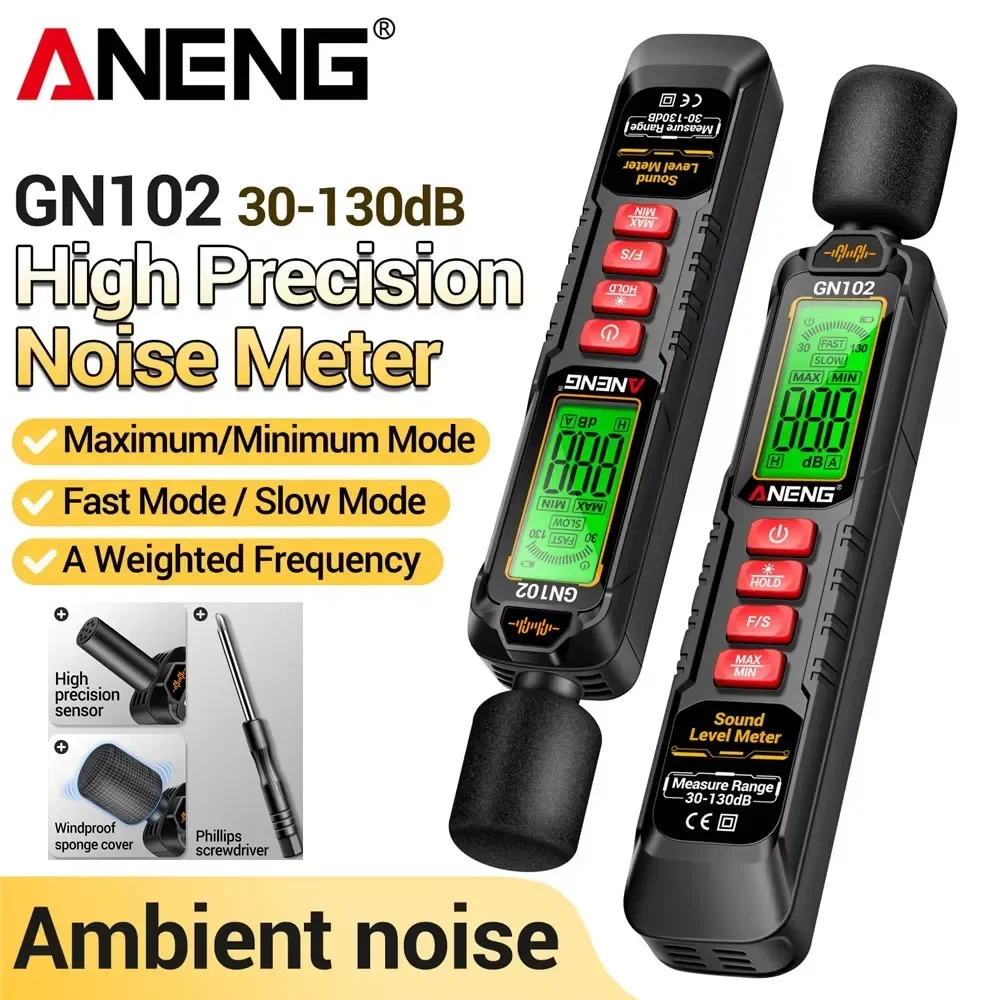
The ANENG GN102 is a compact, high-precision digital sound level meter engineered for accurate ambient noise assessment across diverse environments. This device targets professionals and enthusiasts requiring reliable decibel measurements for environmental monitoring, industrial safety, and personal comfort analysis. Its design prioritizes portability and ease of use, making it an accessible tool for various acoustic measurement tasks.
Calibrated Accuracy and Resolution
The GN102 specifies a measuring range of 30-130dB, a broad spectrum covering everything from quiet whispers to loud industrial machinery. This range is critical for comprehensive environmental noise assessments. The device's stated noise accuracy is +/
For metrological applications, a +/
Compared to basic smartphone applications that often provide uncalibrated and highly variable sound level estimations, the GN102 offers a dedicated sensor and specified accuracy. This distinction positions it as a more reliable instrument for any task demanding consistent and verifiable acoustic data. The dedicated hardware ensures that environmental factors like phone case acoustics or internal microphone quality do not unduly influence readings.
Operational Modes and Frequency Weighting
This sound level meter incorporates both Fast Mode (125ms sample rate) and Slow Mode (1Sec sample rate). These distinct sampling rates cater to different types of noise analysis. Fast Mode captures transient noise events, such as sudden impacts or short bursts of sound, providing a rapid response to fluctuating acoustic conditions. Slow Mode, conversely, offers a more averaged reading, smoothing out rapid fluctuations to provide a stable measurement of continuous noise. This is particularly useful for assessing steady-state noise levels over time.
If monitoring machinery with intermittent operation, Fast Mode would capture peak noise levels. For evaluating ambient background noise in an office, Slow Mode would yield a more representative average. The ability to switch between these modes enhances the meter's adaptability to various measurement scenarios. This dual-mode functionality is a significant upgrade over single-mode devices, which often force a compromise between responsiveness and stability in readings.
The GN102 features A-weighted frequency response, a crucial aspect for human perception of loudness. A-weighting filters the sound spectrum to mimic the human ear's sensitivity at different frequencies, making the measured decibel value more representative of how loud a sound is perceived by people. The frequency response range is specified as 30Hz-8KHz, covering most audible frequencies relevant to environmental and occupational noise. This ensures that the measurements correlate well with human auditory experience.
Without A-weighting, a sound level meter would treat all frequencies equally, which does not align with how humans perceive sound. For instance, very low or very high frequencies, while present, contribute less to perceived loudness. The inclusion of A-weighting makes the GN102 suitable for applications like assessing noise pollution in residential areas or ensuring compliance with workplace noise exposure limits, where human hearing is the primary concern. This feature elevates the device beyond a simple sound pressure gauge, making it a tool for human-centric acoustic analysis.
Ergonomics and Portability
The device's physical form factor is notably compact, with a weight of 53g. This minimal mass ensures effortless portability, allowing users to carry it in a pocket or tool bag without inconvenience. The ABS material construction suggests a balance between durability and lightweight design. The visual input indicates a slender, pen-like form factor, which facilitates single-handed operation. The inclusion of a backlit bright screen ensures readability in various lighting conditions, from dimly lit workshops to bright outdoor environments. This is a practical consideration for field use.
Its small size means it can be deployed discreetly for monitoring, or easily transported between different measurement points. The red control buttons are visually distinct and appear to be tactile, suggesting positive feedback upon actuation. The design prioritizes functional accessibility. Compared to bulkier, more traditional sound level meters, the GN102's compact design reduces user fatigue during extended measurement sessions and simplifies storage. This makes it an ideal choice for mobile professionals.
Application Versatility
The ANENG GN102 is depicted in various application scenarios, including residential environments, workshops, offices, libraries, and for household appliances. This broad range of depicted uses underscores its versatility. In a residential setting, it can identify sources of noise pollution, such as loud neighbors or malfunctioning appliances. For workshop environments, it assists in monitoring noise levels to ensure worker safety and compliance with occupational health standards. The ability to measure noise from household appliances helps in identifying quieter models or diagnosing issues.
If you are a facilities manager, this meter could quickly assess noise levels in different office zones to optimize acoustic comfort. In a library, it could verify that ambient noise remains within acceptable limits for concentration. The visual examples demonstrate its utility in both professional and personal contexts, highlighting its adaptability. This wide applicability makes the GN102 a valuable tool for anyone needing to quantify sound levels in their daily life or work, offering a practical solution for diverse acoustic challenges.
Data Interpretation and Retention
The meter features data retention (HOLD function), allowing users to freeze the current reading on the display. This is invaluable when taking measurements in difficult-to-access locations or when needing to record a specific peak value. The Maximum/Minimum mode further enhances data analysis by displaying the highest and lowest decibel readings recorded during a measurement session. This provides a quick overview of the noise level variability without constant monitoring. An undervoltage indication ensures that battery levels are monitored, preventing inaccurate readings due to low power.
For instance, when assessing a fluctuating noise source, the Max/Min function immediately reveals the range of sound pressure levels encountered. This eliminates the need for manual observation of peak and trough values. The automatic shutdown after approximately 15 minutes of inactivity conserves battery life, a practical feature for a portable device. This intelligent power management extends operational time between battery replacements. These data handling features streamline the measurement process, providing more comprehensive insights than a simple instantaneous reading.
The Metrologist's Perspective
From a metrological standpoint, the ANENG GN102 presents itself as a functional entry-level to mid-range sound level meter. Its specified accuracy of +/
Imagine the clarity and control gained when you can precisely quantify the noise levels in your environment. Visualize effortlessly identifying the source of an irritating hum, or confidently verifying the effectiveness of soundproofing efforts. This meter empowers users with objective data, transforming subjective perceptions of loudness into measurable, actionable insights, fostering quieter, more productive spaces. The ANENG GN102 provides the capability to make informed decisions about your acoustic surroundings, ensuring peace of mind and improved well-being. This is not merely a gadget; it is a tool for environmental mastery.