ANENG BT-173 Digital Battery Detector
Official Store Deal
Expert Analysis Overview
The ANENG BT-173 is a compact, multi-chemistry battery diagnostic tool engineered for rapid and precise voltage assessment across a broad spectrum of power cells. This device targets hobbyists, field technicians, and anyone requiring quick, reliable battery status checks without the complexity of laboratory-grade equipment. Its design prioritizes portability and ease of use, making it an accessible solution for everyday power management.
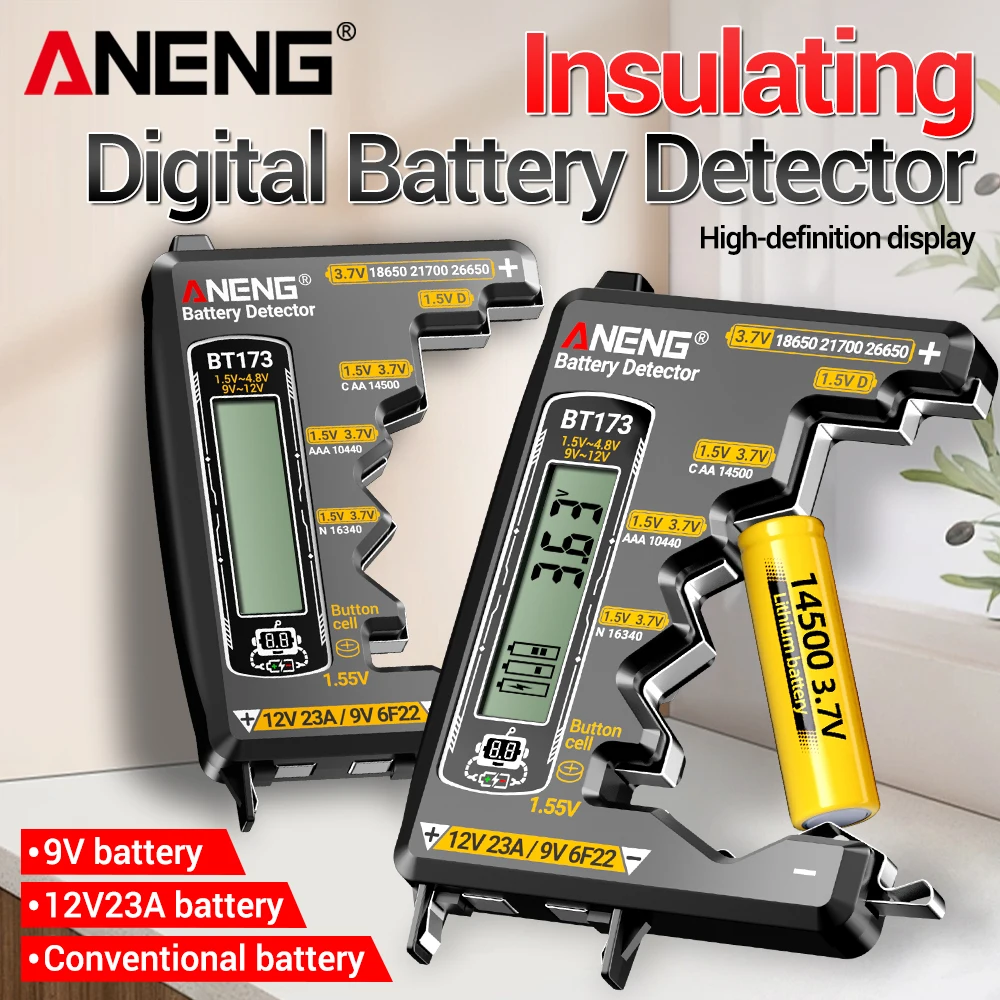
The ANENG BT-173 features a high-definition LCD, providing clear digital readouts of battery voltage. This display offers a resolution down to two decimal places, such as 3.63V or 1.50V. Such granularity is crucial for discerning subtle voltage drops that often indicate a battery's state of charge or impending failure.
For instance, a 1.5V alkaline cell registering 1.2V might still power some low-drain devices but would quickly falter under higher loads. The ability to observe these precise values allows users to make informed decisions about battery replacement or recharging. This level of detail surpasses simple 'good/bad' indicators found on more rudimentary testers.
Compared to analog battery testers, which rely on needle deflection and subjective interpretation, the digital readout of the BT-173 eliminates ambiguity. It provides an objective numerical value. This ensures consistent readings across different users and testing environments, a fundamental aspect of reliable metrology.
This detector boasts extensive compatibility, accommodating a wide array of battery chemistries and form factors. It supports standard 9V batteries, 12V 23A cells, and conventional 1.5V batteries including AA, AAA, C, and D types. Furthermore, it is designed to test diverse lithium batteries such as 18650 and 26650 cells, along with 1.5V button batteries.
This broad support means a single instrument can manage the diagnostic needs of a varied battery inventory. Users no longer require multiple specialized testers for different cell types. This simplifies toolkits considerably.
Unlike many single-purpose battery testers that focus solely on common household cells, the BT-173 extends its utility to specialized power sources. Its dedicated 12V 23A battery detection port, prominently located at the bottom, exemplifies this versatility. This feature is particularly beneficial for those working with remote controls, security devices, or other niche electronics.
The physical dimensions of the ANENG BT-173 are remarkably compact, measuring approximately 10.5cm in length, 8.2cm in width, and 1.42cm in thickness. It weighs a mere 33 grams. This makes it exceptionally portable.
Its small footprint allows it to be easily slipped into a pocket, tool belt, or small compartment. This is ideal for field service technicians, hobbyists attending events, or anyone needing to test batteries on the go. The lightweight construction minimizes user fatigue during prolonged use.
Many traditional multimeters, while offering battery testing functions, are often bulkier and heavier. The BT-173's dedicated design streamlines the process, offering a more convenient form factor specifically for battery diagnostics. Its insulating body also provides a measure of safety during handling.
Operating the BT-173 is straightforward, requiring direct contact between the battery terminals and the designated test points on the device. The clear labeling for each battery type and its corresponding voltage range guides the user. No complex menus or settings are involved.
This intuitive interface minimizes the learning curve. Even novice users can quickly and accurately assess battery health. The instant display of voltage readings provides immediate feedback.
Compared to more complex diagnostic tools that might require specific modes or probe configurations, the BT-173's design is purpose-built for speed and simplicity. Its 'instant battery measurement' capability ensures efficient workflow. This saves valuable time in busy environments.
While the BT-173 offers a digital display with two decimal places, explicit accuracy specifications (e.g., ±% of reading + digits) are not provided in the visual information. The device's resolution is clear, but its absolute accuracy, a critical metrological parameter, remains unspecified. Repeatability, the ability to yield identical results under the same conditions, is an expected characteristic of any reliable measurement instrument.
For most general-purpose applications, the displayed precision is likely sufficient. However, for critical applications requiring certified measurements, the absence of a calibration certificate or stated accuracy limits is a consideration. Users should understand this trade-off.
Unlike professional-grade laboratory equipment that comes with traceable calibration certificates and detailed uncertainty budgets, the ANENG BT-173 is positioned as an affordable, practical tool. Its value lies in its convenience and broad compatibility for everyday use, rather than in meeting stringent metrological standards for scientific research or industrial calibration labs. It provides a reliable indication of relative battery health.
The ANENG BT-173 offers significant value as an essential tool for proactive power management. By quickly identifying weak or dead batteries, it prevents unexpected device failures and optimizes battery usage. This extends the lifespan of devices and reduces waste.
Imagine confidently sorting through a bin of used batteries, instantly identifying those still viable for low-drain applications and discarding only truly depleted cells. This efficiency translates into tangible savings over time. It also reduces environmental impact by minimizing premature disposal.
This device empowers users to maintain optimal performance across their electronic devices. It ensures that critical equipment, from remote controls to emergency flashlights, always has reliable power. The ANENG BT-173 is an investment in operational readiness and resource efficiency.
Precision in Power Diagnostics
The ANENG BT-173 features a high-definition LCD, providing clear digital readouts of battery voltage. This display offers a resolution down to two decimal places, such as 3.63V or 1.50V. Such granularity is crucial for discerning subtle voltage drops that often indicate a battery's state of charge or impending failure.
For instance, a 1.5V alkaline cell registering 1.2V might still power some low-drain devices but would quickly falter under higher loads. The ability to observe these precise values allows users to make informed decisions about battery replacement or recharging. This level of detail surpasses simple 'good/bad' indicators found on more rudimentary testers.
Compared to analog battery testers, which rely on needle deflection and subjective interpretation, the digital readout of the BT-173 eliminates ambiguity. It provides an objective numerical value. This ensures consistent readings across different users and testing environments, a fundamental aspect of reliable metrology.
Universal Cell Compatibility
This detector boasts extensive compatibility, accommodating a wide array of battery chemistries and form factors. It supports standard 9V batteries, 12V 23A cells, and conventional 1.5V batteries including AA, AAA, C, and D types. Furthermore, it is designed to test diverse lithium batteries such as 18650 and 26650 cells, along with 1.5V button batteries.
This broad support means a single instrument can manage the diagnostic needs of a varied battery inventory. Users no longer require multiple specialized testers for different cell types. This simplifies toolkits considerably.
Unlike many single-purpose battery testers that focus solely on common household cells, the BT-173 extends its utility to specialized power sources. Its dedicated 12V 23A battery detection port, prominently located at the bottom, exemplifies this versatility. This feature is particularly beneficial for those working with remote controls, security devices, or other niche electronics.
Ergonomics and Portability
The physical dimensions of the ANENG BT-173 are remarkably compact, measuring approximately 10.5cm in length, 8.2cm in width, and 1.42cm in thickness. It weighs a mere 33 grams. This makes it exceptionally portable.
Its small footprint allows it to be easily slipped into a pocket, tool belt, or small compartment. This is ideal for field service technicians, hobbyists attending events, or anyone needing to test batteries on the go. The lightweight construction minimizes user fatigue during prolonged use.
Many traditional multimeters, while offering battery testing functions, are often bulkier and heavier. The BT-173's dedicated design streamlines the process, offering a more convenient form factor specifically for battery diagnostics. Its insulating body also provides a measure of safety during handling.
Operational Simplicity
Operating the BT-173 is straightforward, requiring direct contact between the battery terminals and the designated test points on the device. The clear labeling for each battery type and its corresponding voltage range guides the user. No complex menus or settings are involved.
This intuitive interface minimizes the learning curve. Even novice users can quickly and accurately assess battery health. The instant display of voltage readings provides immediate feedback.
Compared to more complex diagnostic tools that might require specific modes or probe configurations, the BT-173's design is purpose-built for speed and simplicity. Its 'instant battery measurement' capability ensures efficient workflow. This saves valuable time in busy environments.
Metrological Considerations
While the BT-173 offers a digital display with two decimal places, explicit accuracy specifications (e.g., ±% of reading + digits) are not provided in the visual information. The device's resolution is clear, but its absolute accuracy, a critical metrological parameter, remains unspecified. Repeatability, the ability to yield identical results under the same conditions, is an expected characteristic of any reliable measurement instrument.
For most general-purpose applications, the displayed precision is likely sufficient. However, for critical applications requiring certified measurements, the absence of a calibration certificate or stated accuracy limits is a consideration. Users should understand this trade-off.
Unlike professional-grade laboratory equipment that comes with traceable calibration certificates and detailed uncertainty budgets, the ANENG BT-173 is positioned as an affordable, practical tool. Its value lies in its convenience and broad compatibility for everyday use, rather than in meeting stringent metrological standards for scientific research or industrial calibration labs. It provides a reliable indication of relative battery health.
Value Proposition for Power Management
The ANENG BT-173 offers significant value as an essential tool for proactive power management. By quickly identifying weak or dead batteries, it prevents unexpected device failures and optimizes battery usage. This extends the lifespan of devices and reduces waste.
Imagine confidently sorting through a bin of used batteries, instantly identifying those still viable for low-drain applications and discarding only truly depleted cells. This efficiency translates into tangible savings over time. It also reduces environmental impact by minimizing premature disposal.
This device empowers users to maintain optimal performance across their electronic devices. It ensures that critical equipment, from remote controls to emergency flashlights, always has reliable power. The ANENG BT-173 is an investment in operational readiness and resource efficiency.